Le Shintaïdo en manière douce

Le Shintaïdo en manière douce

par

H. F. Ito Maître Instructeur Shintaïdo

Qu’est-ce que le Shintaïdo de manière douce ?

Depuis ce printemps, le Shintaïdo de manière douce est un sujet qui a voulu être discuté par le Comité Technique Européen.

En se référant à l’histoire et au développement du Shintaïdo, « le Shintaïdo pour tout le monde» a été une intention et un refrain répété. Bien que le terme Shintaïdo de manière douce ait un sens en anglais (gentle Shintaïdo), en français, cela ressemble à une version diluée de l’essence du Shintaïdo, comme un voyage en classe économique en avion, parce quevous ne pouvez pas vous offrir mieux.

Au cours de ma carrière, j’ai assisté à de nombreux échanges de courriels animés sur ce sujet.

“Shintaïdo sans perdre l’expérience”

J’ai été étroitement impliqué dans cette discussion car le Shintaïdo de manière douce reflète une approche que j’avais adoptée au début des années 2000. Je voulais rendre le Shintaïdo accessible à des personnes extérieures aux arts martiaux. Ma devise était: «Modifier le Shintaïdo sans en perdre l’essence de l’expérience».

En discutant avec les instructeurs – que nous utilisions ou non le «Shintaïdo de manière douce», j’ai remarqué les thèmes suivants:

  1. Lorsque nous enseignons le Shintaïdo à des personnes ayant des difficultés physiques, mentales ou émotionnelles, le mouvement doit être doux et délicat. Cependant, si c’est tout ce qu’il y a, les élèves et l’enseignant, souvent risquent de s’ennuyer.
  2. Il est important de partager périodiquement certaines techniques de kaiho-kei ou de faire du chudan-tsuki en position kibadachiavec un kiaiferme. Vous pouvez aussi donner aux gens l’expérience du mouvement Toitsu Kihon, même si leur corps ne peut pas le supporter très longtemps. Cela leur permet de s’éveiller durant l’expérience.
  3. Si nous regardons l’histoire du Shintaïdo, nous voyons que pour être avant-gardiste, il faut d’abord être classique. Du Karaté au Shintaïdo Kaiho-tai au Shintaïdo Yoki-tai, nous continuons à construire à partir de racines classiques. Le jigo-kei, le kaiho-kei, le yoki-kei, le seiritsu-kei– toutes ces formes de keiko ont des avantages, mais aucune d’entre elles n’est aussi puissante à elle seule qu’elles ne le sont ensemble. Un bon enseignement doit les inclure toutes.
  4. C’est pourquoi les instructeurs de Shïntaido, utilisant la manière douce, doivent être capables de passer d’un style à un autre, en réponse immédiate à la condition de leurs élèves.

Devrions-nous dire que, par exemple, les étudiants pourraient commencer par le yoki-kei et, à mesure qu’ils deviendront plus forts, avanceront vers le kaiho-kei (ou peut-être même le jigo-kei) et finiront par le seiritsu-kei?

Je suggère que les examens de 2020 pour Sei-Shihan et Dai-Shihan soient axés sur la capacité des candidats à comprendre ces points et à les mettre en pratique dans leur propre enseignement.

Pour votre information, j’inclus un tableau illustrant la relation entre le Yoki-kei et le Kaiho-kei, ainsi que le Jigo-kei et le Seiritsu-kei. J’ai initialement développé ce tableau pour clarifier ma propre pensée sur les différences et les similitudes entre ces éléments du Shintaïdo.

Un tableau de référence

Kaiho-keiYoki-keiJigo-keiSeiritsu-kei
Style de postureKaihotai: La partie avant du corps est ouverte. l’Attitude pleine de confiance. Le bas du dos est légèrement courbé. "Le pont de vie tsubo (life gate tsubo)" situé derrière le nombril est fermé. La direction des yeux porte au devant et légèrement vers le haut.Koshi est droit (non courbé). "Le pont de vie tsubo” est ouvert. La partie arrière du corps est ouverte. La direction de l’oeil est légèrement incliné vers le bas. Une apparence de mollesse comme s’il y avait un manque de confiance. Expression d’humilité (non-assumée).La posture est solide comme un chêne inflexible, avec un poing fortement défensif. La force est concentrée dans le Tanden, comme si elle soulevait quelque chose de lourd.Style de posture Kaihotai: La partie avant du corps est ouverte. l’Attitude pleine de confiance. Le bas du dos est légèrement courbé. "Le pont de vie tsubo (life gate tsubo)" situé derrière le nombril est fermé. La direction des yeux porte au devant et légèrement vers le haut. Koshi est droit (non courbé). "Le pont de vie tsubo” est ouvert. La partie arrière du corps est ouverte. La direction de l’oeil est légèrement incliné vers le bas. Une apparence de mollesse comme s’il y avait un manque de confiance. Expression d’humilité (non-assumée). La posture est solide comme un chêne inflexible, avec un poing fortement défensif. La force est concentrée dans le Tanden, comme si elle soulevait quelque chose de lourd. Seiritsu-tai.
La posture est érigée de manière franche. Les yeux portent directement devant, regardant à l'horizon.
Méthode pour le keiko, waza et kataKeiko est basé sur les principes fondamentaux (Daikihon) de Tenshingoso, Eiko et leurs applications, ainsi que sur le saut Shintaïdo, le Kaikyakuzenshin, le Kiai et le Hassei renshu (pratique du cri), les techniques à main ouverte, etc.Wakame, travail en kumite de méditation, Musoi, Muso-Ken, Hoten-Kokyu-ho, Mae-Geri (doux et doux). Meiso-jump.Jikyo-ken. Uke-zuki Sei-ken. Pratique Style-Sumo. Ces formes sont couramment observées dans le karaté Shintaïdo.Chusei-ken. Oi-zuiki Sei-ken. Ki-ichi-i. Main libres Diamond cut sutra.
Méthode pour le GoreiLes forts survivent. Allez, allez - Plus, plus, plus vite et plus loin. Gorei est strict et exigeant, sans qu’il y ait place à poser de questions. Compétitif et stimulant, c’est comme si on enseignait aux grimpeurs à se concentrer entièrement sur le fait d’atteindre le sommet. Pas de compromis. Réveille des capacités chez les élèves qui sont généralement endormis, comme être dans un feu et trouver une force que vous ne saviez pas que vous aviez.Tout le monde se rassemble, se tiennent la main et monte progressivement la montagne ensemble. Le Gorei amène les gens à une randonnée agréable et coopérative, consciente et appréciant les quatre saisons et le paysage de montagnes, de rivières, d’herbe et d’arbres. Les gens gagnent en énergie et en considération pour les autres, et sont encouragés à s’entraider.
Effets du keikoTranscendant la situation actuelle, le corps et l’esprit s’ouvrent avec souplesse et sans hésitation. En même temps, l'énergie est libérée et le nouveau soi émerge de l’ancien. Développe la pensée positive. Passe par le mandala Kongokai.S'adapter à la situation actuelle. La tension et la fatigue disparaissent. et le corps devient comme une algue dans l'océan. Encourage la compréhen- sion de soi et la compréhen-
sion des autres. Passe par le mandala de Taizokai.
Prenant l'énergie à l'extérieur de soi et la résumant dans un état d'esprit de légitime défense. Cela est courant dans les kata du karaté Shintaïdo.Se tenant debout, au centre de Kaihotai, de Jigotai et de Yokitai, la posture devient droite et claire.
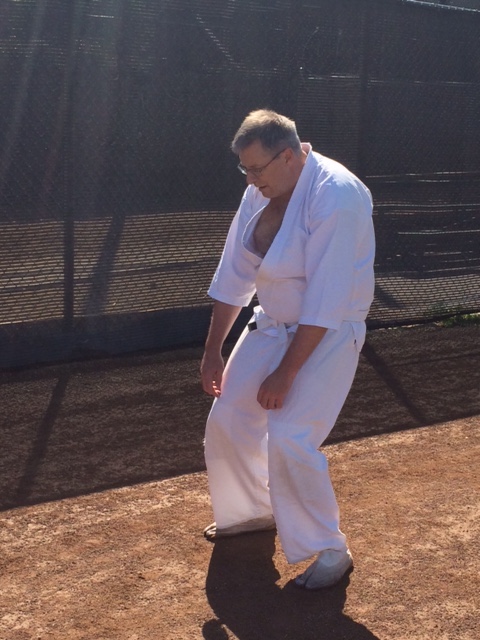
Kaihotai
Kaihotai
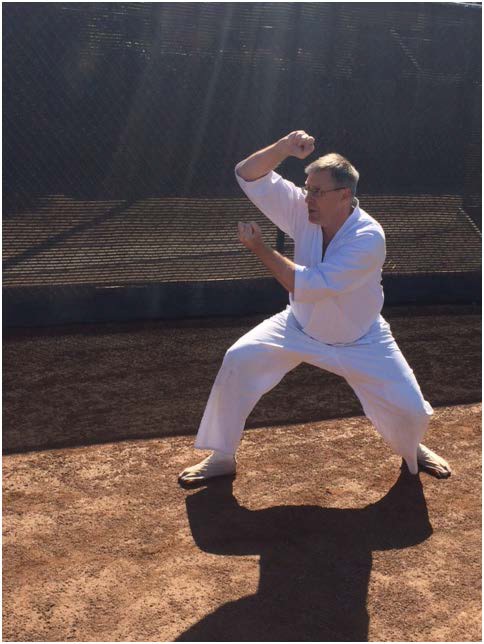
Yokitai
Yokitai
Jigotai
Jigotai
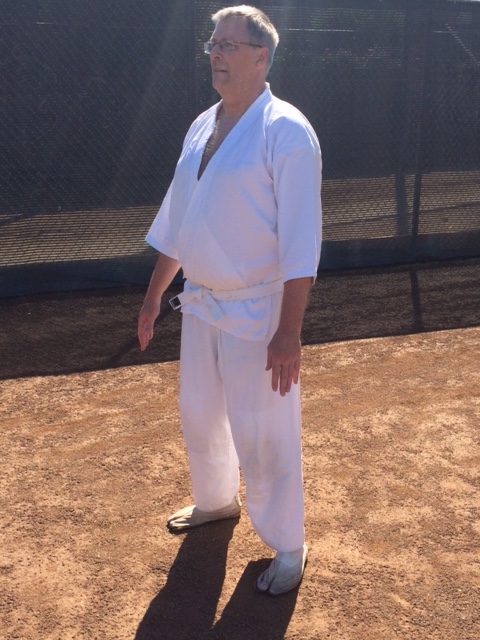
Seiritsutai
Seiritsutai

Addendum (expérience de Lee Seaman):

Quand j’ai commencé le Shintaïdo, j’avais 25 ans. La plupart des autres étudiants avaient entre 18 et 30 ans et Aoki-sensei venait de fêter ses 30 ans. Tout le monde était en excellente forme physique et nous n’avons rien fait à part Kaiho-tai keiko. Aoki-sensei nous a dit que Tenshingosoet Eiko étaient le noyau du Shintaïdo et que ces deux formes constituaient également le noyau de notre pratique. Le plus intense possible, le plus d’expansion possible, le plus fort (voix) possible !

Je pratique le Shintaïdo depuis presque 40 ans maintenant et je suis parvenu à la conclusion qu’Aoki-sensei avait un enseignement caché. D’après mon expérience, il y a quelque chose de plus fondamental que Tenshingoso et Eiko. Cela me rappelle le koan sur la porte sans porte – je l’appelle la technique sans technique. L’incarnation de Tenchijin, informe Tenshingoso, et constitue le cœur battant d’Eikodai. Ce coeur dans le Shintaïdo est la base de toute notre pratique, et ses branches sont le kaiho-tai, le yoki-tai, le jigo-tai et le seiritsu-tai.

Je pense que pour offrir le Shintaïdo à un monde qui en a plus que jamais besoin, nous avons besoin de ces racines au coeur de la pratique.


Gentle Shintaido

Gentle Shintaido

by

H. F. Ito
Shintaido Master Instructor

What is Gentle Shintaido?

Since this Spring Gentle Shintaido has been the topic European Technical Committee instructors have wanted to discuss.

Looking back at the history and development of Shintaido, “Shintaido for Everyone” has been an intention and repeated refrain. Although the term Gentle Shintaido makes sense in English, in French it sounds like a diluted version of Core Shintaido − like flying economy class because you can’t afford anything better.

During my Shintaido career I have seen many animated email exchanges on this topic.

“Shintaido without losing the experience”

I have been closely involved in this discussion because Gentle Shintaido mirrors the approach I took starting in the early 2000s. I wanted to make Shintaido accessible to people outside the martial arts. My motto was “Modify Shintaido without losing the core experience.”

In talking with instructors – regardless of whether or not we use the term Gentle Shintaido – I have noticed the following themes:

  1. When we teach Shintaido to people who have physical, mental or emotional difficulties, the movement has to be gentle and soft. However, if that is all there is the students as well as the teacher may become bored.
  2. It is important to periodically share some Kaiho-kei techniques, or to do Chudan-tsuki on kibadachi with a firm kiai. Or you can give people the experience of Toitsu kihon movement, even if their bodies can’t sustain it for very long. This allows them to have an awakening experience.
  3. If we look back over the history of Shintaido, we see that in order to be avant-garde it is necessary to be classical first. From Karate to Shintaido Kaiho-tai to Shintaido Yoki-tai, we continue to build from classical roots. Jigo-kei, Kaiho-kei, Yoki-kei, Seiritsu-kei — all of these keiko forms have advantages, but none of them are as powerful alone as they are together. Good teaching must include them all.
  4. That is why Gentle Shintaido instructors must be able to switch immediately from one style to another in response to their students.

Should we say that, for example, students might start with Yoki-kei and as they grow stronger advance to Kaiho-kei (or maybe even Jigo-kei), and finish up in Seiritsu-kei?

I suggest that the 2020 examinations for Sei-Shihan and Dai-Shihan should focus on candidates’ ability to understand these points and to put them into practice in their own teaching.

For your information,  I’m including a table showing the relationship between Yoki-kei and Kaiho-kei, as well as Jigo-kei and Seiritsu-kei. I originally developed this table to clarify my own thinking about the differences and similarities among these elements of Shintaido.

A reference table comparing Yokitai and Kaihotai

Kaiho-keiYoki-keiJigo-keiSeiritsu-kei
Style of postureKaihotai: The front of the body is completely open. Attitude is full of confidence. Lower back is slightly arched. "Life gate" tsubo immediately behind belly button is closed. Eye direction is forward and slightly upward.Koshi is flat (not arched). "Life gate" tsubo is open. The back of the body is open. Eye direction is slightly downward. Appears somewhat weak, as if lacking confidence. Expressing humility (unassuming).Stance is solid like an unyielding oak tree, with a strongly defensive fist. Strength is focused in the Tanden, as if lifting something heavy.Seiritsu-tai. Stance is erect. Eye direction is straight forward, looking to the horizon.
Method of doing keiko, waza and kataKeiko is based on the fundamentals (Daikihon) of Tenshingoso, Eiko and their applications as well as Shintaido jump, Kaikyakuzenshin, Kiai and Hassei renshu (shouting practice), open-hand techniques, etc.Seaweed, meditation partner work, Musoi-, Muso-ken, Hoten-Kokyu-ho, Mae-geri (soft & gentle). Meiso-jump.Jikyo-ken. Uke-zuki Sei-ken. Sumo-sytle pushing practice. These forms are commonly seen in Shintaido karate.Chusei-ken. Oi-zuiki Sei-ken. Ki-ichi-i. Freehand Diamond Mudra cut.
Method of doing GoreiThe strong survive. Go, go - More, more, faster & farther. Gorei is strict and demanding, with no questions asked. Competitive and challenging, like teaching rock climbers how to focus completely on getting to the top. No compromise. Awakens abilities in students that are usually asleep, like being in a fire and finding strength you never knew you had.Everyone comes together in companionship, holding hands and gradually walking up the mountain together. The Gorei leads people on a cooperative and enjoyable hike, aware of and appreciating the four seasons and the scenery of mountains, rivers, grass and trees. People gain energy and consideration for others, and are encouraged to help each other.
Effect of keikoTranscending the current situation, the body and mind open with flexibility and without hesitation. At the same time, all energy is released and the new self emerges from the old skin. Develops positing thinking. Goes through the Kongokai Mandala.Accommodating the current situation. Tension and fatigue melt away. and the body becomes like a seaweed in the ocean. Encourages insight into the self and understanding of others. Goes through the Taizokai Mandala.Taking energy from outside the self and collecting it in a self-defense mindset. This is commonly seen in the kata of Shintaido karate.Standing in the center of Kaihotai, Jigotai, and yokitai, the posture becomes straight and clear.
Kaihotai
Kaihotai
Yokitai
Yokitai
Jigotai
Jigotai
Seiritsutai
Seiritsutai

Addendum (Lee Seaman’s experience):

When I started Shintaido, I was 25 years old. Most of the other students were between 18 and 30, and Aoki-sensei had just celebrated his 30th birthday. Everyone was in great physical shape, and we did nothing but Kaiho-tai keiko. Aoki-sensei told us that Tenshingoso and Eiko were the core of Shintaido, and those two forms were also the core of our practice. The bigger the better, the farther the better, the louder the better.

I have been practicing Shintaido for almost 40 years now, and I have come to the conclusion that Aoki-sensei had a hidden teaching. In my experience, there is something more basic than Tenshingoso and Eiko. It reminds me of the koan about the gateless gate – I call it the techniqueless technique. It embodies Tenchijin, informs Tenshingoso, and is the beating heart of Eikodai. This core Shintaido is the basis of all our practice, and Kaiho-tai, Yoki-tai, Jigo-tai, and Seiritsu-tai are its branches.

I believe that, to give Shintaido to a world that needs it more than ever, we need roots in this core place.


Notes sur la formation – Kaishoken

par Mark Bannon

Quelle est la technique d’arts martiaux la plus forte? Au fil des ans, j’ai entendu différentes réponses en fonction du style, de la formation et de l’enseignant. Certains croient un coup de pied fort, d’autres un coup de poing fort (tsuki), d’autres un mélange secret.

Comment répondrais-je à la question si on me le demandait ce matin? Ma réponse serait “Shintaido kaishoken est la technique la plus forte et digne de la pratique quotidienne. Dans le glossaire shintaido, kaishoken est défini comme « la main ouverte et exprimant ». C’est peut-être une réponse déroutante à certains. D’autres peuvent avoir une compréhension différente et des pensées sur le sujet. Voici ma pensée et ma perspective actuelles.

Quand j’ai commencé à étudier les arts martiaux, j’ai observé une fascination pour le développement de la technique la plus efficace pour s’adresser à un adversaire perçu. Dans la lignée Funakoshi-Egami-Aoki, il existe un chemin bien documenté qui s’est produit pour développer le tsuki (tel qu’il est actuellement pratiqué dans Shintaido) comme technique éprouvée.

Si je comprends bien l’histoire, il y avait une joie immédiate quand Maître Egami a trouvé son nouveau tsuki (front-punch). Très efficace, élégant, mouvement fluide, application du corps entier de la force qui pourrait facilement renverser un homme avec un coup. Une arme élégante s’il y en avait une.

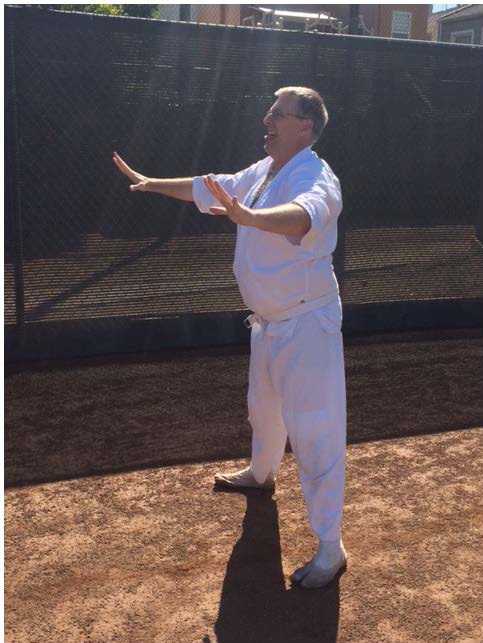
Photo par Mark Bannon

Ce qui a suivi, cependant, était une prise de conscience que cette nouvelle technique était si puissante que les blocs traditionnels et les stratégies n’étaient pas une défense contre ce nouveau tsuki. Une technique encore plus forte était nécessaire pour répondre à cette nouvelle arme. Une course aux armements littérale s’était déclenchée.

L’histoire du tsuki est dans la section sept du livre Shintaido de Maître Aoki. Maître Aoki discute de la recherche que lui et Maître Egami ont fait pour devenir des « spécialistes du tsuki » et de sa découverte de kaishoken comme défense contre le nouveau tsuki.

J’ai commencé à essayer la main ouverte comme une technique pour recevoir un tsuki. Au début, ce n’était pas une technique très satisfaisante. Comme je continuais ma pratique Shintaido, j’ai entendu d’autres étudiants poser des questions sur kaishoken. Je n’étais apparemment pas le seul qui ne l’a pas immédiatement obtenu. En réponse, des étudiants plus expérimentés (senpai) répondraient que, kaishoken à Shintaido signifie en fait “main ouverte – corps ouvert.” Cette définition élargie a commencé à avoir plus de sens. Très bien. Je pourrais pratiquer cela – recevoir le tsuki avec une main ouverte et un corps ouvert. Ma technique a apparemment commencé à s’améliorer.

Comme l’amélioration est venue, un senpai m’a demandé d’ouvrir les yeux. Faites attention, voyez tout. Ne vous laissez pas distraire par des objets brillants. Cette leçon a résonné. Il m’est venu à l’esprit que kaishoken n’était pas seulement la main ouverte, le corps ouvert, mais ajouter les yeux ouverts. Ne tombez pas dans le piège de votre environnement et de votre rencontre initiale. Voyez tout. Regardez la situation avec les yeux doux. Prends tout. Je me sentais assez jazzé avec kaishoken à ce stade. Qu’y a-t-il de mieux ?

Quelques semaines plus tard, j’ai assisté à un atelier Shintaido au Québec. Pendant l’exercice, on m’a demandé d’« ouvrir mon esprit » et d’aller au-delà de ce monde et de voyager aux coins de l’univers. Voir tous les angles, les potentiels, les défis, regarder au-delà, voyager le temps et l’espace. ouah. Les choses ont changé. J’ai vécu quelque chose de nouveau. A partir de ce moment, mon Kaishoken a évolué de la main ouverte – corps ouvert – les yeux ouverts – à l’esprit ouvert.

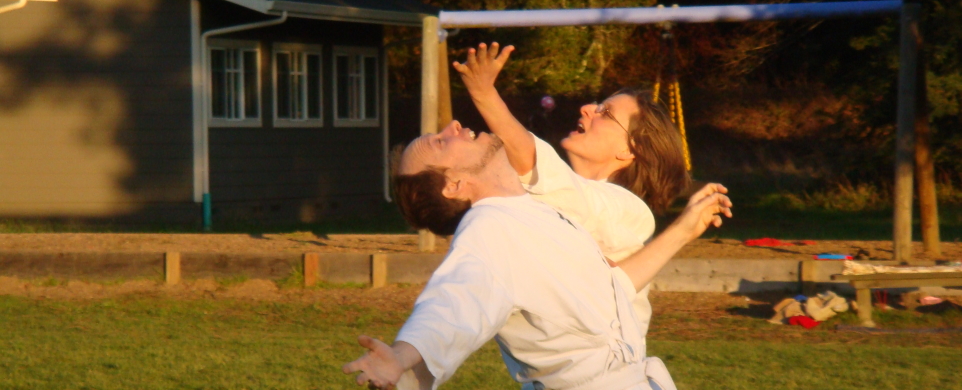
Kaishoken
Phot par Mark Bannon

Armé d’un esprit ouvert, j’ai vu des possibilités venir à moi avant qu’ils ne soient en vue. Je n’étais plus en défense. Je recevais activement l’intention et l’anticipation. Maintenant, c’est une technique forte! J’ai commencé à utiliser mon nouveau kaishoken (ouvert à la main ouverte à l’esprit ouvert) dans toutes sortes de circonstances. J’utilisais kaishoken au travail pour améliorer les relations avec mes collègues, avec des clients qui construisaient des projets plus novateurs et établissant des relations plus étroites avec la famille et des relations plus significatives entre amis. Un vrai keiko se développait.

Puis un jour, je me suis retrouvé dans une rencontre et je n’ai certes pas très bien géré. Rien de voyant, mais j’y ai pensé toute la journée et les actions que j’aurais pu / aurait dû prendre pour provoquer un résultat différent. Il m’est soudainement venu à l’esprit, la réponse pourrait être kaishoken. Cette fois, j’ai réalisé que si j’avais abordé la rencontre avec un cœur ouvert, le résultat aurait pu être beaucoup amélioré. J’ai réalisé que kaishoken est vraiment le cœur ouvert.

Photo par Mark Bannon

Ma définition de kaishoken a commencé simplement comme une note glossaire “main ouverte.” Comme ma pratique est devenue plus riche, ma compréhension a évolué: main ouverte – corps ouvert – yeux ouverts – ouverture d’esprit, – ouvrir votre cœur. Kaishoken est sans doute la technique la plus forte et j’ai besoin de pratiquer tous les jours. Une technique pour mettre fin à la course aux armements.


Notes on Training – Kaishoken

Notes on Training – Kaishoken

by Mark Bannon

What is the strongest martial arts technique? Over the years, I have heard different answers depending on style, training, and teacher. Some believe a strong kick, others a strong punch (tsuki), others a secret mix.

How would I answer the question if I were asked this morning? My response would be “Shintaido kaishoken is the strongest technique and worthy of daily practice.” In the Shintaido glossary, kaishoken is defined as the “opening and expressing hand”. Maybe that’s a puzzling answer to some. Others may have a different understanding and thoughts on the subject. Here’s my current thinking and perspective.

When I first started studying martial arts, I observed a fascination with developing the most efficient technique to address a perceived opponent. In the Funakoshi-Egami-Aoki lineage, there is a well documented path that occurred to develop the tsuki (as currently practiced in Shintaido) as a proven technique.

As I understand the story, there was immediate joy when Master Egami found his new tsuki (front-punch). Very efficient, elegant, flowing motion, full body application of force that could easily knock a man down with one blow. An elegant weapon if there ever was one.

Photo by Mark Bannon

What followed, however, was a realization that this new technique was so powerful that the traditional blocks and strategies were no defense against this new tsuki. An even stronger technique was needed to respond to this new weapon. A literal arms race had ignited.

The story of the tsuki is in Section Seven of Master Aoki’s Shintaido book. Master Aoki discusses the research he and Master Egami did to become “tsuki specialists” and his discovery of kaishoken as a defense against the new tsuki.

I began trying the open hand as a technique to receive a tsuki. At first, it was not a very satisfying technique. As I continued my Shintaido practice, I heard other students ask about kaishoken. I was apparently not the only one that didn’t immediately get it. In response, more experienced students (senpai) would respond that, kaishoken in Shintaido actually means “open hand – open body.” This expanded definition started to make more sense. Very good. I could practice that – receive the tsuki with an open hand and an open body. My technique seemingly started to improve.

As improvement came, a senpai instructed me to open eyes. Pay attention, see everything. Don’t become distracted by shiny objects. That lesson resonated. It occurred to me that kaishoken was not only open hand, open body, but add open eyes. Don’t fall into the trap of your surroundings and initial encounter. See everything. Look at the situation with soft eyes. Take it all in. I was feeling pretty jazzed with kaishoken at this point. What could be better?

A few weeks later I attended a Shintaido workshop in Quebec. During the exercise, I was instructed to “open my mind” and go beyond this world and travel to the corners of universe. See all the angles, potentials, challenges, look beyond, travel time and space. Wow. Things changed. I experienced something new. From that moment, my Kaishoken evolved from open hand – open body – open eyes – to open mind.

Kaishoken
Phot by Mark Bannon

Armed with an open mind, I saw possibilities coming at me before they were in sight. I was no longer on the defense. I was actively receiving intention and anticipating. Now that is a strong technique! I started using my new kaishoken (open hand-open body-open eyes-open mind) in all sorts of circumstances. I was using kaishoken at work improving relations with co-workers, with clients building more innovative projects, and building closer relationships with family and more meaningful relationships friends. A true keiko was developing.

Then one day I found myself in an encounter and I admittedly didn’t handle it very well. Nothing serous, but I thought about it all day and actions I could have/should have taken to cause a different outcome. It suddenly occurred to me, the answer could be kaishoken. This time, I realized had I approached the encounter with an open heart, the result could have been much improved. I realized kaishoken is really open heart.

Photo by Mark Bannon

My definition of kaishoken started simply as a glossary note “open-hand.” As my practice became more rich, my understanding evolved: open hand – open body – open eyes – open mind, – open your heart. Kaishoken is arguably the strongest technique and one I need to practice every day. A technique to end the arms race.
HF Ito’s Bay Area Summer Workshop 2019

HF Ito’s Bay Area Summer Workshop 2019

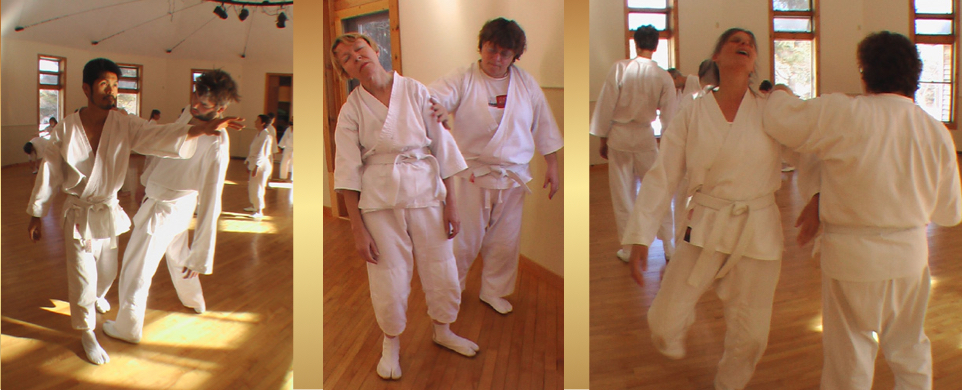
Le samedi 17 août, à l’Académie Marin de San Rafael, en Californie, le maître instructeur HF Ito a dirigé un Keiko dans la région de Bay Area (San Francisco) rendant visite à des pratiquants du Shintaido. 12 étaient présent le matin et 10 en après-midi à travers deux keiko, sur le thème : Ouvrir la porte du Perception : Muso-Ken. Compte tenu de son intention à réduire les voyages transatlantiques depuis son domicile en France et de ne visiter l’Amérique du Nord qu’une fois par an, il s’agissait probablement du dernier atelier d’été d’Ito Sensei en Californie du Nord. Pour certains d’entre nous, ce fait ajoutait une nuance subtilement poignante à l’enseignement profond et nuancé de Ito Sensei. Sarah Baker et John Bevis ont documenté l’atelier en vidéo tout au long de la journée.

Le Keiko a commencé par une forme d’échauffement qui était nouvelle pour beaucoup d’entre nous. Connie Borden a présenté des mouvements basés sur la fin de la partie III du Taimyo kata qui se jette dans le début de la partie I de Taimyo de celui-ci.

Connie Leads Warmups

Ces mouvements s’appellent Embrasser le ciel (ho-ten-kokyu-ho), le corps tournant en rotation trois quarts (hokushin kokyu-ho), oodachi zanshin et kan ki). Ils concentrent la respiration (kokyu) dans un mouvement spiralique en tournant autour notre colonne vertébrale dans notre être pour atteindre plus haut dans les cieux et plus basvers le centre de la terre. Nous avons étudié les contrastes découlant de la création de petits cercles en dessous de nous, puis à  ouvrir en verticale, en face et en diagonale de soi pour tracer de grands cercles et embrasser le ciel. En nous inclinant en gratitude, nous avons étudié la compression de l’air et de l’espace corporel du devant nous. Pour commencer le hokushin kokyu-ho, nous avons étreint un arbre, puis nous nous sommes lentement élargis dans cette relation, en faisant l’expérience du contraste entre le haut et le bas tout en continuant de nous concentrer sur la verticalité et la respiration lente et profonde. Notre main avant s’élevait avec les doigts et la paume de la main dirigés vers l’arrière, tandis que la main inférieure était dirigée vers le bas et les trois quarts derrière nous, la paume de la main tournée vers l’intérieur.

Tout au long de ces mouvements, nous avons pratiqué afin que nos yeux suivent nos mouvements, ultimement, le mouvement des yeux nous aide à traverser dans l’espace et à travers le temps. Dans le dernier segment, nous nous sommes ouvert à Ten avec les mains kaisho-ken vers le ciel, puis nous avons formé un tsuki croiser devant la poitrine pour saisir ce qui nous attendait, en croisant les bras devant nous, nous nous sommes retrouvés dans la posture classique du karaté, le kaiho-tai.  Avec kan ki, partie I de Taimyo ouverture, nous nous allongions devant nous comme pour plonger dans l’océan du ki et après avoir fait un dernier grand cercle autour de nous, nous avons laissé l’énergie du ki atterrir dans ce nouvel espace, paumes des mains se refermant en tsuki. Nous avons ramené notre tsuki à nos côtés, laissant nos coudes derrière nous tout en approfondissant notre kiba-dachi (position d’équitation). Après avoir maintenu cette position pendant un moment pour permettre à nos corps de se sentir réchauffés, nous nous sommes tenus debout, laissant nos bras se déplacer vers le bas sur les côtés de nos corps, les doigts ainsi dynamiser, pointant vers le bas. Après l’échauffement dû à la respiration, aux torsions, à la spirale et à l’expansion, nous avons fini par nous sentir tout à fait droits et clairs, prêts à étudier notre conscience de nous-mêmes et à accroître la compréhension des autres.

Avant de commencer la pratique physique, nous nous sommes assis en cercle et Ito Sensei a pratiqué une conversation basée sur un document imprimé à double face. Avec l’aide de Tomi Nagai-Rothe et de Nao Kobayashi pour la traduction, il a d’abord abordé les différentes formes de ki. Allant du manque de confiance / peur (yowa-ki) à la détermination et à la disponibilité (tsuyo ki) ou dans la simplicité d’être (non-ki), de prendre soin de sa propre énergie (ki wo tutete) à être attentionné et attentif envers les autres (ki-kubari), et plus encore.

Ito’s Talk

Le concept épineux de sak-ki, qui se traduit par la soif de sang ou l’intention de tuer, était essentiel car il était étroitement lié au deuxième segment de la discussion, le muso-ken. En pratique, nous travaillions le développement de la sensibilité aux énergie se retrouvant ou provenant de derrière nous, en particulier, sur l’intention ou l’approche de quelqu’un souhaitant nous attaquer par derrière. Comme le dit Ito Sensei, mu-so peut être interprété, d’une part, comme signifiant «rêve», «vision», «prémonition» et «voyance», ou d’autre part comme quelque chose de «déphasée», «sans phénomène» et «vide» s’apparentant à l’absence totale de lumière ou de matière sombre.

On peut donc penser que Muso-ken utilise l’épée de perception, la définition française donnée par l’instructeur général du shintaido français Pierre Quettier. La pratique du matin et de l’après-midi s’est donc concentré à l’apprentissage d’une utilisation efficace de cette épée.

Nous avons commencé par wakame kumite, l’initiateur utilisant un toucher de plus en plus léger à un rythme s’accentuant et le récepteur développant une sensibilité de plus en plus affinée au contact et à la direction de l’énergie traversant le corps. Ito Sensei a souligné que le wakame est une chose que vous ne pouvez jamais croire avoir perfectionnée, c’est une chose à travailler pour le reste de votre vie – dans les relations, dans la famille, au travail et dans le monde.

L’essentiel de la pratique était de développer la sensibilité avec le dos, de faire de tout notre dos un capteur (ou un ensemble de capteurs), comme un radar, détectant et prenant conscience de ce qui nous arrive par derrière. Alors que nous cultivions la sensibilité envers quelqu’un venant de derrière, nous avons travaillé sur deux modèles de pas différents pour recevoir l’attaque. L’un consistait à faire un pas en avant et légèrement décalé (avec le pied droit, par exemple), ouvrant un chemin à l’attaquant en faisant pivoter et en écartant légèrement le pied gauche et en la «accueillant» pour qu’elle entre et passe dirigé de la main gauche. Le deuxième consistait à faire un pas diagonale en arrière (avec le pied droit, par exemple), ouvrant un nouveau chemin en pivotant créant un espace pour permettre à l’attaquant de passer, accueillant et exhortant le partenaire dans un mouvement Tenshingoso «E» de droite. Les deux techniques développe la capacité de gérer l’attaque dans l’espace et dans le temps. Bien que Ito Sensei n’en ait pas beaucoup parlé, les récepteurs dans le kumite ont été encouragés à reconnaître et à expérimenter les synchronisations A, B et C sur le spectre de réponse, précoce à tardive.

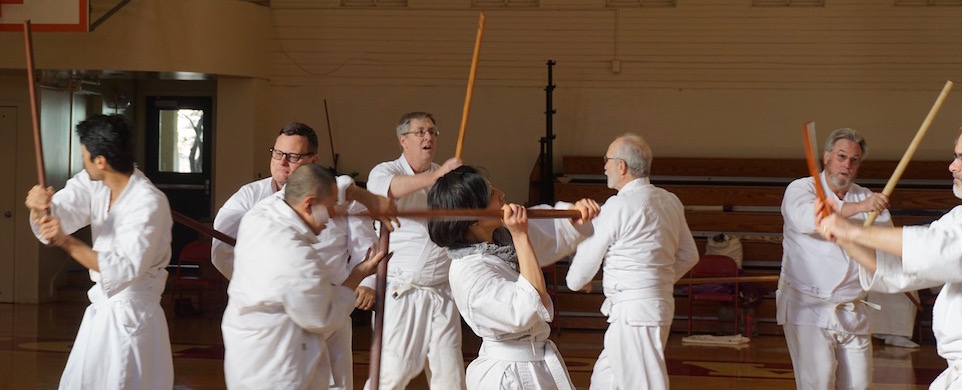
Après avoir travaillé sur la marche, les recepteurs du kumite ont pris les armes – soit un magazine enroulé jouant le rôle d’un bâton court, puis un boken ou un bokuto – et ont ajouté les mouvements gedan baraï et ha-so à leur réception.

Quant aux assaillants, ils ont approché leurs partenaires kumite par l’arrière avec différentes techniques (et armes): en utilisant les premiers mouvements du kata Diamond Huit Cut, en s’avançant avec un mouvement de lance. Au cours du keiko de l’après-midi, Ito Sensei nous a fait subir des attaques d’épée dai jodan de derrière, pour finalement recevoir deux attaquants afin que nous puissions mesurer et gérer leurs énergies différentes. Entre les keiko, nous nous sommes retirés chez Jim et Toni Sterling pour un brunch potluck (pottelocke pour les Québécois) qui est devenu une continuation du keiko par la communion sociale et une discussion philosophique.

Sword practice

Vers la fin du keiko en après-midi, Ito Sensei a parlé de Tenshingoso en termes métaphoriques, appréciant ses mouvements dans un retournement constant, comme nous pourrions le faire avec des chaussettes. Sur terre mais au-delà des limites de l’univers en tenant (shoko) notre planète avec bonté et l’amenant à l’intérieur de nous-mêmes. Enfin, il nous a confié des «devoirs» en solo, des mouvements Muso-Ken qu’il nous avait enseignés et nous a rappelé que nous devons appliquer notre pratique du Shintaïdo, en général, à notre façon de penser la vie, la mort, et à notre façon de vivre nos vies dans le monde.


H.F. Ito’s Bay Area Summer Workshop 2019

H.F. Ito’s Bay Area Summer Workshop 2019

By Derk Richardson and Connie Borden

On Saturday, August 17, at Marin Academy in San Rafael, California, Master Instructor H.F. Ito led Bay Area and visiting Shintaido practitioners—12 in the morning session, 10 in the afternoon—through two keiko based on the theme “Opening the Door of Perception: Muso-Ken.” Given his intention to cut back on transatlantic travel from his home in France and to visit North America only once a year, this was possibly Ito Sensei’s last summer workshop in Northern California. For some of us, that fact added a subtly poignant undertone to Ito Sensei’s deep and nuanced teaching. Throughout the day, Sarah Baker and John Bevis documented the workshop on video.

Keiko began with a form of warm-ups that was new to many of us. Connie Borden introduced the movements based on the end of Taimyo kata part III flowing into the start of Taimyo part I.

Connie Leads Warmups

These movements are called Hugging the Sky (ho-ten-kokyu-ho), Three Quarters turn (hokushin kokyu-ho), oodachi zanshin, and kan ki. They focused on breathing (kokyu) while having us rotating, spiraling, and twisting our spine and our being to reach higher into the heavens and lower into the center of earth. We studied contrasts of creating a small circle below ourselves then opening diagonally to draw a big circle and embrace the sky. As we bowed, we studied compressing the air and space in front of us. To start hokushin kokyu-ho, we hugged a tree in front of us and then slowly expanded ourselves upward and downward, experiencing the contrast between up and down while elongating our beings, continuing our focus on deep and slow breathing. Our front hand reached up with the fingers and palm facing back, while the lower hand pointed down and three-quarters behind ourselves with the palm facing inwards.

Throughout these movements we practiced having our eyes follow our movements, ultimately having our eye movement help us go further into space and across time. In the last segment, we opened to Ten with kaisho-ken hands to the sky and then formed a tight tsuki to grasp what was waiting for us, then crossing our arms in front of ourselves we ended in the classic karate stance, kaiho-tai. With kan ki as the opening of Taimyo part I, we reached out in front of ourselves as if to dive out into the ocean of ki, and after making one last big circle around ourselves, we let ki energy land in our outstretched, wide-open palms and made a tight tsuki. We pulled our tsuki back to our sides, letting our elbows point behind ourselves while deepening into kiba-dachi (horse-riding stance). After holding this stance for a moment to allow our bodies to feel warmed, we stood in seiritsu-tai, letting our arms move downwards to our sides with our fingers actively pointed downwards. From the warmups of breathing, twisting, spiraling, and elongating, we ended feeling straight and clear, hopefully ready to study awareness of ourselves and increase understanding of others.

Before we began physical practice, we sat in a circle and Ito Sensei gave a free-flowing talk based on a double-sided handout. With Tomi Nagai-Rothe and Nao Kobayashi assisting with translation, he first discussed the various forms of ki (energy or, in French, esprit), ranging from lack of confidence/fearfulness (yowa-ki) to being resolute and ready (tsuyo-ki) or easy going (non-ki), from taking care of your own energy (ki wo tutete) to being considerate of and attentive to others (ki-kubari), and more.

Ito's Talk
Ito’s Talk

The thorny concept of sak-ki, which translated to “bloodthirstiness” or “the intention to kill,” was pivotal because it related closely to the second area of discussion, muso-ken. In our practice, we would be working on developing sensitivity to energy behind us, specifically the intention and approach of someone attacking us from behind. Mu-so, Ito Sensei explained, can be taken to mean “dream,” “vision,” “premonition,” and “clairvoyance,” on the one hand, or “no phase,” “no phenomenon,” and “emptiness,” on the other, akin to the complete absence of light or dark matter.

Muso-ken, then, can be thought of as employing the sword of perception, the English definition given by French Shintaido General Instructor Pierre Quettier. And the physical practice of the morning and afternoon was dedicated to learning how to use this sword effectively.

We began with partner wakame, the initiator using a lighter and lighter touch at a quickening pace, and the receiver developing a more and more refined sensitivity to the contact and the direction of the energy through the body. Ito Sensei emphasized that wakame is something that you can never assume to have perfected, something to work on for the rest of your life—in relationships, in the family, at work, and out in the world.

The core of the practice was developing sensitivity with our backs, making our entire backside a sensor (or an array of sensors), like radar, detecting and becoming aware of what’s coming at us from behind. As we cultivated sensitivity to someone approaching from behind, we worked on two different stepping patterns to receive the attack. One involved stepping forward and slightly out (with the right foot, for instance), opening a path for the attacker by pivoting and drawing the left foot slightly aside and “welcoming” her to enter and pass with a Tenshingoso “E” motion with the left hand. The second stepping pattern involved stepping back and slightly behind (with the right foot, for instance), again opening a path by pivoting that leaves room, but not too much, for the attacker to pass, and again welcoming and urging the partner forward with a right-hand “E” motion. Both techniques are ways of managing space and time. Although Ito Sensei did not talk much about it, receivers were encouraged to be aware of and experiment with A, B, and C timing on the early-to-late-response spectrum.

After working on the stepping, the receivers took up weapons—a rolled magazine playing the part of a short stick, and then either a boken or bokuto—and added gedan bari and ha-so movements to their receiving.

As for the attackers, they approached their receiving kumite partners from behind with different techniques (and weapons), as well: using the first movements of the Diamond Eight Cut kata and stepping forward with a spearing motion; using a rolled up magazine as a short stick; and using a boken or bokuto. During the afternoon keiko, Ito Sensei had us receive dai jodan sword attacks from behind, eventually receiving two attackers so that we could gauge and deal with their different energies. Between sessions, we retreated to the home of Jim and Toni Sterling for a potluck brunch that became a continuation of keiko through social communion and philosophical discussion.

Sword practice
Sword practice

Toward the end of the afternoon keiko, Ito Sensei talked a bit about Tenshingoso in metaphorical terms, likening the patterned movements to a constant turning inside out, as we might do with socks; extending ourselves to the other side of the earth and beyond the boundaries of the universe; holding our planet with loving kindness and bringing it inside ourselves. Finally, he charged us with solo “homework” practice of the Muso-Ken movements he had taught us, and reminded us that we need to apply our Shintaido practice in general to the way we think about life and death, and the way we live our lives in the world.