Nominations for SOA Board members are now open. A SOA Board member works with other board members and SOA officers to help fulfill the mission of supporting keiko and instructors in the US and Canada.
What are some of the things a board members have done?
A sub-committee of the SOA Board worked with an amazing marketing/branding professional, Robert Friedman. They devised a fresh and inventive way to describe Shintaido.
With this revitalized way to think of Shintaido as “Opening to Life”, the teachers group led by Lee Seaman and Nancy Billias designed a five-week ‘soft hand’ curriculum for beginners which is designed to be conducted over Zoom. Board members contributed to articles and worked with Body Dialogue editor Jim Sterling for our Body Dialogue. The Shintaido YouTube Channel now offers new videos every few weeks led by Sarah Baker, who works with the SOA Board and officers.
SOA board members set the strategy for SOA, establish the annual budget to accomplish these strategies while also maintaining the infrastructure of a national nonprofit organization.
A person may self-nominate themselves. If nominating another person, please have their agreement before making the nomination.
A board member serves a term of 2 years. The term is from September 2021 to September 2023.
A board member attends 4 board meetings each year and participates in committee work throughout the year.
Nominations close on 24 July 2021and the elections will happen from 1 August to 14 August.
Do you want to join us? Write us a little letter or shoot a short video about you and your motivation to become the Shintaido of America board member.
The current members of the Board from September 2019 to 2021 are Nancy Billias, elected voting member Connie Borden, elected voting member David Franklin, elected voting member Herve Hofstetter, elected voting member Brad Larson, elected voting member
We have two permanent SOA Board members H. F. Ito, lifetime member Michael Thompson, lifetime member
an online / offline Shintaido course that takes 15 minutes per day for 21 days Starting Sunday April 25, 2021 Details of the program and registration here
Personally, I don’t like Zoom meetings much. Doing exercise through Zoom is slightly less bad than a meeting, but it still lacks something. As I mentioned in a previous Body Dialogue article, there are some experiences we can only access when we are physically in the same space together. Those kinds of experiences cannot happen through the Internet.
Rather than trying to imitate or simulate those face-to-face experiences, which would be like banging my head against a brick wall, I decided to design an online Shintaido course with a different objective: to take as little time as possible online to supply participants with a program that they can “unpack” and later practice offline as a solo practice. That’s why I came up with the format “21 days, 15 minutes per day.”
In real life, Shintaido classes are typically 90 minutes or two hours long and people sometimes say they don’t have time to attend. It can be high bar for beginners. When we practice online, even a practice as short as 45 minutes may feel a bit tiring rather than invigorating because of the various problematic effects of video conferencing on the eyes and brain, a phenomenon that’s been labeled “Zoom fatigue.” (There’s an excellent National Geographic article explaining the reasons for Zoom fatigue here).
But what about a 15-minute class? If you were (or are) a complete novice, would you be more likely to give Shintaido a try if the class only took 15 minutes? Avoiding “Zoom fatigue” is only one of the reasons I came up with the format of 15 minutes per day for 21 days. Another reason is to encourage regular daily practice, and this requires forming a new habit. It’s not scientifically clear how long it takes to form a new habit, but after I intuitively chose 21 days, I found out that many experts recommend this. In fact, there is something called “the 21/90 rule,” a rule of thumb that if you commit to a goal for 21 consecutive days, it can become a habit; and if you continue your habit for another 90 days, it can become a permanent lifestyle change.
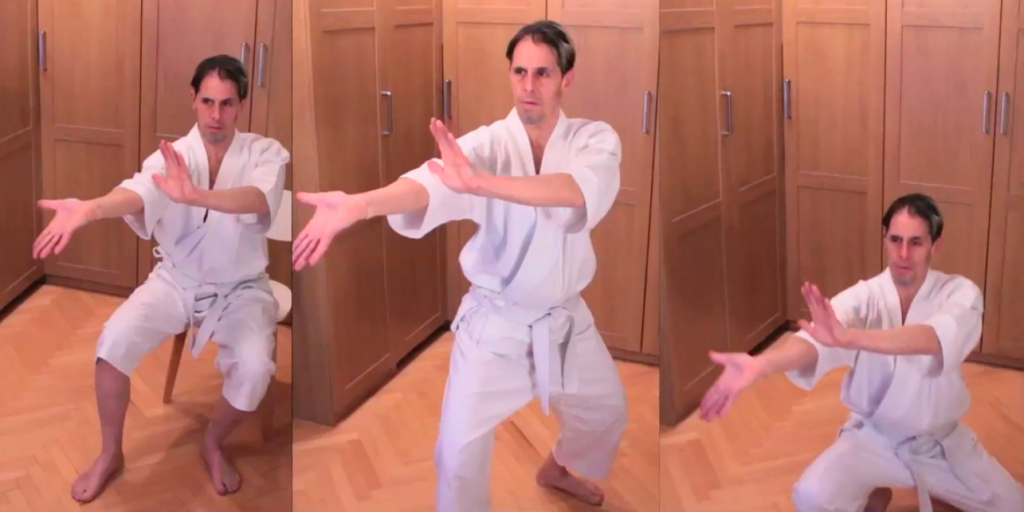
Excerpt from David Franklin’s hybrid Shintaido coursee
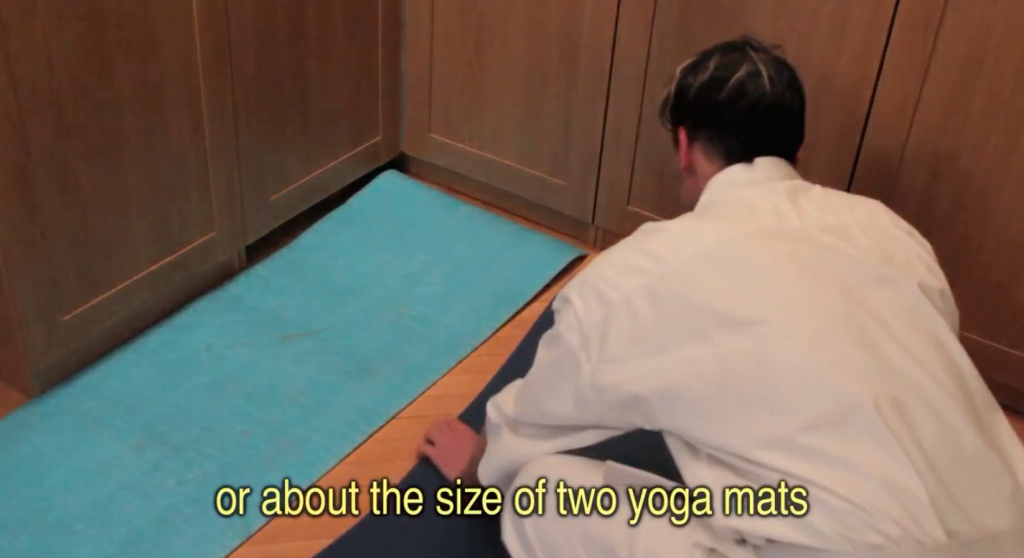
With this in mind, the structure of the course is meant to minimize the amount of time that participants spend online and maximize the habit of practicing alone every day, even if just for a few minutes. Solo practice is very empowering, especially if you learn flexible methods that allow you to practice outdoors when possible or indoors as needed. It helps you become independent and internally stabilized. Nobody can exclude you from it, nobody can unplug it, it doesn’t matter if the power goes out or what the weather is outside, and even if you’re very busy, you just need minimum 15 minutes per day and about three square meters of space.
An analogy for this process is when you receive a compressed file through the Internet, for example. Before sending, the other person’s computer has to do some work to make the file smaller (so it uses less memory or data). That’s similar to my work of preparing the course and the 1st week of instructional videos. Then the compressed (smaller) file gets sent through the “thin pipe” of the Internet connection, which is analogous to the livestream part of the workshop, which is limited to 15 minutes per day. Finally, after you download the file into your computer, your computer has to decompress the file before you can use it. This corresponds to the last week of the workshop, when you do the work of solo practice to integrate the knowledge into your movement.
The course is also designed to be accessible for people in a wide range of physical conditions, so just as you can choose the level of spiciness when you order Indian food for example, there are variations of techniques that I call “mild,” “medium,” or “intensive” that each participant can choose from according to their taste.
Excerpt no. 2 from David Franklin’s hybrid Shintaido course
Another challenge of live-streamed practice (such as Zoom) is that when learning new material, it’s difficult to catch many details on a livestream. This can be due to poor picture quality, unreliable Internet connection, poor audio etc., none of which can easily be solved on the spot. The quality of sound and picture is usually better on pre-recorded online videos (such as Vimeo or YouTube) than on live-streamed videos. Pre-recorded videos also give us the chance to pause, to watch again, to focus on the parts that we want to pay more attention to. I’ve addressed that problem by using pre-recorded online instructional videos as part of the course.
An additional advantage of using instructional videos before the live-streamed Zoom classes is that when you “arrive” at the live-streamed part of the workshop, you can concentrate on following along with the rhythm. You don’t need to concentrate as much on the details of the techniques because you’ve already learned these details through the instructional videos. And this advantage will also apply as we return to having in-person practices.
Therefore, the course focuses on developing some of the basic movement principles of Shintaido: yoki-tai vs. kaiho-tai, kiri-komi vs. kiri-harai (if you are new to Shintaido and don’t know these Japanese terms yet, no worries! You’ll learn them step-by-step during the course). There are also techniques that are not unique to Shintaido, but are essential, such as using the ulnar (pinkie) edge of the arm to unify movement, vertical alignment, long focus, etc. Practicing these fundamental elements regularly will give you a foundation that will serve you well in any Shintaido class and at every level of experience.
So in the schedule, you’ll see that the first week of the course consists of practicing along with instructional videos that I’m creating specifically for this course — seven of them, one for each day of the 1st week of the course.
During the second week, groups will meet online and practice together. To accommodate people in different time zones, I’m offering two times each day:
6:45am CEST / 12:45am EDT / 9:45pm PDT
6:45pm CEST / 12:45pm EDT / 9:45am PDT
The third week of the course is when you commit to independent solo practice of 15 minutes per day with no videos, livestreams or devices for seven more days. Finally, there is an optional feedback and discussion meeting to be held online on the last day of the third week, May 16th.
Finally, I’d like to offer this course as a tool that instructors or group leaders can use. If you’re familiar with Shintaido, you’ll see there isn’t much original about the movement techniques that I’ll teach in the course. But I’ve tried to arrange Shintaido techniques in a way that packs a lot of content into a short amount of time and a small space (sort of like a bonsai tree). If you’re a Shintaido instructor or group leader, feel free to use this course as an open-source tool. You can offer this course to your students or friends and after they complete Week 1 (the instructional videos), you can teach Week 2 yourself, either online or in person (according to local conditions), and offer your own interpretation.
Calling all creative designers – SOA is launching a LOGO contest.
Why? Shintaido of America has a current logo of the “jumping man”. As part of our branding initiative, we want to consider creating additional logos. We invite you to be inspired by the theme “opening to life.”
Tell me more The SOA branding initiative is “Shintaido – Opening to Life”. Perhaps you might like to take the opportunity to create a design that expresses what “Opening to Life” means to you. We are considering having the winning design be adopted as the new SOA logo. However, there is no promise we will decide to use these logos. Designs will be published anonymously for the voting.
What is the timeline? January 23, 2021, was the ‘kickoff’ to our contest. SOA will close the contest on April 30th. The top three winners will be announced in June 2021.
How will it be judged? The community of Shintaido practitioners and supporters will be eligible to vote in Mid-May. The top three submissions will then be given to our panel of experts for a final selection and recommendation to the Board.
Our two experts are Mario Uribe and David Sirgany.
Mario has been an honorary member of the SOA Board for many years. He is a well-known artist whose work spans the worlds of both Western and Asian art.
The second member of the panel is David Sirgany. David is a long-time practitioner of Shintaido and has over 25 years of experience with therapeutic bodyworker and somatic educator. David is an Iyengar certified yoga instructor and has taught both nationally and internationally over the past 20 years. He is also an accomplished artist and photographer.
Learn more about Iyengar yoga here and look at David´s photography work here.
What are the criteria? 1) compatible with our SOA branding of “Opening to Life.” 2) eye-catching and recognizable 3) inspirational and artistic 4) a visual style that reflects a community of practitioners 5) additionally, a successful logo design would look good in both black and white and in color.
How do I submit my design or designs? Send your design(s) to SOA President Connie Borden at bordensheets@aol.com
Shintaido of America is very pleased and excited to announce that Tereza Soldatova has joined our social media team as the new Newsletter Content and Outreach Specialist. Tereza will be responsible for publishing Body Dialogue articles on our website and reaching out to the subscribers on our Mailchimp marketing platform. Also, she will be managing the content of our Facebook and Instagram pages. She will be working with Jim Sterling, body dialogue editor and Rob Kedoin, SOA’s webmaster.
Hiring Tereza is an important step forward for SOA’s Branding Initiative and Strategic Plan.
Tereza lives in Prague, Czech Republic. She has become familiar with Shintaido via David Franklin and helps with Shintaido CZ activities.
She has worked for various companies as a social media manager and is taking classes in social media marketing strategy. She has experience working with WordPress, Mailchimp, Facebook and Instagram.
Tereza has a bachelor’s degree in sociology and is working on her master’s degree in semiotics.
As she mentioned in her CV, “Social media is a powerful communication tool. When handled with precision and creativity, it can help meaningful projects to grow.”
Tereza enjoys cinema, analog photography, and body movement.
Calling all creative designers – Shintaido of America (SOA) is launching a LOGO contest.
Why? – SOA has a current logo of the “jumping man”. As SOA just completed a branding initiative, SOA is considering creating additional logos. We invite you to be inspired by “opening to life.”
Tell me more – The SOA branding initiative is “Shintaido – Opening to Life”. At time of this announcement, PacShin is closing their Kangeiko with the theme “Opening to Life”. We hope you have been inspired. Perhaps you might like to take this interest and create a design or several designs that express what Opening to Life means to you. We are considering having the winning design to be adapted to the SOA logo, however there is no promise we will decide to use these logos. Designs will be published anonymously for the voting.
What is the timeline? – Today 23 January is the ‘kickoff’ to our contest. SOA will close the contest 30 April. The top three winners will be announced 1 June 2021. The SOA Board meeting is the 13 June when there will be a decision on the best choice for SOA.
How will it be judged? – The community of Shintaido practitioners and supporters will be eligible to vote in Mid- May. We are planning for a panel of experts to judge the top three winners to advise the SOA board on the best choice for SOA.
What are the criteria? – 1) Compatible with our SOA branding of “Opening to Life.” 2) eye catching and recognizable 3) Inspirational and artistic 4) a visual style that reflects a community of practitioners, 5) additionally, a successful logo design would look good in both black and white and in color.
How do I submit my design or designs? – To SOA President Connie Borden – bordensheets@aol.com
Can you show me the current SOA logo and other Shintaido designs? – Yes, and I would like to introduce David Franklin who will show via ZOOM some of these logos.
Building on the success of the April 4, Taimyo in a Time of Separation, Zoom event, Master Instructor H. F Ito will be teaching again May 30. Here are the class times in some major cities:
7am San Francisco
10am New York
3pm London
4pm Paris
11pm Tokyo
Class will be 45-minutes long. Please sign in about 15 minutes before the start and we can chat together. The Zoom info is: