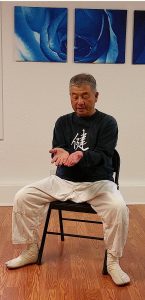
This is my story of using Taimyo Kata for world peace and healing over the past 20 years. It is a story about friendships and collaborations, world events, timely encounters and a personal calling to contribute to peacemaking and healing. I see my life as a tapestry of relationships and this is one part of that tapestry.
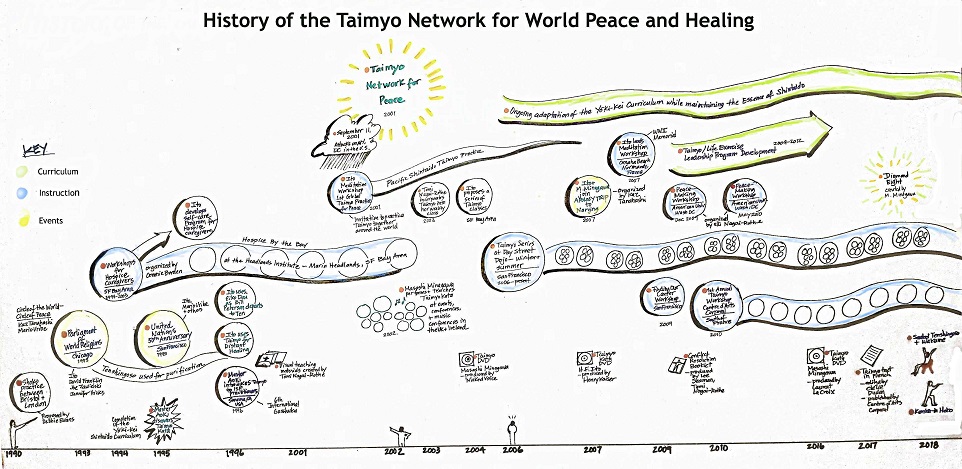
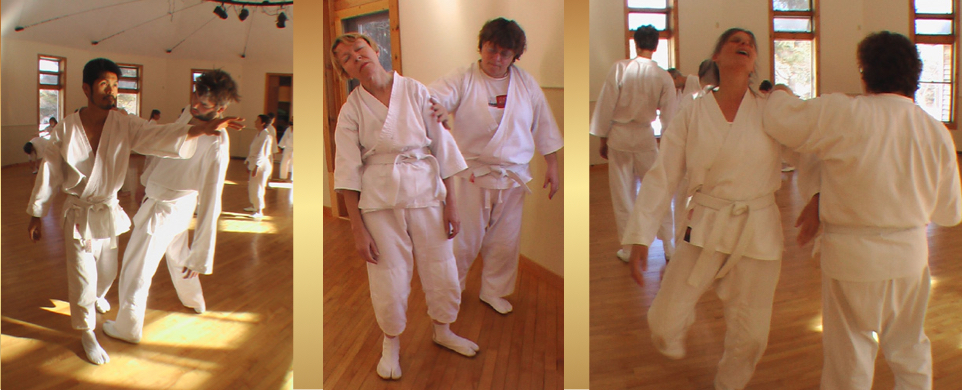
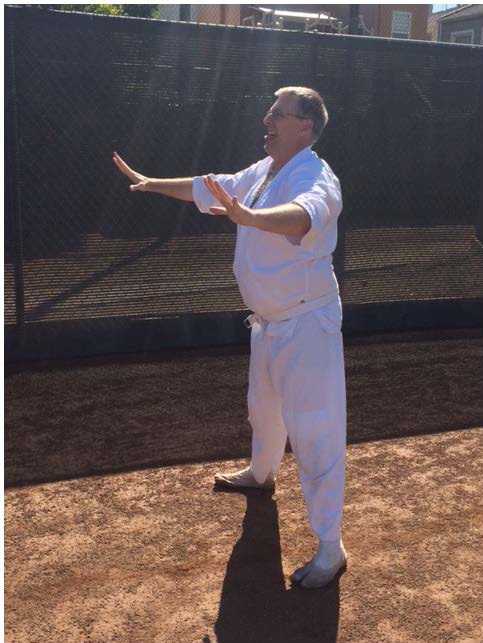
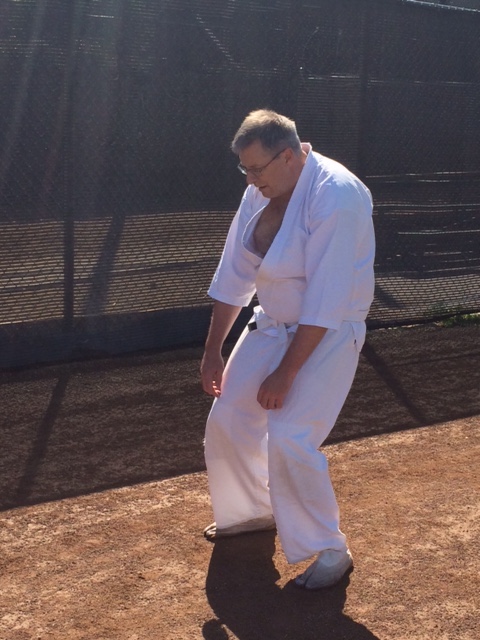
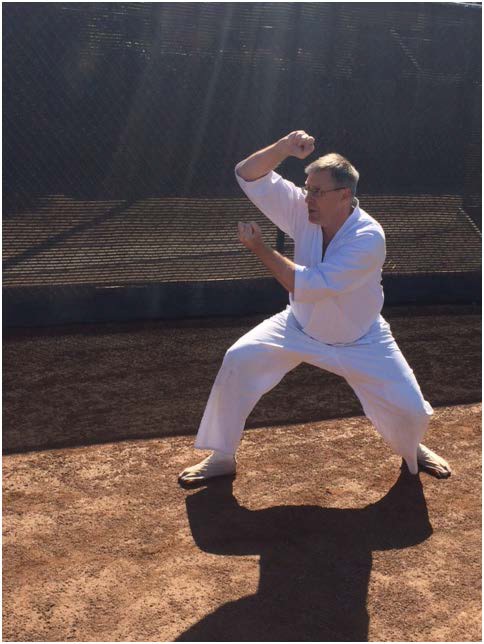
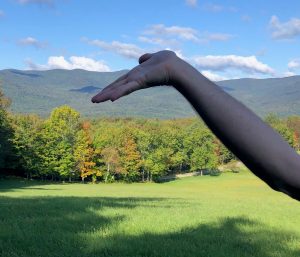
As you read along you can follow this story via the graphic history above, created by Tomi Nagai-Rothe.
Pre-History
In the early 1980s John Kent and James Cumming were leading business English trainings as well as cultural training for German and Swedish businessmen going to Japan. I led a Shintaido workshop for their clients. Later, John would lead kenko taiso in the mornings when he and Jim were teaching.
As their work expanded more into intercultural training, they hired me to offer intercultural workshops for their clients. This was the start of ITO Services (Intercultural Training and Orientation) which was my first adaptation of Shintaido to non-martial arts audiences.
Shoko Practice at a Distance
In 1996, Debbie Evans, a UK Shintaido instructor in Bristol, and her Shintaido friend living in London were feeling challenged by their shoko practice. Debbie suggested they practice at the same time to support one another. So at the appointed time, Debbie practiced shoko facing east (toward London) and her friend practiced facing west (toward Bristol).
In keiko we do shoko practice with partners facing one another. It allows us to do it much longer than we could alone. When Aoki-sensei practices toate he sends his awareness some distance to connect to another person because our imaginations can extend beyond time and space. Debbie put all of this into practice.
Stress Management Workshops and Distant Healing
As the executive director of Hospice by the Bay, a non-profit hospice service provider, Connie Borden asked me to design a stress management course for hospice caregivers. Families, friends and other caregivers of the dying experience stress and Connie felt they would benefit from a workshop aimed at their needs. I was happy to do it, but Connie had no budget for such a course.
At the same time, my friend Henry Kaiser was serving as a family board member with the Henry J. Kaiser Family Foundation. He had had the idea of supporting my teaching for several years. Because Henry could not contribute to me as an individual, he proposed supporting my teaching for 7 or 8 years through a non-profit that would organize workshops which I would lead. I put Connie and Henry together and voila! This was my second major adaptation of Shintaido for a non-martial arts audience. This time it was specifically designed for wellness and healing.
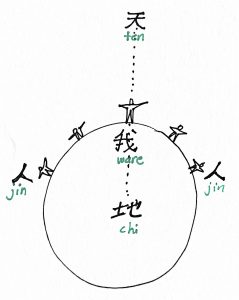
Ten chi jin Illustration by T. Nagai-Rothe
I created some conceptual charts to explain the concept of distant healing that could be used for Yokikei or Kaihokei keiko. I visited groups in Europe and the U.S. and recommended distant healing through keiko to help others with health issues, depression, etc.
I started teaching at L’Attitude in Quebec and at the Japanese Arts Seminar at Green Gulch Zen Center in Muir Beach, California and used the charts to describe Shintaido and particularly stress management.
Peace and Healing
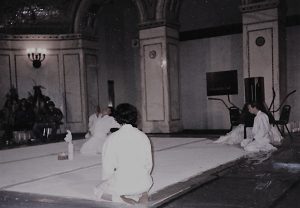
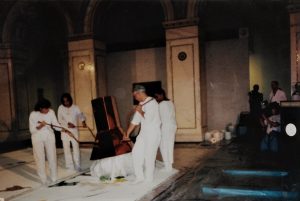
Parliament of World Religions — Photo by Mario and Liz Uribe
Mario and Liz Uribe, founders of the Japanese Arts Seminar, were impressed with this approach and invited me to participate in their peace work. In 1993 I participated in the Parliament of World Religions at Mario and Liz’s invitation.
Parliament of World Religions — Photo by Mario and Liz Uribe
Mario took the brush-painted circle practiced by Kaz Tanahashi and made it a group activity to set the tone for peace among world religions. He created a huge brush that four people could use to paint a large circle (Enso). They asked me to ritually purify the canvas with Shintaido movement before the circle was painted.
You can read more about the Parliament experience here on page 2 of Body Dialogue.
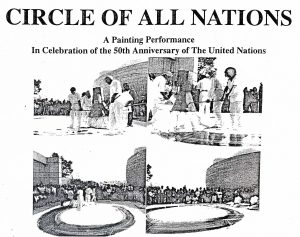
UN 50th Anniversary 1995
In 1995 we organized another Enso painting ceremony in San Francisco’s Civic Center Plaza for the United Nations 50th Anniversary in San Francisco (Resource: Body DialogueUnited Nations 50th – Will the Circle be Unbroken?)
The purification ritual for the brush circle is similar to what Kazu Yanagi (artist, painter) does by painting with water to purify a canvas. The house purifications I perform for healing and prosperity are the same: they clear away barriers and stuck ki energy.
Purification Rituals and End of Life Rituals
I was able to be with Bill Peterson, a Shintaido practitioner in San Francisco, at the end of his life. Sitting by his bed, I sensed that even though he struggled to breathe and be in his body, he was ready to go. As I held him, I asked him to do a meditation with me. We imagined ourselves doing Tenshingoso Dai and finally, Eiko Dai. I encouraged Bill to run and to let go. (Resource: Body DialogueFacing Death, Part II)
Like the purification ritual, this was about clearing a path forward. In this life this process creates an open space for peace and healing, and for those leaving this life, it creates a path to peace.
The Development of Taimyo Kata
Master Aoki developed Taimyo Kata in 1995 and shared it at the 1996 Shintaido International in Sonoma County, California. Taimyo became a form to focus much of what came before: distant healing, stress management, spreading peace and purification.
Over decades of practice, I have come to see Taimyo as a microcosm of all of Shintaido – a gallery or collage of Shintaido movement. Taimyo is like a fractal. One part of it reflects the whole. In one sense, I feel like its parts express my own life.
Taimyo and Global Peace
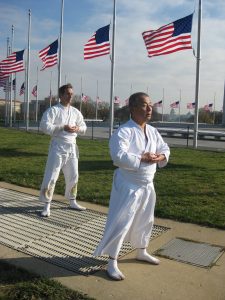
Taimyo at the Washington Monument, Washington DC. Photo by T. Nagai-Rothe
I was scuba diving at Point Lobos in California on the morning of Tuesday, September 11, 2001 and learned about the attacks on the World Trade Center and the Pentagon (U.S. Department of Defense) after emerging from the ocean.
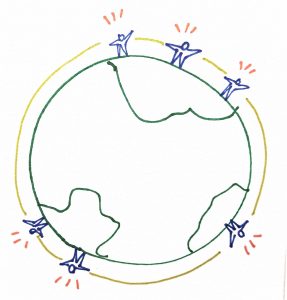
Hands around the world
That week I was working with Rob Gaston and Tomi Nagai-Rothe to finalize plans for a weeklong meditation workshop starting Sunday, September 23 in the Bay Area. We had 17 people participating in person and 12 people participating virtually from different parts of the U.S. and other countries.
It was an ambitious format and the attacks upended our plans. How could we use our practice to make sense of what had happened? Could we do something positive through the workshop? We brainstormed many ideas: meditation as healing, creating stronger connections at a distance, managing our fears and pain. Then we came up with the image of practitioners standing at various places on the globe and, through their Taimyo practice, extending an enormous web of caring and peace around the earth. This was the genesis of the International Taimyo Network for Peace.
Developing and Expanding Taimyo Kata
Masashi Minagawa began to perform and teach Taimyo at conferences and music performances in Ireland and the UK. I expanded my teaching of Taimyo with a more global perspective on our practice and the need for peacemaking.
In 2006 we began an ongoing workshop series at the Day Street Dojo in San Francisco, thanks to Connie Borden. I built on the material covered in the Caregiver Workshops (1994 – 2003) incorporated Tai Chi from my study with Master Ma and connected the practice to personal peace-making (resolving conflicts within ourselves), healing (including distant healing) and peace – the impact we have on those around us and where we are called to create positive social change.
9/11 focused our Taimyo practice and connected it to our hopes for peace.
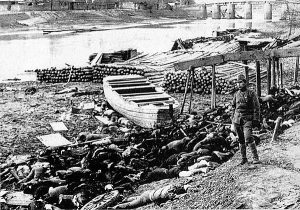
My friend and colleague Kaz Tanahashi – artist, teacher, peacemaker and Buddhist practitioner – invited me and Masashi Minagawa to join him for an apology pilgrimage to Nanjing, China in 2007. Kaz had arranged to participate in the Nanjing University international conference on the 70th anniversary of the Nanjing Massacre.
We felt for some time that it was important to make a formal apology as individual citizens since Japan had not done so. Still, we were anxious about going to Nanjing — concerned about an angry response from the Chinese.
Bodies of massacre victims on the shore of the Qinhuai River. From Wikipedia
The conference participants included those who have studied and experienced genocide in many parts of the world. There was press coverage of the conference and our apology ceremony. People in Nanjing seemed glad that we had come.
Masashi Minagawa and I went down to the edge of the river for our own meditation and form of apology. After some time I had a profound sense that the souls of those who had been massacred were present, and that they were not only forgiving but loving. I will never forget that experience.
That same year I organized a Meditation Workshop on Omaha Beach in France to lift up peacemaking — rather than the glorification of war that often happens there.
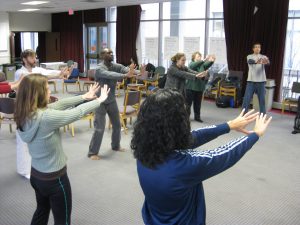
In 2009 and 2010 Elli Nagai-Rothe helped organize a Peacemaking Workshop at American University in Washington DC for graduate students in the International Peace and Conflict Resolution Program and others interested in practical peacemaking. Taimyo and Shintaido provided a powerful and practical antidote to the intellectual work of graduate studies.
Peacemaking Workshop at American University Photo by T. Nagai-Rothe
A Taimyo and Life Exercise Curriculum
With the help of Lee Seaman and Tomi Nagai-Rothe I created a curriculum and teaching program so that I could involve others in sharing this work. I began certifying my students in the U.S., France, Japan and Quebec. There are now 19 people coaches and instructors around the world.
My students in the South of France have held an annual Taimyo Workshop since 2010. They invited me to teach for many years, and now four students have taken over and established the Institut des Nuages Flottants and lead Taimyo Workshops four times a year.
Diamond Eight Cut
In 2016 Masashi Minagawa was inspired to create the Diamond Eight Cut – an improvisation on Shintaido movement that brings to fruition 50 years of Shintaido practice, teaching and research and development. It combines Tenshingoso and Eiko as well as Kiri-Oroshi kumite in an elegant and accessible form that can be used for celebration or purification, energetic healing, and connecting our inner world with the Universe.
Diamond Eight is a perfect fit for movement inspired by Taimyo Kata. I have taught it and found innumerable ways to creatively adapt it to my students’ needs over the past three years. Its combination of centering, clearing, opening and healing makes Diamond Eight a fractal of Shintaido.
It miraculously helps us express and experience everything from Mother Nature and the deep Universe to the cells in our body and everything in-between. When I practice Diamond Eight it feels like my body is its own cosmos and, simultaneously, as if tiny versions of my cellular self are also practicing Diamond Eight.
After practicing the Diamond Eight, I understand meditation in a deeper way — in a way that monks probably understood intellectually, though not somatically. It is an amazing gift.
Ito and Lee Ordeman at the Washington Monument. Pearl Harbor Day – December 7, 2009. Photo by T. Nagai-Rothe
Diamond Eight marks a new era for Shintaido and Taimyo that I trust will carry us for many many years to come.
Since this Spring Gentle Shintaido has been the topic European Technical Committee instructors have wanted to discuss.
Looking back at the history and development of Shintaido, “Shintaido for Everyone” has been an intention and repeated refrain. Although the term Gentle Shintaido makes sense in English, in French it sounds like a diluted version of Core Shintaido − like flying economy class because you can’t afford anything better.
During my Shintaido career I have seen many animated email exchanges on this topic.
“Shintaido without losing the experience”
I have been closely involved in this discussion because Gentle Shintaido mirrors the approach I took starting in the early 2000s. I wanted to make Shintaido accessible to people outside the martial arts. My motto was “Modify Shintaido without losing the core experience.”
In talking with instructors – regardless of whether or not we use the term Gentle Shintaido – I have noticed the following themes:
When we teach Shintaido to people who have physical, mental or emotional difficulties, the movement has to be gentle and soft. However, if that is all there is the students as well as the teacher may become bored.
It is important to periodically share some Kaiho-kei techniques, or to do Chudan-tsuki on kibadachi with a firm kiai. Or you can give people the experience of Toitsu kihon movement, even if their bodies can’t sustain it for very long. This allows them to have an awakening experience.
If we look back over the history of Shintaido, we see that in order to be avant-garde it is necessary to be classical first. From Karate to Shintaido Kaiho-tai to Shintaido Yoki-tai, we continue to build from classical roots. Jigo-kei, Kaiho-kei, Yoki-kei, Seiritsu-kei — all of these keiko forms have advantages, but none of them are as powerful alone as they are together. Good teaching must include them all.
That is why Gentle Shintaido instructors must be able to switch immediately from one style to another in response to their students.
Should we say that, for example, students might start with Yoki-kei and as they grow stronger advance to Kaiho-kei (or maybe even Jigo-kei), and finish up in Seiritsu-kei?
I suggest that the 2020 examinations for Sei-Shihan and Dai-Shihan should focus on candidates’ ability to understand these points and to put them into practice in their own teaching.
For your information, I’m including a table showing the relationship between Yoki-kei and Kaiho-kei, as well as Jigo-kei and Seiritsu-kei. I originally developed this table to clarify my own thinking about the differences and similarities among these elements of Shintaido.
[table id=6 responsive=scroll/]
Kaihotai
Yokitai
Jigotai
Seiritsutai
Addendum (Lee Seaman’s experience):
When I started Shintaido, I was 25 years old. Most of the other students were between 18 and 30, and Aoki-sensei had just celebrated his 30th birthday. Everyone was in great physical shape, and we did nothing but Kaiho-tai keiko. Aoki-sensei told us that Tenshingoso and Eiko were the core of Shintaido, and those two forms were also the core of our practice. The bigger the better, the farther the better, the louder the better.
I have been practicing Shintaido for almost 40 years now, and I have come to the conclusion that Aoki-sensei had a hidden teaching. In my experience, there is something more basic than Tenshingoso and Eiko. It reminds me of the koan about the gateless gate – I call it the techniqueless technique. It embodies Tenchijin, informs Tenshingoso, and is the beating heart of Eikodai. This core Shintaido is the basis of all our practice, and Kaiho-tai, Yoki-tai, Jigo-tai, and Seiritsu-tai are its branches.
I believe that, to give Shintaido to a world that needs it more than ever, we need roots in this core place.
What is the strongest martial arts technique? Over the years, I have heard different answers depending on style, training, and teacher. Some believe a strong kick, others a strong punch (tsuki), others a secret mix.
How would I answer the question if I were asked this morning? My response would be “Shintaido kaishoken is the strongest technique and worthy of daily practice.” In the Shintaido glossary, kaishoken is defined as the “opening and expressing hand”. Maybe that’s a puzzling answer to some. Others may have a different understanding and thoughts on the subject. Here’s my current thinking and perspective.
When I first started studying martial arts, I observed a fascination with developing the most efficient technique to address a perceived opponent. In the Funakoshi-Egami-Aoki lineage, there is a well documented path that occurred to develop the tsuki (as currently practiced in Shintaido) as a proven technique.
As I understand the story, there was immediate joy when Master Egami found his new tsuki (front-punch). Very efficient, elegant, flowing motion, full body application of force that could easily knock a man down with one blow. An elegant weapon if there ever was one.
Photo by Mark Bannon
What followed, however, was a realization that this new technique was so powerful that the traditional blocks and strategies were no defense against this new tsuki. An even stronger technique was needed to respond to this new weapon. A literal arms race had ignited.
The story of the tsuki is in Section Seven of Master Aoki’s Shintaido book. Master Aoki discusses the research he and Master Egami did to become “tsuki specialists” and his discovery of kaishoken as a defense against the new tsuki.
I began trying the open hand as a technique to receive a tsuki. At first, it was not a very satisfying technique. As I continued my Shintaido practice, I heard other students ask about kaishoken. I was apparently not the only one that didn’t immediately get it. In response, more experienced students (senpai) would respond that, kaishoken in Shintaido actually means “open hand – open body.” This expanded definition started to make more sense. Very good. I could practice that – receive the tsuki with an open hand and an open body. My technique seemingly started to improve.
As improvement came, a senpai instructed me to open eyes. Pay attention, see everything. Don’t become distracted by shiny objects. That lesson resonated. It occurred to me that kaishoken was not only open hand, open body, but add open eyes. Don’t fall into the trap of your surroundings and initial encounter. See everything. Look at the situation with soft eyes. Take it all in. I was feeling pretty jazzed with kaishoken at this point. What could be better?
A few weeks later I attended a Shintaido workshop in Quebec. During the exercise, I was instructed to “open my mind” and go beyond this world and travel to the corners of universe. See all the angles, potentials, challenges, look beyond, travel time and space. Wow. Things changed. I experienced something new. From that moment, my Kaishoken evolved from open hand – open body – open eyes – to open mind.
Phot by Mark Bannon
Armed with an open mind, I saw possibilities coming at me before they were in sight. I was no longer on the defense. I was actively receiving intention and anticipating. Now that is a strong technique! I started using my new kaishoken (open hand-open body-open eyes-open mind) in all sorts of circumstances. I was using kaishoken at work improving relations with co-workers, with clients building more innovative projects, and building closer relationships with family and more meaningful relationships friends. A true keiko was developing.
Then one day I found myself in an encounter and I admittedly didn’t handle it very well. Nothing serous, but I thought about it all day and actions I could have/should have taken to cause a different outcome. It suddenly occurred to me, the answer could be kaishoken. This time, I realized had I approached the encounter with an open heart, the result could have been much improved. I realized kaishoken is really open heart.
Photo by Mark Bannon
My definition of kaishoken started simply as a glossary note “open-hand.” As my practice became more rich, my understanding evolved: open hand – open body – open eyes – open mind, – open your heart. Kaishoken is arguably the strongest technique and one I need to practice every day. A technique to end the arms race.
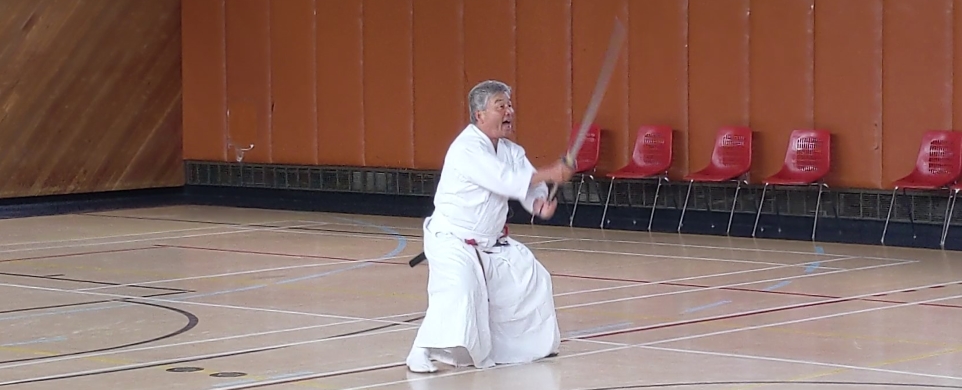
During the workshop last weekend held by Québec Shintaido Doshokai, Master Instructor H. F. Ito gave the following demonstration of the Shintaido kenjutsu kata, “Chuden no Kata” with the naked blade.
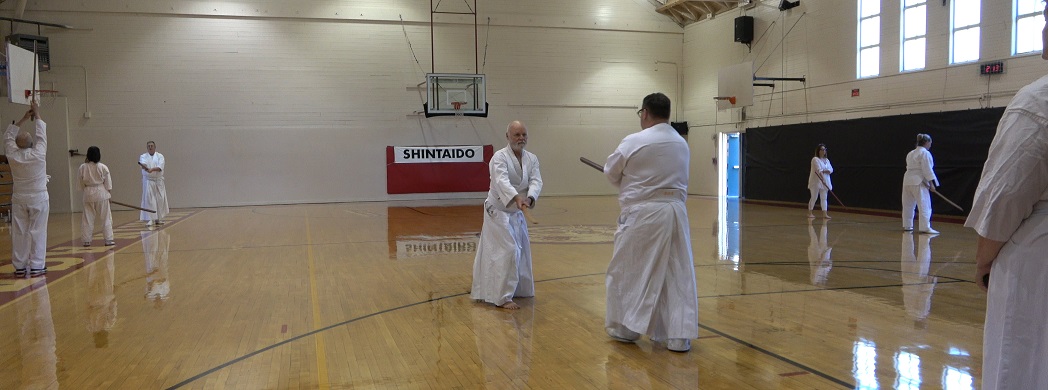
On Saturday, August 17, at Marin Academy in San Rafael, California, Master Instructor H.F. Ito led Bay Area and visiting Shintaido practitioners—12 in the morning session, 10 in the afternoon—through two keiko based on the theme “Opening the Door of Perception: Muso-Ken.” Given his intention to cut back on transatlantic travel from his home in France and to visit North America only once a year, this was possibly Ito Sensei’s last summer workshop in Northern California. For some of us, that fact added a subtly poignant undertone to Ito Sensei’s deep and nuanced teaching. Throughout the day, Sarah Baker and John Bevis documented the workshop on video.
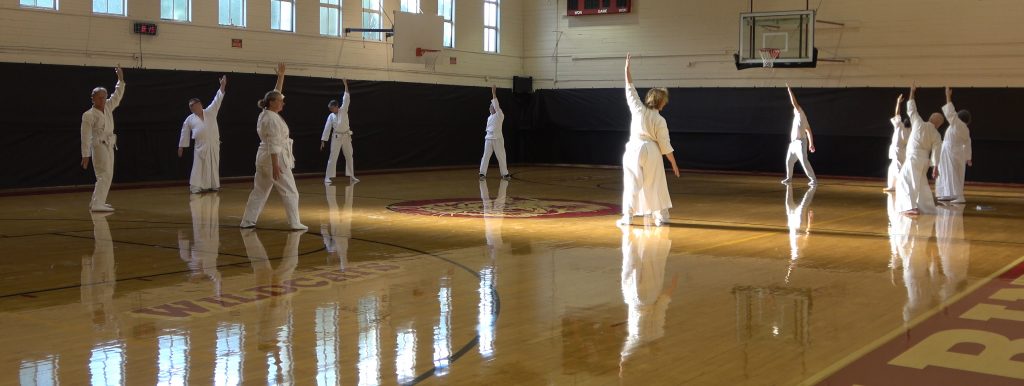
Keiko began with a form of warm-ups that was new to many of us. Connie Borden introduced the movements based on the end of Taimyo kata part III flowing into the start of Taimyo part I.
Connie Leads Warmups
These movements are called Hugging the Sky (ho-ten-kokyu-ho), Three Quarters turn (hokushin kokyu-ho), oodachi zanshin, and kan ki. They focused on breathing (kokyu) while having us rotating, spiraling, and twisting our spine and our being to reach higher into the heavens and lower into the center of earth. We studied contrasts of creating a small circle below ourselves then opening diagonally to draw a big circle and embrace the sky. As we bowed, we studied compressing the air and space in front of us. To start hokushin kokyu-ho, we hugged a tree in front of us and then slowly expanded ourselves upward and downward, experiencing the contrast between up and down while elongating our beings, continuing our focus on deep and slow breathing. Our front hand reached up with the fingers and palm facing back, while the lower hand pointed down and three-quarters behind ourselves with the palm facing inwards.
Throughout these movements we practiced having our eyes follow our movements, ultimately having our eye movement help us go further into space and across time. In the last segment, we opened to Ten with kaisho-ken hands to the sky and then formed a tight tsuki to grasp what was waiting for us, then crossing our arms in front of ourselves we ended in the classic karate stance, kaiho-tai. With kan ki as the opening of Taimyo part I, we reached out in front of ourselves as if to dive out into the ocean of ki, and after making one last big circle around ourselves, we let ki energy land in our outstretched, wide-open palms and made a tight tsuki. We pulled our tsuki back to our sides, letting our elbows point behind ourselves while deepening into kiba-dachi (horse-riding stance). After holding this stance for a moment to allow our bodies to feel warmed, we stood in seiritsu-tai, letting our arms move downwards to our sides with our fingers actively pointed downwards. From the warmups of breathing, twisting, spiraling, and elongating, we ended feeling straight and clear, hopefully ready to study awareness of ourselves and increase understanding of others.
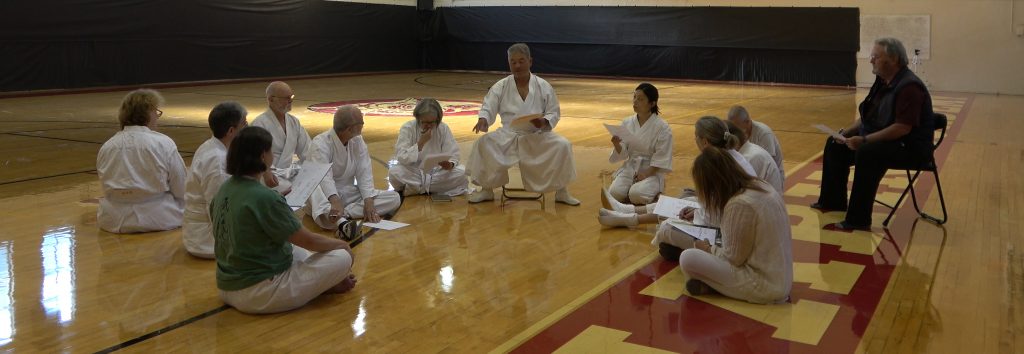
Before we began physical practice, we sat in a circle and Ito Sensei gave a free-flowing talk based on a double-sided handout. With Tomi Nagai-Rothe and Nao Kobayashi assisting with translation, he first discussed the various forms of ki (energy or, in French, esprit), ranging from lack of confidence/fearfulness (yowa-ki) to being resolute and ready (tsuyo-ki) or easy going (non-ki), from taking care of your own energy (ki wo tutete) to being considerate of and attentive to others (ki-kubari), and more.
Ito’s Talk
The thorny concept of sak-ki, which translated to “bloodthirstiness” or “the intention to kill,” was pivotal because it related closely to the second area of discussion, muso-ken. In our practice, we would be working on developing sensitivity to energy behind us, specifically the intention and approach of someone attacking us from behind. Mu-so, Ito Sensei explained, can be taken to mean “dream,” “vision,” “premonition,” and “clairvoyance,” on the one hand, or “no phase,” “no phenomenon,” and “emptiness,” on the other, akin to the complete absence of light or dark matter.
Muso-ken, then, can be thought of as employing the sword of perception, the English definition given by French Shintaido General Instructor Pierre Quettier. And the physical practice of the morning and afternoon was dedicated to learning how to use this sword effectively.
We began with partner wakame, the initiator using a lighter and lighter touch at a quickening pace, and the receiver developing a more and more refined sensitivity to the contact and the direction of the energy through the body. Ito Sensei emphasized that wakame is something that you can never assume to have perfected, something to work on for the rest of your life—in relationships, in the family, at work, and out in the world.
The core of the practice was developing sensitivity with our backs, making our entire backside a sensor (or an array of sensors), like radar, detecting and becoming aware of what’s coming at us from behind. As we cultivated sensitivity to someone approaching from behind, we worked on two different stepping patterns to receive the attack. One involved stepping forward and slightly out (with the right foot, for instance), opening a path for the attacker by pivoting and drawing the left foot slightly aside and “welcoming” her to enter and pass with a Tenshingoso “E” motion with the left hand. The second stepping pattern involved stepping back and slightly behind (with the right foot, for instance), again opening a path by pivoting that leaves room, but not too much, for the attacker to pass, and again welcoming and urging the partner forward with a right-hand “E” motion. Both techniques are ways of managing space and time. Although Ito Sensei did not talk much about it, receivers were encouraged to be aware of and experiment with A, B, and C timing on the early-to-late-response spectrum.
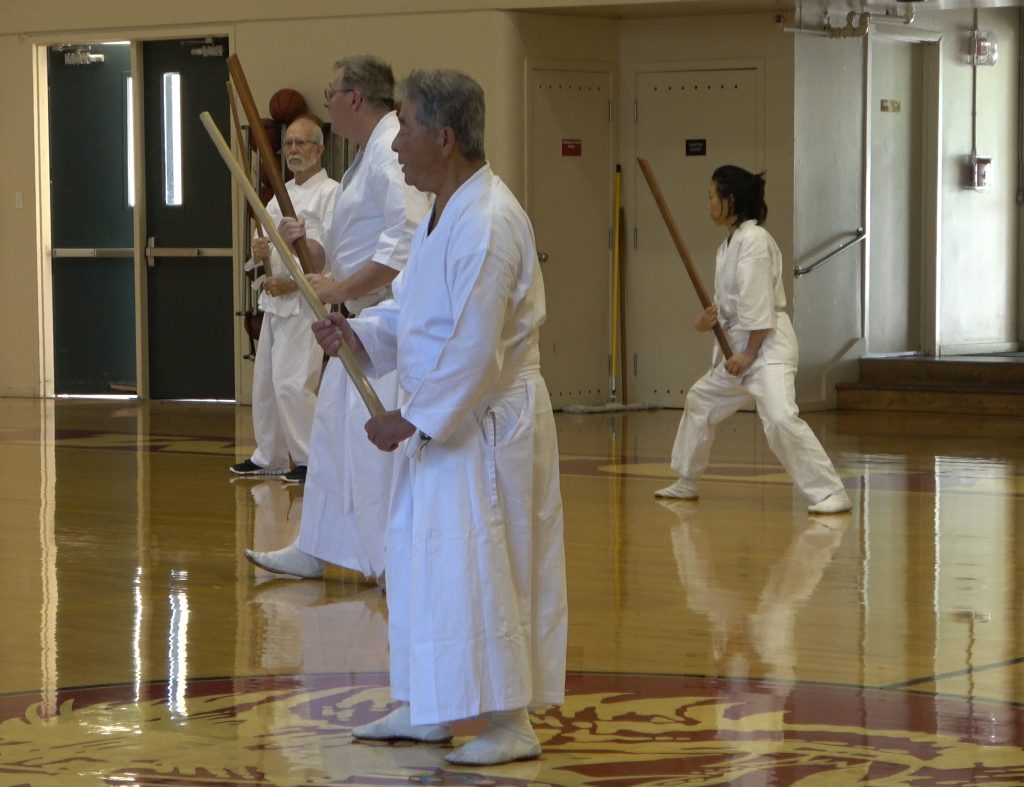
After working on the stepping, the receivers took up weapons—a rolled magazine playing the part of a short stick, and then either a boken or bokuto—and added gedan bari and ha-so movements to their receiving.
As for the attackers, they approached their receiving kumite partners from behind with different techniques (and weapons), as well: using the first movements of the Diamond Eight Cut kata and stepping forward with a spearing motion; using a rolled up magazine as a short stick; and using a boken or bokuto. During the afternoon keiko, Ito Sensei had us receive dai jodan sword attacks from behind, eventually receiving two attackers so that we could gauge and deal with their different energies. Between sessions, we retreated to the home of Jim and Toni Sterling for a potluck brunch that became a continuation of keiko through social communion and philosophical discussion.
Sword practice
Toward the end of the afternoon keiko, Ito Sensei talked a bit about Tenshingoso in metaphorical terms, likening the patterned movements to a constant turning inside out, as we might do with socks; extending ourselves to the other side of the earth and beyond the boundaries of the universe; holding our planet with loving kindness and bringing it inside ourselves. Finally, he charged us with solo “homework” practice of the Muso-Ken movements he had taught us, and reminded us that we need to apply our Shintaido practice in general to the way we think about life and death, and the way we live our lives in the world.
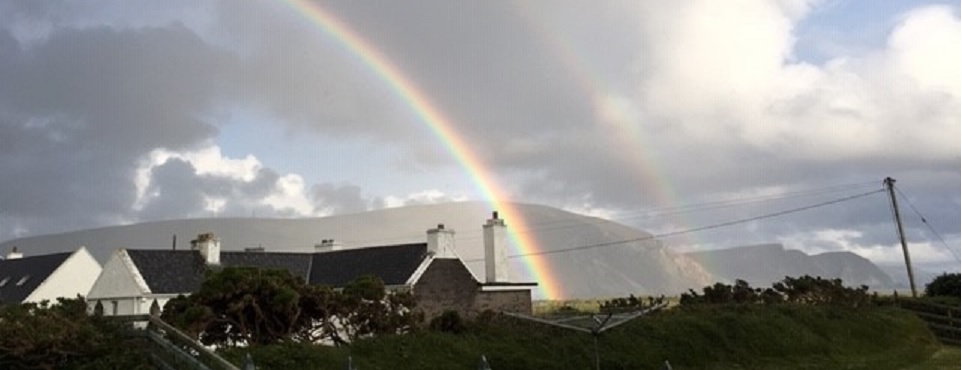
In June 2019, ten Northeast American retreatants ventured across the pond to Achill Island, a wind- tossed haven on the westernmost coast of Ireland. Led by Rev. Sue Foster (Roger Solomon’s wife) and Rev. Maebh from the Sacred Path Retreat Center, our quest was to explore how the wisdom of Celtic spirituality might enlighten our daily lives.
Ireland is renowned as a beautiful and hospitable land, and one that has experienced terrible hardships and suffering, but at times, it’s also been the center of Western civilization and culture. Their deep spirituality can be traced back to Druidic traditions, centuries before the arrival of Christianity. Like the Shintaido founders, the Celts were focused on developing an organic relationship with nature and connecting with the grace in all of creation, asserting the life-affirming aspects of our elemental existence. In contrast to the Roman church’s dogma of “original sin,” the leaders there promulgated the notion of “original blessing”.
Although the North Atlantic winds there are strong enough to blow your chi away, the natives feel a powerful sense of alignment with the sacred earth and sky. It’s a good place to develop Ten-Chi-Jin. (Ten = heaven; Chi = earth; Jin = self)
In 563 Columba came to the isle of Iona and established the first monastery in Scotland. One of the earliest centers of Celtic Christianity, they practiced a radical gender-neutral egalitarianism, sometimes being led by a female abbess.
Influenced by the ancient texts of the Wisdom Tradition and the writings of St. John (he who listened to the heartbeat of Jesus), this movement resisted the authoritarian, hierarchical Roman Catholic Church as long as they could. According to legend, young warriors would spend their final year of training living in the gender role of the opposite sex to seek a more attuned balance of life.
J. Philip Newell writes “The passion of the Celtic mission lay in finding meaning in the heart of all life, a sense of wonder in relation to the elements, to recognize the world as the place of revelation, and the whole of life as sacramental. The western isles developed a rich treasure of prayers that referenced the sun, moon and stars as graces, and the spiritual coming through the physical. God is seen as the Life within all life. The Celtic crosses, triangulated knots, and illuminated texts incorporated designs that symbolized the interlacing of God and humanity, heaven and earth, spirit and matter.”1
I see clear parallels here with the mystical and anthropomorphic aspects of Shintaido. Aoki Sensei quotes sword master Sekiun to the same point: “We call the highest level which could be attained sei or “holiness”. This realm is yuiitsu muni- just as the sun is one and the moon is one. It is the highest and the holiest.”2
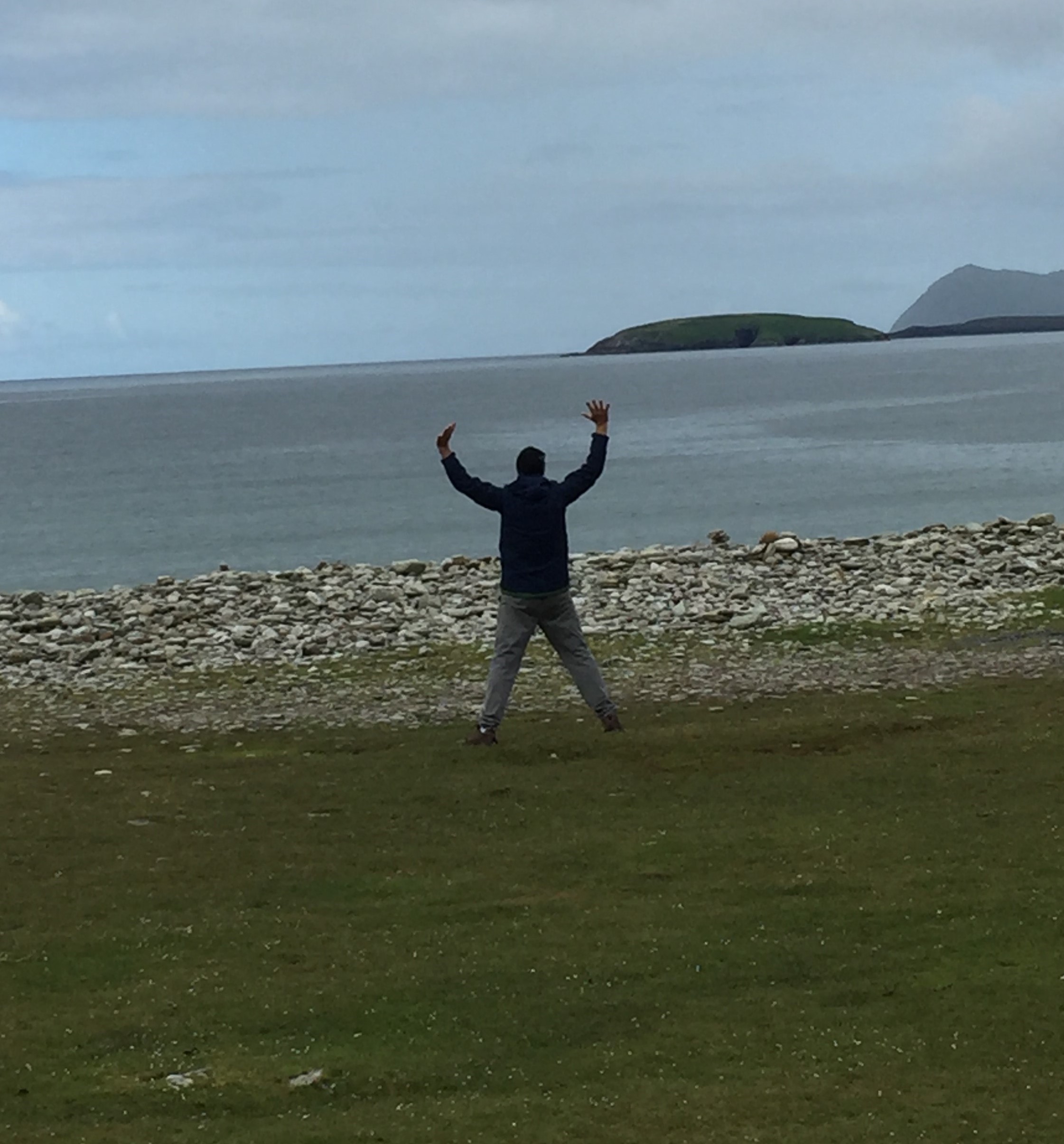
Matt Shorten in Ireland–Photo by Rev. Sue Foster
As Michael Thompson Sensei wrote in the Introduction to the Shintaido handbook, “Where does the body end and the mind or spirit begin? He (the budoka) is a specialist of that invisible and yet very physical part of ourselves which our doctors have not yet discovered. His ‘treatment’ is to teach us to communicate with our deeper selves, with each other, with nature and with God through the medium of our bodies”.3
One of the sacred practices we did on the retreat was to walk a stone labyrinth, situated on a peaceful hillside between a towering waterfall and a pristine sandy beach. Unlike a maze, a labyrinth has only one way in and one way out, but is nevertheless replete with surprising turns and discoveries. As one enters, you set an intention, and then just perform the movement with sincerity, trusting that when you finish, a clarity will arise upon emerging. Or as Aoki Sensei has said, “The locus of one swing of the sword is itself a sign”.4
On the last day there, when our spirits were high, but our bodies restless after a long sitting meditation, I offered to lead the group in some uplifting movement. We did Ritsu-i-ju Meiso-ho (10-position standing meditation), wakame (seaweed), and aozora-taiso (blue sky exercise), all with beach and sky visualizations. Although some in the group were limited physically, our hearts were open to what was within and without.
1) J. Philip Newell, Listening to the Heartbeat of God, p. 3, Paulist Press. 2) Haroyuki Aoki, Shintaido, p. 31, Shintaido of America. 3) ibid, p. 12. 4) ibid , p. 35.