an online / offline Shintaido course that takes 15 minutes per day for 21 days Starting Sunday April 25, 2021 Details of the program and registration here
Personally, I don’t like Zoom meetings much. Doing exercise through Zoom is slightly less bad than a meeting, but it still lacks something. As I mentioned in a previous Body Dialogue article, there are some experiences we can only access when we are physically in the same space together. Those kinds of experiences cannot happen through the Internet.
Rather than trying to imitate or simulate those face-to-face experiences, which would be like banging my head against a brick wall, I decided to design an online Shintaido course with a different objective: to take as little time as possible online to supply participants with a program that they can “unpack” and later practice offline as a solo practice. That’s why I came up with the format “21 days, 15 minutes per day.”
In real life, Shintaido classes are typically 90 minutes or two hours long and people sometimes say they don’t have time to attend. It can be high bar for beginners. When we practice online, even a practice as short as 45 minutes may feel a bit tiring rather than invigorating because of the various problematic effects of video conferencing on the eyes and brain, a phenomenon that’s been labeled “Zoom fatigue.” (There’s an excellent National Geographic article explaining the reasons for Zoom fatigue here).
But what about a 15-minute class? If you were (or are) a complete novice, would you be more likely to give Shintaido a try if the class only took 15 minutes? Avoiding “Zoom fatigue” is only one of the reasons I came up with the format of 15 minutes per day for 21 days. Another reason is to encourage regular daily practice, and this requires forming a new habit. It’s not scientifically clear how long it takes to form a new habit, but after I intuitively chose 21 days, I found out that many experts recommend this. In fact, there is something called “the 21/90 rule,” a rule of thumb that if you commit to a goal for 21 consecutive days, it can become a habit; and if you continue your habit for another 90 days, it can become a permanent lifestyle change.
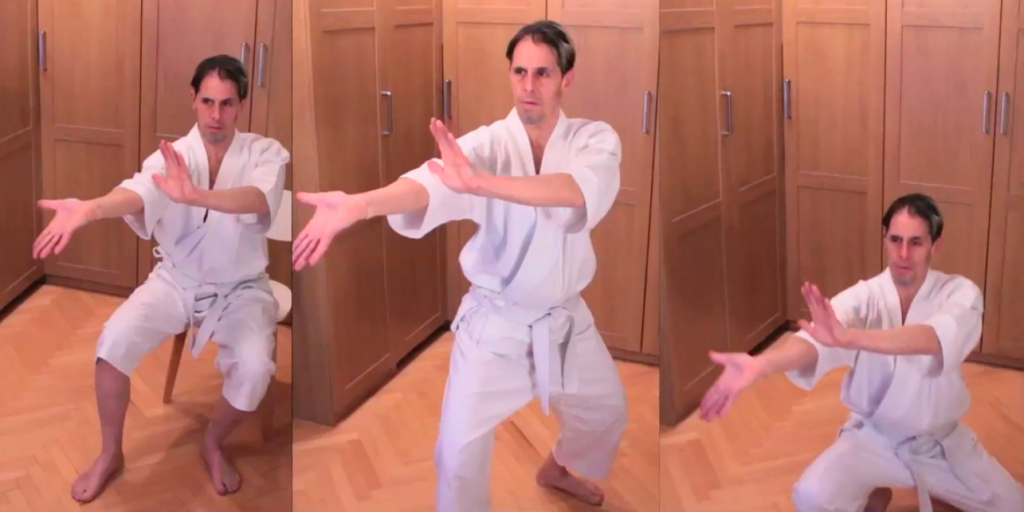
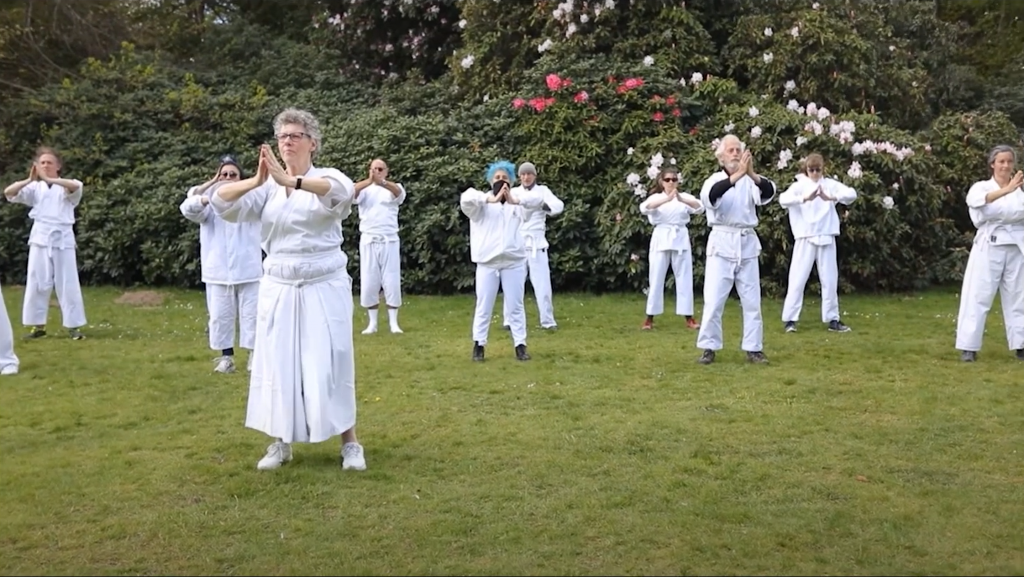
Excerpt from David Franklin’s hybrid Shintaido coursee
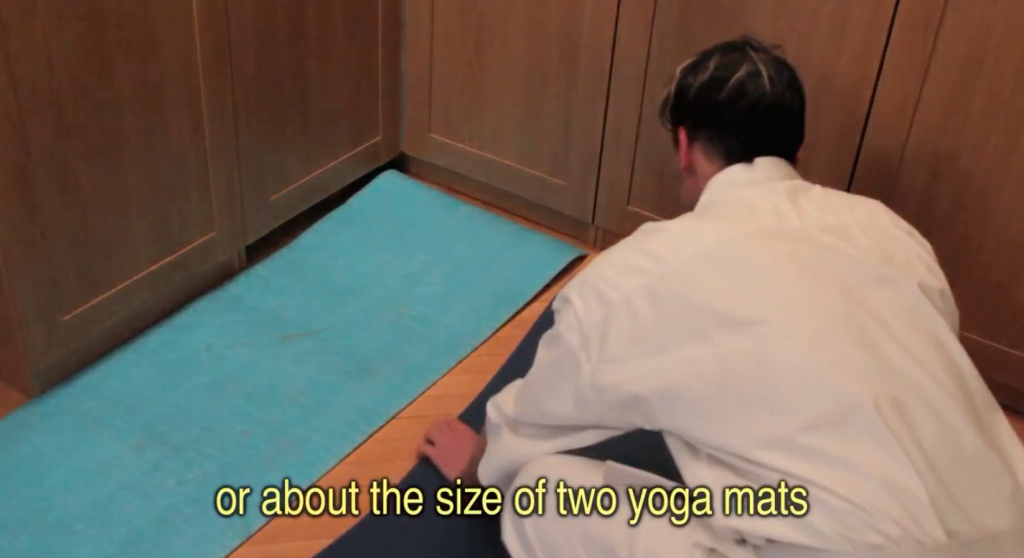
With this in mind, the structure of the course is meant to minimize the amount of time that participants spend online and maximize the habit of practicing alone every day, even if just for a few minutes. Solo practice is very empowering, especially if you learn flexible methods that allow you to practice outdoors when possible or indoors as needed. It helps you become independent and internally stabilized. Nobody can exclude you from it, nobody can unplug it, it doesn’t matter if the power goes out or what the weather is outside, and even if you’re very busy, you just need minimum 15 minutes per day and about three square meters of space.
An analogy for this process is when you receive a compressed file through the Internet, for example. Before sending, the other person’s computer has to do some work to make the file smaller (so it uses less memory or data). That’s similar to my work of preparing the course and the 1st week of instructional videos. Then the compressed (smaller) file gets sent through the “thin pipe” of the Internet connection, which is analogous to the livestream part of the workshop, which is limited to 15 minutes per day. Finally, after you download the file into your computer, your computer has to decompress the file before you can use it. This corresponds to the last week of the workshop, when you do the work of solo practice to integrate the knowledge into your movement.
The course is also designed to be accessible for people in a wide range of physical conditions, so just as you can choose the level of spiciness when you order Indian food for example, there are variations of techniques that I call “mild,” “medium,” or “intensive” that each participant can choose from according to their taste.
Excerpt no. 2 from David Franklin’s hybrid Shintaido course
Another challenge of live-streamed practice (such as Zoom) is that when learning new material, it’s difficult to catch many details on a livestream. This can be due to poor picture quality, unreliable Internet connection, poor audio etc., none of which can easily be solved on the spot. The quality of sound and picture is usually better on pre-recorded online videos (such as Vimeo or YouTube) than on live-streamed videos. Pre-recorded videos also give us the chance to pause, to watch again, to focus on the parts that we want to pay more attention to. I’ve addressed that problem by using pre-recorded online instructional videos as part of the course.
An additional advantage of using instructional videos before the live-streamed Zoom classes is that when you “arrive” at the live-streamed part of the workshop, you can concentrate on following along with the rhythm. You don’t need to concentrate as much on the details of the techniques because you’ve already learned these details through the instructional videos. And this advantage will also apply as we return to having in-person practices.
Therefore, the course focuses on developing some of the basic movement principles of Shintaido: yoki-tai vs. kaiho-tai, kiri-komi vs. kiri-harai (if you are new to Shintaido and don’t know these Japanese terms yet, no worries! You’ll learn them step-by-step during the course). There are also techniques that are not unique to Shintaido, but are essential, such as using the ulnar (pinkie) edge of the arm to unify movement, vertical alignment, long focus, etc. Practicing these fundamental elements regularly will give you a foundation that will serve you well in any Shintaido class and at every level of experience.
So in the schedule, you’ll see that the first week of the course consists of practicing along with instructional videos that I’m creating specifically for this course — seven of them, one for each day of the 1st week of the course.
During the second week, groups will meet online and practice together. To accommodate people in different time zones, I’m offering two times each day:
6:45am CEST / 12:45am EDT / 9:45pm PDT
6:45pm CEST / 12:45pm EDT / 9:45am PDT
The third week of the course is when you commit to independent solo practice of 15 minutes per day with no videos, livestreams or devices for seven more days. Finally, there is an optional feedback and discussion meeting to be held online on the last day of the third week, May 16th.
Finally, I’d like to offer this course as a tool that instructors or group leaders can use. If you’re familiar with Shintaido, you’ll see there isn’t much original about the movement techniques that I’ll teach in the course. But I’ve tried to arrange Shintaido techniques in a way that packs a lot of content into a short amount of time and a small space (sort of like a bonsai tree). If you’re a Shintaido instructor or group leader, feel free to use this course as an open-source tool. You can offer this course to your students or friends and after they complete Week 1 (the instructional videos), you can teach Week 2 yourself, either online or in person (according to local conditions), and offer your own interpretation.
New for Shintaido in 2021 was PacShin Kangeiko via Zoom. PacShin offered three keiko on three separate days via Zoom so that Shintaido practitioners could deepen their study during this time of COVID pandemic. Thirty-seven people studied over the course of three days across two weekends—January 16, 17, and 23, 2021. Participants attended from the San Francisco Bay Area, the East Coast of the USA, the UK, Belgium, France, Italy, and the Czech Republic. The Kangeiko theme was “Opening to Life.”
Gianni Rossi, Shintaido General Instructor from Italy, and Margaret Guay, Shintaido Instructor from Shintaido Northeast, taught open-hand and Bokuto Shintaido techniques. Shin Aoki, Shintaido Senior Instructor, served as Director of Instruction. Shin, Cheryl Williams, and Derk Richardson were the organizers and Gasshuku managers. Sarah Baker edited all the Zoom recordings.
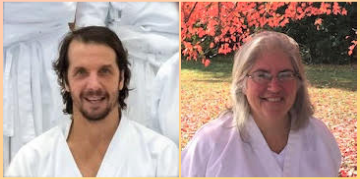
PanShin instructors Gianni Rossi (left) and Margaret Guay (right)
Derk opened Kangeiko with a poem. As a reflection on the theme, “Opening to Life,” he read this poem by Mary Oliver:
I DON’T WANT TO LIVE A SMALL LIFE
I don’t want to live a small life. Open your eyes, open your hands. I have just come from the berry fields, the sun kissing me with its golden mouth all the way (open your hands) and the wind winged clouds following along thinking perhaps I might feed them, but no I carry these heart-shapes only to you. Look how many how small but so sweet and maybe the last gift I will ever bring to anyone in this world of hope and risk, so do. Look at me. Open your life, open your hands.
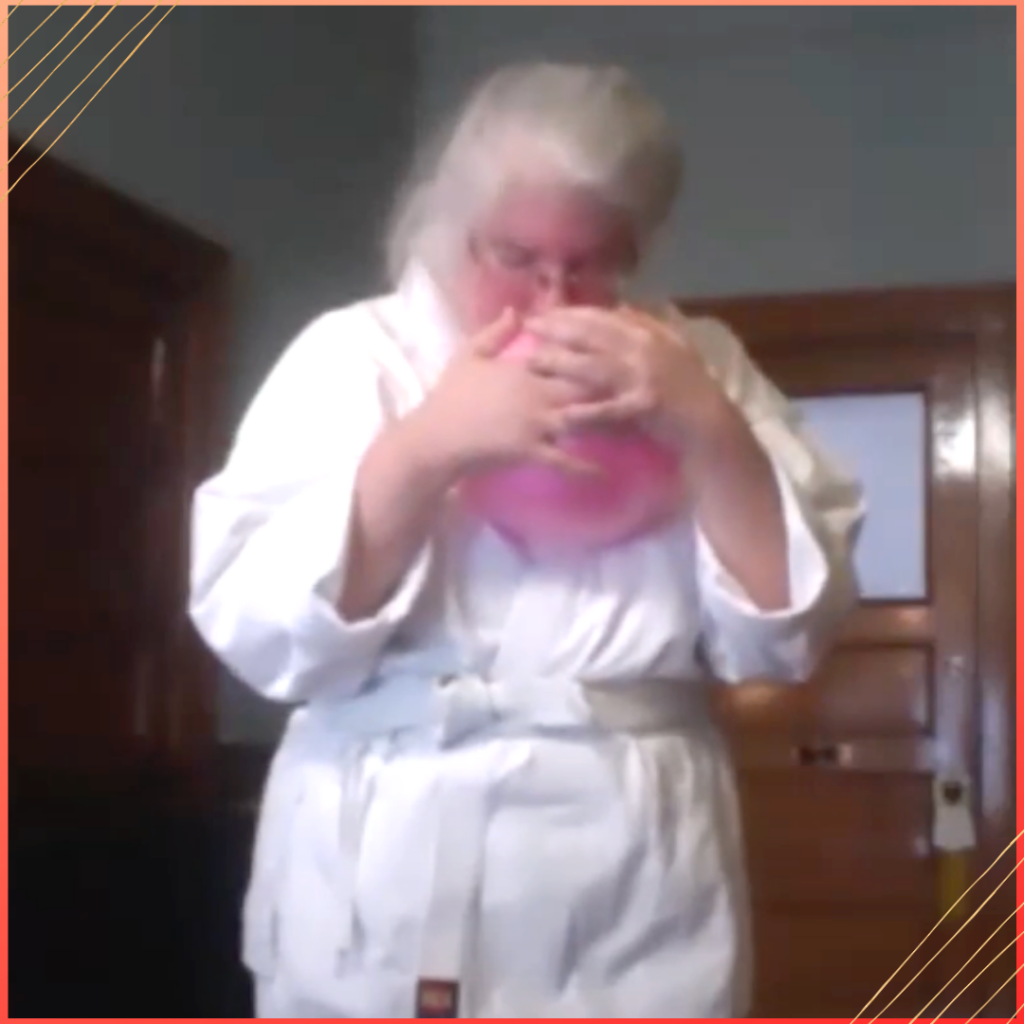
Gianni and Margaret co-taught all three keiko, leading us remotely from hundreds and thousands of miles away, yet with striking intimacy. In her teaching, Margaret combined her study of Body-Mind Centering with Shintaido, taking the idea of “opening” down to the cellular level of human development, and encouraging us to explore our body movements through all of our senses, especially while rolling on the floor! During the first keiko, she reminded us of the heart-mind connection as she demonstrated holding a ball in front of her chest, while resting her head on the ball.
During the second keiko, she led us through movements of the hand, directing our attention to how our fingers folded and unfolded, opened and closed, as we made fists, teaching about the evolution of our grip, and making the connection to how we do Tsuki. During the final keiko, Margaret had us reach through the windows of our computer, tablet, and phone screens and feel the connection with all the other Zoom participants.
Margaret Guay while teaching
Gianni taught both open-hand Shintaido and Bokuto, leading the first keiko’s extensive warmups with Bokuto. During the second keiko, he led in Eiko Dai, urging us to “go far, far, far” while running in place in our confined spaces, and he asked us to unmute ourselves so we could hear one another. The holding a “virtual” sword vertically, we reached out into the world and brought it back into our bodies, then we practiced with our actual swords. The keiko also included mochikai-e, receiving Tsuki with wakame, and more. During his closing keiko he encouraged to “fly” around our rooms with multi-directional cutting, and transported us back through time and space to a keiko he recalled with Master Instructor Masashi Minagawa in Italy, 12 or 15 years ago, taking us to the origins of Diamond Eight Cut. As Gianni “attacked” us with the various Diamond Eight cuts, we received on our side of our screens with wakame.
With Margaret leading, we finished with a meditative kata, originally shared by Michael Thompson, that brought together elements of Diamond Eight Cut and Ten-Point meditation, allowing us to settle into a deep contemplative space together through our bodies.
During the weekdays, four supplementary keiko were offered to all participants. Connie Borden taught two keiko focusing on Taimyo No Kata Part I and one keiko practicing Taimyo Part III. Bela Breslau’s keiko gave us the opportunity to deepen our study and exploration of Tenshingoso.
Opening the second weekend, Derk read the poem “The Guest House” by 13th-century Persian poet Mewlana-Jalaluddin-Rumi:
THE GUEST HOUSE
This being human is a guest house. Every morning a new arrival. A joy, a depression, a meanness, some momentary awareness comes As an unexpected visitor. Welcome and entertain them all! Even if they’re a crowd of sorrows, who violently sweep your house empty of its furniture, still treat each guest honorably. He may be clearing you out for some new delight. The dark thought, the shame, the malice, meet them at the door laughing, and invite them in. Be grateful for whoever comes, because each has been sent as a guide from beyond.
And as part of the closing ceremony for our weeklong study of “Opening to Life,” Derk read another poem by Mary Oliver:
DON’T HESITATE
If you suddenly and unexpectedly feel joy, don’t hesitate. Give in to it. There are plenty of lives and whole towns destroyed or about to be. We are not wise, and not very often kind. And much can never be redeemed. Still, life has some possibility left. Perhaps this is its way of fighting back, that sometimes something happens better than all the riches or power in the world. It could be anything, but very likely you notice it in the instant when love begins. Anyway, that’s often the case. Anyway, whatever it is, don’t be afraid of its plenty. Joy is not made to be a crumb.
At the conclusion of each keiko, after a short break, participants were invited to stay online and engage in Q&A sessions with the instructors and open-ended discussions as a group. Although remote practice in separate spaces may not be an ideal way to practice Shintaido, Kangeiko via Zoom allowed Shintaido folks to practice with people they may never have met or hadn’t seen in a long time, and to converse and share our impressions of our experience.
All three of the formal 2021 PacShin Kangeiko keiko can be accessed and watched on the Shintaido of America YouTube channel.
Calling all creative designers – SOA is launching a LOGO contest.
Why? Shintaido of America has a current logo of the “jumping man”. As part of our branding initiative, we want to consider creating additional logos. We invite you to be inspired by the theme “opening to life.”
Tell me more The SOA branding initiative is “Shintaido – Opening to Life”. Perhaps you might like to take the opportunity to create a design that expresses what “Opening to Life” means to you. We are considering having the winning design be adopted as the new SOA logo. However, there is no promise we will decide to use these logos. Designs will be published anonymously for the voting.
What is the timeline? January 23, 2021, was the ‘kickoff’ to our contest. SOA will close the contest on April 30th. The top three winners will be announced in June 2021.
How will it be judged? The community of Shintaido practitioners and supporters will be eligible to vote in Mid-May. The top three submissions will then be given to our panel of experts for a final selection and recommendation to the Board.
Our two experts are Mario Uribe and David Sirgany.
Mario has been an honorary member of the SOA Board for many years. He is a well-known artist whose work spans the worlds of both Western and Asian art.
The second member of the panel is David Sirgany. David is a long-time practitioner of Shintaido and has over 25 years of experience with therapeutic bodyworker and somatic educator. David is an Iyengar certified yoga instructor and has taught both nationally and internationally over the past 20 years. He is also an accomplished artist and photographer.
Learn more about Iyengar yoga here and look at David´s photography work here.
What are the criteria? 1) compatible with our SOA branding of “Opening to Life.” 2) eye-catching and recognizable 3) inspirational and artistic 4) a visual style that reflects a community of practitioners 5) additionally, a successful logo design would look good in both black and white and in color.
How do I submit my design or designs? Send your design(s) to SOA President Connie Borden at bordensheets@aol.com
This is a publication of British Shintaido. It was the first inaugural lecture, given by Peter Furtado in January 2021, about the Rakuntenkai group who developed Shintaido with Aoki Sensei in the 1960s, and the importance of their mission to the world today.
Peter is a long-time teacher and practitioner of Shintaido and a celebrated British historian. He traces the evolution of Shintaido over 60 years starting with its roots in Japan and eventual adoption in Europe and the United States. He incorporates in his talk many treasured videos and photographs from the Rakutenkai days.
After the lecture is over, Peter answers questions from the audience. I hope you enjoy it!
As I’m writing this, the Covid-19 virus is spreading rapidly in many parts of the world and there are a lot of restrictions on various kinds of public gatherings and meetings. There are limits on the number of people who can gather, even for outdoor exercise. Of course, this means people are spending a lot more time at home or alone. Here in the Czech Republic, there was a two-week ban on singing in music classes in elementary schools, high schools, and music conservatories, because using your voice — singing or yelling — can spread the virus.
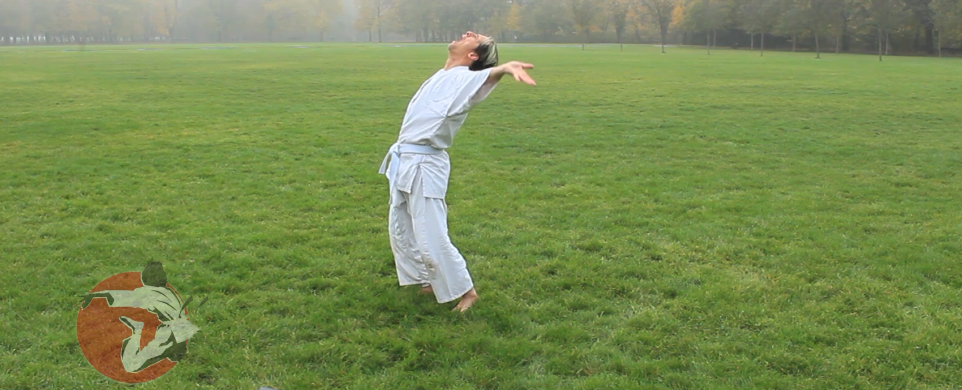
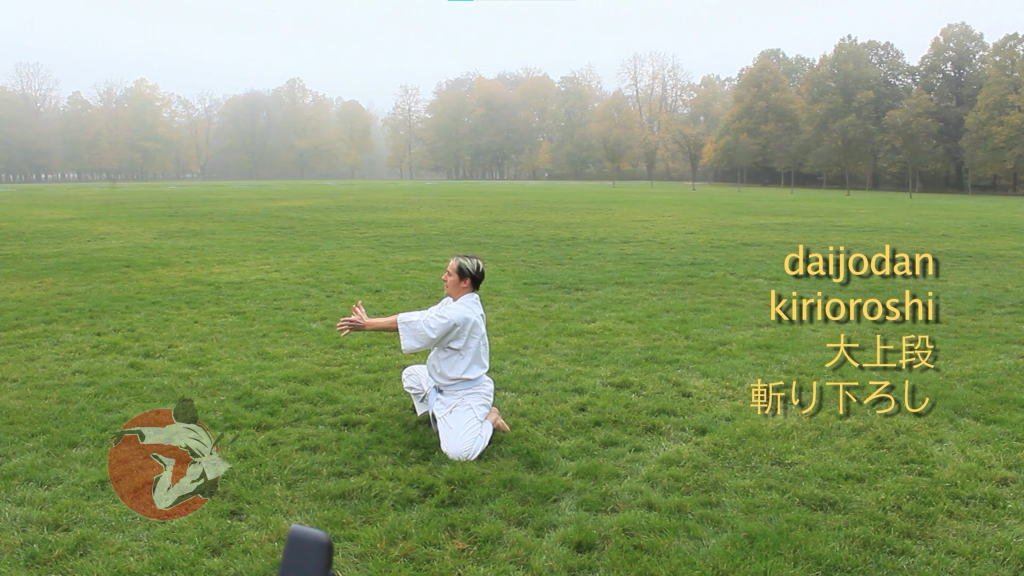
Considering that using an expansive voice is a component of two of the three fundamental techniques in Shintaido, and also feeling that this whole situation is making many people want to scream at the top of their lungs, I decided this would be a good time to encourage people to practice Eiko Dai — the signature Shintaido technique in which one runs far and yells loudly — safely. So, I made a video about doing Eiko outdoors alone, and also about how to do the miniaturized “bonsai” versions, Daijodan kirioroshi and Daijodan kirikomi musubidachi.
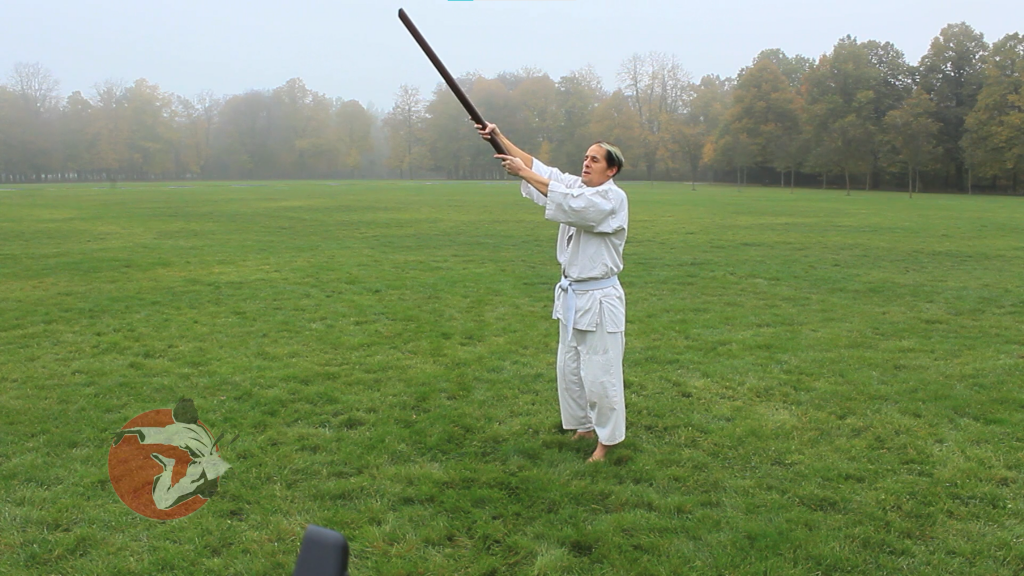
Also, the video includes an example of doing Eiko with the bokutoh, the unique type of wooden sword used in Shintaido. I show demonstrate how to grip the bokutoh properly and glance at the different shapes of the traditional katana (metal sword), the traditional bokken (wooden sword), and the unique Shintaido-style bokutoh.
General instructor David Franklin
A few years ago, I completed a master’s degree at Université Paris 8 St-Denis, where Pierre Quettier, a long-time Shintaido instructor, became my thesis advisor. The theme of my thesis was about types of knowledge that are usually only communicated face-to-face. What types of things can you only learn when you are physically in the same room with the teacher? What are the things that normally cannot be recorded by a video camera, and why?
These questions were incorporated into the process of making the video. One of the tricks I used, was that while making the video, I was also live-streaming the practice and had a few people participating. I had my phone (for the Internet streaming) and a video camera recording at the same time. Psychologically, this put me into a more familiar mental space. Rather than performing for the camera, I had to teach the class “in real time” for the people who were participating remotely. This made me speak and present the techniques in a more natural way, while still trying to be aware of the fact that I was communicating through the medium of the camera and the Internet.
But rather than posting the recording of the whole practice unedited, I then went to the studio and the editing console and made a more finished product. I added a few close-ups and different camera angles of technical details that I couldn’t shoot out in the field. I also “opened the curtain” and revealed myself in the role of video editor. Instead of the video editing process being a kind of hidden “magic,” I wanted to increase the audience’s awareness that the video they are watching has been crafted and designed to present the information to them in the best way possible.
General instructor David Franklin
Finally, I added subtitles — in English. Why would I add subtitles in English, when I’m speaking English in the video? I believe this could increase the online “reach” of the video. It’s called the “world wide web” because it is in fact world-wide, and that means it’s possible that people in many countries may see the video. My experience as an English teacher in the Czech Republic has shown me that many people can read English better than they can understand spoken English, and often people studying English enjoy watching videos in English with English subtitles so that they can learn pronunciation and improve their ability to understand spoken English. It’s a way to improve access for people who are not native English speakers, without actually translating the subtitles into a foreign language.
My hope is that people will not just enjoy the video, but that it will inspire them to get up early in the morning when there are not many people around and go out to a place where they can safely use their voices to the fullest extent. In my opinion, shouting at the sky is incredibly beneficial to both the body and the psyche, and it’s worth the effort.
Here’s the video:
https://youtu.be/PxYxJrooI4A
* Written, performed, shot, and edited by David Franklin. Featured book: “Shintaido: The Body is a Message of the Universe” by Hiroyuki Aoki, English trans. by H.F. Ito and Michael Thompson. Music: “Future Gladiator” by Kevin MacLeod (incompetech.com), licensed under Creative Commons: by attribution 3.0 http://creastivecommons.org/licenses/by/3.0/