In the Northeast, our coldest cold spell this winter came in February. It was down to zero where I live just north of NYC, and windy as well. In an otherwise mostly mild winter, it suddenly felt dangerous just to be outside. My chickens, who usually strut around happily in the open air all season, took refuge in their dog crate and did not want to come out. I was reminded that cold, very cold, and extremely cold are all quite different things.
So it was for Kangeiko weekend. I planned to join the gasshuku late, driving up to Massachusetts in time to make the second keiko, because I had business at home on Saturday morning. That morning I got voice mail from Mary Foran saying, “The dojo has no heat. We are in the basement with a space heater. Just letting you know in case you want to rethink coming all this way.” I texted back, “Unless you decide to give up and go home, I’d like to come. I want to see everybody.” Since Kangeiko means cold weather practice, and since we’ve done a lot of Kangeiko together for many years, I didn’t think there was much chance of disbanding because of cold weather, even extremely cold weather.
Sure enough, when I got to the Town Hall in Petersham, Massachusetts, I was greeted by friends in down vests and gloves, saying, “Wear whatever you want for this keiko as long as it’s warm.” They led down to the basement where, with the help of the space heater, the space was up above freezing, just barely. Bela Breslau had taught that morning, and had to start by discussing with the group what to do about the lack of heat. Unfortunately, a couple of people had needed to drop out because the cold wasn’t workable for them, including Michael Thompson who had been scheduled to give some of the instruction. The people who stayed had begun by huddling in a circle and sharing verbally some of what was going on in their lives. Then Bela led freehand sword cutting. Swords turned out not to work because the basement ceiling was too low.
For the second keiko, Matt Shorten led warmups and Stephen Billias taught. I found that the basement was really very cold! After a 3-hour drive, it was hard to feel that warmups had done much in the way of warming my body. But as we went through our usual keiko progression, bringing more vigor into our movement, the warmth started to come. We practiced more sword movements free hand: hasso and mugen. Finally, Stephen asked if we were willing to go upstairs into the dojo with no heat at all, so we could use our swords. We agreed, we went, and it was even colder! But – now we had bokutohs and boken. And Stephen had us working in pairs. There is something about the alertness that comes with kumitachi that warms my body, every time. It was especially noticeable once Stephen put us in groups of five, with four attacking one who stood in the center. The eyes, the brain, the blood, the arms and legs all went on high alert. Now it seemed good to me to be doing such a very cold weather practice, bringing life and warmth into the depths of winter.
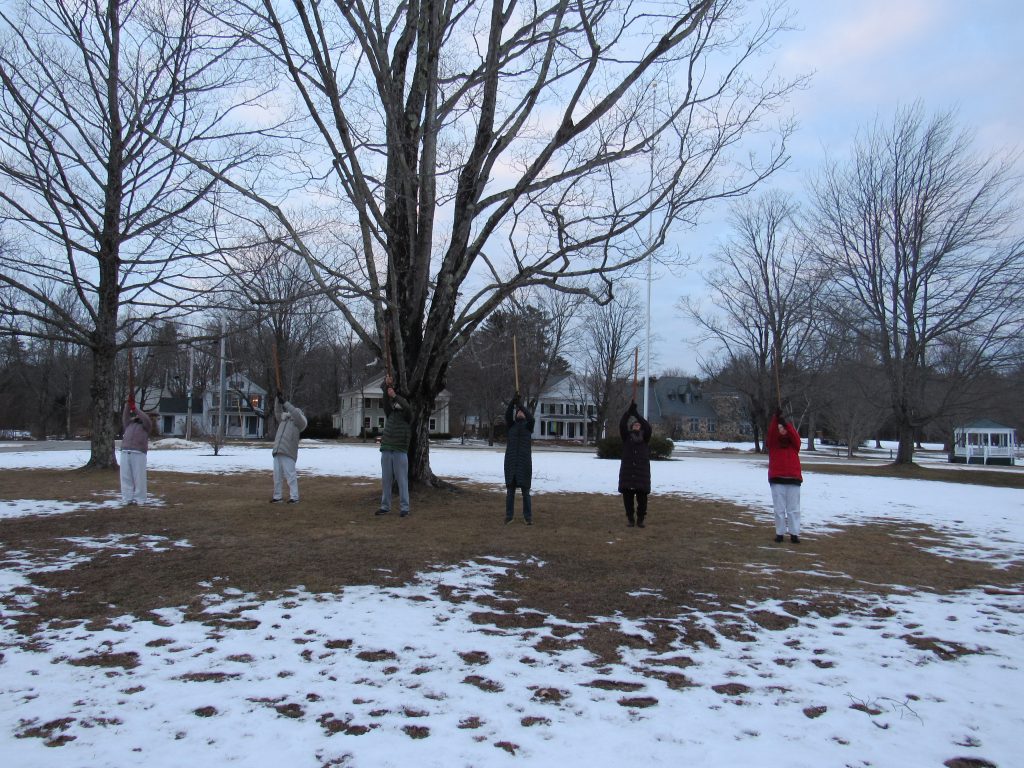
Stephen brought us outside for a final tenso-shoko. We stood in a patch of the village green and cut forward as the church bell struck five and the bell tower of the Town Hall turned orange in the setting sun.
Dinner was at Matt and Bonnie’s home, cozy, potluck, with a dog and a fire. Some of us stayed at Hartmann’s herb farm, a place we have been before, before the pandemic, before Joe Zawielski sensei’s passing. It was good to be back. As Margaret Guay- who was my roommate – said to me, “This feels important.” The importance was not in the content of the keikos so much as in the resumption of the gasshuku kata. It was important to eat together, to do more than one keiko and experience the physical/emotional/spiritual changes from one keiko to the next. It was good that at least some of us could be together under one roof.
On Sunday morning, Margaret led us in beautiful katas: diamond eight (free hand and then with sword) and finally Taimyo Part One. As we walked out of Town Hall after saying our goodbyes, guess what! It was up to forty degrees. The cold weather lasted just as long as the Kangeiko.
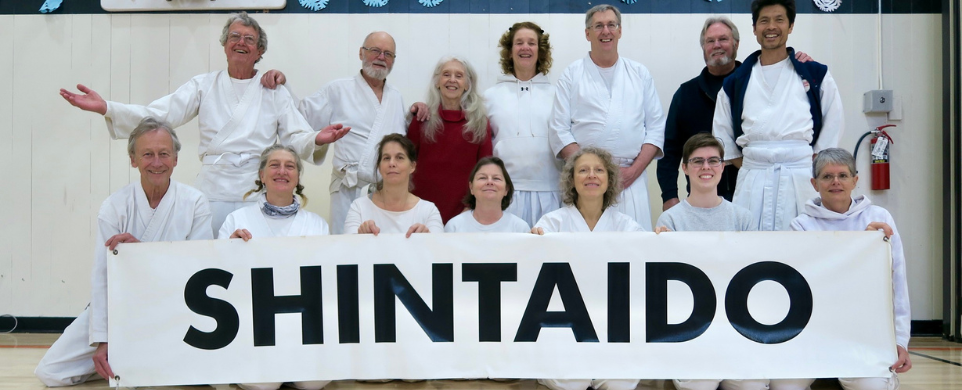
It had been three years since Pacific Shintaido was able to host its annual Kangeiko gathering in person. But, after two years of surprisingly successful virtual workshops, with participants from all over North America and Europe interacting via Zoom, Shintaido practitioners came together over the Martin Luther King Jr. holiday weekend to explore the theme Hei Ho: The Strategy of Fighting, the Strategy of Peace. On Saturday, January 14, and Sunday, January 15, four keikos were held in the gymnasium at Claremont Middle School in Oakland.
General Instructor Connie Borden and Senior Instructor Rob Gaston accepted the invitation by the Pacific Shintaido Board—Shin Aoki, Cheryl Williams, and Derk Richardson—to serve as guest instructors for Kangeiko 2023. Both hold Yondan ranking in kenjutsu, which was the general subject for the workshop. The specific theme, Hei Ho: The Strategy of Fighting, the Strategy of Peace, was inspired by a 2020 interview with Master Instructor Masashi Minagawa (published in Body Dialogue on November 6, 2022). In his opening ceremony remarks, Derk quoted Minagawa Sensei’s comments on Kangeiko (“we refresh our old selves and go back to the original beginner’s mind”), Kenjutsu (“The sword can be used as a tool or compass which can show us how to manage our lives, it can show us which direction to follow”), and the concept of Hei Ho. “The word Hei Ho 兵法 … means the Strategy of War. If Hei is written differently [using another Chinese character 平] it can also mean Strategy of Peace 平法.… Therefore, there are two ways of studying martial arts, the way of war and the way of peace.”
Before we began warmups, led by Director of Instruction Shin Aoki, Rob Sensei led us in an exercise to help set our intention for both Kangeiko and the coming year. He asked the ten attendees to offer up words that spontaneously came to mind when we thought about achieving peace in the world. Responses included “love,” “empathy,” “compassion,” “forgiveness,” “community,” “diversity,” and more. Rob Sensei urged us to fold those thoughts into our intention and hold that intention throughout the workshop.
After warmups, Connie Sensei led us in several sets of Reppaku, two linked movements in Taimyo kata. Drawing fists to hips, we opened palms and extended them forward while taking a right hangetsu step. Then, bringing feet together and the backs of our hands together at the chest, we reached up overhead, twisted our hands back, and cut forward and out while taking a left hangetsu step. Connie Sensei offered the images of emptying our pockets, lightening our loads, letting go of the burdens we carry, and spreading the seeds of intention, and then flying up and opening out to see the view before us. After a couple of repetitions, we were encouraged to find our own inspirations and images as we repeated the movements.
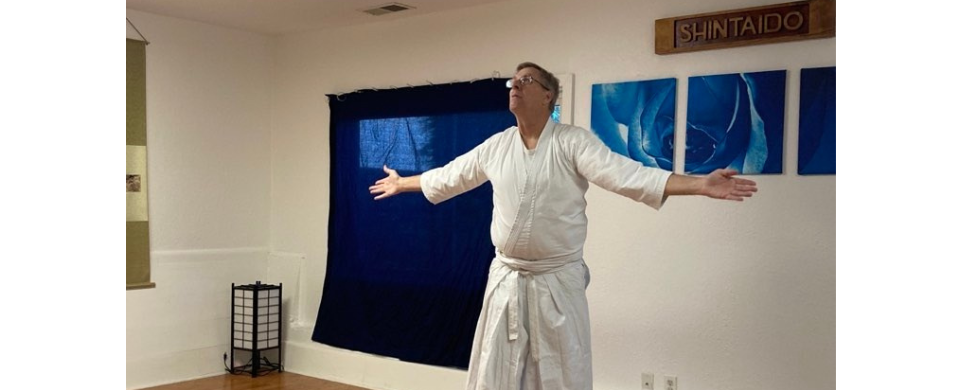
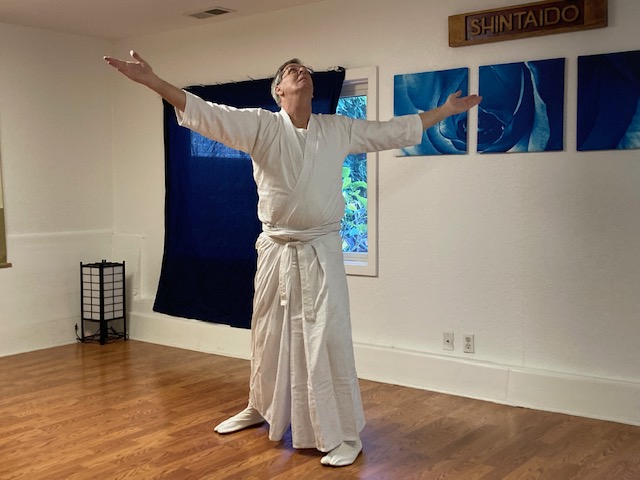
For the next hour, Rob Sensei led us in kiri-oroshi kumite, a partner cutting and opening technique, keeping in mind the goals of reconnecting and establishing a physical and spiritual conversation. Keiko one concluded with Rob Sensei leading us in Hoten Kokyu Ho, the gentle kata of embracing the great universe, bowing, embracing the tiniest universe, and rising up again. Those of us familiar with the poem Rob Sensei had written to correspond with the movements might have envisioned expanding our awareness from ourselves to others, to greater communities and cultures, to nature, the biosphere, and cycles of birth and death, and to the solar system, galaxies, and black holes, acknowledging that we are made of stardust and the universe is in us, and finally expanding our awareness to Ten and rising up to Ten Chi Jin.
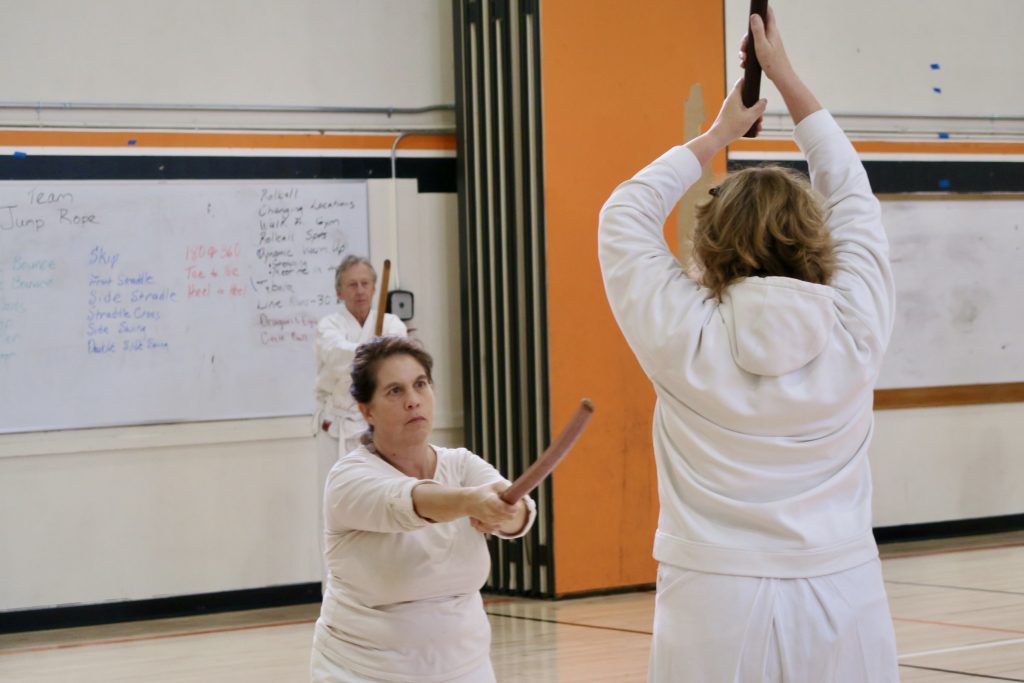
The next three keikos were dedicated almost entirely to kenjutsu, with participants using bokuto or, in some cases, bokken. Connie Sensei and Rob Sensei taught alternating segments of the curriculum they have developed together. On Saturday afternoon, after Sandra Bengtsson led warmups, Connie led us through stepping practice with bokuto—steps number one through four, plus irimukae, holding the bokuto in a vertical position close to the body and doing step number one, as if stepping into one’s sword. Rob Sensei guided us in sword-drawing techniques and in practicing the transitions between shoko and tenso. And Connie Sensei gave us instruction in bokuto kumite, dai jodan versus jodan, demonstrating with Rob Sensei and adding new partner pairings until all participants were doing the kumitachi. Keiko number two ended with 15 minutes of open-hand Tenshingoso kumite.
Keiko number three, on Sunday morning, began with Connie Sensei leading a freeform style of warmups with the aim of dissolving the roles of leader and follower, emphasizing listening, softening, releasing, and achieving fluid movement. Rob Sensei reviewed the previous afternoon’s kumitachi, which we practiced with different partners and many repetitions. Connie Sensei introduced one-hand Tenshingoso kumite, with one partner responding to the other’s four Tenshingoso movements, cultivating a tight, elastic “ma.” We did the same in two lines of partners facing each other, one side leading and the other responding, moving together in a chorale. In the end, practitioners in both lines did all four Tenshingoso movements, the lines flowing back and forth like ocean waves. Ten minutes of Wakame brought the keiko to a close.
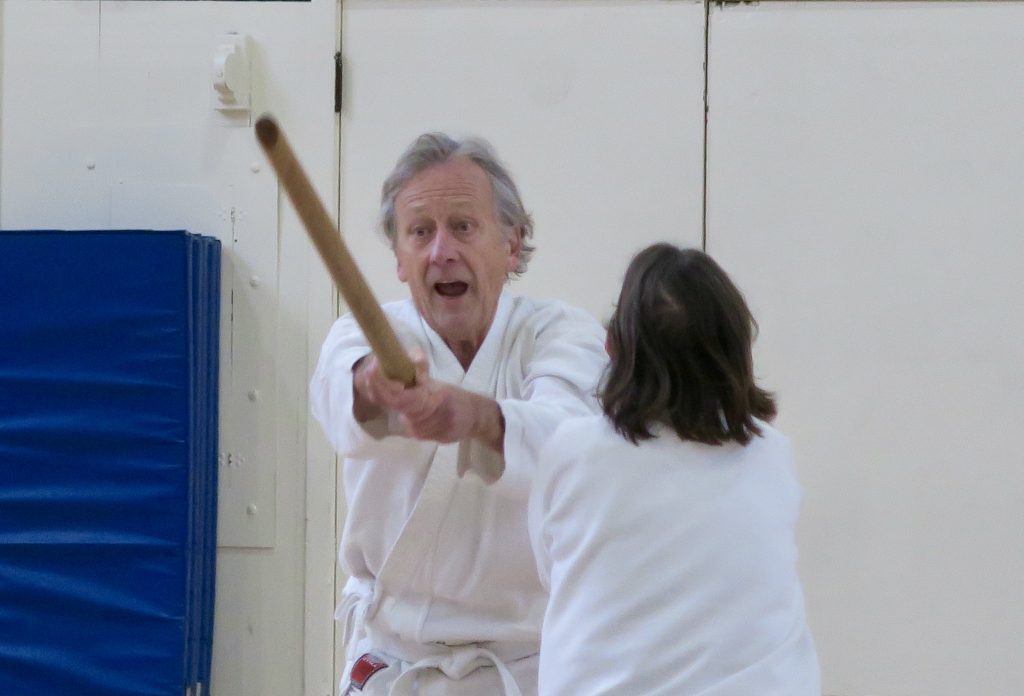
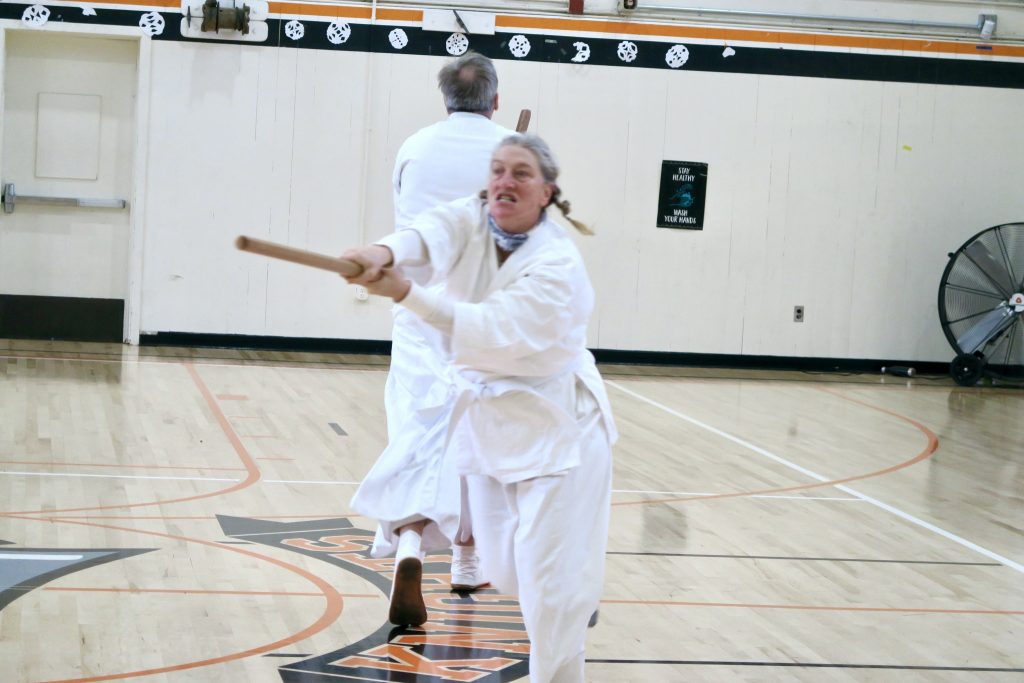
For the last of the four keikos, after Derk led 30 minutes of warmups, we continued with our kenjutsu practice. We divided into two groups. One person stood in the middle, sword raised in tenso. One by one, the others stepped forward quickly and cut the stationary person with jodan kiri komi. Each practitioner took a turn in the center. Our final sword practice was eiko dai kumite, dai jodan versus jodan kiri komi. It started with Connie Sensei and Rob Sensei. Then it became a rotation until everyone had participated. The last few pairings became more free-flowing and continuous. The keiko closed with Connie Sensei leading us in another movement from part one of Taimyo kata, Sai-Zan, “breaking through mountains.” She has reflected deeply on this movement’s relationship to the practice of death awareness, an analog to an army’s retreat, in focused concentration, without fear. But, as a coda to our Kangeiko curriculum, it felt more like an affirmation of life and of our collective intention to move forward with what we had learned.
Overall, the kenjutsu curriculum that Connie Sensei and Rob Sensei created for Pacific Shintaido’s Kangeiko 2023 was fairly basic—simple, foundational movements with a lot of repetition and opportunities to practice with different partners. For those practitioners with less kenjutsu experience, it provided an opportunity to develop muscle memory and inhabit the form. For more senior practitioners, it opened up the space to go deeper into their relationship with the sword—bokuto or bokken—and explore the meaning within. For all, there was an exhilarating suffusion of tenso feeling. We thank Connie Sensei and Rob Sensei, and participants from the greater Bay Area and from Florida, for making Kangeiko an expanded moment of self-refection and enhanced connection with our fellow Shintaido “beginner’s mind” practitioners, the human community, and the universe.
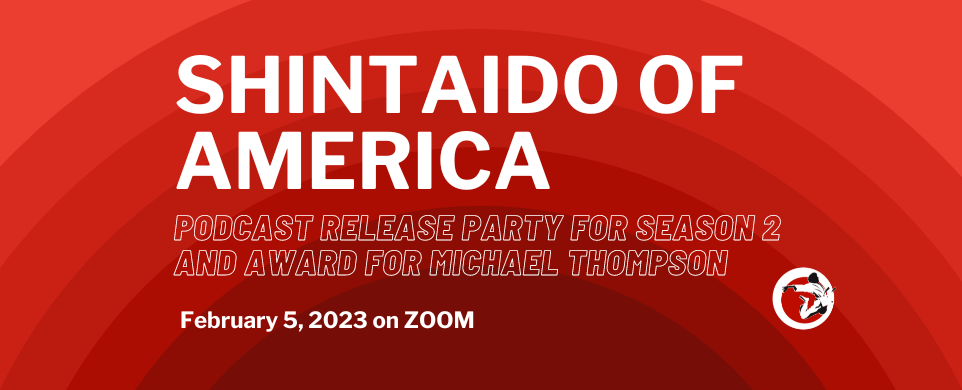
On February 5, 2023, we will launch season 2 of the Shintaido of America podcast. Because we enjoy Shintaido literature, we will be reading another book. In season 2 of the podcast, we would like to honor Master Instructor in residence and Shintaido of America co-founder Michael Thompsons by reading from his autobiography Untying Knots: The Shintaido Chronicle.
The book is the personal story of Michael Thompson. In a frank and reflective way, he tells of his youth in America and his breakthrough trip to France, where he first encountered Shintaido. The very title “Untying Knots” refers to the Buddhist practice of non-attachment.
It suggests that together with Michael, we will embark on a journey of understanding and acceptance of self and the transformation Michael has experienced through Shintaido.
Lifetime achievement award for Michael Thompson Michael was first introduced to Shintaido in 1971 in France where he met Aoki sensei in person. Michael eventually traveled to Japan and studied Shintaido with the Rakutenkai group for two years.
In 1976, Michael co-founded the Shintaido of America organization which he lead for four years. In 2004, he became the first non-Japanese Shintaido Master Instructor. In 1996, Michael wrote an autobiographical book, Untying Knots: The Shintaido Chronicle, in which he reflected on his 25 years of international Shintaido experience.
This year, Michael turns 85 and we would like to recognize his work with a lifetime achievement award. We will honor Michael at the start of the launch party, to which we have invited many of his students who are now Shintaido instructors including Bill Burtis, Stephen Billias, Gianni Rossi and many others.
The program of the launch party 🔴 start at 11AM West Coast / 2PM East Coast / 7PM UK / 8PM Europe 🔴 honoring Michael Thompson with a lifetime achievement award 🔴 inviting Michael´s students to reflect on his impact 🔴 introducing season 2 of the Shintaido of America podcast 🔴 toast
How to participate On February 5, 2023, we will meet online via ZOOM and we would be delighted if you decide to connect and celebrate with us. Join the ZOOM call via this link or write us at president@shintaido.org.
Follow the release party event on Facebook We will publish all the news and details on the Facebook event of the release party. Click on “Interested” or “Going” to let us know you are coming! There, we will introduce our party guests in more detail, talk about the book and other news.
Listen to season 2 of the Shintaido of America podcast Season 2 of the podcast is dedicated to the book Untying knots: The Shintaido Chronicle by Michael Thompson read by Shintaido General Instructor David Franklin. Each episode will be followed by an interview. David will talk about Shintaido-related topics with various people who are familiar with our practice.
On February 6, you will find the first episode of season 2 of the Shintaido of America podcast on most of the usual podcast applications.
Support us Shintaido of America produces this podcast and many educational materials such as articles, videos, practice meetings and others on a shoestring budget. Even a small donation will help us continue.
You can help us by telling your friends about us.
You can also subscribe to our e-mail newsletter.
You will receive 2 e-mails per month with detailed information about what we are working on, invitations to workshops and much other interesting news. By following Shintaido of America on Facebook, Instagram and YouTube you can be sure to always receive the freshest news about our projects.
Buy the book If you wish to expand your collection of Shintaido books in your library, you can buy Michael´s book in our store. There, you will find other Shintaido publications such as textbooks, anthologies, and booklets.
I wrote a recent article on grief, death and loss; I now have some reflections on the benefit of practicing Taimyo Part I — specifically the movement 碎山/Sai-Zan “breaking through mountains”— using kokyu in relation to the individual practice of death awareness. As a forewarning, the subject is awareness of one’s mortality, so you may wish to pick the best time to read and reflect on this topic.
What can be practiced with Sai-Zan within Taimyo? This was a focus of study at the Quebec Gasshuku in September 2022: we step back while doing a tsuki forward, we step back a second time, while keeping our concentration, then we step back a third time bringing our fists to the center of our chest/heart and then tsuki forward to finish with our arms open wide. The analogous military strategy is when the leader retreats with their troops while keeping concentration, keeping troops from fleeing in fear, and making sure no one is left behind.
Sai-Zan and its application to living life was the focus of a dinner discussion in Quebec. I asked the group, “Can you name other (non-military) heroic efforts threatened by almost certain demise?” Here are some of the ones I thought about: the doctors and nurses in New Orleans during Hurricane Katrina in the stranded nursing home with its frail residents; neighbors like Ko Ueda taking food to isolated neighbors during the COVID pandemic; Mike Sheets taking sandbags in wheelbarrows up our street to prevent garages from flooding, when a large water main broke and sent rivers of brown sludge down our street. Can you think of examples?
I have been reading and reflecting on how our mind resists awareness of our mortality. Fears and regrets are often reasons to avoid this subject. What do most of us really wish for? One desire is to build an ideal world, to live fully, so we may not want to ask ourselves “What if?”
And what about our daily life awareness? I was fortunate to experience 20 years of working in hospice and palliative care, experiencing death and dying up close. I was aware of my mortality and the ever-present reminders of the shortness of life that made me stay awake and stay aware.
I see a practice for death awareness, so I explored doing the three movements of Sai-Zan, while incorporating what Thich Nhat Hanh wrote in his book, The Blooming of a Lotus:
Knowing I will get old, I breathe in, Knowing I can’t escape old age, I breathe out. Knowing I will get sick, I breathe in. Knowing I can’t escape, I breathe out. Knowing I will die, I breathe in. Knowing I can’t escape death, I breathe out.
>>>>>
Determined to live my days deeply in mindfulness, I breathe in. Seeing the joy and benefit of living mindfully, I breathe out.
I brought this practice to a local hospice during an open mic session on death and dying on November 3rd. Comments included “visceral,” “cathartic,” and “a way to process grief.” For Shintaido and students of body movement, there is focused work with the breath – kokyu – breathing in through the nose; breathing into the belly and slowly releasing. We can practice Sai-Zan with a focus on our breath while stepping backward and reaching forward with our arms/fists.
This is an unfinished essay – how might you finish it? How do you develop awareness of mortality? What parts do you resist or how do you avoid daily practice? What are your deepest fears? What are your greatest joys?
Watch the Reflection on Sai-Zan on Shintaido of America YouTube channel.
*Many ask me “What’s next Connie?”- hence my moniker: Next Steps Connie.
Phillipe Beauvois has been a student and teacher of Shintaido for 45 years along with Taichi and Shin-Anma Shiatsu. He participated in the First International Shintaido Gasshuku in 1980 and studied with Robert Breant. In 1985 he started teaching Shintaido on the French Riviera in Grasse. Phillipe, who has been diagnosed with terminal head and neck cancer, reflects on his learnings and his wishes for future students.
Consider visiting Phillipe´s website (in French, can be translated into English in a browser).
About the author Many of you may have been fortunate to have had a chance to do keiko with Robert Gaston. He is a Senior Instructor of Shintaido and has practiced and studied for almost 40 years. He is a member of the International Technical Exam Committee (ITEC).
Rob initially studied Shintaido with John Seaman while he was at college in Oregon. When he left school, he joined the U.S. Navy and was stationed on the USS Enterprise aircraft carrier. He made part of this giant ship his dojo where he taught Shintaido to his colleagues.
He currently lives in the San Francisco Bay Area with his wife Sandra and daughter Sally both of whom practice Shintaido.
Rob teaches two classes a week; one Bojutsu and one Shintaido via Zoom. Please enjoy his movement and poetry.
This poem came to me at the end of a Zoom Master style class for the Global Taimyo Community taught by Clélie Dudon with Ito-sensei giving feedback.
She taught Taimyo part 3. Ito-sensei gave feedback to us all that focused on the Hoten-kyoku-ho. He expressed two important points, first focus on extending our reach in the bow, like a starfish encompassing and surrounding a sea urchin and second to feel ourselves being inflated from the outside, like the hairs on our entire body are being gently pulled.
I am not sure when I first learned the basic sequence of Hoten-kyoku-ho. It was probably at a Pacific Shintaido meditation workshop in the early to mid 90s.
Initially, it was a healthy body movement that helped ease my sore back after a lot of kaihokei Keiko. But when it was included in the Taimyo sequence and the subsequent Pacific Shintaido’s Taimyo workshop, it became one of the movements I began to feel connected, to others, to nature, to the universe, to something more.
It has had, like other Shintaido movements (i.e ,kirioroshi kumite) a multi-layer effect on my consciousness, peeling or cutting through levels of awareness. The effects and my awareness of Hoten-kyoku-ho have been gradual over many years and I have expressed my most recent “ah-ha” in this poem.
Thank you and please enjoy.
Hoten Kokyu Ho (“Hugging Heaven”)
I bow and embrace, thank and acknowledge myself, body, present situation. Turning to the right, I feel myself invited to expand my awareness to others my family, friends, coworkers, those I struggle with.
I turn and face forward, changing my view point to face life directly. I bow and embrace, thank and acknowledge them. Turning to the left, I feel myself invited to expand my awareness to a greater community the struggles we have with other viewpoints and cultures.
I turn and face forward appreciating the beauty and strength in diversity. I bow and embrace, thank and acknowledge humanity. Turning to the right, I feel myself invited to expand my awareness to Nature, ecosystems, the biosphere, the earth, the struggle of survival, the cycles of life and death of all beings.
I turn and face forward changing my view point, Nature and I are inherently interlinked. I bow and embrace, thank and acknowledge connection to nature. I turn to the left. I feel myself invited to expand my awareness to the solar system, the sun, the planets and all their moons, the space between and their cycles.
I turn and face forward changing my view point, I am affected by their cycles their pull and tug keeping my world safe for life. I bow and embrace, thank and acknowledge our solar system.
I turn to the right, I feel myself invited to expand my awareness to the Milky Way and all galaxies. The star nurseries, nebulae, supernova and black holes.
I turn and face forward changing my view point, I am made of stardust and all that is in the universe is in me. I bow and embrace, thank and acknowledge the cosmos.
I turn to the left and I feel myself invited to expand my awareness to Ten. I turn and face forward changing my view point, I am always in Ten and Ten is in me. I bow and embrace, thank and acknowledge. I rise up to Ten Chi Jin posture.