
by Tomi Nagai-Rothe
This article was written as part of the Asian-American Restorative Justice Network’s reflections document, following two years of funded gatherings by the Asian Law Caucus.

As a longtime practitioner and teacher of Shintaido, I have been interested in martial arts applications to interpersonal conflict. My teacher used the term “software” to describe applications outside the dojo (practice space), in contrast to the “hardware” of traditional martial arts practice. In 2023 and 2024, I piloted this approach through a series of five-day workshops focused on embodied martial arts and creative conflict transformation.
About Shintaido
Shintaido’s lineage is through Master Shigeru Egami – founder of Shotokai Karate – who was a disciple of Master Gichin Funakoshi – the founder of Shotokan Karate and considered to be the father of modern karate. Karate’s roots are in Chinese Shaolin martial arts, with roots in Buddhist philosophy which originated in India and migrated to China, Korea and Japan.
Master Hiroyuki Aoki, the founder of Shintaido and a disciple of Master Egami, started out as an actor and found the martial arts to be his creative medium. His study of Buddhism, Christianity, Taoism, Hinduism, and improvisational music and art brought together past and present through Asian traditions and other influences.
Partner Practice (Kumite, Japanese for “intertwining hands”)
Martial arts often use a partner practice form: one-on-one sessions as short as 5 minutes but often longer, kumite is the physical analogue to an interpersonal relationship.
Boundaries
Kumite has a clearly defined beginning and end. Bowing in, we respect our partner and the spirit they bring. Bowing out, we thank our partner and acknowledge the end of our short practice relationship. The following values and guidelines create further structure to the interaction and relationship.
Values & Guidelines
-
-
- We respect one another
- We are in this together (for a defined period)
- We have a responsibility to one another (we will keep each other physically safe)
- We are building a creative container together
- My end goal is to uplift my partner
- Our working relationship has boundaries (a clear and mutually understood beginning and end)
- My partner can teach me more about myself
- Other people are holding the larger space around us
-
How Does Kumite Teach Us About Moving Through Conflict?
Practiced over time, kumite creates a profound somatic dialogue through a structured interaction, bypassing the limitations of words and language. The resulting relationship can provide a somatically grounded and trusting connection encompassing mind-body-spirit. This relational foundation can help withstand the turbulence of interpersonal conflict.

Somatic Attunement to Ourselves and Others
Somatic observation as self-reflection: Because our bodies carry information we may not be aware of, noticing how we stand and move can provide insight into our state of mind-body-spirit. For example, with the help of an attentive partner or teacher, we may find out that our energy is on our back foot – holding back – even if we are not conscious of it. This provides opportunities to reflect on what may be causing the holding.
Our experience of movement is different with each partner, because even though the basic movements are prescribed, each person brings their own body type, personality, energy, and perspective to the interaction. This calls us to be somatic listeners – attentive to the nuance of movement and energy – not simply words. This can be very helpful when the participants have different first languages.
Ultimately, this helps us see that we are more than verbal communicators: talk is only one tool to help us address conflict.
Resilience: Transforming Turbulence
In Shintaido, the physically and mentally challenging aspects of kumite offer insights for working through conflict. Our Wakame (seaweed) practice is calming and meditative, and can be practiced individually, but most often with a partner – and occasionally in a group.

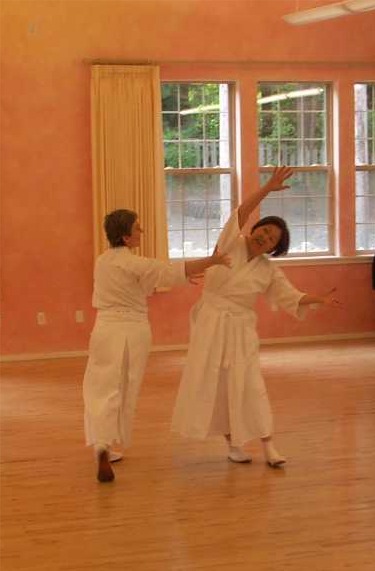
One person is the seaweed, rooted in the ocean floor, and one person is the ocean current. The ocean current leads the seaweed in movement. The partners work to come into a deep harmony with one another by taking turns as the seaweed and the ocean, creating a rhythmic movement until they find a shared meditative space.

This moving partner meditation practice comes from a high-speed running karate kumite in which one person runs at their partner full force. The desired outcome is to uplift and make one’s partner brighter – not to stop or defeat them.
This “attack” is a pure and sincere effort to connect to the core of one’s partner: to wake them up and dislodge whatever energy they may not need. It’s an explosion of compassion. The depth and sincerity of the attack creates the opportunity for transformation.


The kumite begins with running and fast flowing movement led by the receiver. They move the attacker to the side, roll or move them in flows using friction to deepen the connection. The attacking partner keeps reaching out because the receiving partner keeps inviting them in, creating space for them to keep moving toward them.
Then a strong karate block creates friction, changes the pace, and builds a stronger connection. Slowly the partners’ energies align, their movements slow as they tire. The receiver invites the now tired attacker into the flowing movement that leads to wakame. By the end, they are one flow of movement, one breath with shared perspectives.
When I teach, I demonstrate the roots of the wakame practice to show that turbulence and friction are key elements in the process that leads to creating connected relationships. A valuable lesson in staying with a conflict even when things get difficult.
Awareness of Time and Space
Timing: In the martial arts, timing is everything. Slow timing results in more physical conflict.
Quick (anticipatory) timing creates space for movement and transformation. This provides many opportunities to reflect on relationships outside the movement practice at the individual and group level.
Movement activity groupings: The exercises are organized into individual, 1:1/partner, and group, nested within one another. As individuals and partners we live within a larger community. In Shintaido, the corollary is group practice in which there are multiple and shifting partners, and sometimes group movement in a dance-like form. Group practice strengthens the values and guidelines listed above to create a trust substrate over time. These can be organized into pre-conflict, conflict and post-conflict phases.

Where we position ourselves in relationship to others in life is modeled in how we work in the dojo. This physical modeling provides a tool for exploring and being curious about how we stand in relation to those around us.
Final Thoughts
Just as Restorative Justice is a living practice, martial arts-derived movement is a practice. It need not be complicated: the structure of a few key activities and the values they embody can become a shared language of relationship – something to lean on when words fail to create the connection we need.
Thank you Tomi for providing a means to integrate our Shintaido Practice into our daily lives.
Beautifully written and wonderful photos. Thank you Tomi.
Beautiful Tomi.
Excellent application…
Great!! Staying in contact/conflict finally leads to softer connection (understanding) – transformation!
Thank You Tomi!
Anukampa