by Jean Marc Otto Bruc
These words reflect the rich sharing of The Global Taimyo Community (GTC) members during our second worldwide gathering for the year 2026. We had our main gathering on Sunday the 20th of September. Following the Spring gathering that took place Sunday 26 of April, it has been a total of four weeks of practices focused on Taimyo Kata. The theme, chosen by Connie Borden – Trust in Mind – is inspired by a poem from Sengcan, third Ch’an patriarch:
“The great way is not difficult for those who have no preferences. When love and hate are both absent everything becomes clear and undisguised…the way is perfect like vast space.”
This year, like the previous one, different peoples from around the world offered practices related to Taimyo Kata the week before and the week following the main gathering on Sunday that included Taimyo Kata practice and small and big group discussions. This format has been quite appreciated by the participants, as it offers the possibility of practicing daily for two weeks with leaders from different countries, each of them reflecting a personal appreciation of Taimyo Kata or related thoughts or practices. This made it rich with insights, sharing, and creation – while deepening the connections among the participants.
Robert Gaston, from California, USA, offered a practice of the Sunrise-Sunset Kata. This is a fusion kata of Shintaido and Tai Chi developed by H.F. Ito Sensei. Many of us have seen it evolving through different versions as Ito Sensei was refining it. Robert ended the kata and linked it seamlessly with Taimyo Kata.
Mark Smith and Marianne Van der Tas animated four early morning practices, UK time, with a collegial leading of the three parts of Taimyo Kata each led by a different person, taking a turn. This is a regular practice that they have on scheduled days throughout the year. Laurent Lacroix, in the UK, led the three parts of Taimyo Kata on two sessions for the Night Owls, a group that practices regularly through Zoom at 9 pm, UK time.
Ula Chambers, in the UK also led parts of Taimyo Kata on chairs for two sessions and introduced in the first session a remarkably interesting and new” image-based” kumite where people were to receive Taimyo Kata Part 1 from an imaginary partner. The practice on chairs was also interesting and reminiscent of the work of Ito Sensei, who had introduced seated practice, such as Tenshingoso seated on a chair.
Fabrice Buonanno, from France, led a practice with relaxation through breathing and then movements and visualizations of flow of energy, circulating around the body, using the image of a lotus flower opening to conclude the exercise and then ending with a practice of the Ten Positions of standing meditation. He also expressed the fact that those sessions give him a sense of a great connection with the peoples attending.
Nicole Beauvois, also in France, spoke about the importance of breathing for calming, she spoke of being in the ocean with fish and letting everything be as it is. She expressed her wishes for us to let go of anxiety. David Palmer, in the US, spoke about the benefits of Taimyo with the slowness allowing the awareness of stiffness and of which muscles are engaging. He said that he is rehabilitating his right shoulder for about the 50th time, so those ten days give him the opportunity for a rehabilitation program.
Like Robert, I shared a practice of Sunrise Sunset Kata from our open-air dojo in Nice, France. I really appreciate that kata and I practice it usually first in the morning when I do my personal practice. Participants expressed appreciation for it and asked for additional resources. This highlights that these weeks are a great opportunity to share, discover, and enrich our mutual practices.
Tomi Nagai-Rothe, from California, US, started with breathing and relaxing, eye “yoga” movements followed by face, jaw, and neck massage. Her focus was to calm the vagus nerve, a key part of our parasympathetic nervous system that regulates essential involuntary functions like heart rate, breathing, and digestion. We then went into small room discussions about the effects of that the sharing of Taimyo (or other parts of our lives) can have beyond our relatives, friends, or work circles. We then practiced Taimyo Kata Part 1 trying to embody those ideas and concluded with a large group sharing.
On Tomi’s second session, the discussion was centered on offering an object or material that represented what we cherish most about Taimyo Kata. I offered a bowl of soup and received raindrops of water. Other offerings were a broken tea pot repaired with gold, a Japanese mending technique called Kintsukoroi (also known as Kintsugi) which, instead of hiding cracks highlights the breaks, making the piece unique and more valuable. Other offerings were a ball of warm clay that could be shaped in various forms as well as a ball of energy.
Nagako Cooper offered two Taimyo sessions, which took place from 10:30 to 11:15 on Friday mornings UK time. This Zoom Shintaido class has actually been offered weekly since Spring 2020, so it also provided a wonderful opportunity for regular class members and GTC members from around the world to meet and share the practice together. Each morning, they started with Tenshin Juso-Ho as a warm-up, including the ‘Sunrise, Sunset’ movements. Then they took a moment to connect with all the Taimyo practitioners around the world. On the first Friday, Nagako invited everyone to choose a particular place, person, or group of people to whom they might want to send the healing energy of Taimyo.
On the second Friday, this group imagined holding hands and forming a circle around the Earth. They took three deep breaths together, connecting with the rhythms of the Earth and with each other. Then they offered their Taimyo to our Mother Earth and to all beings who dwell upon this beautiful planet. They ended each session with a closing circle, expressing gratitude to each other for the shared practice and to the nature surrounding us. Nagako ended with a Mokuso.
Jane Yung, who has been a Shintaido student since the mid 1970’s and who has studied calligraphy from the late Kawahatsu Sensei, shared about her learning of Mu and shared what the elements in the kanji Mu represent. Lee Seaman shared the calligraphy of Mu:

Mu can translate as Nothing, Not, or Nothingness. Pure awareness, as existing prior to the experience of knowledge, is a meaning used by the Ch’an school of Buddhism which can summarize in one word the theme proposed this year.
Sunday the 20th of September, for the main gathering, it was with pleasure and emotion that we practiced the third part of Taimyo Kata with the leading of H.F. Ito Sensei through a 2021 French video. Robert Gaston stated:
“This is a practice that carries beyond our life – and continues. Ito has passed beyond the Bardoes, to Heaven, Nirvana or someplace else. This is just a reminder that he is still with us, as we see him on screen today.”

After Connie shared a few words from the poem “The Great Way” two reflection questions were given for the small group discussions: How do you approach living neither entangled in the outer world, nor caught up in inner feelings? And how did practicing with Ito Sensei today bring you closer to understanding this? We had two sessions of discussion in two-person groups, allowing us to exchange and elaborate our thoughts on those questions.
We then studied the last mantra concluding the Heart Sutra with Doshu Masashi Minagawa. Minagawa Sensei started by explaining that the Heart Sutra is the most popular text in Buddhism, related to the notion of emptiness and the illusion of the reality of things, teaching that all phenomena are empty of inherent existence. He explained that Aoki Sensei considered that the Heart Sutra world and Tenshingoso world are the same. This ending mantra is said to contain the essence of the sutra:
Gate Gate
Paragate
Parasamgate
Bodhi svaha
that translates to:
Gone, gone, gone beyond, gone completely beyond. Awakening!
But Minagawa Sensei also pointed out that in the Dalai Lama’s tradition the translation is:
Go, go, go beyond, go completely beyond. Awakening!
Which is of course very reminiscent of Eiko Dai for Shintaido practitioners, and the phrase “Go, go young people, go beyond!” of the Rakutenkai days.
Minagawa Sensei commented on the universal energy in the vibration of the mantra. He then instructed us on the movement associated with the different words of the mudra and we practiced it together, with a variation of pace and a feeling of getting deeper and deeper.

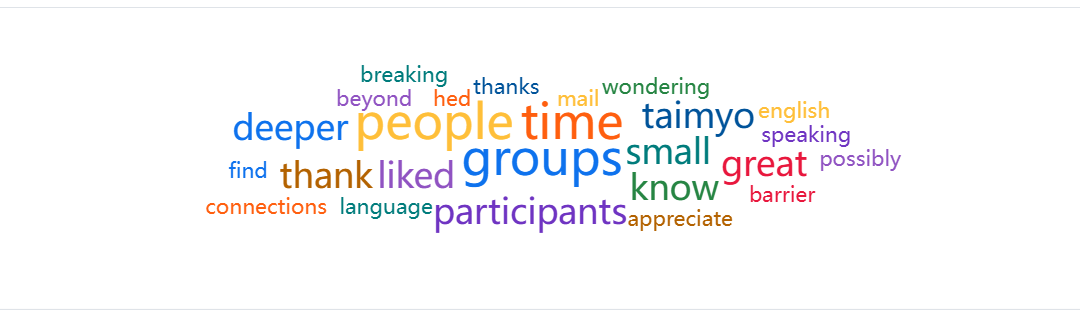
We concluded the session with one large group discussion. Everyone could listen to what each individual wanted to express about their impressions, feelings and insights after the practices and small group discussions, leaving silent time in between each comment. Our words appear in the ‘word cloud’ shown at the top of this article.
0 Comments