2018, All Years, Body Dialogue Newsletter, News
Carole Brouillette wrote with the sad news that Anne-Marie Grandtner passed away on December 18, 2018.
Anne-Marie lived in Montreal, Canada. She often attended Shintaido North East events.
At home in Montreal she taught Shintaido classes and in 2015 arranged for Shintaido to be included in a chorale performance in the Chapelle Notre-Dame du Sacre Coeur in Montreal.
You can see more photos of Anne-Marie from that 2015 event online.
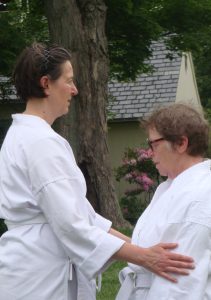
Anne-Marie and Barbara Barnard
2018, All Years, Body Dialogue Newsletter
31 October to 4 November 2018
By Connie Borden and Shin Aoki
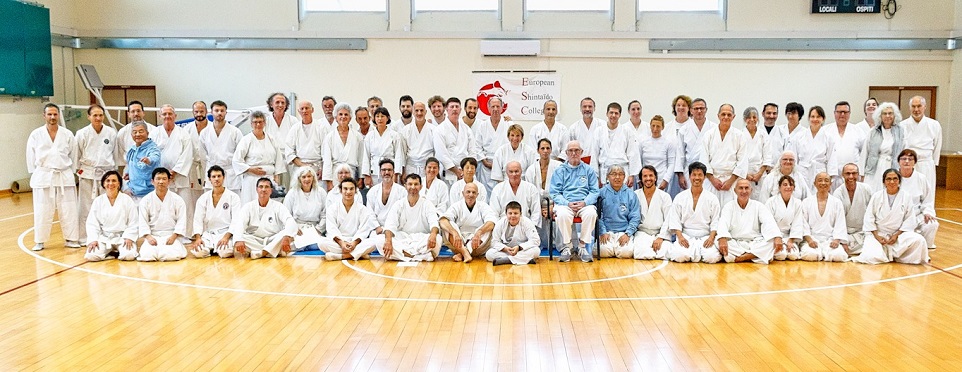
For five days, sixty Shintaido Practitioners practiced in Tirrenia, in the Italian region of Tuscany. From pasta to wine, from early morning meditation to late evening meetings, the group was united in the theme Toitsu Tai. Organizers Davide, Patrizio and Gianni had the vision of each keiko trying to reach the core of Shintaido. They asked the teachers of the subjects of karate, bojutsu, kenjutsu, meditation and open hand Shintaido to show these disciplines as expressions of the same spirit from the deep heart of Shintaido. As Mike Sheets said: “The instructors had us work very hard to find the center of both yourself and your partner. The other reminder was not about pieces of Shintaido but the whole – how they are connected.”
Master Instructor Masashi Minagawa spoke of the theme Toitsu Tai – Unification. Here are his words:
“We (Gianni and I) agreed that when you let go of unnecessary things, only the character ichi- one -Oneness is left. . . .

Ichi – One
For me, this one line contains everything. It is the ‘Line of Life’, the starting line, the goal line, the beginning and the end. It is my Golden Line, The Diamond Eight, One swing of the sword and “Ichi no Tachi” – the first movement of Jissen Kumitachi.”
The advanced group spent the first three keiko studying with Ito Sensei. Chuden no Kata and Okuden no Kata in the kenjutsu program were practiced. In addition, the group selected a few of the advanced Jissen Kumitachi to focus their study.
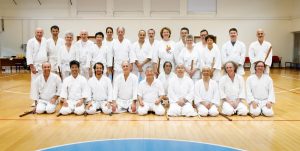
Advanced workshop group
Minagawa Sensei lead the next three advanced keiko to focus on Jissen Kumitachi #1 to 11. Each morning started with an hour of collegial practice to review the teaching from the day before. Each evening concluded with meetings: the Kenjutsu Task Force, the European Technical Committee, and the general membership meeting of the European Shintaido College.
The last night was a party that included Ula leading ice-breaker activities and Shin teaching line dancing!
High level exams were offered Friday afternoon on 3 November. Congratulations to
- Shigeru Watanabe – San Dan Karate
- Daisuke Uchida – San Dan Bojutsu
- David Eve, Alex Hooper, Georg Muller, Marc Plantec, Daisuke Uchida and Shigeru Watanabe – Ni Dan Kenjutsu
- Shigeru Watanabe – Shintaido Sei-Shidoin/Instructor
- Jean-Louis de Gandt, Serge Magne, Mike Sheets and Soichiro Iida – Shintaido Sei-Shihan/Senior Instructor
The general gasshuku began Friday afternoon with a keiko taught by Gianni Rossi. Two keiko were taught on Saturday. Weather cleared enough to be at the beach with a stunning view of the mountains to the north and a calm sea to the west. Shin Aoki and David Franklin taught karate.
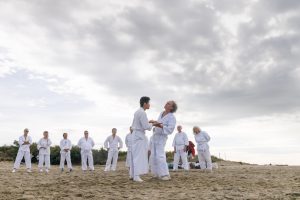
Shin Aoki teaching in Italy
The second beach keiko was bojutsu lead by Alain Chevet, Georg Muller and Stephan Seddiki. The group experienced an Italian sunset over the water.
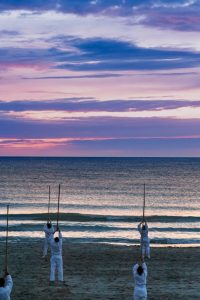
Bojutsu keiko at sunset Italy
Saturday morning and Sunday morning, Ito Sensei lead a 6:30am Taimyo meditation.
The fourth keiko was kenjutsu by Pierre Quettier and Ula Chambers. Pierre gave a demonstration with his katana showing Chuden no Kata and Okuden no Kata. Masashi Minagawa lead the closing keiko with open hand Shintaido.
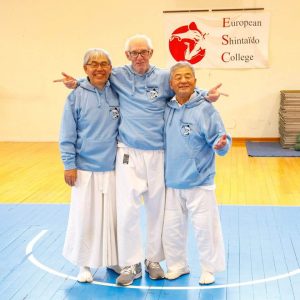
Three masters of Shintaido
The United States was represented by David Franklin, Mike Sheets, Connie Borden, Michael Thompson, Mark Bannon, HF Ito and Shin Aoki.
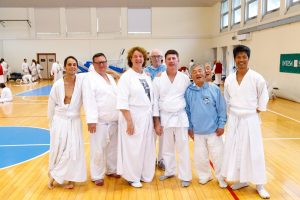
USA group at Italy semi international
Photos by Marc Plantec.
2018, All Years, Body Dialogue Newsletter
by
Master Instructor H.F. Ito
Life is a path. We come from Mu and we go back to Mu. Life is long, and our own lives are each a small part of life. Sometimes rain, sometimes wind, sometime life or death. Pretty simple, actually, it is what it is. Ikkyu
Joe and John. I’m sorry I missed a chance to talk to you just before your departures.
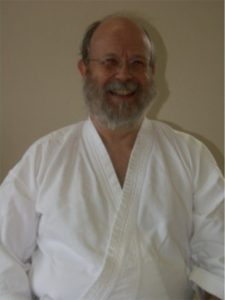
John Seaman
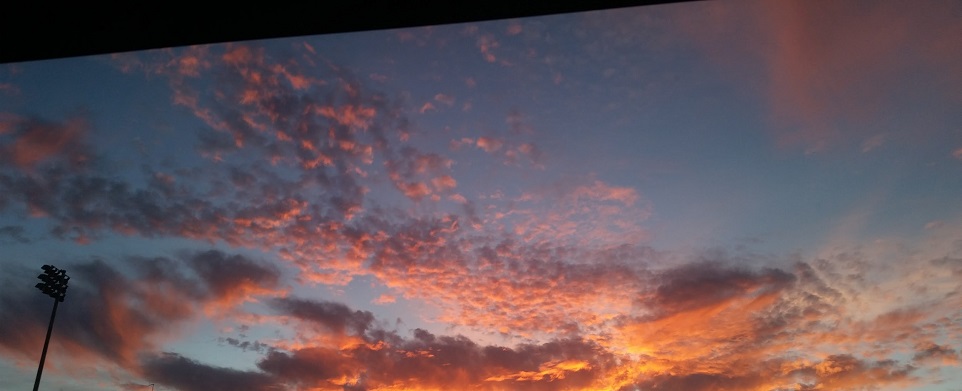
In these days, the more I practice Tenshingoso, the more I appreciate the end of the movement (Oooooo~Uuuuuu~Mmmmmm)!
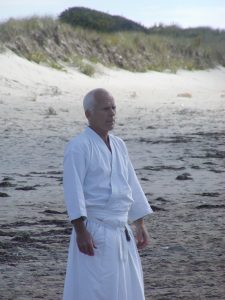
Joe Zawielski
When I was young, I was practicing this part of Tenshingoso according to the text/recommendation written by Aoki-sensei.
I enjoyed it, and I kept sharing my understanding with many people having the confidence of how much I know about the cycle of our life.
Now that I’m 76 years old, I understand that my grasp of this part of Tenshingoso has been rather superficial.
It is always difficult for me to watch those who helped me share Shintaido leave for the next stage of their life. I wish I could have had a face-to-face meeting and express my gratitude in person.
But, I am lucky that I can still communicate with you, through the following ways:
- Through the sound of Oooooo, I believe that I can reach you who are now omnipresent in the universe!
- Through the sound of Uuuuu~Mmmmm, I can feel you in my Hara, You are gone but I still have many memories of the goodness I have studied from you.
- Through the sound of Mmmm~Aaaaa, I can ask you to appear!
I hope you will continue to share Shintaido, and want to ask you to become our “Guardians” in the sky!
Looking forward to talking to you in Ten in the near future!
2018, All Years, Body Dialogue Newsletter
by
Tomi Nagai-Rothe
[John Seaman, a long-time Shintaido instructor, passed away in April of this year. See the News Item. John and Lee started their practice during the early days of Shintaido in Japan. They taught groups in Oregon and Washington for many years. In this article, Tomi Nagai-Rothe writes about how influential John Seaman was in her life. Body Dialogue Editor]
John at Seminary
With John there was always a story. I remember his account of his studies at San Francisco Theological Seminary in San Anselmo, California during the American War in Vietnam. John was active with students who participated in the 1960s version of an underground railroad, housing draft dodgers and conscientious objectors as they made their way north to Canada where they could request asylum. 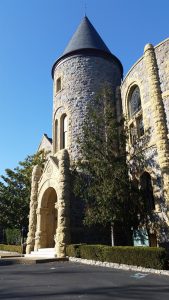
John didn’t fit into the mold of the purely intellectual student and struggled against what he felt was the seminary’s narrow and academic view of the world. He spent time in the outdoors to decompress and often visited the Mountain Theater on Mt. Tamalpais. And John often took an unorthodox approach to life, driven by his creativity and curiosity.
One of my favorite stories was the visit that Sara Lee Morrissey (later Seaman) made to campus as a visitor. Lee met John on campus and they became fast friends. Fellow students remarked that John’s personality had mellowed noticeably during Lee’s visit, and they appreciated it!
John drove Lee to the airport when it was time to leave. As they drove, something hung in the air — perhaps it wasn’t the right time for Lee to leave? Return home or stay? The car turned around and they never made it to the airport. Lee stayed on at the seminary for some time, and John’s fellow students welcomed her salutory effect on him. John and Lee were always together after that.
Teaching Stories
There were a raft of “teaching” stories and when John started one, the longer term students would nod knowingly and watch the expression of the newest people. What were they taking from this story? What did John intend to convey and for what reason? The stories were an opportunity to see a part of oneself reflected in a safe way — in a medium that had space for feelings and upwellings of memory. It was also a chance for those who had heard the story many times to see if they could harvest new insights.
Life Questions
My early questions to John were about Shintaido practice. Once I was scared by a feeling that came up during practice and while others laughed it off, John simultaneously took it seriously and made it seem normal and unsurprising. I was so relieved and grateful to be seen at that moment. And I was able to relax, knowing that my experience wasn’t unnatural.
Over the next ten years my questions expanded to ones about life. I had dozens of conversations with John about personal challenges because I knew he would never be shocked, and would always tell a story that contextualized my experience. John modeled how to create a safe harbor. Since then I have mentored and coached many people and drawn continuously on John’s model to try to provide a safe harbor for others who are seeking.
Shintaido John-Style
I made regular visits to Bellingham to study with John and Lee and their students. I was interested in John’s unorthodox (compared to the Bay Area) teaching style that included a very informal warm-up with lots of conversation and new ways of presenting bo technique. I appreciated that the focus was never on perfect technique, but on what the technique allowed us to learn about ourselves and our relationships with our Shintaido practice partners.
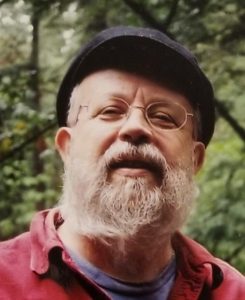
John Seaman
John created a big space around practice so we could look at what we hoped to gain from Shintaido, what stepping back or stepping forward could be an analogy for (for example), why being opened up by our partners made us cry, or even why we just didn’t feel like participating. John made space to look at inward manifestations as well as outward ones. Any topic was fair game.
Life Practice and Life Teaching
John had a very high expectation that people around him pay attention to their spiritual development including their shadow side – and address those changes that need to be made in their lives. If you saw him irritated or short with someone, it was probably because they are not paying attention to this aspect of their lives.
John and Lee and their more experienced students used to have regular conversations they termed “staffing.” It was a cross between addressing personnel issues and mapping personal development. They would talk about where people were in their practice and their lives. It was always compassionate and never gossipy and the goal was supporting people in the way they needed to be supported.
At first I mostly listened and then, after many visits to Bellingham, Washington, I came to know their students better and began to participate. Each person’s situation was held lovingly and with respect. Decades later I serve as an elder at my Quaker church and know the tone and approach to take for pastoral care because I practiced it with John and Lee.
Teaching Shintaido
When I began preparing for my instructor exam I turned to John and Lee for support and advice. John was incredibly supportive and one day I surprised him by asking if he would support me by taking the exam with me. It was a bit mean because I had cornered him, but John agreed. We had many conversations about the exam elements and about Taimyo Kata, which John didn’t much like. In the end, it made a huge difference for me, being able to take the instructor exam with him in the big, cold gym at Mount Madonna Center in Watsonville, California. It was one example of John going the extra mile for his students.
One of John’s maxims (and stories, of course) was that a good teacher always creates students more talented than they are. It was set as the gold standard and gave John an opportunity to tell stories about students who had gone on to become talented Shintaido practitioners and teachers.
After I became an instructor John and Lee provided so many opportunities for me to teach in Bellingham and to work with them on exams. The debriefs about how people did and what they showed were always the richest part of the experience.
Spiritual Seeking
When I met John and Lee I was a spiritual seeker and they provided glimpses into their practice as Christian mystics. Just enough to make me curious. I asked lots of questions and John told stories about the Presbyterians and I learned about pentecostals, fundamentalists, contemplatives and mystics.
I spent years asking very basic and dumb questions about Christianity and faith in action. John always had good information and a contextualizing story to help me feel less dumb. He and Lee were endlessly supportive without pushing me in any particular direction. It was an unconditional love that modeled being a follower of Jesus in a profoundly life changing way. Without that love and guidance I would not have found my church home with the Religious Society of Friends (Quakers) nor be doing the work I am doing as a Quaker.
The Old Growth Douglas Fir Grove
On one of my Bellingham visits John took me to a special stand of old growth Douglas Fir near the highway to Mt. Baker but tucked back from the road. John and lee had learned about it from a Lummi elder who trusted them enough to take them there.
I walked a short path and stepped under the dark tree canopy and felt like I had entered another world — as in a storybook. The air felt different, the light was filtered and soft and it felt like a very old yet alive place. It looked like a forest but it felt inhabited like no forest I’ve ever entered. We walked quietly and connected to the trees, and sat on the moss and downed trees.
In the first version of my will I asked to have my ashes scattered under the trees there. And in the current version of my will John is named as the person to lead my memorial service. When I heard that John had died I knew I wanted to organize a remembrance for him — since I outlived him, and in thanks for his willingness to do the same for me.
The Wolf Pack
One of the deepest lessons I carry from my study with John and Lee is how essential a learning community is if one is adventurous and interested in spiritual growth. I think it is either too terrifying or too dangerous as a solo activity. John used to say, “a lone wolf is a dead wolf.” Hunting for insight with the support and help of the pack makes a successful hunt more likely, and my study with John proved that.
Thank you, John, for including me in your pack.
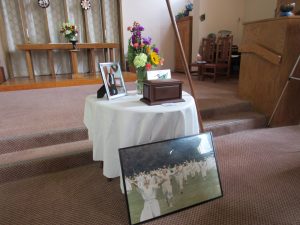
2018, All Years, Body Dialogue Newsletter, News
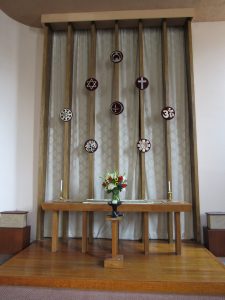
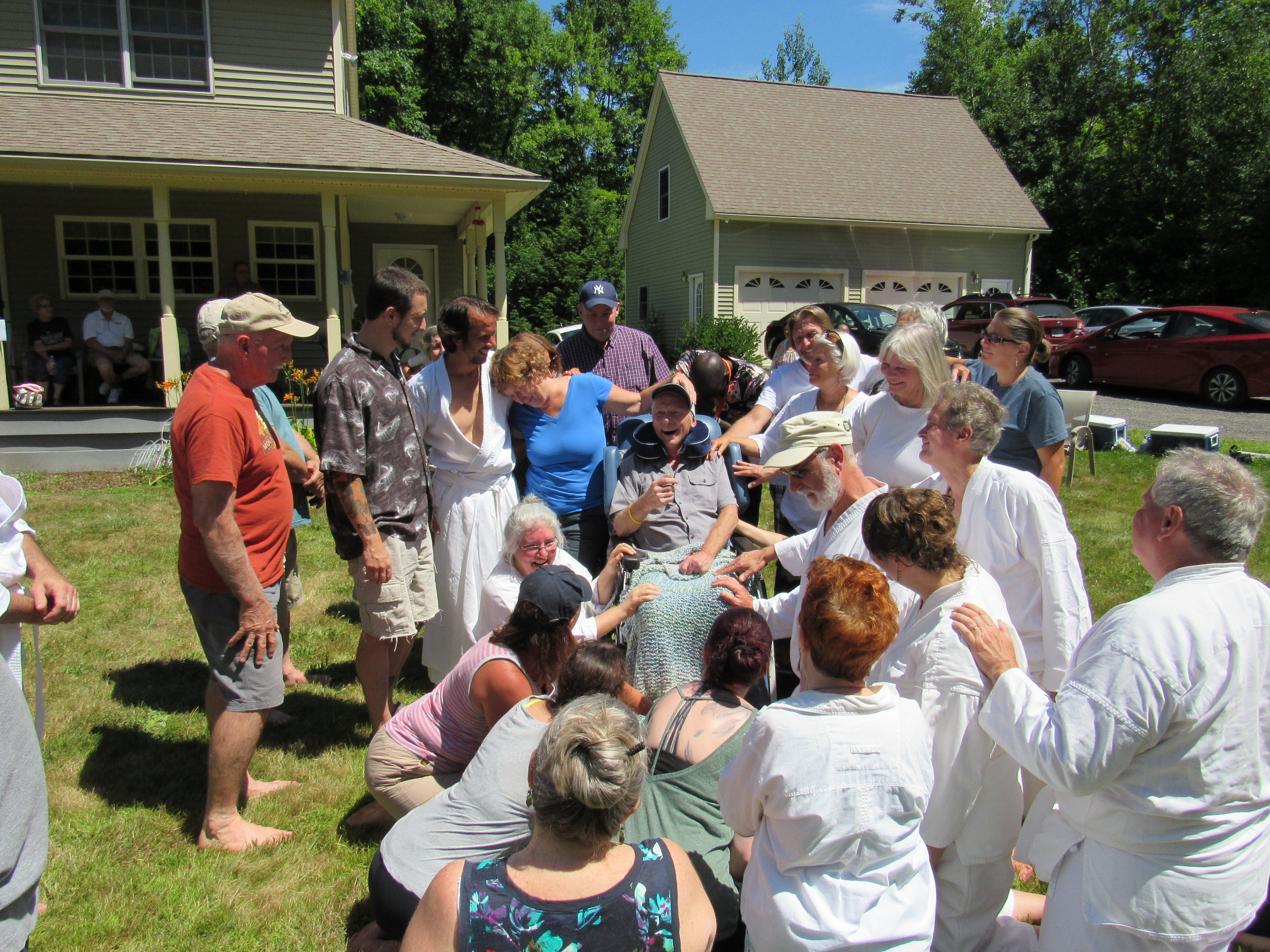
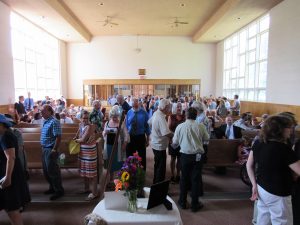
On Friday, August 10th, 2018 a Celebration of Life was held for Joseph J. Zawielski at the Unitarian Universalist Church in Worcester, Massachusetts.
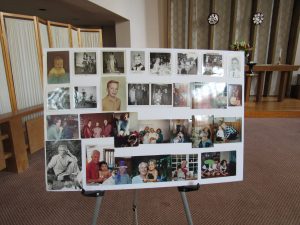
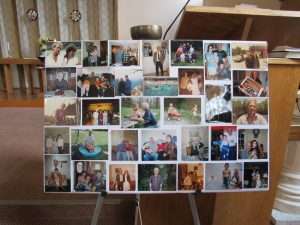
Many Shintaido people were in attendance. Master Instructor Michael Thompson spoke and then led a group in Diamond Eight Kata as part of the ceremony. This remembrance and the last Keiko for Joe were beautiful sendoffs for much-loved teacher of Shintaido, General Instructor Joe Zawielski.
2018, All Years, Body Dialogue Newsletter, News
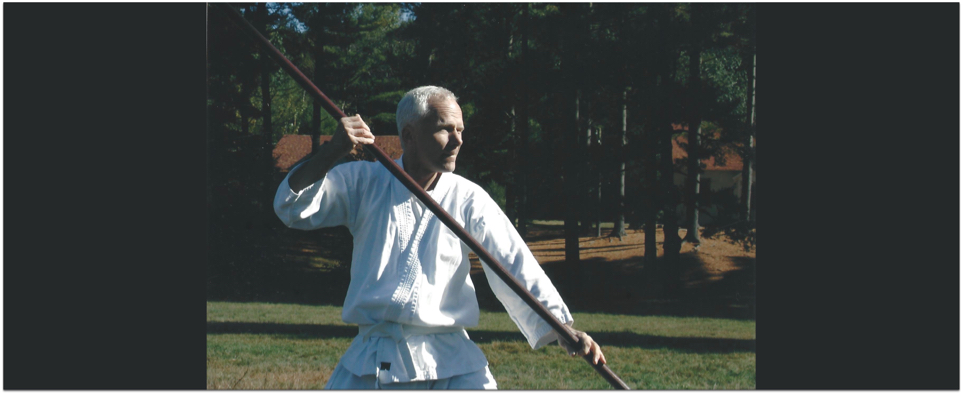
Joe Zawielski died peacefully at home on August 1st, 2018 at 9:30am. Joe had been open about his health and expected death with many posts about his love for everyone in his life. Home hospice services were being provided to Joe and his family. Gianni Rossi led a keiko for 50 people with Joe in attendance on Saturday July 21st, 2018.
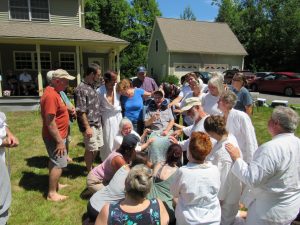
Photo by Stephen Billias
Joe began his study of Shintaido in 1980 and began his path as a Shintaido Instructor in 1986 and became a General Instructor (4th Dan) in 2016. He also was ranked a SanDan (3rd degree black belt) in Boh, awarded in 2004 and ranked Shintaido Kenjutsu San Dan, awarded in 2016. Joe was a member of the International Technical and Examination Committee (ITEC) as well as SOA National Technical Committee (NTC).
Joe’s family will tell us more about arrangements as they are made. They thanked everyone who has been with him and those who have let Joe know how much he was loved.
Connie Borden
President SOA

The sky over Joe’s keiko.
Photo by Stephen Billias.