
by Derk Richardson
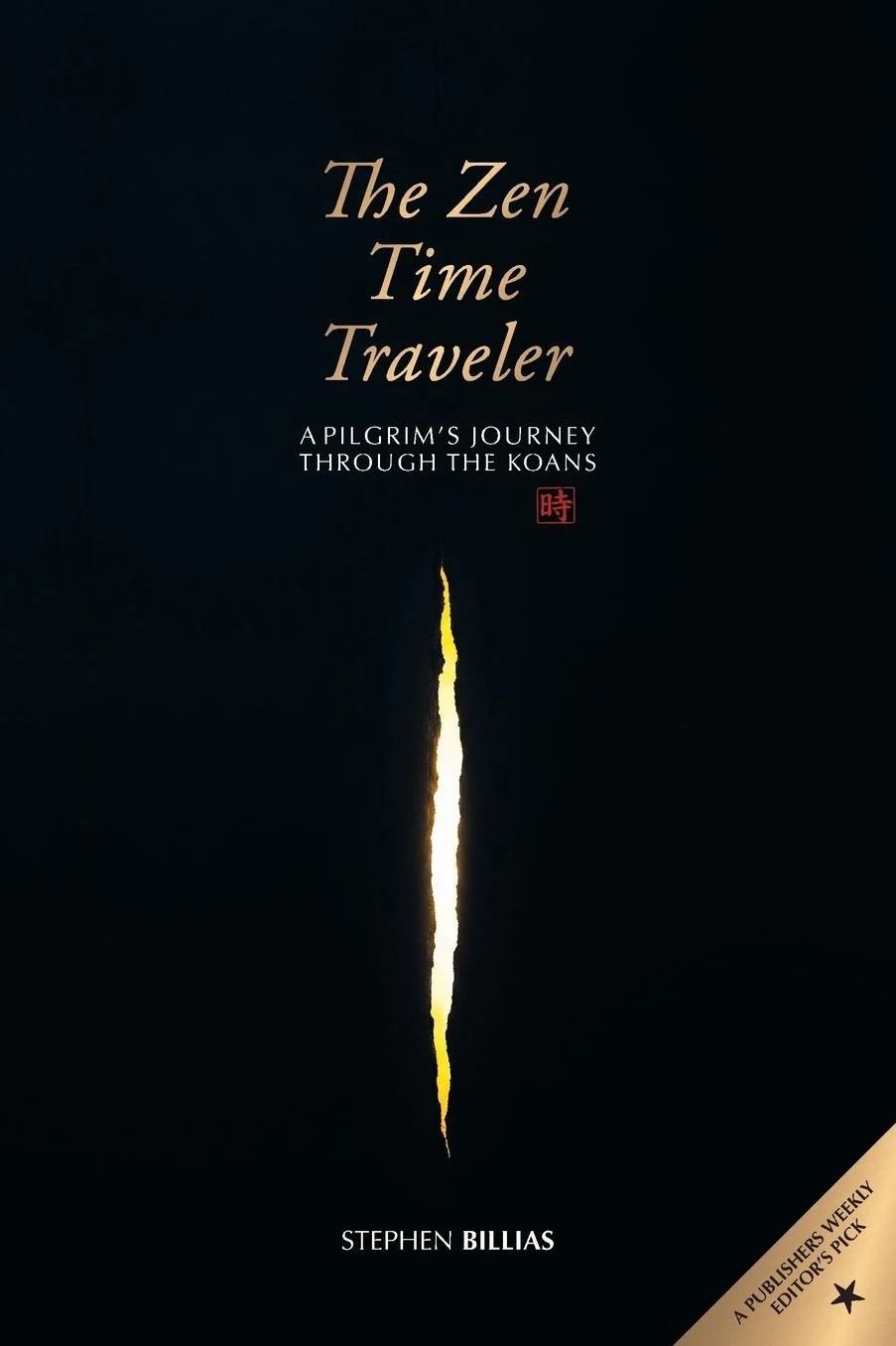
In his new book, The Zen Time Traveler: A Pilgrim’s Journey Through the Koans (Discovery Publishers), Stephen Billias weaves together the fantasy of leaping back and forth across centuries, the mystery of interchangeable and intermingling identities, and the timeless theme of spiritual quest into a compelling story that is virtually impossible to put down until you get to the surprising end. Along the way, he challenges our conventional understanding of time, space, and self while taking us on his protagonist’s journey toward awakening through the obstacles of craving, attachment, and delusion.
Many of us know Stephen as a fellow Shintaido practitioner and instructor, a former Body Dialogue editor, and the cofounder, with his wife, Bela Breslau, of the Shintaido Farm (now the Engaged Mindfulness Institute) in Deerfield, Massachusetts. He has also been a theater actor, screenplay writer, technical publications manager, and the author of seven published science fiction/fantasy novels, a collection of short stories, and, cowritten with Bela, the literary novel Pilgrim Maya. But it is his Buddhist practice that inspired him to write The Zen Time Traveler.
“Shintaido was my practice for many, many years, since 1990,” Stephen explains. “Around 2010, as my body aged, I realized a lot of the movements were too difficult for me. My body just couldn’t do them anymore.” He turned to Tai Chi, under Wolfe Lowenthal at Long River Tai Chi Circle in Western Massachusetts, and more recently immersed himself more deeply in Zen. “I’ve been a Zen student for most of my life,” he says, “but didn’t have a real practice until maybe five to seven years ago. I had done a lot of reading of Buddhist books, but I found the real meat of the thing in Zen sitting.”
Sitting in meditation and contemplating Zen koans is the starting point for the new novel. The protagonist and his unusual journey are described in the publisher’s summary:
Stephen Maine is a middle-aged project manager navigating the collapse of his marriage and the quiet despair of modern burnout. But his weekly Zen meditation class in a Massachusetts church basement offers an unexpected escape. By reciting a mysterious haiku, Stephen finds his consciousness hurtled across the space-time continuum, landing squarely in the body of Wùkōng, a Japanese monk traveling through Song Dynasty China in the year 1225.
“In this vibrant, dangerous ancient world, Zen koans are not abstract intellectual riddles—they are visceral, life-or-death encounters with legendary Chan masters. As Stephen navigates this dual existence, he finds himself increasingly drawn to the past, captivated by a fierce, magical sword maker named Yabaku, and the thrilling asceticism of his host’s spiritual quest.
“I can’t really point to a moment where I said, I’d like to write a time-travel fantasy about Zen Buddhism,” Stephen Billias notes. “I wish I could pinpoint that moment when I was, you know, sitting in the Zendo and thinking of the haiku and was transported to the 13th century, but I don’t think it happened that way. It probably just happened one morning at my desk, thinking, how can I best bring these koans to life? I very deliberately chose to write a book about Zen koans without having done any formal koan study. At the end of the book, the character, Stephen, hasn’t solved any of the koans. And neither have I. But I’m about to start doing a more formal koan study with my main teacher.
“In that respect, I have two main goals for the book,” he continues. “If it is read by people who have no idea what a koan is, this will be a fun introduction. If it’s read by people who are Zen practitioners and have studied koans, this might just be a fresh or unique way to look at them.”
Stephen sees close parallels between, even convergences of, Shintaido and Buddhist practice. “The overriding idea of Buddhism,” he explains, “it that when you get rid of your ego and you aren’t clinging to anything, you are going to be free. And it’s available to you right now. And I think Shintaido has a method of ridding you of your ego by exhausting your body until you don’t have that, your ego, to fall back on anymore.”
He also notes that master Shintaido instructor Mashashi Minagawa, in his recent memoir, Aikukan: A life in Shintaido, introduces a kata that fuses the final chanted words of the Mahāyāna Buddhist Heart Sutra—“gate gate pāragate pārasaṃgate bodhi svāhā”—with Shintaido movements.
And in a serendipitous development, Minagawa-sensei made an essential contribution to the physical presentation of The Zen Time Traveler. “I had such a wonderful kumite with him,” Stephen says. “I sent Discovery Publishers a haiku of mine that Tricycle magazine had published. They liked it and had their designer create a sumi-e (brush-and-ink) image to go with it at the end of the book. It was a gourd, which is the subject of the haiku. I suggested we get somebody to translate the haiku into Japanese and put that on the illustration. I contacted Minagawa-sensei and asked him if he’d be willing to translate the haiku and, because we know he is an outstanding calligrapher, if maybe he would also do calligraphy of it. He did, and they loved it.
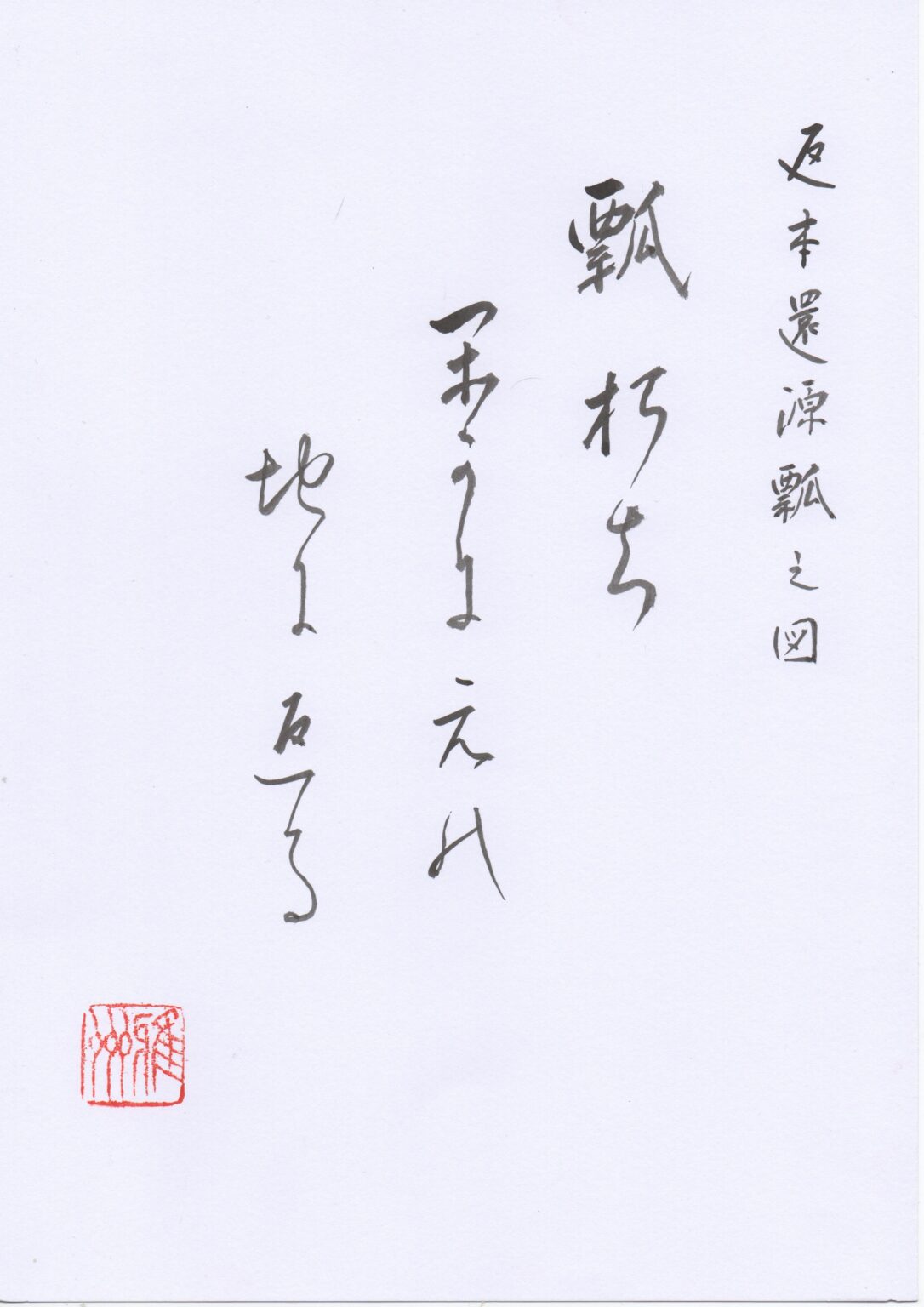
But Minagawa didn’t stop there. He, as Shintaido people do, went beyond. The image of the gourd reminded him of the ninth of the Ten Ox Herding Pictures (a series of drawings that accompany short poems used in the Zen tradition to describe the stages of a practitioner’s progress toward enlightenment), so he added a little bit in Chinese kanji referencing the ninth picture’s title. The published loved that, too, and they found the poem that goes with the ninth picture and printed it on the facing page. As I said, we had a great kumite—Minagawa-sensei, me, and the publisher—in that process.”
In condensed form, the two-page spread represents Stephen’s intention as the author of The Zen Time Traveler. “My real goal in writing this book was not fame or fortune,” he says. “I’m not a teacher, I’m not a Roshi, I’m not an abbot, I’m not a priest. I’m just a fantasy writer with a Zen practice, and I felt like this was how I could contribute to the spread of the Buddhist dharma in some small way.”
Stephen Billias and Bela Breslau will be hosting a book launch party for the publication of The Zen Time Traveler on Sunday, July 12th, from 2:00 to 4:00 p.m. at the Engaged Mindfulness Institute (formerly the Shintaido Farm), 595B River Road in Deerfield, Massachusetts.
Barnes & Noble link for the book (and its cover image): https://www.barnesandnoble.com/w/the-zen-time-traveler-stephen-billias/1149835205?ean=9781788946896
The illustrations referred to above can be found here:
https://billiasbreslauwriters.com/stephen-sketches-the-evolution-of-an-illustration/
Congratulations Stephen!
Congratulations Stephen! A worthy accomplishment.