Report: Global Taimyo April 2026 Gathering

Report: Global Taimyo April 2026 Gathering

by Connie Borden and Tomi Nagai-Rothe
Published:

“The Great Way is not difficult For those who have no preferences. When love and hate are both absent Everything becomes clear and undisguised. . . . The Way is perfect like vast space.”

                                                                            Sengcan, third Ch’an patriarch

Inspiration: Effortless Action Connie Borden was inspired by Sengcan’s writing on trust in awareness/mind to set the tone for the Global Taimyo Community’s 2026 gatherings. Taimyo means Great Mystery and is a distillation of the creative experience of Shintaido founder Hiroyuki Aoki. HF Ito founded the Global Taimyo Network to facilitate small changes around the world so that we can find ease in our mind and our lives can shift from a negative direction to a positive one (i.e. ease rather than dis-ease). In 1999, HF Ito wrote about our Shintaido lineage. He included Bodhidharma, considered the first patriarch and founder of Ch’an Buddhism, who taught the Shaolin monks in China to develop physical stamina through what became Kung Fu, in addition to their meditation. Ch’an was pronounced Zen when imported to Japan, and the legacy of the Shaolin monks manifested in Japan through Okinawan Karate – a Shintaido predecessor. We can hear the echo of Shintaido when hearing ‘let everything be as it is’ and ‘move with the wild energy of the Cosmos’ (Wu-wei). Wu-wei is a core Taoist concept translated to “effortless action.” The Sengcan poem expresses the principles of nonduality, grounded in the earth and earthly mysteries.
April 2026 Gathering From 19 April 2026 to 2 May 2026 the Global Taimyo Network gathered over ZOOM to practice Taimyo and to gather in community. Taimyo sessions were offered by 11 individuals from 3 countries: France, United Kingdom, and the USA. With a total of 26 offerings, there were a variety of global times provided to offer participation including from Japan. On the 26th of April 18 people participated in a two-hour community gathering to discuss the impact of practicing Taimyo on their lives.
Tomi Nagai-Rothe suggested participants read her article: Enacting Ito Sensei’s Legacy  prior to the Global Taimyo gathering. In this article Tomi states:

“On several occasions Ito reminded me that I could teach Shintaido with what is innate and deep – not the surface stuff – using my intention, experience, and imagination in a quiet way. A reminder to cast aside “preferences” as Sengcan says (see below his poem). So, I hope you will consider how the quiet ripples you already make in the world can be part of carrying on Ito’s legacy.”

Connie read this part of the Sengcan poem, Trust in Mind/Trust in Awareness, translated by Richard B. Clarke.

The Great Way is not difficult For those who have no preferences. When love and hate are both absent Everything becomes clear and undisguised. Make the smallest distinction, however, And heaven and earth are set indefinitely apart. If you wish to see the truth, Then hold no opinions for or against anything. To set what you like against what you dislike Is the dis-ease of the mind. When the deep meaning of things is not understood, Then the mind’s essential peace is disturbed to no avail. The Way is perfect like vast space Where nothing is lacking and nothing is in excess. Indeed, it is due to our choosing to accept or reject That we do not see the true nature of things. Live neither in the entanglements of outer things, Nor in inner feelings of emptiness.

Connie closed with the last line of the poem:

Words, the Way is beyond Language, for in it there is no yesterday, no tomorrow, no today.

  These two questions were asked of GTC attendees: “When have you had an experience of everyday life falling away?” “Is there a part of Taimyo that enhances this type of opening/this type of experience?” We practiced Taimyo to enhance our discussion. Jean Marc Otto Bruc lead Taimyo Part I and Part II. Connie Borden led Taimyo Part III. We then went into small groups to talk about our experience of practicing Taimyo. Some impressions: the state of timelessness brings rejuvenation of energy; being in the timeless state is reality – not the exception, and doing Taimyo brings relaxation so when I am relaxed I can engage with others more openly; maintaining personal practice along with group practice helps in a fuller appreciation of Taimyo Kata. One person shared the differences between an intense experience that is focused like Shoko versus going deep as in Mokuso that expands broadly and outwardly. Another shared that the sound created in Mokuso harmonizes within each of us thereby bringing us to Aikukan, the space of love. Here are some comments from the participants from across the two weeks:
    • Marianne van der Tas (UK) said “ We are so fortunate to have ZOOM to allow us to participate from so many different locations.”
    • Nicole Beauvois (France) “ I would say that Taimyo Kata and Diamond 8 Cuts are a continual support in my daily life and that each time I practice it, it is like coming back to a more original self or part of myself that I did not know. I can see some luminous part but sometimes, I can also see some gray zone in myself and that helps me a lot in my life.  Since the departure of my husband who was also my dear sensei, these two kata have been helping me have a place where I feel good, like a cocoon of peace and softness.”
    • David Palmer (USA) on Reppaku and Saizan  “Moving forward, I felt myself crossing a threshold (of many kinds). Then, stepping back, a sensation of pulling away, a withdrawal inward.”
 
Our second gathering for 2026 is the 20th of September. We hope to see you then! Learn more about the Global Taimyo Community, read articles, watch videos from previous gatherings, and register for upcoming gathering here.
Report: Pacific Shintaido Kangeiko 2026

Report: Pacific Shintaido Kangeiko 2026

by Derk Richardson

Published:

Pacific Shintaido’s Kangeiko 2026 was an exceptional event in several ways. For the first time in many years, the annual winter workshop was held as a sleep-over gasshuku. Keiko were conducted over two days, Saturday and Sunday, January 17 and 18,  in the gymnasiums of Technology Middle School in Rohnert Park (about 50 miles north of San Francisco), and most participants stayed overnight Saturday in a large Airbnb rental house in nearby Santa Rosa, a 15-minute drive from the dojo. In addition, Shintaido of America exams were folded into the program after the Sunday morning keiko, with results announced and at the end of the workshop, and members of SOA’s National Technical Council offered demonstrations from the advanced curriculums of Shintaido karate, bojutsu, and kenjutsu.

Bay Area Senior Instructors Robert Gaston and Jennifer Peringer based the teaching on their investigation of the gasshuku theme “Kumite through Time and Space” (a variation on the Shintaido of America 50th Anniversary theme, “Kumite across Time and Space”). They focused on the concept of irimi (roughly translated as “entering”), applying it to four directions of movement—mae (forward), sagari (back), yoko (to the side), and ushiro (turning)—and incorporating open-hand techniques and weapons (bokuto, bokken, and boh).

Across the weekend, 16 people, including two attendees from the East Coast, participated in keiko. The level of experience ranged from a few years to several decades, and Robert and Jennifer shaped the curriculum accordingly. Jennifer was the lead teacher for the two morning keiko, Robert for the afternoons. Someone different led the warmups for each keiko, which added distinctive character to the sessions: Shin Aoki led a formal tenshin-jusoho; Sally Gaston emphasized stretching; Jennifer had us use boh for part of her warmup; and Lee Ordeman, attuned to the group’s levels of energy and fatigue, opened the final session with lots of slow movement and massage.

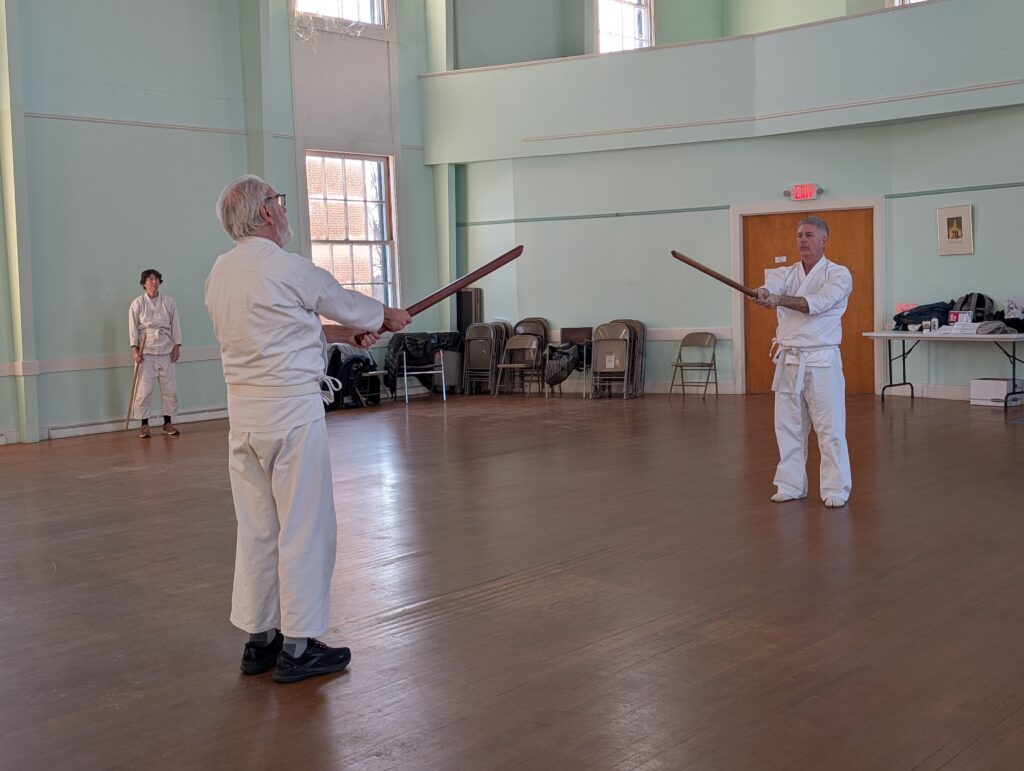
Similarly, each keiko had a unique flavor and flow. In keeping with the theme (kumite) and focus (irmi), Jennifer and Robert led a wide variety partner exercises and arrangements. They included partner-directed meiso jumping and rolling; daijodan kirikomi/kirioroshi and rolling in response to the four stepping directions; relatively basic kumitachi with swords; open-hand uchite cutting attacks and receiving, adding mae-irimi and yoko-irimi stepping and a bojutsu variation; small group practice dedicated to karate, bojutsu, or kenjutsu irimi applications (followed by demonstrations by each of the three groups); and various wakame arrangements leading to a free-flowing and ecstatic group wakame into collective tenso. The cumulative effect of the four keiko not only led to a deeper understanding the role of irimi in kumite, but also instilled a bodily sense of how timing and space (together comprising ma) are inextricably related in our practice.

The feeling of community (the collective ma) that developed over the weekend was enhanced by having lunch together in the gym, organized and prepared by Sandra Bengtsson and Sally Gaston, and by most of us staying overnight in an Airbnb house that Jason Ravitz researched and secured. Despite a few quirky hiccups in the accommodations, the spirit of the evening—fueled by a bountiful pot-luck dinner and elevated with wine (for some) and live music—was galvanizing. (Mike Sheets gallantly rode herd on the kitchen crew, managing to coordinate potentially chaotic preparations of dinner and breakfast.) A special feature of the festivities Saturday night was a visit from General Instructor Jim Sterling, who answered questions about the 50-year history of Shintaido of America and entertained and enlightened us with colorful and humorous stories of his experiences.

The “add-ons” to the Sunday proceedings—the NTC demonstrations and the SOA exams—reinforced the idea that Shintaido, as a practice and an organization, has a rich history (60 years in Japan, 50 years in America), a multifaceted and ever-evolving curriculum, and the potential for growth and expansion. In the exams, Sally Gaston, Martha Rodriguez-Salazar, Nicole Masters, and Jennifer Abajar, challenged different kyu levels of bojutsu and karate. The NTC demos were performed by Byron Russell (Hangetsu no Kata, an element in the sandan karate exam), Mike Sheets (Hojo no Kata, shodan bojutsu), Robert Gaston (Shoshi-no-Kon, shodan bojutsu), Jennifer Peringer and Shin Aoki (Soei Kumibo, sandan bojutsu), and Connie Borden, Lee Ordeman, and Sandra Bengtsson (Sannin-ichiretsu, General Instructor exam). The presentation capped the afternoon with a wave of inspiration for all of us in the audience.

In the opening ceremony, we revisited the words of Master Instructor Masashi Minagawa about the meaning of Kangeiko, which read in part, “At New Year we refresh our old selves and go back to the original beginner’s mind. Then we celebrate the coming year and ask for health and happiness. At Kangeiko especially, we try to find the real existence, our own nature inside ourselves.”

In the closing ceremony, Cheryl Williams read a poem by Pamela Joyce Randolph, “Time and Space,” which captured a certain essence of the workshop’s kumite theme:

Give me time to know myself,
and space to stand alone.
I need to get to know my heart,
and have thoughts of my own.
Give me your encouragement,
and trust in what I do,
Then I’ll uncover what was lost,
and share the best with you.

Kangeiko 2026 was likely the last gasshuku to be organized by the current PacShin Board of Directors—Shin Aoki, Cheryl Williams, Derk Richardson—which has been in place for well over a decade. We are looking forward to the next phase of the Pacific Shintaido journey.

Report: A French Gasshuku with Shin Aoki

Report: A French Gasshuku with Shin Aoki

by Jennifer Peringer

Published:

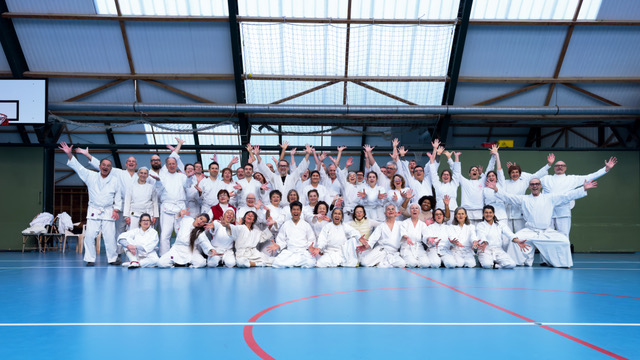
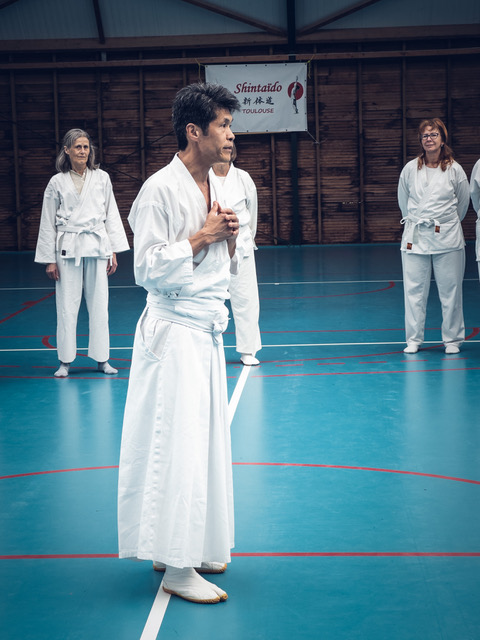
We just got back from a wonderful gasshuku in France taught by Shin Aoki, and organized by Christine Gov and Serge Magne. It took place outside the west coast beach town of Sables d’Olonne, from Feb 20 -22, and had 50 people in attendance, mainly from France but with some participants from as far afield as Germany, England, the Czech Republic, and Martha and myself from California. The event started with one keiko for advanced practitioners, then four keikos for all, the second of which was a boh class, taught by David Franklin and myself. The theme of the event, set by Shin, was ‘Giving and Receiving’, a theme rich with possible Shintaido interpretations.

Throughout the gasshuku Shin taught a variety of open hand and sword techniques, including wakame, renki kumite, tenchi kirikomi, kasumi, tsunami, sagari and ushiro receiving. These were all taught in the service of deeply exploring concepts related to the theme, such as:

      • The need to start from a place of being centered, then find your partner’s center.
      • Different timings, and particularly ways in which the receiver can influence the timing of the attacker. Shin also used a radio wave analogy, inviting participants to tune into different channels of their partner’s energy.
      • Changing quickly from kaihotai (open hips, hands and expression) to yokitai (soft receptive body), and the importance of the leader embodying these concepts if they want to inspire them in the follower. As a life application, the idea is that you need to embody/exemplify the energy you would like to receive from others.
      • The idea of developing an image/vision/intention, then sharing it with your partner.

In the boh keiko, David took the beginners and taught a version of tenshingoso kumite with boh. Meanwhile, I took the advanced students and used yonhon kumibo with breath work and vocalization to explore the concepts of giving with precision and commitment, and receiving with open heart and without fear. Then all joined together for a glorious group eiko dai.

There was a fun party on Saturday night, where the Toulouse group presented a festive dance choreography mixing tenshingoso and salsa (!), David Franklin played some blues harmonica, I led a little singalong version of La Bamba, and Shin made everyone happy by teaching a groovy line dancing routine.

At the end of the gasshuku Shin’s closing remarks were particularly moving, saying he learned as much as he taught, and talking about how both giving and receiving can be hard, how you need to open your heart, and how we all have much to learn.

I’d like to finish this article with an online comment after the event by one of the French participants, Blandine Graveline:

Bonjour
Une semaine après je suis encore sous le charme du week end dernier. Un immense merci à toutes celles et ceux qui ont organisé, animé et guidé ce kangeiko. Ça a été pour moi un moment magnifique et surprenant. La beauté, la précision, l’intensité des gestes des instructeurs, la joie puissante des eikos collectifs, la bienveillance de chacun, la générosité et la simplicité des sensei invités – tout cela m’a profondément touchée.  
Le shintaido me surprend toujours plus. Cette pratique m’a appris et m’apprend encore à me tenir droite, à faire face, à me défendre ou à esquiver, à m’assouplir, à accueillir l’autre et surtout, comme le répète Eric Philippe, “mon” instructeur parisien qui n’a pas pu venir, à être digne. Quelle école ! Un apprentissage qui fortifie et aide à résister aux menaces du moment – un pas vers la liberté…
Ma profonde gratitude envers Shin Aoki et vous toutes et tous. 
Blandine 

Hello
One week later I still feel the charm of last week end. Huge thanks to those who organized, kept going and guided this kangeiko. It was a great and surprising moment for me. The beauty, the precision, the intensity of the instructors’ gesture, the powerful joy of the group’s eikos, the kindness of everyone, the generosity and simplicity of the invited sensei’s – everything touched me deeply. 
Shintaido surprises me still more. This practice teaches me to stand up straight, to cope, to defend myself or to evade, to become more flexible, to greet someone and specially – as Eric Philippe, my instructor from Paris who couldn’t join, would repeat, to be dignified. What a school !  A learning that gives strength and helps to resist to actual threats – a step towards liberty…. 
My deep gratefulness towards Shin Aoki and all of you
Blandine

Exam Results Jan. 2026

Published:
Hello Shintaido members,

Shintaido of America held exams for karate and bojutsu at Pacific Shintaido’s Jan. 2026 Kangeiko.  Examiners were Shin Aoki and Jennifer Peringer, with Mike Sheets as goresha. Thank you to Pacific Shintaido for providing the time and space in their Kangeiko and Shintaido of America for sponsoring and coordinating the exams.

In Shintaido karate, Nicole Masters received the rank of 9 kyu and Martha Rodriguez-Salazar received the rank of 5 kyu.

In Shintaido bojutsu, Jennifer Abejar received a rank of 8 kyu, Martha Rodriguez-Salazar and Sally Gaston received the rank of 2 kyu.

Again, thank you to the examinees for their performance, the examiners for their careful eyes and feedback, and all those who made these Shintaido exams possible.