Oct ’26 Workshop: Calming Ourselves to Transform Stress & Conflict

Published:
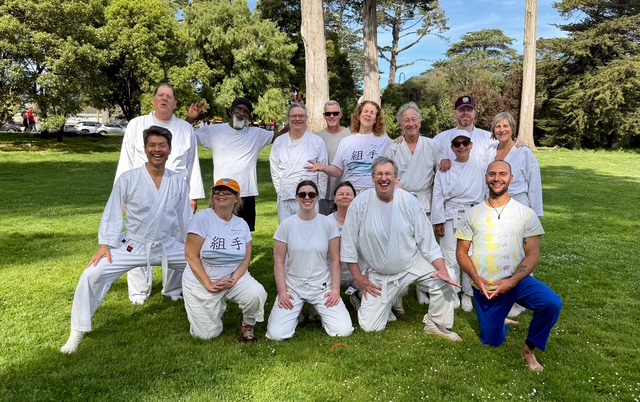
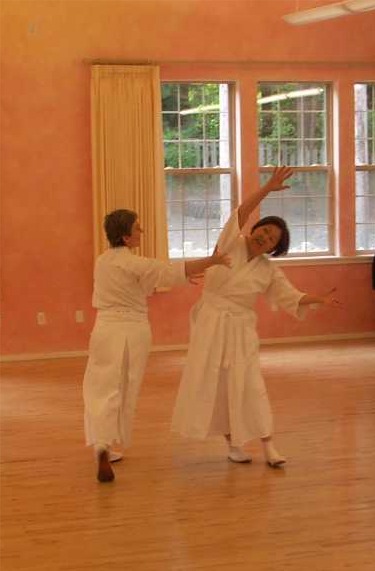
Registration is OPEN for this in-person workshop on October 10 -11, 2026. Join Shintaido instructors Tomi Nagai-Rothe and Lee Seaman for this weekend workshop of 3 keiko and a video premiere presentation and color Shintaido history map, “Roots of Shintaido: Our Cultural Inheritance From Three Masters.” Let’s use the Shintaido in our bodies to heal and transform internal and external stress and conflict in order to positively affect those around us. Re-experience Tenshingoso, Tenshingoso kumite, Wakame-Bamboo and other kumite in a joyful and accessible way. This weekend will be special as we premiere a video of Master Minagawa relating the history and roots of Shintaido. Be the first to receive the color printed history map. Cost:

$100 for the full weekend Oct 10 + 11, 2026 all 4 keiko Sat AM:   9 – 11 AM Sat PM:   1 – 3  PM            Sun AM:  9 – 11 AM (video premiere plus color history map) Sun PM:  1 – 3  PM

$25 per each keiko you are available to attend

Note: Sunday morning will be the video premiere with Shintaido history map.

Please Register Here In-person Location: 426 Day Street, San Francisco, California Questions? Contact Connie at bordensheets@aol.com
Kumite and Conflict

Kumite and Conflict

by Matt Shorten

Published:

I’ll begin by thanking Tomi for starting this conversation with so many wise insights about the interaction of Shintaido and conflict transformation. I believe this issue has a deep foundation in our movement, and still has many  possibilities to develop  a richer exploration and practice. Shintaido is so varied and our curriculum so broad that it lends itself to many purposes and outcomes: health exercise, martial techniques, unity with partners, connection with nature, self-expression, self-reflection, but also conflict resolution.

One of the truly unique features of Shintaido practice is the intent to bring out the best in our kumite partners. While most martial arts are based upon a traditional win/ lose approach, ours is striving, ideally to yield a win/win outcome, the essential guideline for any progressive interpersonal mediation or conflict transformation.

Tomi references her Quaker faith as one source of influence on her work in this field. Me too! Because of our Peace Testimony and tradition of pacifism, Quakers have a reputation for avoiding conflict. But avoidance is not a healthy approach to conflict. As the Theory of Nonviolence informs us, the root causes of issues must be addressed or they will fester. The exemplary models of Rev. Dr. Martin Luther King Jr., Nelson Mandela and Mahatma Gandhi each led dynamic social movements which directly confronted their oppression- actively, personally, and strategically.

Aoki Sensei has said “ The objective of kumite is the study of relationship. The entire attack and receive kumite is sustained by relationship “ .  But we all know that when a conflict is not transformed, and instead descends into violence or abuse or is not ended fairly, the root issue will arise again until justice can prevail.

   So, let’s look at some of the levels of conflict in our practices, and how that reflects itself in relationships. At the most basic level, when faced with a skillful attack, sometimes the best we can do may be just getting out of the way. Okay,  but not great either, right? We’ve avoided harm, yet may have only enabled the attacker. And sometimes we can present a strong block, as when responding to gedan barai.The strike is met with equal force, and the conflict ends in a draw. This might be a better outcome, but the root issue is still not addressed. 

   A skillful sempai might be able to respond to an attack with a strong  block or perhaps avoidance, and also follow with a strong counter. This looks like effective technique from a purely martial sense, but through our lens of managing relationship doesn’t this just escalate the conflict?

   One level up, “ entering their space” with irimi or enticing them into ours with sagarai helps establish connection, a positive beginning to conflict transformation, parallel to listening in a therapeutic setting. Both irimi and sagarai techniques help us avoid the strike , arrive at a safer space, AND remain in a closer, engaged relationship  with the initiator. So, this seems to be a good step in the right direction, literally. 

   At another more advanced level the receiver may choose to turn with the attacker in the direction of their intended path, accompanying them throughout, all the while maintaining close contact. In Cutting the Blue Sky (p.136), Ito Sensei explains how the use of A-point timing can facilitate this. Now perhaps we can see , even feel the issue from their viewpoint and explore that adventure together. Then, ideally the conflict has begun to be transformed in a positive direction, with new perspectives and growth from that developing connection. In Tenshingoso our sensei always emphasize the importance of bringing our partners to their Tenso. The feeling of connection is integral to the concept of life exchange.

I genuinely admire the optimism and idealism of the founders. But in the 21st century, where violence is so sudden and fatal, I’m not sure we have all the techniques for all situations or prospective participants. When I’m facilitating nonviolence workshops in the local medium-security prison or training street workers to intervene with “at-risk” juveniles, these street wise men insist we keep it 100% real. They won’t let me get away with fluffy , weak stuff about being nice or turning the other cheek. They will tune out everything that won’t work in their vulnerable explosive living conditions. In such settings, the bottom line is always how to reduce the threat of violence and de-escalate the level of danger. So, we try to focus on practical strategies to find whatever limited agency we can identify and maximize.

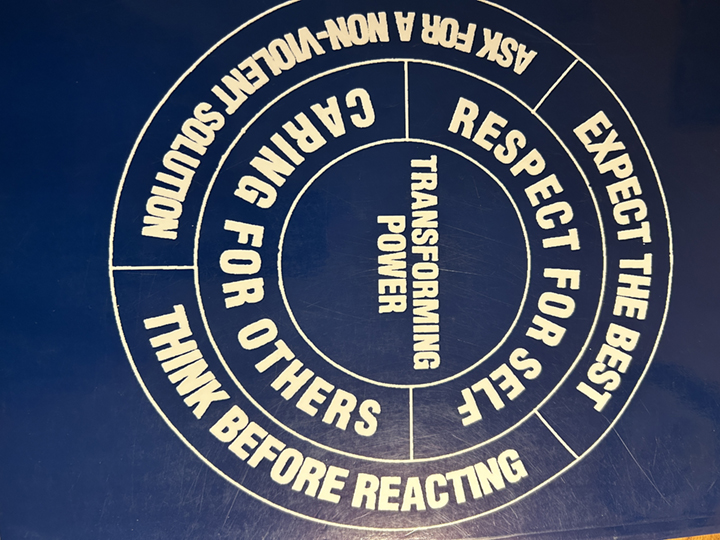
In the Alternatives to Violence Program (AVP) we call that kind of personal agency “Transforming Power”- power with, not power over. But how do we get to a win/win outcome when firm limits are being set by uncaring authorities- correction officers or bureaucratic state agencies? For the website see: https://avpusa.org and https://avp.international.

   In his wonderful new book Aikukan (p. 150) Minagawa Sensei writes that one of the vital aspects of keiko is “ The importance of letting others cut you-self-sacrifice”. In my experience this approach is not tenable with prisoners, DYS youth or those recovering from trauma. They are just too vulnerable to risk that the oncoming strike will be “the cut that heals”. Or in the prison vernacular, “Taking a short is for suckers”.

   One of the group discussion questions in the program is “What is Violence”? Folks usually begin by mentioning fighting and the use of force. After a few minutes, the conversation broadens to other issues like hatred, abuse, addiction, neglect , poverty, and other non-physical stuff. But over the past few years, I’ve come to my own understanding of violence as anything that keeps us from being our best selves or that separates us from each other and the unity of all creation. 

   King always stressed that we must strive to overcome the cause of the injustice, not defeat the people on the other side. In these difficult times with the risks so harsh and the consequences so costly, perhaps the current challenge for all of us to address is the interface between our relationships and our kumite practices, both in and out of the dojo.

   Can we create and hold enough space to reconcile with those whom we have serious differences? What would such kumite look like?

Book Review -Stephen Billias, The Zen Time Traveler

by Derk Richardson

Published:

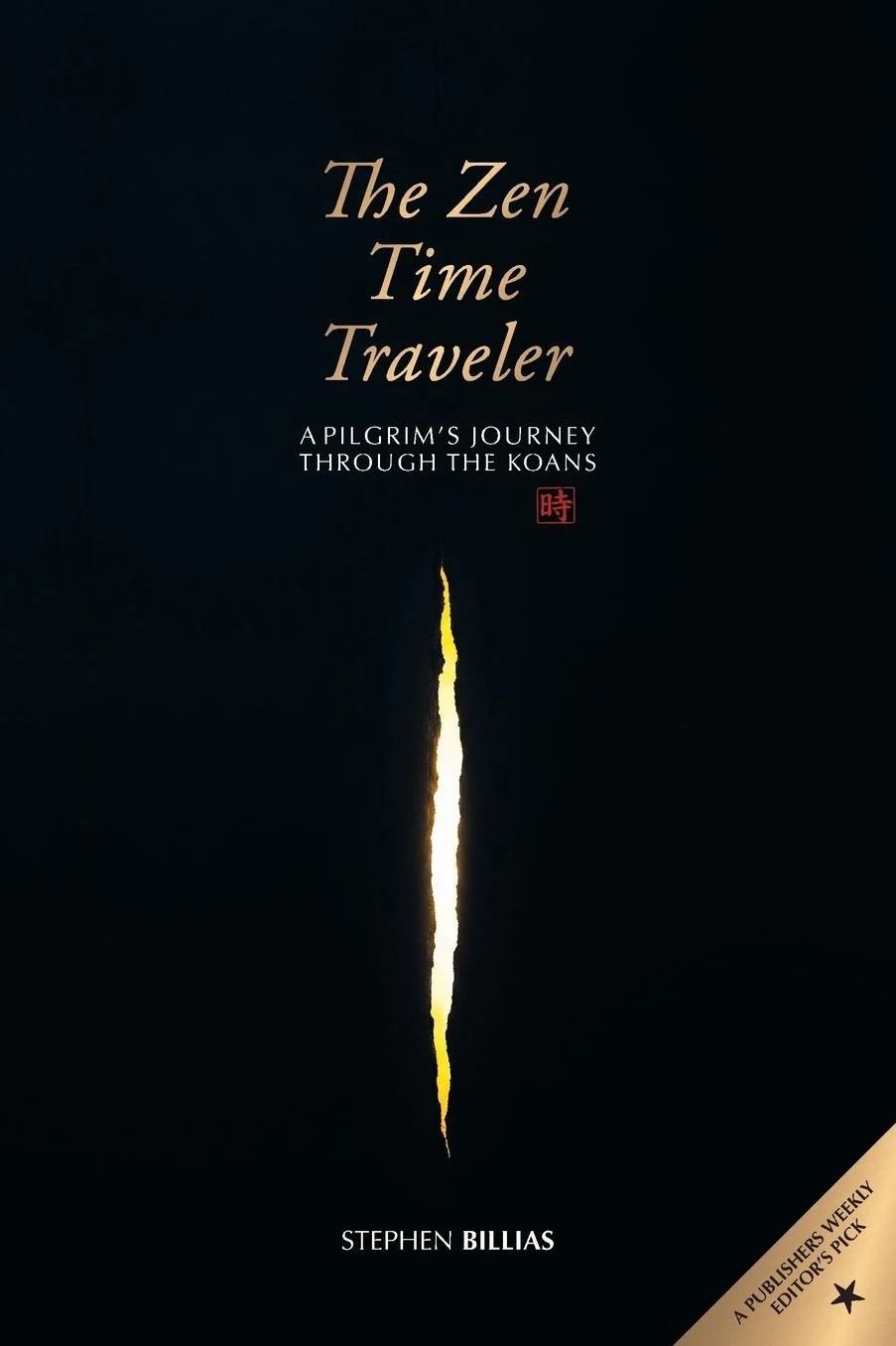
In his new book, The Zen Time Traveler: A Pilgrim’s Journey Through the Koans (Discovery Publishers), Stephen Billias weaves together the fantasy of leaping back and forth across centuries, the mystery of interchangeable and intermingling identities, and the timeless theme of spiritual quest into a compelling story that is virtually impossible to put down until you get to the surprising end. Along the way, he challenges our conventional understanding of time, space, and self while taking us on his protagonist’s journey toward awakening through the obstacles of craving, attachment, and delusion.

Many of us know Stephen as a fellow Shintaido practitioner and instructor, a former Body Dialogue editor, and the cofounder, with his wife, Bela Breslau, of the Shintaido Farm (now the Engaged Mindfulness Institute) in Deerfield, Massachusetts. He has also been a theater actor, screenplay writer, technical publications manager, and the author of seven published science fiction/fantasy novels, a collection of short stories, and, cowritten with Bela, the literary novel Pilgrim Maya. But it is his Buddhist practice that inspired him to write The Zen Time Traveler.

“Shintaido was my practice for many, many years, since 1990,” Stephen explains. “Around 2010, as my body aged, I realized a lot of the movements were too difficult for me. My body just couldn’t do them anymore.” He turned to Tai Chi, under Wolfe Lowenthal at Long River Tai Chi Circle in Western Massachusetts, and more recently immersed himself more deeply in Zen. “I’ve been a Zen student for most of my life,” he says, “but didn’t have a real practice until maybe five to seven years ago. I had done a lot of reading of Buddhist books, but I found the real meat of the thing in Zen sitting.”

Sitting in meditation and contemplating Zen koans is the starting point for the new novel. The protagonist and his unusual journey are described in the publisher’s summary:

Stephen Maine is a middle-aged project manager navigating the collapse of his marriage and the quiet despair of modern burnout. But his weekly Zen meditation class in a Massachusetts church basement offers an unexpected escape. By reciting a mysterious haiku, Stephen finds his consciousness hurtled across the space-time continuum, landing squarely in the body of Wùkōng, a Japanese monk traveling through Song Dynasty China in the year 1225.

“In this vibrant, dangerous ancient world, Zen koans are not abstract intellectual riddles—they are visceral, life-or-death encounters with legendary Chan masters. As Stephen navigates this dual existence, he finds himself increasingly drawn to the past, captivated by a fierce, magical sword maker named Yabaku, and the thrilling asceticism of his host’s spiritual quest.

“I can’t really point to a moment where I said, I’d like to write a time-travel fantasy about Zen Buddhism,” Stephen Billias notes. “I wish I could pinpoint that moment when I was, you know, sitting in the Zendo and thinking of the haiku and was transported to the 13th century, but I don’t think it happened that way. It probably just happened one morning at my desk, thinking, how can I best bring these koans to life? I very deliberately chose to write a book about Zen koans without having done any formal koan study. At the end of the book, the character, Stephen, hasn’t solved any of the koans. And neither have I. But I’m about to start doing a more formal koan study with my main teacher.

“In that respect, I have two main goals for the book,” he continues. “If it is read by people who have no idea what a koan is, this will be a fun introduction. If it’s read by people who are Zen practitioners and have studied koans, this might just be a fresh or unique way to look at them.”

Stephen sees close parallels between, even convergences of, Shintaido and Buddhist practice. “The overriding idea of Buddhism,” he explains, “it that when you get rid of your ego and you aren’t clinging to anything, you are going to be free. And it’s available to you right now. And I think Shintaido has a method of ridding you of your ego by exhausting your body until you don’t have that, your ego, to fall back on anymore.”

He also notes that master Shintaido instructor Mashashi Minagawa, in his recent memoir, Aikukan: A life in Shintaido, introduces a kata that fuses the final chanted words of the Mahāyāna Buddhist Heart Sutra—“gate gate pāragate pārasaṃgate bodhi svāhā”—with Shintaido movements.

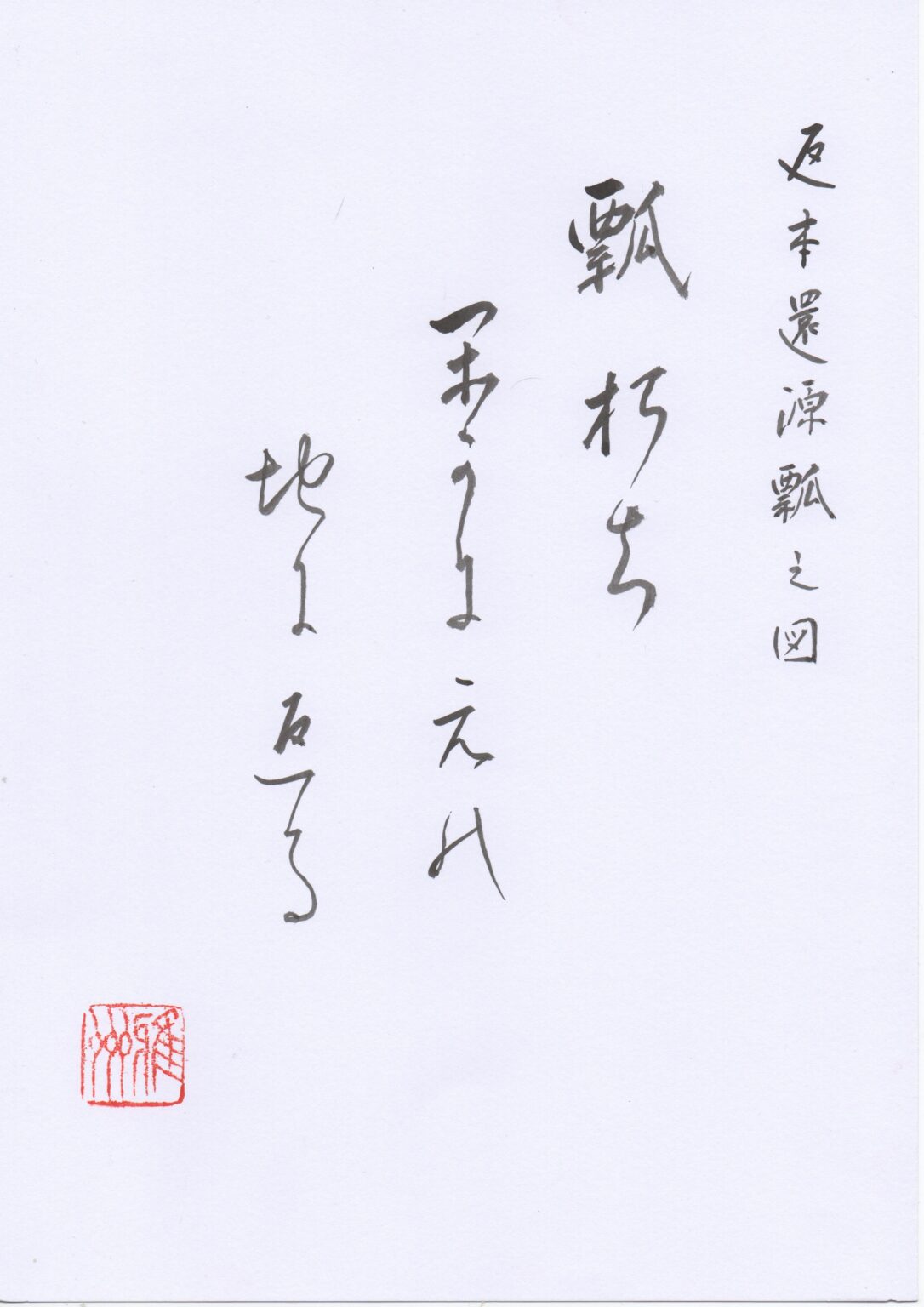
And in a serendipitous development, Minagawa-sensei made an essential contribution to the physical presentation of The Zen Time Traveler. “I had such a wonderful kumite with him,” Stephen says. “I sent Discovery Publishers a haiku of mine that Tricycle magazine had published. They liked it and had their designer create a sumi-e (brush-and-ink) image to go with it at the end of the book. It was a gourd, which is the subject of the haiku. I suggested we get somebody to translate the haiku into Japanese and put that on the illustration. I contacted Minagawa-sensei and asked him if he’d be willing to translate the haiku and, because we know he is an outstanding calligrapher, if maybe he would also do calligraphy of it. He did, and they loved it.
But Minagawa didn’t stop there. He, as Shintaido people do, went beyond. The image of the gourd reminded him of the ninth of the Ten Ox Herding Pictures (a series of drawings that accompany short poems used in the Zen tradition to describe the stages of a practitioner’s progress toward enlightenment), so he added a little bit in Chinese kanji referencing the ninth picture’s title. The published loved that, too, and they found the poem that goes with the ninth picture and printed it on the facing page. As I said, we had a great kumite—Minagawa-sensei, me, and the publisher—in that process.”

In condensed form, the two-page spread represents Stephen’s intention as the author of The Zen Time Traveler. “My real goal in writing this book was not fame or fortune,” he says. “I’m not a teacher, I’m not a Roshi, I’m not an abbot, I’m not a priest. I’m just a fantasy writer with a Zen practice, and I felt like this was how I could contribute to the spread of the Buddhist dharma in some small way.”


Stephen Billias and Bela Breslau will be hosting a book launch party for the publication of The Zen Time Traveler on Sunday, July 12th, from 2:00 to 4:00 p.m. at the Engaged Mindfulness Institute (formerly the Shintaido Farm), 595B River Road in Deerfield, Massachusetts.

Barnes & Noble link for the book (and its cover image): https://www.barnesandnoble.com/w/the-zen-time-traveler-stephen-billias/1149835205?ean=9781788946896

The illustrations referred to above can be found here:
https://billiasbreslauwriters.com/stephen-sketches-the-evolution-of-an-illustration/

New Pacific Shintaido Board of Directors

New Pacific Shintaido Board of Directors

Published:

As of May 1, 2026, the Pacific Shintaido Board of Directors was reconstituted with five new members: Jennifer Peringer, Martha Rodriguez-Salazar, Tom Abbott, Jason Ravitz, and Matthew Spigelman. They had been nominated by the outgoing board—Shin Aoki, Cheryl Williams, and Derk Richardson—at an open Pacific Shintaido meeting in San Francisco on April 21. A survey of PacShin practitioners found no objections to their installment and no additional nominations, so the new board is in place and will serve for a minimum tenure of one year. Each new member brings a unique personal history of Shintaido experience and a unique set of skills that will benefit the organization. Shin, Cheryl, and Derk had worked together on the board for well over a decade. Among possible projects for the new board are revitalizing the PacShin website, supporting teachers and their classes, promoting the growth of Shintaido, enhancing PacShin social media presence, supporting regional workshops, and overseeing the organization of Kangeiko 2027 next January. 

The board can be reached at board@pacshin.shintaido.org

Transferring Knowledge from Kumite to Conflict Transformation

Transferring Knowledge from Kumite to Conflict Transformation

by Tomi Nagai-Rothe

Published:

This article was written as part of the Asian-American Restorative Justice Network’s reflections document, following two years of funded gatherings by the Asian Law Caucus.

As a longtime practitioner and teacher of Shintaido, I have been interested in martial arts applications to interpersonal conflict. My teacher used the term “software” to describe applications outside the dojo (practice space), in contrast to the “hardware” of traditional martial arts practice. In 2023 and 2024, I piloted this approach through a series of five-day workshops focused on embodied martial arts and creative conflict transformation.

About Shintaido
Shintaido’s lineage is through Master Shigeru Egami – founder of Shotokai Karate – who was a disciple of Master Gichin Funakoshi – the founder of Shotokan Karate and considered to be the father of modern karate. Karate’s roots are in Chinese Shaolin martial arts, with roots in Buddhist philosophy which originated in India and migrated to China, Korea and Japan.

Master Hiroyuki Aoki, the founder of Shintaido and a disciple of Master Egami, started out as an actor and found the martial arts to be his creative medium. His study of Buddhism, Christianity, Taoism, Hinduism, and improvisational music and art brought together past and present through Asian traditions and other influences.

Partner Practice (Kumite, Japanese for “intertwining hands”)
Martial arts often use a partner practice form: one-on-one sessions as short as 5 minutes but often longer, kumite is the physical analogue to an interpersonal relationship.

Boundaries
Kumite has a clearly defined beginning and end. Bowing in, we respect our partner and the spirit they bring. Bowing out, we thank our partner and acknowledge the end of our short practice relationship. The following values and guidelines create further structure to the interaction and relationship.

Values & Guidelines

      • We respect one another
      • We are in this together (for a defined period)
      • We have a responsibility to one another (we will keep each other physically safe)
      • We are building a creative container together
      • My end goal is to uplift my partner
      • Our working relationship has boundaries (a clear and mutually understood beginning and end)
      • My partner can teach me more about myself
      • Other people are holding the larger space around us

How Does Kumite Teach Us About Moving Through Conflict?
Practiced over time, kumite creates a profound somatic dialogue through a structured interaction, bypassing the limitations of words and language. The resulting relationship can provide a somatically grounded and trusting connection encompassing mind-body-spirit. This relational foundation can help withstand the turbulence of interpersonal conflict.

Somatic Attunement to Ourselves and Others
Somatic observation as self-reflection: Because our bodies carry information we may not be aware of, noticing how we stand and move can provide insight into our state of mind-body-spirit. For example, with the help of an attentive partner or teacher, we may find out that our energy is on our back foot –  holding back – even if we are not conscious of it. This provides opportunities to reflect on what may be causing the holding.

Our experience of movement is different with each partner, because even though the basic movements are prescribed, each person brings their own body type, personality, energy, and perspective to the interaction. This calls us to be somatic listeners – attentive to the nuance of movement and energy – not simply words. This can be very helpful when the participants have different first languages.

Ultimately, this helps us see that we are more than verbal communicators: talk is only one tool to help us address conflict.

Resilience: Transforming Turbulence
In Shintaido, the physically and mentally challenging aspects of kumite offer insights for working through conflict. Our Wakame (seaweed) practice is calming and meditative, and can be practiced individually, but most often with a partner – and occasionally in a group.

One person is the seaweed, rooted in the ocean floor, and one person is the ocean current. The ocean current leads the seaweed in movement. The partners work to come into a deep harmony with one another by taking turns as the seaweed and the ocean, creating a rhythmic movement until they find a shared meditative space.

This moving partner meditation practice comes from a high-speed running karate kumite in which one person runs at their partner full force. The desired outcome is to uplift and make one’s partner brighter – not to stop or defeat them.

This “attack” is a pure and sincere effort to connect to the core of one’s partner: to wake them up and dislodge whatever energy they may not need. It’s an explosion of compassion. The depth and sincerity of the attack creates the opportunity for transformation.

The kumite begins with running and fast flowing movement led by the receiver. They move the attacker to the side, roll or move them in flows using friction to deepen the connection. The attacking partner keeps reaching out because the receiving partner keeps inviting them in, creating space for them to keep moving toward them.

Then a strong karate block creates friction, changes the pace, and builds a stronger connection. Slowly the partners’ energies align, their movements slow as they tire. The receiver invites the now tired attacker into the flowing movement that leads to wakame. By the end, they are one flow of movement, one breath with shared perspectives.

When I teach, I demonstrate the roots of the wakame practice to show that turbulence and friction are key elements in the process that leads to creating connected relationships. A valuable lesson in staying with a conflict even when things get difficult.

Awareness of Time and Space
Timing: In the martial arts, timing is everything. Slow timing results in more physical conflict.
Quick (anticipatory) timing creates space for movement and transformation. This provides many opportunities to reflect on relationships outside the movement practice at the individual and group level.

Movement activity groupings: The exercises are organized into individual, 1:1/partner, and group, nested within one another. As individuals and partners we live within a larger community. In Shintaido, the corollary is group practice in which there are multiple and shifting partners, and sometimes group movement in a dance-like form. Group practice strengthens the values and guidelines listed above to create a trust substrate over time. These can be organized into pre-conflict, conflict and post-conflict phases.

diagram by Tomi Nagai-Rothe

Where we position ourselves in relationship to others in life is modeled in how we work in the dojo. This physical modeling provides a tool for exploring and being curious about how we stand in relation to those around us.

Final Thoughts
Just as Restorative Justice is a living practice, martial arts-derived movement is a practice. It need not be complicated: the structure of a few key activities and the values they embody can become a shared language of relationship – something to lean on when words fail to create the connection we need.