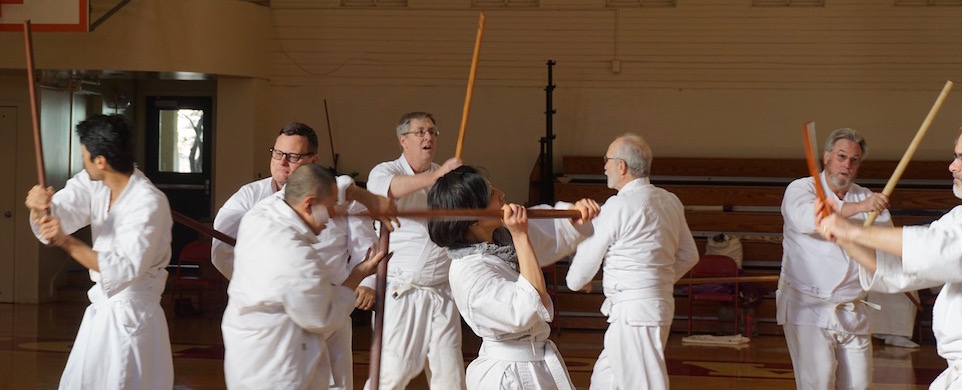
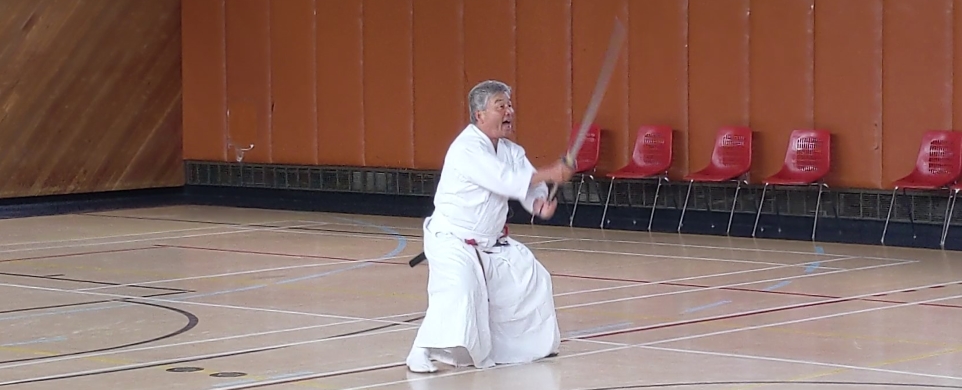
Shintaido kenjutsu is our newest exam curriculum. The first draft of the curriculum was being worked on by the International Technical Exam Committee in 2016 (see Body Dialogue #39) The most recent version of the curriculum has now been added to the website along with notes for the partner sword exercises, Jissen-Kumitachi, required for nidan and sandan.
Lee Ordeman will be teaching a series of 5 classes on Saturday’s beginning Saturday, September 28. Classes will be taught from 2pm-3:30pm. This Saturday’s class is free and will be held at the Sixth Presbyterian Church. The remaining classes will be held in Rock Creek Park for only $10 per class!
Connie Borden will be offering 4 classes this fall to study Taimyo, Musoken, and Tenshingoso beginning next Tuesday from 7:00pm-8:30pm at the Day Street Dojo. You can find more information in the event calendar.
What is the strongest martial arts technique? Over the years, I have heard different answers depending on style, training, and teacher. Some believe a strong kick, others a strong punch (tsuki), others a secret mix.
How would I answer the question if I were asked this morning? My response would be “Shintaido kaishoken is the strongest technique and worthy of daily practice.” In the Shintaido glossary, kaishoken is defined as the “opening and expressing hand”. Maybe that’s a puzzling answer to some. Others may have a different understanding and thoughts on the subject. Here’s my current thinking and perspective.
When I first started studying martial arts, I observed a fascination with developing the most efficient technique to address a perceived opponent. In the Funakoshi-Egami-Aoki lineage, there is a well documented path that occurred to develop the tsuki (as currently practiced in Shintaido) as a proven technique.
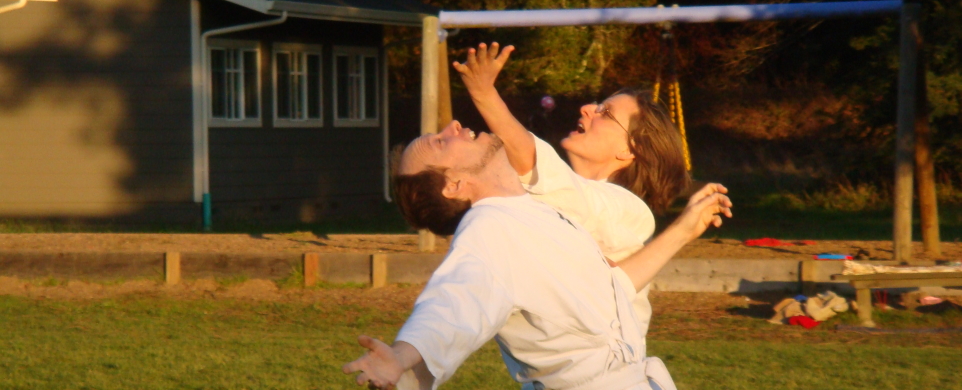
As I understand the story, there was immediate joy when Master Egami found his new tsuki (front-punch). Very efficient, elegant, flowing motion, full body application of force that could easily knock a man down with one blow. An elegant weapon if there ever was one.
Photo by Mark Bannon
What followed, however, was a realization that this new technique was so powerful that the traditional blocks and strategies were no defense against this new tsuki. An even stronger technique was needed to respond to this new weapon. A literal arms race had ignited.
The story of the tsuki is in Section Seven of Master Aoki’s Shintaido book. Master Aoki discusses the research he and Master Egami did to become “tsuki specialists” and his discovery of kaishoken as a defense against the new tsuki.
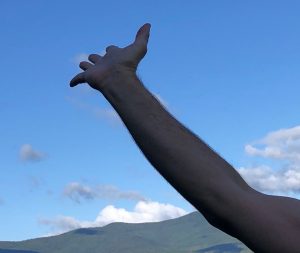
I began trying the open hand as a technique to receive a tsuki. At first, it was not a very satisfying technique. As I continued my Shintaido practice, I heard other students ask about kaishoken. I was apparently not the only one that didn’t immediately get it. In response, more experienced students (senpai) would respond that, kaishoken in Shintaido actually means “open hand – open body.” This expanded definition started to make more sense. Very good. I could practice that – receive the tsuki with an open hand and an open body. My technique seemingly started to improve.
As improvement came, a senpai instructed me to open eyes. Pay attention, see everything. Don’t become distracted by shiny objects. That lesson resonated. It occurred to me that kaishoken was not only open hand, open body, but add open eyes. Don’t fall into the trap of your surroundings and initial encounter. See everything. Look at the situation with soft eyes. Take it all in. I was feeling pretty jazzed with kaishoken at this point. What could be better?
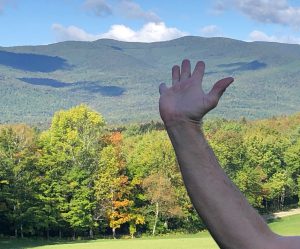
A few weeks later I attended a Shintaido workshop in Quebec. During the exercise, I was instructed to “open my mind” and go beyond this world and travel to the corners of universe. See all the angles, potentials, challenges, look beyond, travel time and space. Wow. Things changed. I experienced something new. From that moment, my Kaishoken evolved from open hand – open body – open eyes – to open mind.
Phot by Mark Bannon
Armed with an open mind, I saw possibilities coming at me before they were in sight. I was no longer on the defense. I was actively receiving intention and anticipating. Now that is a strong technique! I started using my new kaishoken (open hand-open body-open eyes-open mind) in all sorts of circumstances. I was using kaishoken at work improving relations with co-workers, with clients building more innovative projects, and building closer relationships with family and more meaningful relationships friends. A true keiko was developing.
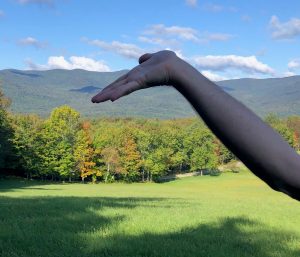
Then one day I found myself in an encounter and I admittedly didn’t handle it very well. Nothing serous, but I thought about it all day and actions I could have/should have taken to cause a different outcome. It suddenly occurred to me, the answer could be kaishoken. This time, I realized had I approached the encounter with an open heart, the result could have been much improved. I realized kaishoken is really open heart.
Photo by Mark Bannon
My definition of kaishoken started simply as a glossary note “open-hand.” As my practice became more rich, my understanding evolved: open hand – open body – open eyes – open mind, – open your heart. Kaishoken is arguably the strongest technique and one I need to practice every day. A technique to end the arms race.
During the workshop last weekend held by Québec Shintaido Doshokai, Master Instructor H. F. Ito gave the following demonstration of the Shintaido kenjutsu kata, “Chuden no Kata” with the naked blade.