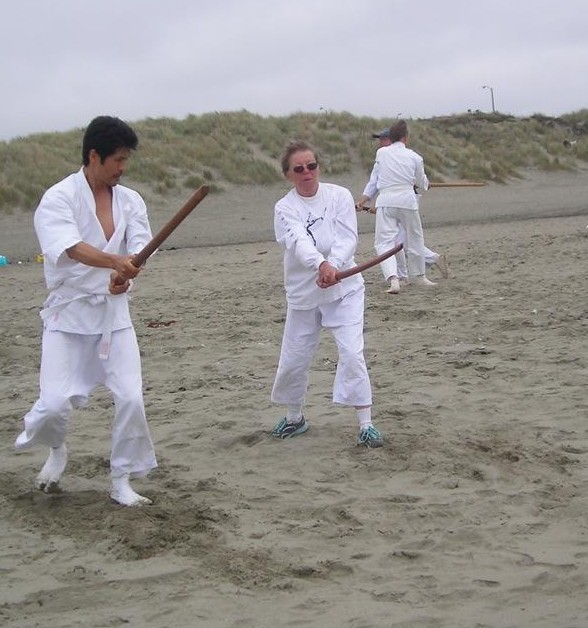
Across Time and Space: Interview with Aoki-Sensei, 1986
Reprint: Interview with Aoki-sensei on August 24, 1986
By Michael and Leslie Goldberg
Re-Published: September 2, 2026
SoA: What were your impressions of Shintaido Ten?
A-S: It was very beautiful, very pretty, very peaceful on the surface yet underneath I felt there was a lot of energy which never emerged, like an egg which hasn’t been broken. But it wasn’t the right time for that energy to emerge. Later, an instructor might help the group break through the shell.
SOA: Could you compare Shintaido Ten with the first International Gasshuku, which was held In San Francisco In the summer of 1980?
A-S: The first International was much bigger, much wider, stronger and ROUGH. This time was not rough. It was different: better organized and softer.
SoA: Did you like the Idea of giving students the opportunity to choose their own type of keiko?
A-S: It was a very fresh experience for me. And I thought it was good because, say, one person might want very hard training, and another might want to have just deep meditation.
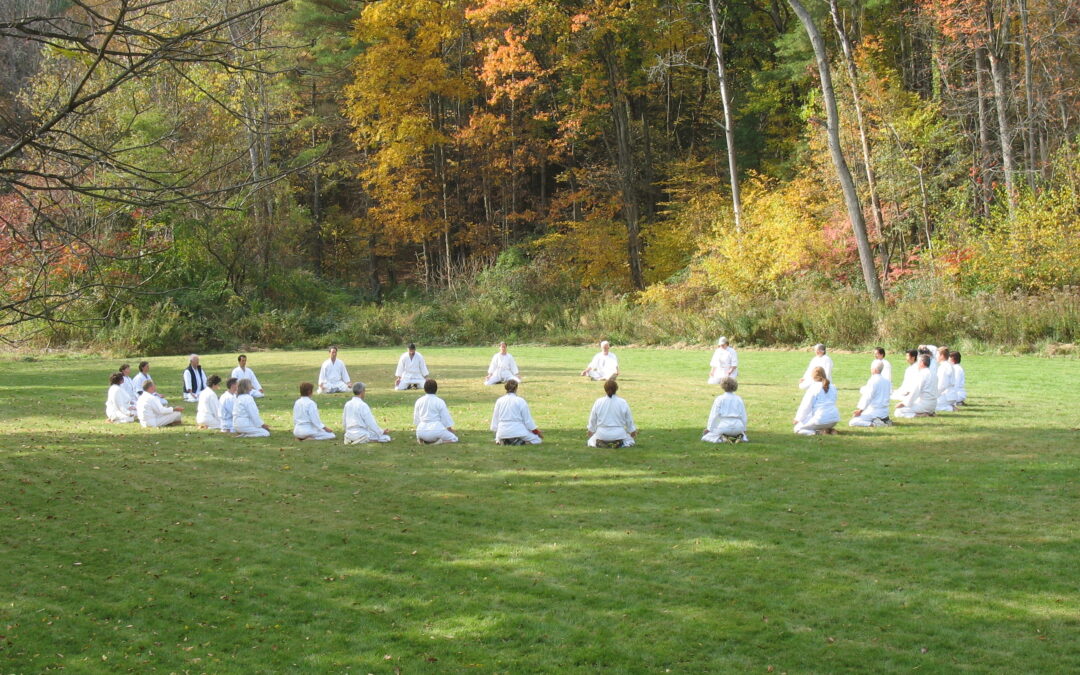
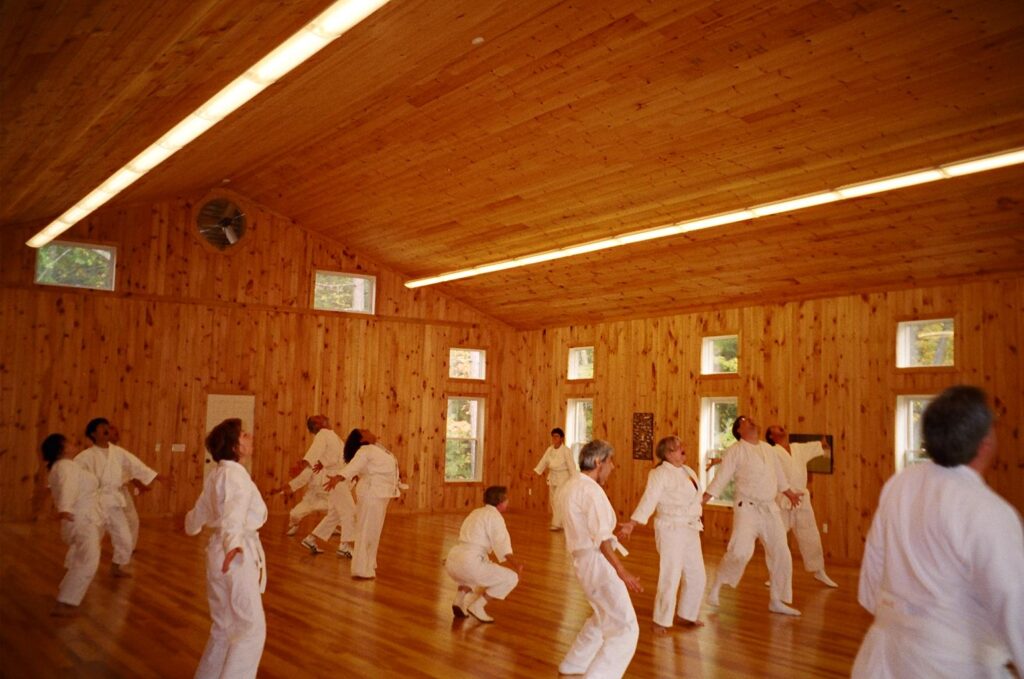
For instance, Hideko’s group was very soft and peaceful. It was very beautiful, eh? On the other hand, Ken’s group had a very martial arts feeling. Both groups were good. The two give Shintaido balance. Shintaido itself consists of a very open technique and a very soft technique.
SoA: Please talk about the difference between open technique and soft technique.
A-S: There are two systems in Shintaido: open and soft. Personally, I prefer the soft system. But when I started Shintaido my body was very strong and I was young and I had many young followers, so I started with open technique.
It’s better to start, if you can, with open technique. Open your system. After I completed this, then I started to develop soft technique.
Soft keiko is very good for someone who has a weak body. Open keiko is very strong. If you start with soft keiko and eventually do open keiko, you might find that it’s not so difficult.
Cezanne, Picasso, Walt Whitman, Abraham Lincoln are all living people for me.
People like Pascal, Dostoevsky, Henry Miller, Basho, all speak to me right now.
SoA: We understand that over the last five years, you’ve spent a lot of time developing the soft Shlntaldo program in order to bring Shlntaldo to a larger group, including older disabled people. Have there been obstacles or frustrations?
A-S: Recently we’ve started teaching Shintaido at several “cultural centers” in Japan. Many of the students are elderly. When we started to teach them kai kyaku dai they said, “Oh no, we can’t do it.” They’d take maybe two or three steps, that was it. It took us one and a half months to teach Tenshingoso. For Tenshingoso kumite, they needed one and a half years. It was difficult because they often had a negative attitude. They’d say I can’t do it because I’m very aged or I’m very weak or because I’m a woman.
We kept at it because of our love of Shintaido and our love for them. We’ve had to work on our teaching methods.
SoA: Have you ever wanted to quit?
A-S: No! I’m like a bulldog. I don’t give up.
SoA: What are your Impressions of the United States?
A-S: To answer that, I’d need 24 hours! In this country, there are so many people, so many races, so many ages, so many different value systems. So, they’ve made everything very plain, very simple in order to reach the widest number of people. That’s OK, but many American people have become slaves of simplicity. They’ve lost the ability to understand deep matters. Very often people say to me, “Shintaido is very difficult, please explain it more simply. If I were to do that, it might be good for business, but it would be a disservice. “
Keiko should be very simple. But the philosophy should be very rich . . . keiko becomes simpler, philosophy should become deeper.
Many American people have become slaves of simplicity. They’ve lost the ability to understand deep matters.
SoA: Could you talk about the “American neurosis?”
A-S: The psychological dilemma of the American people is very deep. It’s one of the deepest, because this country has so much stress.
Relationships are very distant and the culture reflects that. In America if an individual happens to be very strong or if he has a lot of talent or money, life can be comfortable. But for a weak person, I think American life is too severe, too hard. If he’s weak, he often ends up living a very lonely life. That shouldn’t be. animals should live in a group. But in this country, everybody lives by himself. At least it looks that way to these Japanese eyes. So wakame (seaweed) kumite is very good for American people.
SoA: Could you talk about the difficulties of Japanese life?
A-S: In Japan, a lot of the stress comes from so many people living so closely together. It can be exhausting.
SoA: How does Shlntaldo offer relief for some of the stress?
A-S: Some people in Japan say Shintaido is a spiritual sunburst. Soft Shintaido relieves people’s tension and softens the body. The body returns to a more natural state. And if they next study “open system,” their possibility is very great. Shintaido people have very bright faces, don’t you agree?
SoA: What suggestions do you have for teaching the new student?
A-S: It’s more important to just work with them rather than instruct or teach them. This is especially important with children. If we work with them that’s enough. Then they begin to enjoy it for themselves.
Private practice is essential. If the beginner can just do meditation or Tenshingoso — anything is OK — at home or at a nearby park, then he can find Shintaido himself. Then Shintaido becomes his own. Until then, Shintaido is just given.
SoA: Please talk about the student-teacher relationship.
A-S: A Japanese will have utmost respect for a teacher. Your teacher is your teacher forever, even if you surpass him. It’s not that way in the United States. Here, someone might study from a certain teacher and then just decide to start his own school. In Japan that would never happen.
SoA: What are your Influences?
A-S: I started Shintaido, but I have been given so many things from many sources — senseis who have gone before me, from Western artists, musicians, novelists and theologians. So, they’re all my teachers.
For me, Van Gogh is not just a historical figure; he’s a person in my life, a living person. Cezanne, Picasso, Walt Whitman, Abraham Lincoln are all living people for me. People like Pascal, Dostoevski, Henry Miller, Basho all speak to me right now.
SoA: Who are your 10 most favorite authors?
A-S: It’s very difficult to come up with a list of 10 because. I’m reading a new book almost every day. The question is difficult because it’s like who are the10 most beautiful girls.
Anyway, I really like ”The Imitation of Christ” by A. Kempis. It means “to follow Christ.” I like Dostoevsky very much. I’ve read the essays of Montaigne over and over again. Walt Whitman is very great. “Uncle Tom’s Cabin” – that book is very great. I like Henry Miller, although his sensibility is very different from mine. I would list Stendahl’s “The Red and The Black,” Rimbaud’s “A Season in Hell,” and “A Hundred Years of Solitude” by Gabriel Garcia Marquez.
When I was in high school, I saw the movie “Death of a Salesman.” Oh, that was something!
SoA: What about music?
A-S: Ah music! I’m much more influenced by music than I am by karate.
SoA: Who are your favorite musicians or composers?
A-S: Louis Armstrong, Jimi Hendrix, Thelonious Monk, Tina Turner — I like her very much, and Marvin Gaye. Of course, Beethoven and Mozart. Recently, I’ve been listening to baroque music a lot. But I also like folk songs of each country.
During the last two years I’ve studied Buddhism and Chinese classics. It’s very interesting, but so difficult and deep — too great for me. My center of thought is probably the New Testament.
I’m more influenced by music than I am by karate.
SoA: Do you think that talking after keiko can enrich one’s Shlntaldo practice?
A-S: Yes, it’s very important. Students should talk more. After kumite, students should share their impressions. Say, “When you did this, this wasn’t right or it gave me a bad feeling. Or this gave a very nice feeling.” I can’t stress it enough. But you shouldn’t talk about your personal training. Keep private; It’s a source of energy. Of course, when a student has some problem, he should discuss it with his senior instructor.
Discussion among Shintaido students after kumite is so important because we can share our experience and study many things. We start to recognize that different people get different things or impressions from the same keiko. Also, as you come to understand another, you’re more able to make adjustments in your own perception.
SoA: Does Shlntaldo recommend any type of meditation?
A-S: There are several different types of meditation in Shintaido. We have a formal standing mediation which has 10 different poses. We also have seiza; open seiza and soft seiza. There are two lotus poses: complete lotus pose and the half lotus pose. The lying down pose. In yoga they call that the dead man pose. We have wakame kumite. This way we get meditation with movement. So that when we go about our daily life, cooking or cleaning the apartment, we can have meditation or deep concentration.
SoA: How can Shlntaldo students deepen their “um?”
A-S: For centuries people have known that meditation is extremely valuable, but of course it’s very hard. Part of the reason I developed Shintaido was that I wanted to make the benefits of meditation available to ordinary working people. I think this can be done by incorporating Shintaido into daily life.
Shintaido involves deep concentration. In practice we emphasize the lower art of the body. This is very important. It’s a way of rejuvenating the body. Shintaido also tries to make the body straight, so that we can take down our center of gravity. We aim to relax the body and take down our energy all the way to the bottom of the feet — just a half inch from the center of the arch of the foot (towards the toes). If a person does this he can become very quiet.
If you do this two or three times, you can get very deep concentration and stop thinking. Then you don’t have to take your breath down anymore. Students might then do any one of the types of meditation for 20 or 30 minutes a day. I’m not saying, however, that this is THE way to achieve satori or some enlightenment. That’s not my business.
SoA: During one of the keikos, you said for people to take rest If they wanted and that this was not a “Shlntaldo ghetto.”
A-S: We do Shintaido because we like to have a happy time. And also, because we want to be more ourselves and more free. If an instructor is very authoritarian, saying do this, do that, etc., etc., we cannot be ourselves. My gorei is very different. I don’t try to teach so much; rather I try to give them an opportunity to study. If somebody thinks they’re being forced by me, it’s not my idea. I support a student’s aspiration to become free or to become better — that’s all. I can only cook a very good dinner, but I can’t force anyone to eat It. I wouldn’t want to.
SoA: What advice would you give to parents of children who are studying Shintaido?
A-S: Sometimes parents bring their children to our dojo and they say my boy is withdrawn or aggressive and please help us. But almost always parents have the same problem! I say OK, maybe Shintaido can help your boy or girl, but then the parents go on and on, saying my boy is this, that and the other. They never give the kid a chance to come to us on his own. Finally, I usually have to say, “No I cannot help. The child is not the problem, you are.” I have to be very honest.
SoA: How can a parent encourage his child?
A-S: If parents study Shintaido with the child – that is the best way. It doesn’t matter if the parents are very unskillful. Kids don’t expect their parents to be so great. They are just happy to have their parents do Shintaido with them. The atmosphere in the home can become very nice. Communication improves.
In terms of raising a child, I say if you find 10 good points in a kid, praise him 10 times. But if you find 10 weak points, please mention only one. Parents usually point 10 times to each weak point.
SoA: During the gasshuku you lectured on the haiku poet Basho. For those who weren’t there , what can we learn from Basho’s example?
A-S: Basho studied only one thing — haiku, which is a very simple kata. Haiku is so simple, but it offered him limitless possibilities.
If you try to study all sorts of different things, it’s no good. Also, Basho did meditation continuously. Through that he became himself. But he wrote haiku with his disciples. He lived with many people and he did meditation, therefore he had very good balance. And he did a lot of traveling.
Basho also studied nature. He touched nature. He became one with nature. This is very important, especially in the United States. You have many opportunities to commune with nature. It’s very nice: the beach, the desert, the forest. Because most people live in cities, this is even more important than before.
SoA: Why are gasshukus so Important?
A-S: Like the other animals, humans are supposed to live in a group. Sometimes we forget that. We don’t respect our neighbor. We think the world revolves around us. So, it’s very important to work with many people, to have that experience. If we have a gasshuku, we can study so many things from neighbors. Of course, a piano solo is very nice, but an orchestra is very great.
About the Authors:
Leslie Goldberg