
21 Days That Will Improve Your Life – hybrid Shintaido course with David Franklin
by David Franklin
an online / offline Shintaido course that takes 15 minutes per day for 21 days
Starting Sunday April 25, 2021
Details of the program and registration here
Personally, I don’t like Zoom meetings much. Doing exercise through Zoom is slightly less bad than a meeting, but it still lacks something. As I mentioned in a previous Body Dialogue article, there are some experiences we can only access when we are physically in the same space together. Those kinds of experiences cannot happen through the Internet.
Rather than trying to imitate or simulate those face-to-face experiences, which would be like banging my head against a brick wall, I decided to design an online Shintaido course with a different objective: to take as little time as possible online to supply participants with a program that they can “unpack” and later practice offline as a solo practice. That’s why I came up with the format “21 days, 15 minutes per day.”
In real life, Shintaido classes are typically 90 minutes or two hours long and people sometimes say they don’t have time to attend. It can be high bar for beginners. When we practice online, even a practice as short as 45 minutes may feel a bit tiring rather than invigorating because of the various problematic effects of video conferencing on the eyes and brain, a phenomenon that’s been labeled “Zoom fatigue.” (There’s an excellent National Geographic article explaining the reasons for Zoom fatigue here).
But what about a 15-minute class? If you were (or are) a complete novice, would you be more likely to give Shintaido a try if the class only took 15 minutes? Avoiding “Zoom fatigue” is only one of the reasons I came up with the format of 15 minutes per day for 21 days. Another reason is to encourage regular daily practice, and this requires forming a new habit. It’s not scientifically clear how long it takes to form a new habit, but after I intuitively chose 21 days, I found out that many experts recommend this. In fact, there is something called “the 21/90 rule,” a rule of thumb that if you commit to a goal for 21 consecutive days, it can become a habit; and if you continue your habit for another 90 days, it can become a permanent lifestyle change.
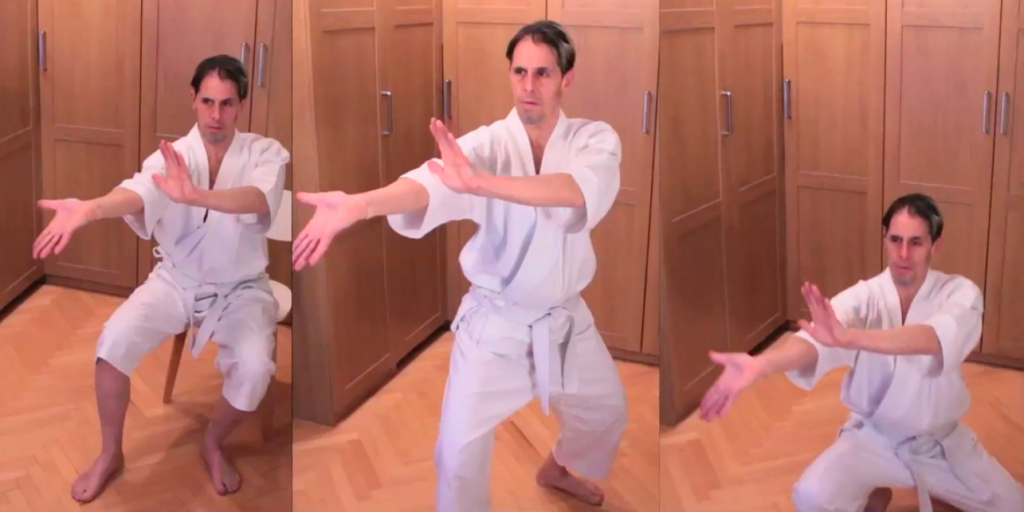
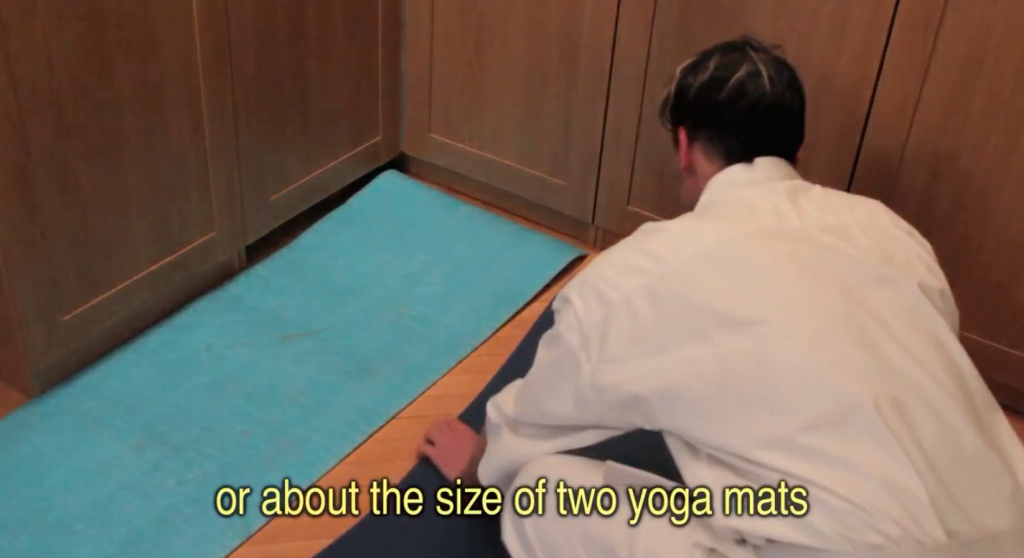
With this in mind, the structure of the course is meant to minimize the amount of time that participants spend online and maximize the habit of practicing alone every day, even if just for a few minutes. Solo practice is very empowering, especially if you learn flexible methods that allow you to practice outdoors when possible or indoors as needed. It helps you become independent and internally stabilized. Nobody can exclude you from it, nobody can unplug it, it doesn’t matter if the power goes out or what the weather is outside, and even if you’re very busy, you just need minimum 15 minutes per day and about three square meters of space.
An analogy for this process is when you receive a compressed file through the Internet, for example. Before sending, the other person’s computer has to do some work to make the file smaller (so it uses less memory or data). That’s similar to my work of preparing the course and the 1st week of instructional videos. Then the compressed (smaller) file gets sent through the “thin pipe” of the Internet connection, which is analogous to the livestream part of the workshop, which is limited to 15 minutes per day. Finally, after you download the file into your computer, your computer has to decompress the file before you can use it. This corresponds to the last week of the workshop, when you do the work of solo practice to integrate the knowledge into your movement.
The course is also designed to be accessible for people in a wide range of physical conditions, so just as you can choose the level of spiciness when you order Indian food for example, there are variations of techniques that I call “mild,” “medium,” or “intensive” that each participant can choose from according to their taste.
Another challenge of live-streamed practice (such as Zoom) is that when learning new material, it’s difficult to catch many details on a livestream. This can be due to poor picture quality, unreliable Internet connection, poor audio etc., none of which can easily be solved on the spot. The quality of sound and picture is usually better on pre-recorded online videos (such as Vimeo or YouTube) than on live-streamed videos. Pre-recorded videos also give us the chance to pause, to watch again, to focus on the parts that we want to pay more attention to. I’ve addressed that problem by using pre-recorded online instructional videos as part of the course.
An additional advantage of using instructional videos before the live-streamed Zoom classes is that when you “arrive” at the live-streamed part of the workshop, you can concentrate on following along with the rhythm. You don’t need to concentrate as much on the details of the techniques because you’ve already learned these details through the instructional videos. And this advantage will also apply as we return to having in-person practices.
Therefore, the course focuses on developing some of the basic movement principles of Shintaido: yoki-tai vs. kaiho-tai, kiri-komi vs. kiri-harai (if you are new to Shintaido and don’t know these Japanese terms yet, no worries! You’ll learn them step-by-step during the course). There are also techniques that are not unique to Shintaido, but are essential, such as using the ulnar (pinkie) edge of the arm to unify movement, vertical alignment, long focus, etc. Practicing these fundamental elements regularly will give you a foundation that will serve you well in any Shintaido class and at every level of experience.
So in the schedule, you’ll see that the first week of the course consists of practicing along with instructional videos that I’m creating specifically for this course — seven of them, one for each day of the 1st week of the course.
During the second week, groups will meet online and practice together. To accommodate people in different time zones, I’m offering two times each day:
- 6:45am CEST / 12:45am EDT / 9:45pm PDT
- 6:45pm CEST / 12:45pm EDT / 9:45am PDT
The third week of the course is when you commit to independent solo practice of 15 minutes per day with no videos, livestreams or devices for seven more days. Finally, there is an optional feedback and discussion meeting to be held online on the last day of the third week, May 16th.
Finally, I’d like to offer this course as a tool that instructors or group leaders can use. If you’re familiar with Shintaido, you’ll see there isn’t much original about the movement techniques that I’ll teach in the course. But I’ve tried to arrange Shintaido techniques in a way that packs a lot of content into a short amount of time and a small space (sort of like a bonsai tree). If you’re a Shintaido instructor or group leader, feel free to use this course as an open-source tool. You can offer this course to your students or friends and after they complete Week 1 (the instructional videos), you can teach Week 2 yourself, either online or in person (according to local conditions), and offer your own interpretation.
You can register and pay here.
Enjoy!
– David Franklin