Curriculum
The shintaido program consists of several disciplines including: shintaido core curriculum, karate, bohjutsu and kenjutsu.
The Shintaido Core Curriculum includes specific titles rather than Dan rankings. The other disciplines (karate, bojutsu, and kenjutsu) have their own curriculum with a very specific structure for techniques and ranking. This system is closely modeled on the ranking tradition found in other Japanese art forms, from other martial arts to calligraphy and even flower arrangements.
Shintaido examinations are held with the rigor and formality that is characteristic of traditional martial arts. Throughout the exams, strong concentration and particular attention to etiquette is requested not only from the examinees, but also from all who are present.
From more basic information about the study of shintaido please see our Study Shintaido FAQ page
For specific information of Shintaido of America Curriculum, please see each of the following:
Shintaido Core Curriculum
Open-hand Shintaido: movements focused on opening the body and voice. These movements are intended to unlock and express yourself. Practice with other class members is also involved.
Soft-hand Shintaido: meditative movement using gentle flowing patterns. These help you to relax, relieve stress and calm your mind and body. Often, older people or those with limiting conditions are attracted to the meditative movements for healthy, easier exercise and group involvement.
| RANK | REQUIREMENTS (current as of 12/2023) |
| MASTER INSTRUCTOR (Doshu) |
|
| GENERAL INSTRUCTOR (Dai-Shihan) |
|
| SENIOR INSTRUCTOR (Sei-Shihan) |
|
| INSTRUCTOR (Sei-Shidoin) |
|
| GRADUATE (Jun-Shidoin) |
|
| ASSISTANT (Senka-Joshu) |
|
| ADVANCED STUDENT |
SOA does not have specific requirements for the content of the Advanced Student evaluation, but provides this list of approved techniques from which regions may choose:
SOA provides this list of approved techniques for reference in making that decision, and also to inform instructors and students of what techniques may be included on the evaluation in other regions. |
An Advanced Student is a person who has decided to deepen his/her practice and begin to study more seriously. An evaluation may be taken after at least one year of practice. SoA membership is required in order to take the Advanced Student evaluation.
The evaluation is not an exam, and the rank of advanced student is automatically granted to the student as part of this evaluation process. (Both Advanced Students and more senior practitioners may request the opportunity to receive an additional evaluation at any event during which SoA exams are given.) The Advanced Student evaluation is not required by SoA in order to take the Assistant exam.
An advanced student is not entitled to attend Advanced Workshops held at the National level.
An Assistant is an Advanced Student or General Member who decides to commit him/herself to serious study of Shintaido and is willing to take on the role of class assistant. An Assistant may be asked to contribute some of his/her time and energy to help out with organizational matters in class and/or the regional or local organization.
An Assistant must be sponsored by a licensed Shintaido Instructor and complete an application form (available at Member Resources /Examinations, and should be submitted to the applicant’s Instructor, who forwards it to the Chairperson of the National Technical Council and to the Examiners.) An interview may be required before taking an exam. An exam may be taken after two years of practice.
A Shintaido Graduate is a student who has been an Assistant for at least one year, fulfilled this role as defined, and completed the Shintaido core curriculum. An application for graduate certification must be submitted to a licensed Shintaido Instructor.
After successful completion of an examination, a Shintaido Graduate receives a diploma which documents that she/he has successfully completed the core Shintaido curriculum. Graduates are eligible to attend Shintaido of America Advanced Workshops, wear hakama, and are eligible to teach.
Note on arranging a Shintaido hakama: Shintaido hakama are white. Shintaido hakama only have embroidery on the back, on the koshi ita or “koshi board.” Please note the embroidery is not mandatory, only suggested. This PDF document may help you in ordering your first hakama. The document identifies the guidelines and one available resource. There are many hakama manufacturers. Please be mindful of the basic requirements of a Shintaido hakama to avoid costly mistakes. If in doubt, please seek out the advice of a senior student.
In addition to demonstrating technical proficiency and otherwise satisfying the international requirements for the Instructor exam, an Instructor applicant must have had significant teaching experience in the year before taking this examination. Instructor candidates submit a resume to the examination committee outlining their keiko experience and contributions to their local Shintaido organization.
In order to keep their credentials current, Shintaido Instructors are expected to attend at least one advanced workshop yearly.
Shintaido Senior Instructors may request a sabbatical from the National Technical Council. During this time, which may extend indefinitely, they are not expected to attend advanced workshops, however they must pay the annual membership fee. SoA membership is year to year.
– Sword study that differs from shintaido kenjutsu and is practiced with a shintaido bohktoh (A “shintaido bohktoh” is a straight wooden sword slightly heavier than a bokken)
| KYUKAJO TECHNIQUE | NAME – BASIC CURRICULUM |
| 1 | Tenshinken Daijodan-kirioroshi |
| 2 | Nikajo Jodan-kirikomi |
| 3A | Sankajo Chudan-kirikomi |
| 3B | Kusanagi Chudan-kirikomi (Hanmi-handachi) |
| 4A | Seichuken Chudanzuki |
| 4B | Jigoken Jodanzuki |
| 5A | Boomerang cut I Jodan-kiriharai |
| 5B | Boomerang cut II Jodan-kiriharai x 2 |
| 6 | Tsunami Chudan-kiriharai + Jodan-kiriharai |
| 7 | Kokuken Chudan-kiriharai + Jodan-kiriharai |
| 8A | Hasso Chudanzuki + Daijodan-kirikomi |
| 8B | Hasso Hasso + Jodan-kiriharai |
| 9 | Mugen Chudan-kirikomi x 2 Sannin Ichiretsu |
Shintaido Karate
Shintaido karate: exercises using punches, kicks, and rolling. This lets you concentrate, focus and express your energy. Also, it teaches you basic self-defense techniques.
| RANK | REQUIREMENTS |
|
GODAN (5th) |
|
|
YONDAN (4th) |
|
|
SANDAN (3rd) |
|
|
NIDAN (2nd) |
|
|
SHODAN (1st) |
|
|
1-2 KYU |
|
|
3-4 KYU |
|
|
5-6 KYU |
|
|
7-8 KYU |
|
|
9-10 KYU |
|
Shintaido Bojutsu
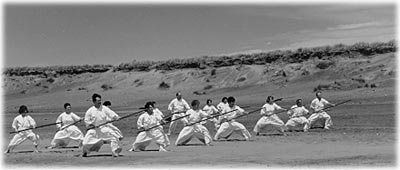
Shintaido bojutsu: exercises using a 6-foot staff. Bojutsu is a unique form of practice that gives you a chance to work with wooden staffs. It adds a different dimension to Shintaido hand movements.
| RANK | REQUIREMENTS |
| GODAN (5th) |
|
| YONDAN (4th) |
|
| SANDAN (3rd) |
|
| NIDAN (2nd) |
|
| SHODAN (1st) |
|
| 1-2 KYU |
|
| 3-4 KYU |
|
| 5-6 KYU |
|
| 7-8 KYU |
|
| 9-10 KYU |
|
Shintaido Kenjutsu
Shintaido kenjutsu: exercises using wooden swords known as bokken. The sword is the classic Japanese warrior weapon. You learn precise/sharpened movements while cutting with the sword. We see this practice as the sword of peace.
| RANK | REQUIREMENTS |
| GODAN (5th) |
|
| YONDAN (4th) |
|
| SANDAN (3rd) |
|
| NIDAN (2nd) |
|
| SHODAN (1st) |
|
For a list of common terms used during class, visit the SOA Glossary.
For a listing of SOA classes and instructor contacts visit Where to Practice.
Examination Requirements
While technical mastery of the forms is essential for promotion, Shintaido examinees at all levels, are expected to use full body expression during their examination.
For all necessary information on Examination Requirements visit the SOA Examinations page.
Included here are procedures, fees, necessary registration forms, and other requirements.
For International Shintaido Groups view our Affiliates and Partners page.