Movers and Shakers of Shintaido – Tribute to Bela Breslau

Movers and Shakers of Shintaido – Tribute to Bela Breslau

by Connie Borden

Published:

Shintaido is formed by people. From the founding of Shintaido in Japan to the introduction of Shintaido into the USA, it was people who transmitted this art form. This year as we celebrate 50 years of the founding of Shintaido of America, it is the  people we are celebrating. Shintaido can be an intensely  personal practice and often I hear that people started the practice at a significant time in their lives. These times could be college, post college, relocating to live in new areas, and seeking wisdom from senior practitioners, many times in related fields such as Amma Massage. Some people were introduced to Shintaido while living in Japan, others were introduced by word-of-mouth, which is still our most successful outreach tool! Many have formed long-term relationships, some in marriage and many in friendship.

First a little of history in the early years.

1975 – 1983 Beginnings of Shintaido in America – first eight years
(adapted from original article by Eva Thaddeus in Body Dialogue, Issue no. 10,2001)


1975: Michael Thompson introduced Shintaido in Geneva, New York. Among his original students were Irene Hadeishi, and Bill Burtis, who is now a Shintaido Instructor.

1976: H.F. Ito and Michael Thompson filed papers at City Hall in San Francisco, officially founding Shintaido of America. They offered Shintaido classes in San Francisco. Jim Sterling, now General Instructor, began studying at this time. So did Bela Breslau, now Senior Instructor and Kazu Shibao, now Senior Instructor.

1980: Tom Abbott, now Instructor, began teaching Shintaido in Worcester, Mass., and Shintaido was registered as a non-profit corporation in Massachusetts. Joe Zawielski, now General Instructor (deceased) began studying at this time.

1982: Lee Seaman Instructor and John Seaman, Instructor (deceased), who previously studied Shintaido in Japan, began teaching in Oregon.

1983: Michael Thompson moved back to the United States after 2 ½ years in Japan. He began a group in Los Angeles, where Friedmann Schultz began Shintaido. Michael then moved to Cambridge, Massachusetts to start teaching Shintaido there.

Shintaido of America wishes to celebration one person often called the “Mother of Shintaido in America.”    This person is Bela Breslau.

Bela currently lives in Northeast (SNE) region in Western Massachusetts. Bela is Senior Instructor and Shintaido Bojutsu Nidan. She is co-founder of the Shintaido Farm.  

Reflecting Americans in general by living in different areas of the USA, Bela lived on the west coast before returning home to the east coast.  While having grown up on the  East coast and having attended Hobart college, Bela was one of three early West Coast students with HF Ito.  In 2001 Bela wrote this about her first day:

“My first day in San Francisco was a beautiful sunny day in September of 1976. After checking in at 776 7th Avenue, meeting up with my very best friend from college, Pamela Olton, seeing Michael Thompson again and meeting Ito, I went with others to Golden Gate Park to do Shintaido. I was wearing a pear of Judo Gi pants and T-shirt.” Body Dialogue, Issue No. 10, 2001.

Bela did many things to foster the growth of the organization while also supporting HF Ito. Bela taught a weekly Friday Night Shintaido class while in the SF Bay Area. She continued teaching with a weekly class at the Shintaido Farm. For many years she was editor of the SOA newsletter. While married to H.F. Ito and living in SF (in the apartment formally rented by Kazu Shibao), she and Ito hosted guests from Japan, France, and other countries. I could tell you more about Bela the lawyer, Bela the real estate agent. Shall I tell you more about the role Bela played a part in the creation and incorporation of the SoA organization? Shall I tell you of the many years she dedicated to organizing and running many gasshukus, workshops, and special classes? Shall I tell you of the major role Bela had with the production of the Shintaido book?  I could tell you of Bela – the wife and life partner with Stephen Billias. I could tell you of Bela the mother of Sophia Billias. What I wish to tell you is of the presence of the person we know as BELA. Thank you Bela for all the kumites across time and space that you have shared with us in our growth as we practice Shintaido and more importantly the growth you have helped foster in us as human beings. Gambatte!

2026 Shintaido of America’s 50th Anniversary: Kumite Across Time and Space

2026 Shintaido of America’s 50th Anniversary: Kumite Across Time and Space

by Connie Borden, Tomi Nagai-Rothe and Robert Gaston

Published:

2026 marks the 50th year of the founding of Shintaido of America as a non-profit.

Our theme for 2026 is Kumite Across Time and Space. We hope to spark inspiration and create resonance with your Shintaido practice.

Senseis H.F. Ito and Michael Thompson spent many hours over the kitchen table in their apartment – shared with Pam Olton in San Francisco – to write the first bylaws for the nonprofit we now call Shintaido of America.

Let’s celebrate 50 years of practice and joy.

50 Posts in 50 Weeks on our Social Media

Postings on Facebook and Instagram. We will be using our rich archive of articles from Body Dialogue and videos from the SOA YouTube Channel to explore the Roots of Shintaido, Shintaido Disciplines, and Taimyo Kata and Peacemaking. These postings over the year will also include a Tribute to Friends, Connections to Music and the Arts as well as videos from many gasshukus.  Not on Facebook or Instagram?  Here are the first four weeks of postings:

Posting on 4 January 2026

In this video made in 2008, Margaret Guay, Shin Aoki, and others, under the  direction of David Franklin, demonstrate how the practice Shintaido touches each of us. Shintaido means “new body way”

Posting on 11 January 2026

Read the January 1983 Body Dialogue article by H.F. Ito on the importance of transfer of Shintaido body wisdom to others.

Posting on 18 January 2026

Watch the video on one of the three Dai Kihon; one of the three core movements of Shintaido – Tenshingoso.

Posting on 26 January 2026

Read a 1986 interview with Aoki Sensei on Shintaido.

Wear a 50th Anniversary T-shirt

Our T-Shirt has the theme Kumite Across Time and Space. Here is a sample of the T-Shirt design (insert visual of T-shirt mock-up). All proceeds from T-shirt sales go to support instructors and kieko in the USA and Canada.
Order here:  Store – Shintaido of America

Stay Connected via What’s App

Share photos of your keiko. Share poems. Read about future social media postings. Reconnect with old friends. Make new friends. Contact Connie to be added to the What’s app group by emailing President@shintaido.org.


We hope you will find 50 ways to engage with others for the joy of self-expression while deepening our Shintaido practice within each of our communities.


Connecting Shintaido Islands

Connecting Shintaido Islands

by Connie Borden

Recently a Shintaido practitioner commented to me how valuable she found knowing about global  Shintaido activities. Since she practices solo or with one other person, she really liked to know of workshops, Gasshuku’s and organizational meetings so she would feel less like an island. Therefore, I am sharing a calendar of global events. Please, if you have more events contact me directly, or put them in the comments at the bottom of this article. 

As you review this calendar of activities you will find International Technical and Examination Committee (ITEC) meetings, British Shintaido, French Shintaido, Global Taimyo Community (GTC), PacShin Kangeiko, and Shintaido of America meetings. Need to know how to reach groups? Here are the links:

    – San Francisco Bay Area: Pacific Shintaido
     – New England: Shintaido North East
     – Eastern Canada: Shintaido Quebec

Europe:

     – European Shintaido College
     – Great Britain: British Shintaido
     – France: Shintaïdo France

Calendar

21 Dec -ITEC meeting – topic ITEC day in 2026 (ZOOM)

9- 11 January 2026 – British Shintaido Kangeiko at White Cottage, Douai Abbey, Woolhampton near Reading

17 – 18 January 2026 – Pacshin Kangeiko in Rohnert Park (north of SF)

26 January 2026 – ITEC subcommittee on Shintaido (ZOOM)

28 January 2026 – ITEC subcommittee on Kenjutsu (ZOOM)

30 January – 1 February 2026 – SNE Kangeiko (Massachusetts, USA)

20 February – 22 February 2026 – Kangeiko in France at Les Sables d’Olonne at the sport Ocean Institute

22 February 2026 – meeting of ESC and SOA on international funding and joint ventures

22 March 2026 – ITEC meeting (ZOOM)

10 -12 April 2026 – British Shintaido Daienshu at Worth School

26 April 2026 – Global Taimyo (ZOOM)

14- 17 May 2026 – French National Gasshuku at Limoges

20 – 25 July 2026 – Kenjutsu workshop – France

20 September 2026 – Global Taimyo (ZOOM)

Shintaido 60th Anniversary Gasshuku

Shintaido 60th Anniversary Gasshuku

by Shin Aoki

The year 2025 marks the 60th anniversary of Hiroyuki Aoki Sensei introducing Shintaido to the world. To commemorate this milestone, a 60th Anniversary Gasshuku was held October 10-14, 2025, at Kujukuri Beach in Japan’s Chiba Prefecture. A venue for many keikos over the years, Kujukuri holds an integral and beloved place in Shintaido history.

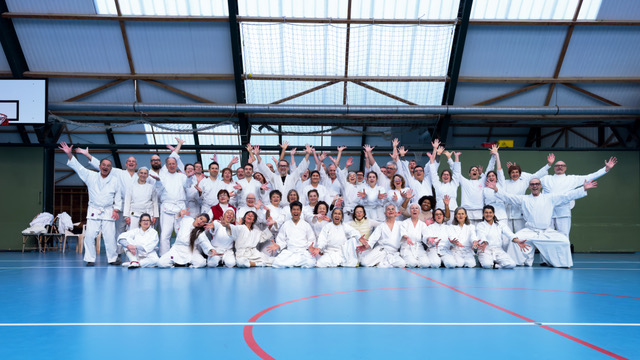
About 45 participants from Japan, France, Italy, Australia, Brazil, and the United States gathered to celebrate this momentous occasion and practice together. The five-day event included an advanced-practitioner workshop, the main gasshuku, and post-gasshuku review sessions. Interpreters were on hand throughout to translate Japanese into French and English.

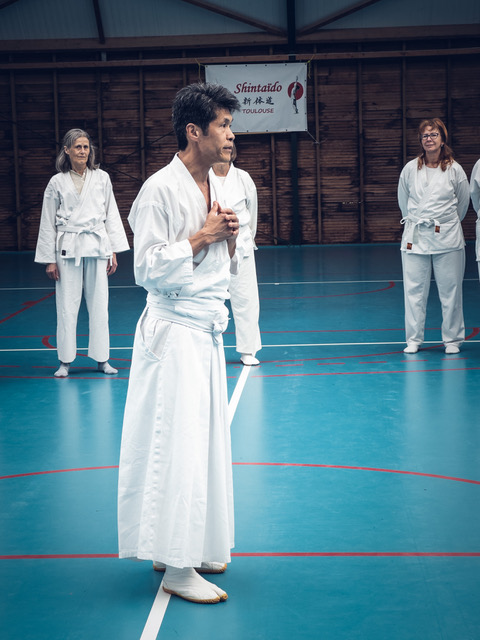
Director of Instruction, Ishii Sensei, led the advanced workshop, assisted by Watari Sensei. The first class focused on Gorei-jutsu—the study of teaching. It included analysis of gorei and vocalization styles, and examined the structure of keiko. In small groups, instructors used various images and vocalizations to create specific effects in the practitioners’ bodies, making them feel lighter and more energized or heavier and more challenged. The students in each group were asked to give feedback. During the second class we reviewed the proper handling of iaito (metal practice swords) and the series of formal movements involved. Then we split into two groups according to participants’ experience, one group working on batto and nohto drills (the practices of drawing and sheathing swords), and the other group working on the advanced Kumitachi curriculum.

The main gasshuku welcomed more new faces, ages ranging from eight to over 80 years old. There were six classes held over three days: two plenary classes for the opening and the closing, two elective classes, and two optional morning sessions. Ishii Sensei led the opening plenary keiko. We studied how to generate contrasting levels or degrees of our energy in kumite. Then, he received tsuki and uchite attacks from several practitioners to demonstrate advanced receiving techniques. In the evening, the instructors gave brief descriptions of each elective class to help us make our selection for the next day. The options included free-hand Shintaido/Tenshintaido, Kenjutsu/Kenbu level 1 and level 2, and Nitoh (double swords), taught by Watari Sensei, Ishii Sensei, and Terasaki Sensei, respectively. They led kihon (fundamental) techniques as well as the new kata and kumitachi curriculum that they have created, as our practice advances from one generation to the next.

The two optional morning sessions were quite popular, and were attended by almost everybody. One group practiced Eiko Dai to push themselves to their limits or just to experience and enjoy the expansiveness of the beach and sky, and the other group studied Taimyo.

Aoki Sensei served as an advisor throughout the gasshuku. He did kumite with the goreishas just before their teaching to condition their bodies and elevate their spirits. He also walked around the dojo during keiko and gave individual advice.

Throughout the event there was an emphasis on quality control for Tenshin-jusoho (warmup kata) and Mae-geiko (breakout). A dozen participants were asked to lead the group, and we all benefited from experiencing their different approaches and energies.

The evenings were full of entertainment! We watched a video documentary shot by a group who organized a real sword (naked blade) test-cutting workshop in a bamboo forest. Aoki Sensei brought out two of his special swords, which we were permitted to handle (carefully!) and appreciate their beauty. One group practiced Japanese calligraphy. Two musicians performed on shō, an ancient flute-like Japanese reed instrument descended from the Chinese sheng, along with the meditative sound of crystal bowls. French participants regaled us with a beautiful vocal chorus, and a Brazilian practitioner performed an entrancing ritual dance. The hosting facility in Chiba served gourmet meals throughout our stay and made its large hot tubs available 24/7, which was so good for our achy bodies.

The last plenary keiko was taught by Ishi Sensei, after which results were shared with those who challenged the exams. In the the closing ceremony, the organizers expressed their hope to encounter more Shintaido and Tenshinkai practitioners from overseas and deepen global connections at future events.

A week after the gasshuku, the 60th Anniversary Celebration was held in Yokohama. It was attended by about 100 people who have been involved in Rakutenkai, Shintaido, and Tenshinkai during the past 60 years. Aoki Sensei’s personal friends gave heartfelt speeches to congratulate the organization. The highlight of the event was a presentation that combined demonstrations of Shintaido and Kenbu accompanied by a narration recounting 60 years of Shintaido history. Archival photos and videos were projected on the back wall during the performance, integrating past and present. The performers represented several countries, showing how the movement has spread throughout the world and touched people’s hearts.


Kenkain Hoko – Portion of Shintaido Northeast Keiko on 10/25/2025

Kenkain Hoko – Portion of Shintaido Northeast Keiko on 10/25/2025

by Stephen Billias

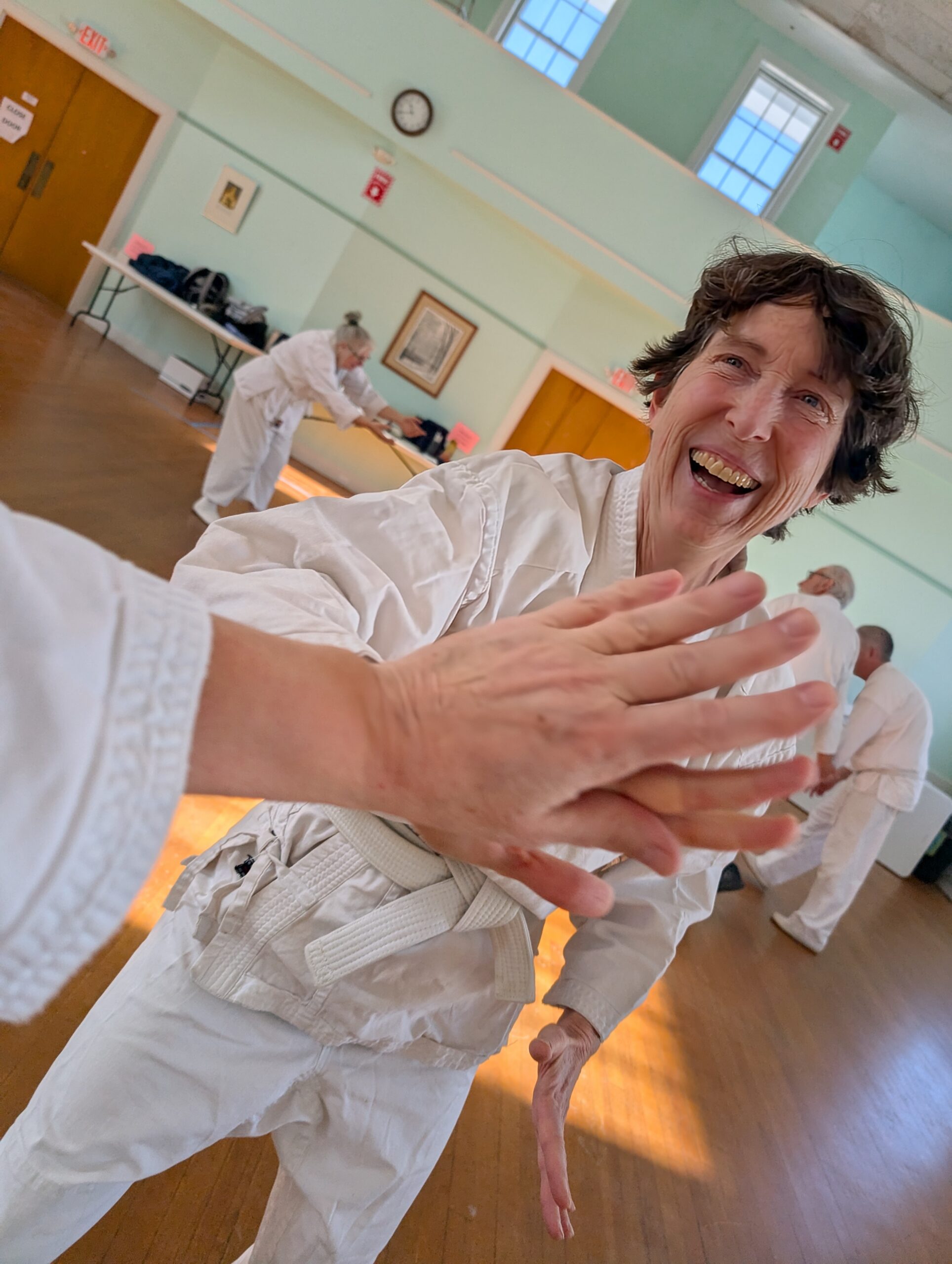
As an aging Shintaido practitioner, I find the meditative aspects of Shintaido: Taimyo, Ten-Position Meditation, Diamond Eight, Kenkain Hoko (Flower Walking) appeal to my body more than vigorous aerobic Shintaido. 

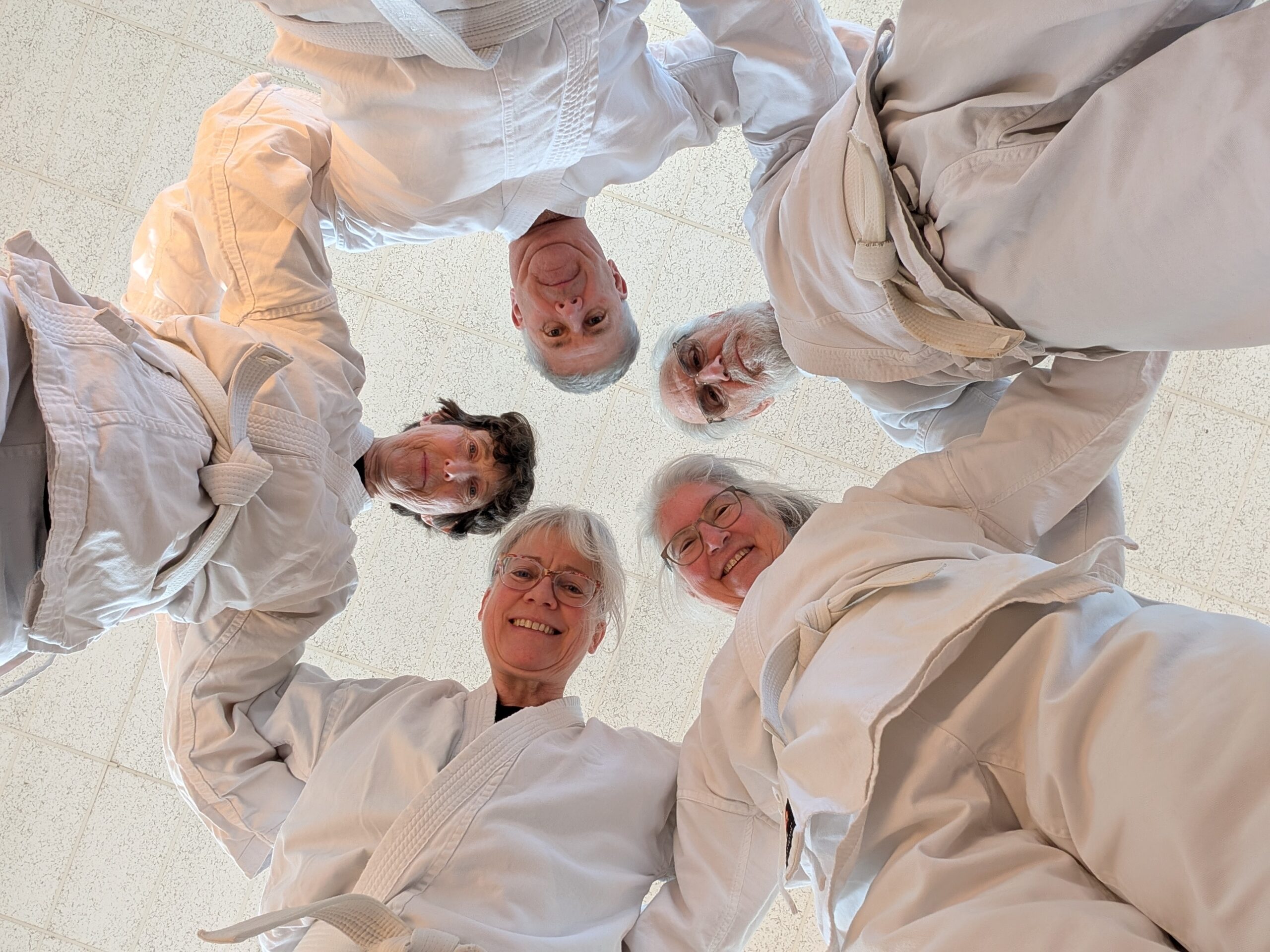
At a recent Shintaido Northeast one-day workshop (co-led by every person in this picture), each of us gave a short gorei over the course of two keikos.

For my portion, we did a short study of Kenkain Hoko. As most of you know, Ken-Ka-i is position six in Shintaido’s ten position meditation, “offering flowers.” This segment included a comparison of Shintaido Kenkain Hoko Flower Walking with Zen Kinhin meditative walking. We looked at the differences and similarities between the two stepping styles and forms of meditation.

First we practiced the original Kenkain Hoko. We started with feet together and stepping in parallel. Some people find this stepping challenging because of difficulty of keeping their balance. Then we practiced Ito’s variation from the Taimyo network in which Ito described a reason for the change in stepping. He said he wanted to make Flower Walking easier for those with balance issues. He ended up with something like normal walking that includes stepping with a slight zig-zag step. Please check out the website link to get the complete description of the stepping.

When we tried Zen kinhin walking, the stepping was quite like Ito’s variation. Kinhin uses the hand position Kon-gō-i, also known as gassho-i, position number five in ten position meditation for lining up, and the shashu hand position from karate (one hand covering the other fist) instead of Ken-Ka-i while walking. There are other differences also. Kenkain Hoko is done in a line moving forward. Kinhin is done moving in a circle clockwise and following in footsteps of the person in front of you. When they take a left step you take a left step, and so on. 

We also tried “fast walking kinhin” which is exactly as it sounds, still trying to follow in the footsteps of the person in front.

We finished doing Kenkain Hoko, with Ito’s modified, simpler steps, holding bowls of water and flowers:

Afterwards Master Instructor Michael Thompson pointed out that Aoki-sensei reversed the position of the hands in Bô-kyô-i (position number eight) and Jô-shin-i (position number nine): In Shintaido left hand is under right. In Zen it’s the opposite, right hand is under left. Also, in the karate from which Shintaido came, there’s a mudra of shielding or wrapping the right fist (active-yang) with the left hand (passive-yin). In Zen, shashu is the opposite, the right hand covers the left fist. Aoki-sensei made these choices deliberately, for reasons known only to him.

The group’s feeling was that though similar, the two forms of meditation expressed differently and created different meditative states.

October Kenjutsu Workshop 2025

October Kenjutsu Workshop 2025

by Connie Borden and Sarah Baker

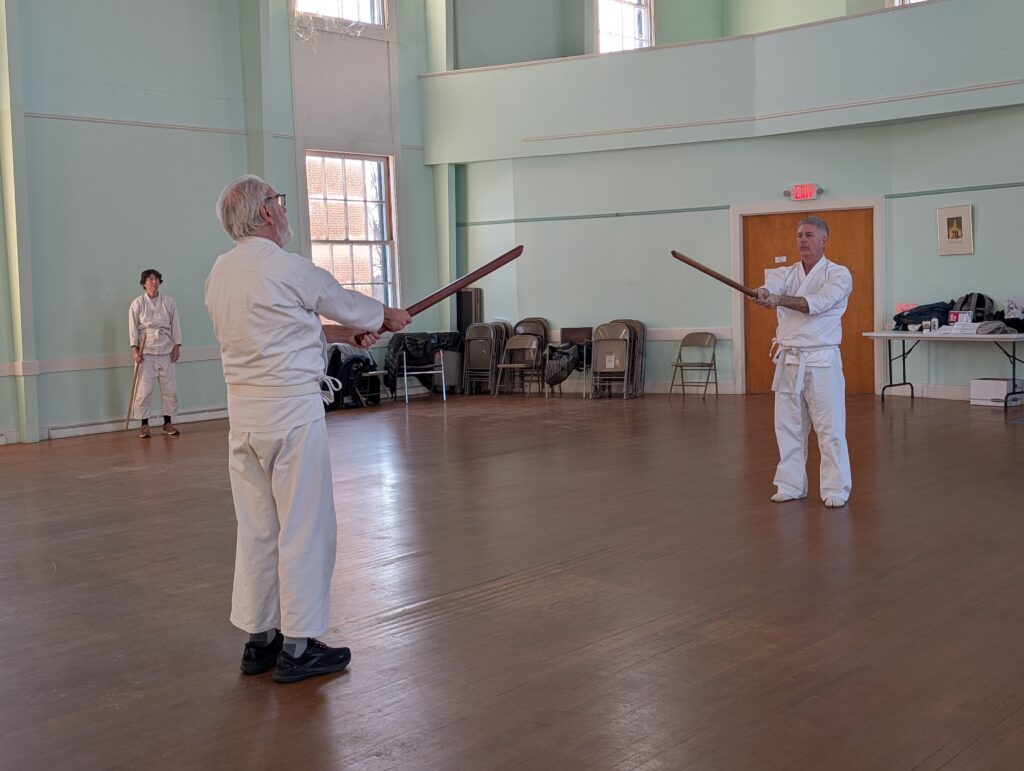
Sixteen people attended a six-Keiko workshop on Kenjutsu with guest instructor Pierre Quettier, 5th Dan Kenjutsu and Shintaido General Instructor. Assisting him were Shintaido Kenjutsu Yondan’s Connie Borden and Robert Gaston. The three-day workshop from 11-13 October 2025 was held in Rohnert Park, CA. The theme “Deepening Connections” suggested both a deepening into our traditions with Japanese sword and a blossoming of potential new classes and new students.

Organizers Connie Borden, Robert Gaston, and Lee Ordeman welcomed participants from both the east coast and the west coast of the USA. Lee, as team leader of the service teams, set the tone of joint collaboration to connect with each other and provide a sense of shared community. Sandra and Sally provided nourishing on-site lunches which served to keep us in community each day of Keiko. Martha, assisted by Dan and Gorazd, did sensei care to ensure our instructors were warmly cared for and allowed instructor’s Pierre, Connie, and Rob to share their lived wisdom from their practice of Kenjutsu. Jennifer, assisted by Laura and various students, did hakama care. Sarah videotaped the six-Keiko to give us a record for future studies. Mike assisted by Bevis,  helped prepare the dojo space and ensured the needs for safety and comfort were met as the dojo team. Tom and Jason kept the group informed throughout with timely announcements, including use of WhatsApp. Robert was the facility liaison for smooth and clear communication with facility staff.

As most people stayed in the Rohnert Park area, Saturday and Sunday evenings included time for conversations. People were curious about many topics and had various inspirational moments.  Lee Ordeman reflected in these post-Keiko discussions with a quotation from Chapter six of Shintaido: the body is a message of the universe. The quotation is “What is kiru-‘cutting’? The locus of one swing of the sword is itself a sign. Only that. Nothing more.” Lee also explored a quote from Sekiun teachings of being natural, moving like a baby in contrast to the typical advice of cutting with power. In another post-Keiko discussion, Tom Abbott shared his thinking and questioning about tenso, heaven and the word “surrender.” Pierre shared his perspective of teaching beginning students the martial art of Kenjutsu. Beyond the discussions there were opportunities to be together for breakfast, dinner, and relax in the pool or hot tub!

Over the 3 days we had six 2-hour Keikos. Three Keiko we practiced in one large group. Two Keiko were practiced by skill level in three smaller groups.  The final Keiko was saved for a review and demonstration.

Connie challenged those with beginning sword experience with the practices of Diamond 8, Tenshingoso Kumitachi no ken, Shoden no Kata Sei, and Go Ho Batto Ho #1 & 2. Robert worked with a group of intermediate level students working on Go Ho Batto Ho #1, 2, and 3 with bokken, the form of Chuden no kata, and Jissen. Rob’s group also joined Pierre’s group for some additional study. Pierre’s primary group of advanced students studied Go Ho Batto Ho #1 to #5 using iaito (practice metal sword), and the form of Okuden no Kata.  

Occasionally, Pierre combined his and Rob’s group to practice collectively. In this combined group, they worked on Chuden no Kata with applications with kumitachi (partner practice) of possible attackers from several possible directions and Jissen forms including Dotoh (#2), Gasshi-uchi (#3),Ryuhi (#4), Kasumi (#5), Iwao (#6), Kusanagi (#7), Kokuken (#14), and Aikiken (#17).  

The final Keiko led by Pierre included demonstrations of what had been taught over the weekend. Connie led the entire group with Tenshingoso no Ken followed by kumitachi (partner practice). Each group showed their Go Ho Batto Ho practice.  More advanced students demonstrated with iaito (practice metal sword) the Go Ho Batto Ho. Connie led those in her group to demonstrate the application of Shoden no Kata with Tenshingoso no ken kumitachi blended. Groups two and three showed several of the Jissen techniques they had studied. 

Pierre performed 8 sword techniques called Toyama-ryu  Batto Ho Kata with his iaito. His demonstration showed clarity of cutting in different directions while also showing his soft, flowing, effortless mastery of the sword.  In a cascade of demonstrations, each group did their kata (as mentioned above), finally all groups did Shoden no kata together. After three days of practice the group was unified in doing the kata as if they were breathing and moving in concert with each other.  

Gratitude was expressed to Pierre at the closing ceremony for his time, wisdom, and teaching. Sally Gaston shared “Awesome weekend-thank you everyone.” John Bevis said “I enjoyed the workshop pace. Every section expanded what we did in the prior section.” Pierre shared his view that Shintaido of America Kenjutsu practice was on their way “with enthusiastic learners running ahead.” In departing, Pierre shared that the enthusiasm of the group “renewed (his) energy and inspiration to go on and to refine further our common good of Kenjutsu practices.” Throughout the practice, Ito Sensei was honored for his Kenjutsu legacy with his photo hanging beneath the Shintaido banner. 

Glossary:

Diamond 8 – the creation of Masashi Minagawa for sword (and open hand)

Tenshingoso Kumitachi no ken  – using the sword to do one of three core Shintaido movements

Go Ho Batto Ho – five drawing techniques for the bokken or iaito

Iaito – metal practice sword

Jissen –  sword techniques for the bokken beyond the 9 basic Shintaido techniques taught with Boktoh. These twenty- two techniques have both names and numbers. 

Shoden no Kata – the first of three Kenjutsu kata for sword

Chuden no kata – the second of three Kenjutsu kata for sword

Okuden no kata – the third of three Kenjutsu kata for sword (also know as the wisdom kata)