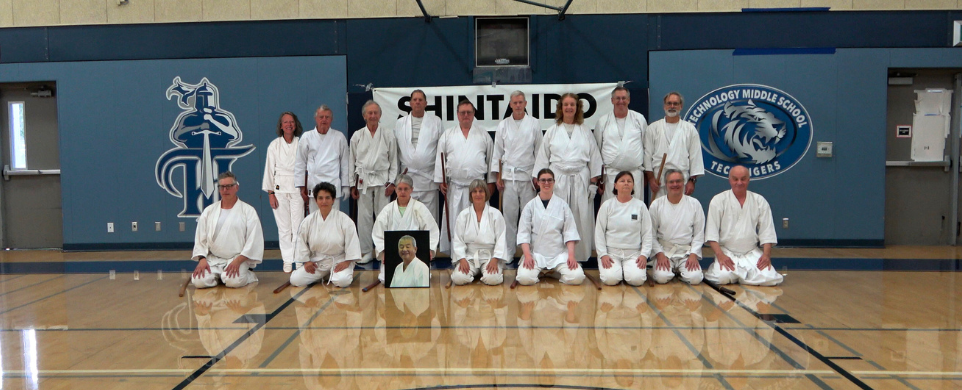
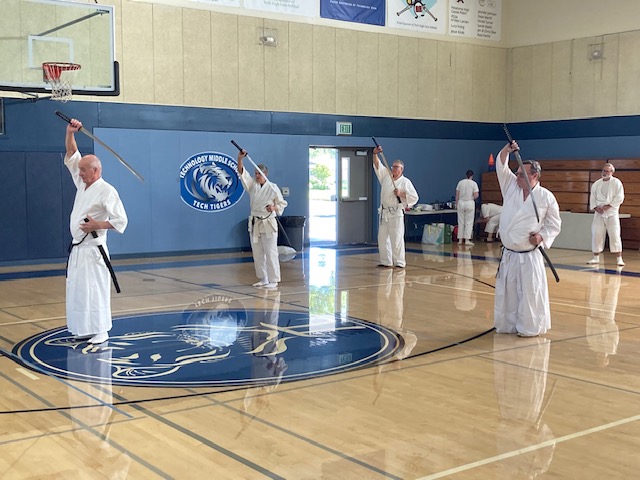
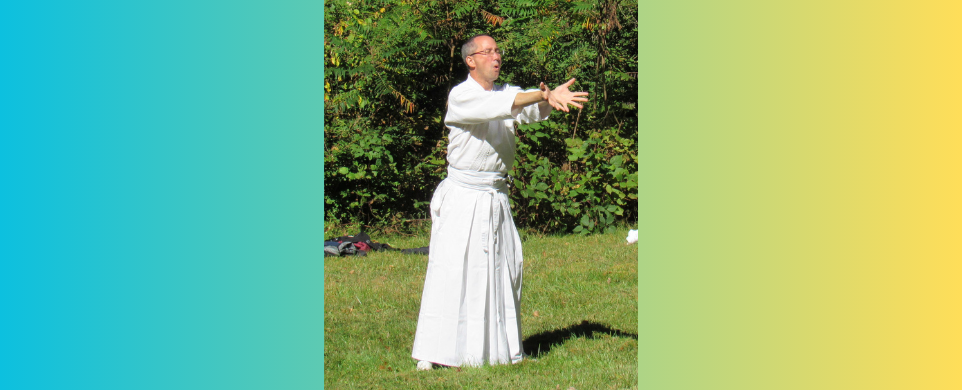
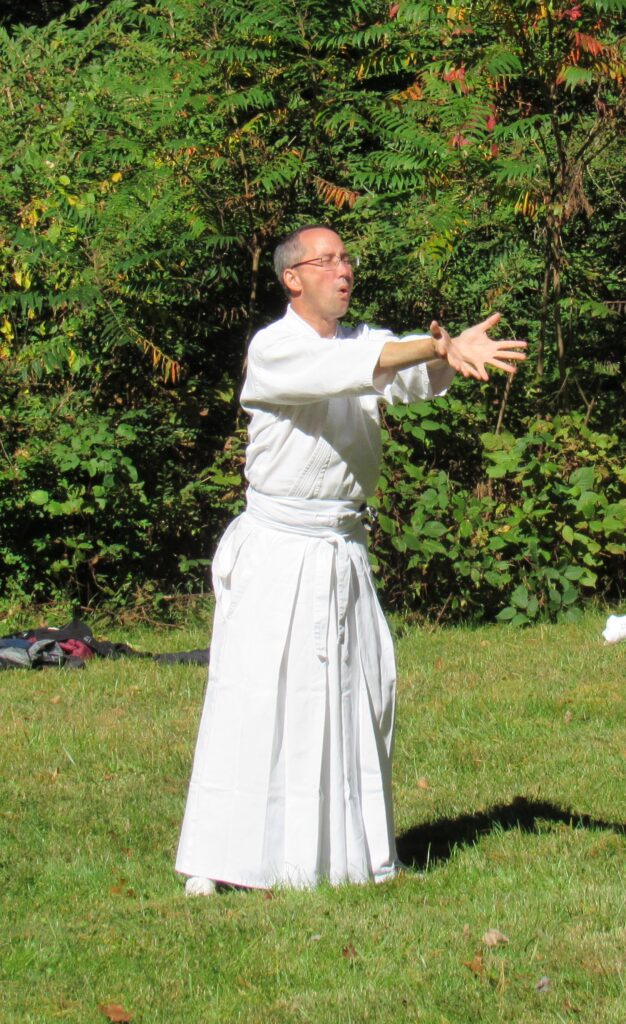
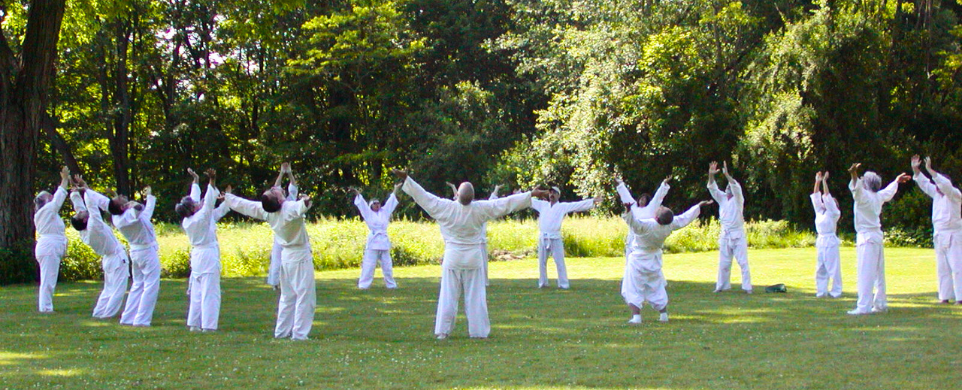
Sixteen people attended a six-Keiko workshop on Kenjutsu with guest instructor Pierre Quettier, 5th Dan Kenjutsu and Shintaido General Instructor. Assisting him were Shintaido Kenjutsu Yondan’s Connie Borden and Robert Gaston. The three-day workshop from 11-13 October 2025 was held in Rohnert Park, CA. The theme “Deepening Connections” suggested both a deepening into our traditions with Japanese sword and a blossoming of potential new classes and new students.
Organizers Connie Borden, Robert Gaston, and Lee Ordeman welcomed participants from both the east coast and the west coast of the USA. Lee, as team leader of the service teams, set the tone of joint collaboration to connect with each other and provide a sense of shared community. Sandra and Sally provided nourishing on-site lunches which served to keep us in community each day of Keiko. Martha, assisted by Dan and Gorazd, did sensei care to ensure our instructors were warmly cared for and allowed instructor’s Pierre, Connie, and Rob to share their lived wisdom from their practice of Kenjutsu. Jennifer, assisted by Laura and various students, did hakama care. Sarah videotaped the six-Keiko to give us a record for future studies. Mike assisted by Bevis, helped prepare the dojo space and ensured the needs for safety and comfort were met as the dojo team. Tom and Jason kept the group informed throughout with timely announcements, including use of WhatsApp. Robert was the facility liaison for smooth and clear communication with facility staff.
As most people stayed in the Rohnert Park area, Saturday and Sunday evenings included time for conversations. People were curious about many topics and had various inspirational moments. Lee Ordeman reflected in these post-Keiko discussions with a quotation from Chapter six of Shintaido: the body is a message of the universe. The quotation is “What is kiru-‘cutting’? The locus of one swing of the sword is itself a sign. Only that. Nothing more.” Lee also explored a quote from Sekiun teachings of being natural, moving like a baby in contrast to the typical advice of cutting with power. In another post-Keiko discussion, Tom Abbott shared his thinking and questioning about tenso, heaven and the word “surrender.” Pierre shared his perspective of teaching beginning students the martial art of Kenjutsu. Beyond the discussions there were opportunities to be together for breakfast, dinner, and relax in the pool or hot tub!
Over the 3 days we had six 2-hour Keikos.Three Keiko we practiced in one large group. Two Keiko were practiced by skill level in three smaller groups. The final Keiko was saved for a review and demonstration.
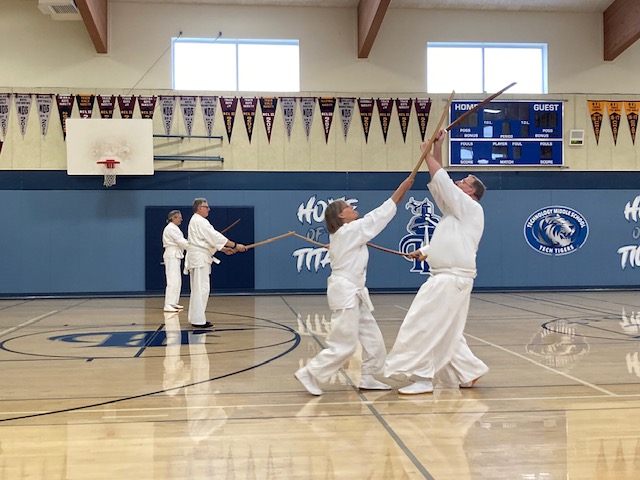
Connie challengedthose with beginning sword experience with the practices of Diamond 8, Tenshingoso Kumitachi no ken, Shoden no Kata Sei, and Go Ho Batto Ho #1 & 2. Robert worked with a group of intermediate level students working on Go Ho Batto Ho #1, 2, and 3 with bokken, the form of Chuden no kata, and Jissen.Rob’s group also joined Pierre’s group for some additional study. Pierre’s primary group of advanced studentsstudied Go Ho Batto Ho #1 to #5 using iaito (practice metal sword), and the form of Okuden no Kata.
Occasionally,Pierre combined his and Rob’s group to practice collectively. In this combined group, they worked on Chuden no Kata with applications with kumitachi (partner practice) of possible attackers from several possible directions and Jissen forms including Dotoh (#2), Gasshi-uchi (#3),Ryuhi (#4), Kasumi (#5), Iwao (#6), Kusanagi (#7), Kokuken (#14), and Aikiken (#17).
The final Keiko led by Pierre included demonstrations of what had been taught over the weekend. Connie led the entire group with Tenshingoso no Ken followed by kumitachi (partner practice). Each group showed their Go Ho Batto Ho practice. More advanced students demonstrated with iaito (practice metal sword) the Go Ho Batto Ho. Connie led those in her group to demonstrate the application of Shoden no Kata with Tenshingoso no ken kumitachi blended. Groups two and three showed several of the Jissen techniques they had studied.
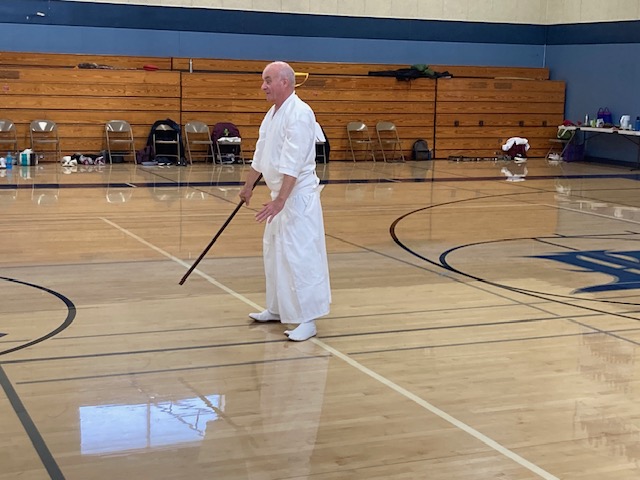
Pierre performed 8 sword techniques called Toyama-ryu Batto Ho Kata with his iaito. His demonstration showed clarity of cutting in different directions while also showing his soft, flowing, effortless mastery of the sword. In a cascade of demonstrations, each group did their kata (as mentioned above), finally all groups did Shoden no kata together. After three days of practice the group was unified in doing the kata as if they were breathing and moving in concert with each other.
Gratitude was expressed to Pierre at the closing ceremony for his time, wisdom, and teaching. Sally Gaston shared “Awesome weekend-thank you everyone.” John Bevis said “I enjoyed the workshop pace. Every section expanded what we did in the prior section.” Pierre shared his view that Shintaido of America Kenjutsu practice was on their way “with enthusiastic learners running ahead.” In departing, Pierre shared that the enthusiasm of the group “renewed (his) energy and inspiration to go on and to refine further our common good of Kenjutsu practices.” Throughout the practice, Ito Sensei was honored for his Kenjutsu legacy with his photo hanging beneath the Shintaido banner.
Glossary:
Diamond 8 – the creation of Masashi Minagawa for sword (and open hand)
Tenshingoso Kumitachi no ken – using the sword to do one of three core Shintaido movements
Go Ho Batto Ho – five drawing techniques for the bokken or iaito
Iaito – metal practice sword
Jissen – sword techniques for the bokken beyond the 9 basic Shintaido techniques taught with Boktoh. These twenty- two techniques have both names and numbers.
Shoden no Kata – the first of three Kenjutsu kata for sword
Chuden no kata – the second of three Kenjutsu kata for sword
Okuden no kata – the third of three Kenjutsu kata for sword (also know as the wisdom kata)
After more than two decades of dedicated service, we would like to express our heartfelt gratitude to Rob Kedoin, who will be concluding his role as SOA webmaster in September 2025. Rob has faithfully stewarded our online presence since at least 2004, helping to make the SOA website an invaluable resource for both members and the public.
Under his guidance, the website has continually evolved—sharing information about Shintaido classes, our curriculum in karate, bojutsu, and kenjutsu, as well as providing vital updates about SOA examinations. Rob’s steady, behind-the-scenes support has ensured that these resources remained reliable and accessible to all.
In 2018, with the support of the SOA Board, Rob spearheaded a major upgrade that made the website fully compatible with iPhones and iPads—an improvement that drew many positive comments from our community. Most recently, in 2025, Rob worked with Board member David Palmer to successfully migrate the SOA website to Dreamhost, a new platform offering enhanced security and SSL certification. These improvements have strengthened our online presence and ensured that SOA continues to serve members with professionalism and care.
In addition to his technical expertise, Rob also contributed as a member of the SOA Board from 2006–2015. His long-standing commitment and countless volunteer hours have left a lasting mark on our organization.
Rob, thank you for your remarkable dedication, your vision, and your tireless efforts on behalf of SOA. We are deeply grateful for all that you have given, and we celebrate your many contributions with heartfelt appreciation.
by David Palmer, Shintaido of America Board member
We are inviting interested members of SOA and the general public to listen to David Palmer speaking on the Value of Touch on Wednesday the 1st of October at 12noon via Zoom. David Palmer, with a massage career spanning 45 years, is speaking on the Value of Touch to the San Francisco End of Life Network (SFEOL). David has been recognized as the “Father of Seated Chair Massage” and in 2007, he was inducted into the Massage Therapy Hall of Fame.
From 1982 to 1989 he was Director of the Amma Institute, the first school in the United States exclusively devoted to traditional Japanese massage. It was during this time he met and studied with H.F. Ito, Shintaido Doshu. David’s study of Shintaido, especially his appreciation for the kata of kenko-taiso (the specific sequence of gentle warmups), continues to the present. David Palmer has been a SOA Board member from March 2024 to the present.
As a colleague of Irene Smith (1946-2021), David has been entrusted with her archive of teaching materials. Smith founded Everflowing in 2001, an organization dedicated to educational outreach and teaching skillful touching as an integral component to palliative care. She also ran Service Through Touch from 1982 until 1999, through which she created massage programs for people living with HIV-AIDS worldwide.
For this presentation David will speak with Connie Borden, SOA President, and Palliative Care Nurse Practitioner about the value of touch for the seriously ill and those at end of life. Join us and bring your questions to this interview that promises to be rich with insights into the ways that human touch can transform our human existence.
We are sharing good news about the Global Taimyo Community (GTC) coming to Shintaido of America (SoA) this month. GTC brings the practice of Taimyo kata as a gateway to reflections on peace and our impact on the world around us. SoA brings 49 years as a non-profit transmitting the form and practice of Shintaido in the U.S., including supporting fledgling local and international groups. We hope this partnership helps deepen Shintaido practice around the world.
What is theGlobal Taimyo Community (GTC)? The GTC originally grew from H.F. Ito’s desire for peace, by practicing Taimyokata around the world both synchronously and asynchronously to create a field of peaceful intentions. Taimyo kata is a specific movement/meditation form from the Shintaido body of practice. Haruyoshi F. Ito and Masashi Minagawa, Shintaido instructors began teaching the Taimyo to the general public as a way of exploring and healing our inner world as well as creating healthier relationships with our outer world — people and nature — beyond time and space. As the network of students grew and became international an informal GTC was born.
How Will it Work? Since 2021 GTC has gathered people from the U.S., Canada, France, the U.K. and Japan a few times per year for practice and conversations via Zoom on themes such as healing, release and transformation, and our soul’s longing.
GTC is organized by the Planning Team – Sarah Baker, Connie Borden, Rob Gaston, Masashi Minagawa, and Tomi Nagai-Rothe – and features a website with many GTC resources including links to video and the Day Street Dojo website.
What Comes Next? As of February 1, 2025 SoA is GTC’s fiscal sponsor and will handle payment-registration for this year’s weeklong virtual gathering July 20 – 26. The GTC website and DayStreetDojo sites will continue.
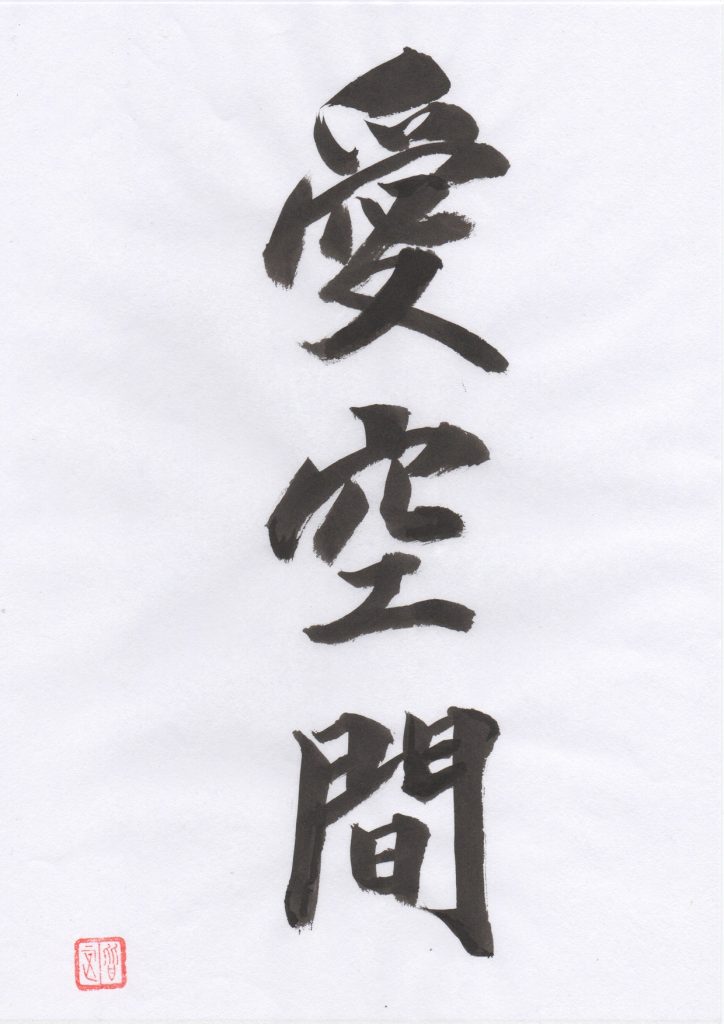
We hope more folx will take the opportunity to come together across space and time to explore “The Space of Love” 愛空間 this summer. Details on the July workshop and registration to be shared soon.
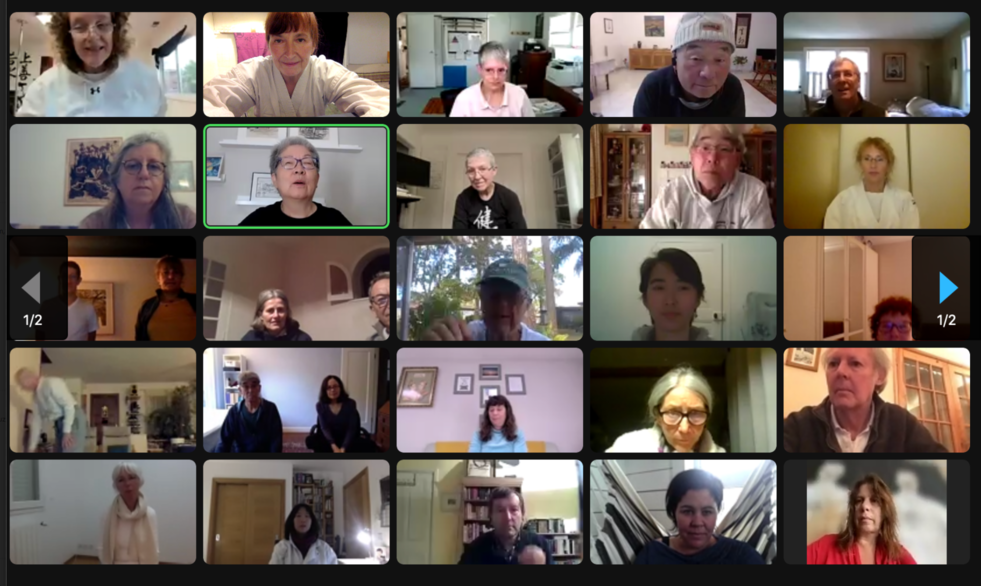
Taimyo practitioners from around the globe gathered via ZOOM from 20 to 26 of July 2025. The week began on Sunday 20 July with Masashi Minagawa, Doshu giving a talk on Aikukan. Here is one part of the message from Minagawa Sensei:
“Our theme this time is aikūkan. It means “a space of love.” This concept dates back to when I first began practicing Shintaido. Back then it wasn’t even called “Shintaido” yet, but “aikūkan” was something Master Aoki often spoke about.
He often said that we live wrapped in the great life force at the root of the universe — embraced within a space of love. Through practice, when we cast off everything unnecessary within ourselves, our true human nature is revealed. A space of love opens up within us, and we become one with the fundamental energy of the universe. This was the spiritual world he sought to explore — and it was from that vision that he founded Shintaido, a path that unites the sacred and the martial, religion and budō.”
Minagawa Sensei concluded with
“By practicing Taimyo again and again, we unite with the message of the universe that lives within us — within our own small universes. Returning to our true selves, we can walk a life that is peaceful, free of conflict, bright, healthy, and filled with happiness. That was Master Aoki’s wish. Inspired by that vision, I hope to continue sharing this message — a message that has run through the web of life since ancient times, a message from the universe — together with all of you.”
Itō-sensei often told us it’s enough just to practice the Taimyo form. “Even if you can’t do the whole sequence, it’s okay to just enjoy it — like enjoying a painting or a piece of music. If you stand within the vibration of its sound, its light, your body will naturally show you the way. You only need to move as you are, let yourself move with that natural flow.”
This activity can become a small light to illuminate the darkness within and around us. Let’s share our light and joy. And finally, let’s return to our own beginnings — to shoshin, beginner’s mind.”
During the week, 8 sessions were offered to deepen the study of Taimyo. Soichiro Iida, Laurent Lacroix, Nicole Beauvois, Rob Gaston, Jean Marc Otto Bruc, Connie Borden, and Nagako Cooper led the sessions. Here are a few comments:
Rob Gaston: “I noticed this morning that the Taimyo sequence has 5 movements in part I, 7 movements in part II, and 5 movements in part III. This made me think of a haiku.
The Moon is still up Let’s do Taimyo together A Circle of Light
Tomi Nagai-Rothe and Nicole Beauvois had this exchange about not getting things perfect: “Navajo (Diné) artists always include a flaw in their pieces because they believe that only the Creator is perfect.”
“I read that this can be seen as ‘honoring oneself with less stress in daily life by striving for excellence, but not perfection.’ “
Antigone Trimis: “I was blessed to be facing a bright sun today. One with nature.”
Sarah Baker and Jean Marc Otto Bruc had this exchange: “I struck by the number of people from around the globe having joined these community practices this week. . . . We share across our different languages some words. . .. each of the separate people sharing the ZOOM space become physically connected.”
“It really felt like we were in the same dojo.”
On the last day, Saturday 26 of July, the gathering included a talk by Tomi, practice with Masashi Minagawa, small group conversation, practice of Taimyo part II with Tomi and a large group conversation. Tomi Nagai-Rothe recounted Ito-sensei’s journey leading the growth of the Global Taimyo Community. Her presentation was titled: Making Peace: H.F. Ito’s Peacemaking Legacy. Tomi included slides, photographs and graphic record to visually review Ito’s legacy. Hiroshima and 9/11 (USA) were two key events that influenced Ito sensei. His legacy includes teaching shintaido to hospice caregivers, deepening the Yokitai curriculum while teaching at the Day Street Dojo, peacemaking events in Washington D. C., and his 2007 Deep Bow Journey to Nanjing. Tomi asked the group to reflect on two questions:
Which part of Ito’s peacemaking legacy will you carry on?
How will you share it – individually and collectively?
Masashi Minagawa led the group with the practice of Diamond 8 Sei, Diamond 8 Dai and Diamond 8 Heart Sutra. Minagawa sensei suggested we read “The Diamond Eight Cut & Life Reflections” by H.F. Ito. Tomi led the group with practice of Taimyo part II- Yokitai version. The focus was soft, round and included pauses after each movement.
Tomi suggested her article in Body DialogueH.F. Ito: A Personal Remembrance. The weeklong practice ended with everyone’s desire for continued connection and eagerness for 2026. Hope to see you then!
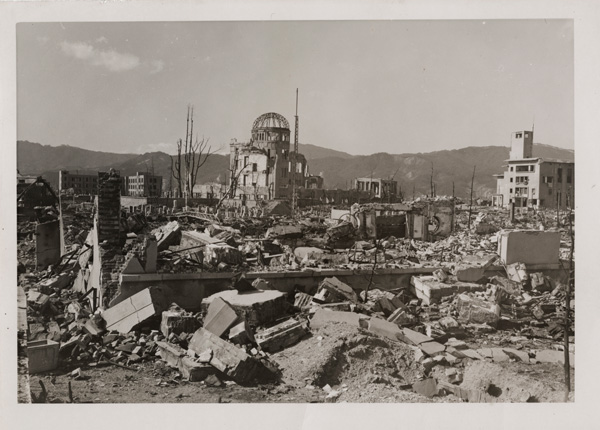
The founders of Shintaido realized the world needed new approaches to conflict resolution, as they acknowledged many of the old ways were no longer useful. On August 6th and 9th, people around the world will be commemorating the 80th anniversary of the atomic bombings of Hiroshima and Nagasaki.
A small nonprofit organization in Worcester, MA, USA -The Center for Nonviolent Solutions is sponsoring and coordinating activities for disarmament advocates to make a significant impact- both locally and globally. This project is an interfaith, interracial and international coalition, involving Hibakusha, congressmen, Catholic bishops, Buddhists and ordinary citizens both here and in Japan. The ultimate goal is to bring folks together to support the movement toward nuclear disarmament. I urge all who read this to participate in any way you can, wherever you can.
The Project: Marking the 80th anniversary of the bombings of Hiroshima and Nagasaki, the Center for Nonviolent Solutions is sponsoring a project to raise awareness of the opportunity presented by the UN Treaty for the Prohibition of Nuclear Weapons to realize the goal of a nuclear weapons free world. While the precise design and dimensions of the commemoration are still emerging, these elements are clear:
We will engage people in the 2nd Massachusetts Congressional District, directly through public dis course and through civic and religious organizations, student groups. We will ask people to partici pate in the global commemoration of the anniversary with local actions including: Walks and vigils, learning groups, local pilgrimages, letters to leaders and other initiatives.
We will organize a small group of people to travel to Japan to honor the Hibakusha (Atomic bomb survivors). We intend that the group traveling to Japan be broadly representative and include young and old, indigenous people, and people of color.
We will make a particular effort to reach out to younger people who might not be aware of the nuclear threat.
Contact: Charlie Washburn | cjwashburn@Gmail.com | 508-868-1267 https://hiroshimacommemoration.my.canva.site Pilgrimage to Japan
In August 2025 we will send a group of US citizens to Japan to stand with the survivors and pledge our commitment to eliminating all nuclear weapons. We are seeking approval of the US House of Represen tatives to include Congressman James McGovern and other members of Congress. Our trip will take 7 days between August 3 and August 10.
We will join other US citizens lead by Archbishop John Wester of Santa Fe New Mexico who has formed a partnership with the Bishops of Hiroshima and Nagasaki. The pilgrimage will serve several purposes:
Embrace the Hibakusha’s (Bomb Survivors) expressed goal achieving a world free of nuclear weapons and for demonstrating through witness testimony that nuclear weapons must never be used again. The extraordinary efforts of Nihon Hidankyo and other representatives of the Hi bakusha were awarded the 2024 Nobel Peace Prize and have contributed greatly to the establish ment of a nuclear taboo.
Amplify the 80th anniversary of the bombings of Hiroshima and Nagasaki to awaken US citizens to the threat posed by nuclear weapons and the arms race that will result from the US investment in “modernization” of our nuclear arsenal.
Animate a movement for the US to lead the way for the countries possessing nuclear weapons to employ the UN Treaty for the Prohibition of Nuclear Weapons as the vehicle to achieve a global ver ifiable elimination of the nuclear threat. Efforts will include continuing education efforts with civic and faith based groups and support for the formation of a Back from the Brink Hub in Worcester and helping to organize groups of Students for Nuclear Disarmament at Worcester Schools
We will also present films and speakers on topics related to nuclear disarmament to increase public awareness.
Background: In November 2023, at a reception celebrating Dorothy Day’s birthday during the second Meeting of States Parties to the Treaty Prohibiting Nuclear Weapons in New York City, I asked Archbish op Wester how other people and groups committed to the abolition of nuclear weapons could support his efforts. He had just described the partnership between two US Catholic diocese and their counter parts in Hiroshima and Nagasaki. He thought a moment and promised to discuss the notion with his colleagues. I was in NYC to support the action taken at the US Mission to the UN to call on the US to sign the treaty. I was struck by the fact that the Archbishop, who was clearly the most prominent leader in the American Church to address the meeting and Member of Congress Jim McGovern, the highest ranking member of US government to speak to the assembly had crossed paths without meeting.
It took months and the opportunity to let my mind wander and explore enough while walking the ancient pilgrim’s path El Camino de Santiago in Spain that the notion of journeying with the Bishops began to take form. Eventually it occurred to me that we might devise a way to have some Americans join with the Bishops and the people of Japan in commemoration of the bombing 80 years ago this August in a way that might move the US closer to accepting a ban on nuclear weapons.
In September I had the pleasure of introducing Archbishop Wester and Representative McGovern via teleconference and they had a wonderful and energetic conversation. The US Presidential Election has distracted us since September and the election’s outcome was not obviously supportive of our intent, but we will press on.
I committed to them that I would begin to work on assembling some people from McGovern’s district to join him in Japan this August. I also said I would look for a way to support the Archbishop’s interest in engaging people of college age. Part of our conversation focused on the fact that many younger Amer icans are unaware of the threat posed by nuclear weapons, much less the massive reinvestment we are making in them. Fewer still know that the Catholic Church has decided that there is no justification for possessing nuclear weapons.
US Representatives McGovern and Jill Tokuda of Hawaii have reintroduced a House Resolution urging the United States to return to the negotiations table on nuclear disarmament and to Leland the global effort to reduce and eliminate nuclear weapons.
…
If you’d like to connect with Shintaido folks living in Japan, contact Ms. Sumiko Koboyashi, or Tomoko Okada at Tenshinkai Office- email: Staff@tenshinkai.jp
If you’d like to join the pilgrimage from the U.S. to Japan, our guide for the group is Mihoko Wakabayashi. Her contact info in Worcester, MA is : Mihoko@Mihokotextiles.com
If you’d like to make a tax-deductible contribution to the project, you can send a check to: The Center for Nonviolent Solutions, 901 Pleasant Street, Worcester, MA 01602