Recently a Shintaido practitioner commented to me how valuable she found knowing about global Shintaido activities. Since she practices solo or with one other person, she really liked to know of workshops, Gasshuku’s and organizational meetings so she would feel less like an island. Therefore, I am sharing a calendar of global events. Please, if you have more events contact me directly, or put them in the comments at the bottom of this article.
As you review this calendar of activities you will find International Technical and Examination Committee (ITEC) meetings, British Shintaido, French Shintaido, Global Taimyo Community (GTC), PacShin Kangeiko, and Shintaido of America meetings. Need to know how to reach groups? Here are the links:
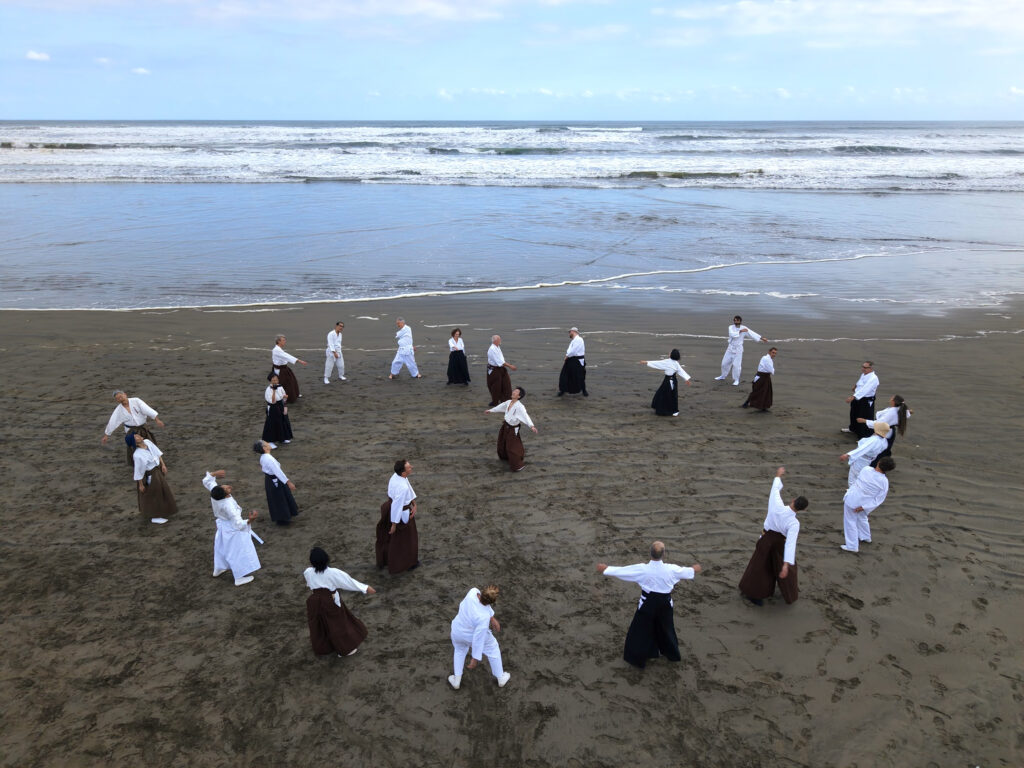
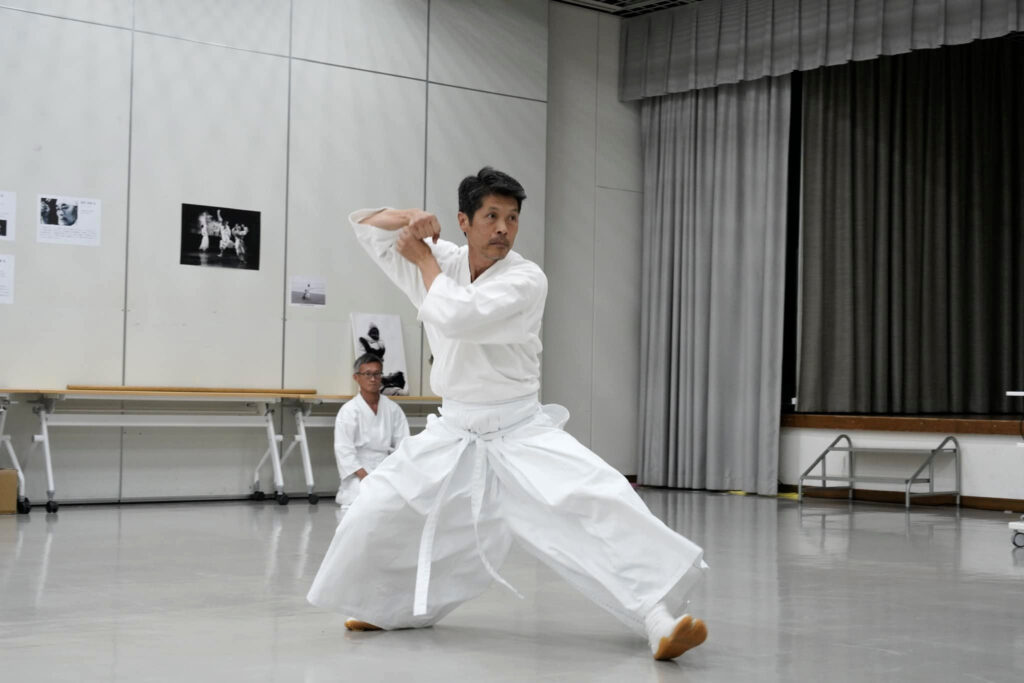
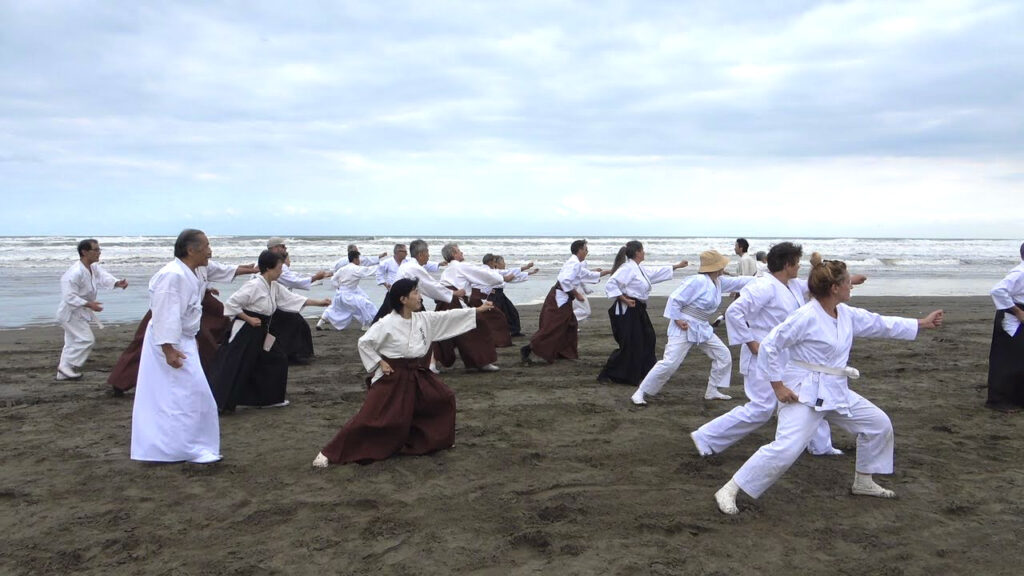
The year 2025 marks the 60th anniversary of Hiroyuki Aoki Sensei introducing Shintaido to the world. To commemorate this milestone, a 60th Anniversary Gasshuku was held October 10-14, 2025, at Kujukuri Beach in Japan’s Chiba Prefecture. A venue for many keikos over the years, Kujukuri holds an integral and beloved place in Shintaido history.
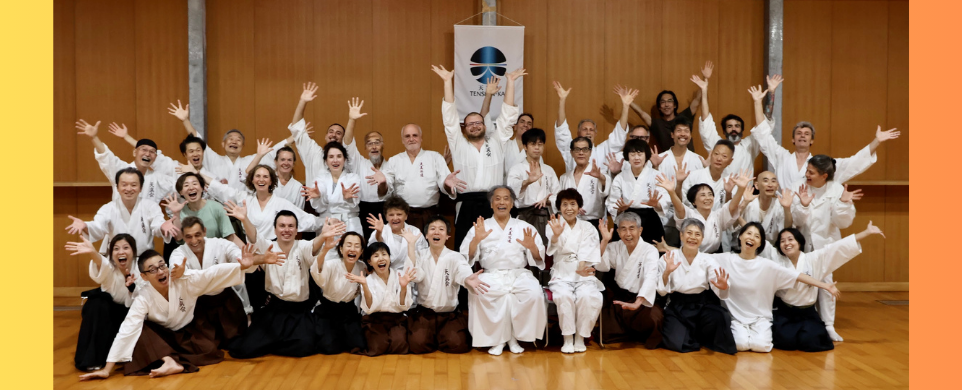
About 45 participants from Japan, France, Italy, Australia, Brazil, and the United States gathered to celebrate this momentous occasion and practice together. The five-day event included an advanced-practitioner workshop, the main gasshuku, and post-gasshuku review sessions. Interpreters were on hand throughout to translate Japanese into French and English.
Director of Instruction, Ishii Sensei, led the advanced workshop, assisted by Watari Sensei. The first class focused on Gorei-jutsu—the study of teaching. It included analysis of gorei and vocalization styles, and examined the structure of keiko. In small groups, instructors used various images and vocalizations to create specific effects in the practitioners’ bodies, making them feel lighter and more energized or heavier and more challenged. The students in each group were asked to give feedback. During the second class we reviewed the proper handling of iaito (metal practice swords) and the series of formal movements involved. Then we split into two groups according to participants’ experience, one group working on batto and nohto drills (the practices of drawing and sheathing swords), and the other group working on the advanced Kumitachi curriculum.
The main gasshuku welcomed more new faces, ages ranging from eight to over 80 years old. There were six classes held over three days: two plenary classes for the opening and the closing, two elective classes, and two optional morning sessions. Ishii Sensei led the opening plenary keiko. We studied how to generate contrasting levels or degrees of our energy in kumite. Then, he received tsuki and uchite attacks from several practitioners to demonstrate advanced receiving techniques. In the evening, the instructors gave brief descriptions of each elective class to help us make our selection for the next day. The options included free-hand Shintaido/Tenshintaido, Kenjutsu/Kenbu level 1 and level 2, and Nitoh (double swords), taught by Watari Sensei, Ishii Sensei, and Terasaki Sensei, respectively. They led kihon (fundamental) techniques as well as the new kata and kumitachi curriculum that they have created, as our practice advances from one generation to the next.
The two optional morning sessions were quite popular, and were attended by almost everybody. One group practiced Eiko Dai to push themselves to their limits or just to experience and enjoy the expansiveness of the beach and sky, and the other group studied Taimyo.
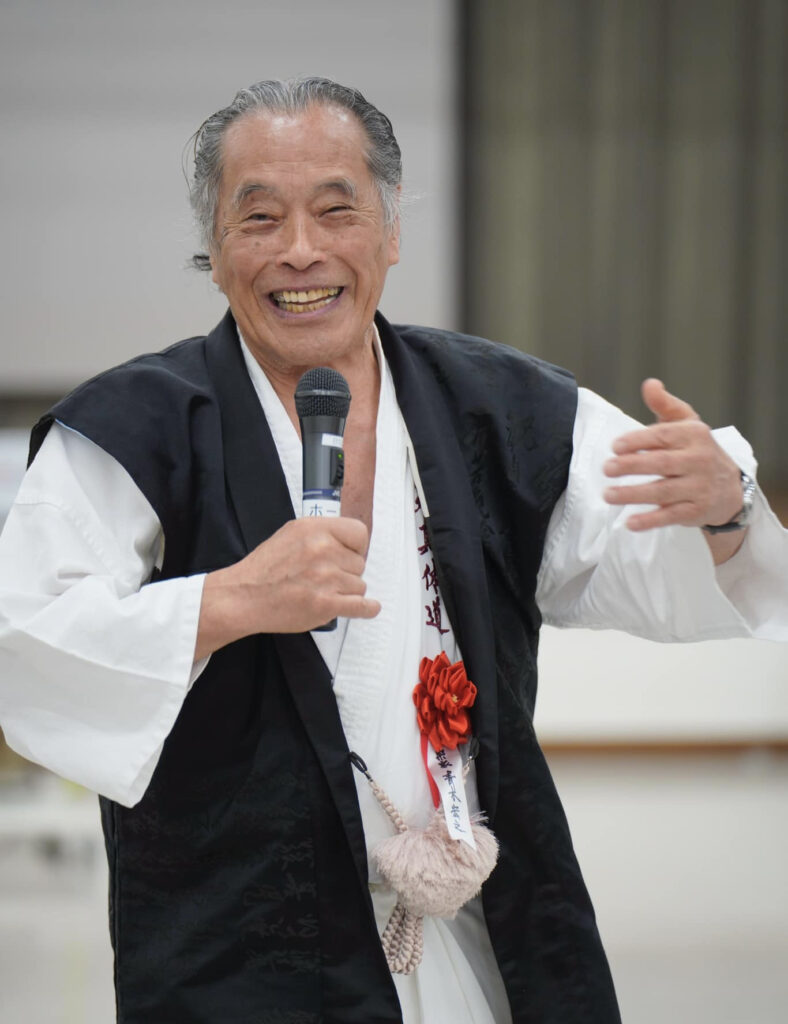
Aoki Sensei served as an advisor throughout the gasshuku. He did kumite with the goreishas just before their teaching to condition their bodies and elevate their spirits. He also walked around the dojo during keiko and gave individual advice.
Throughout the event there was an emphasis on quality control for Tenshin-jusoho (warmup kata) and Mae-geiko (breakout). A dozen participants were asked to lead the group, and we all benefited from experiencing their different approaches and energies.
The evenings were full of entertainment! We watched a video documentary shot by a group who organized a real sword (naked blade) test-cutting workshop in a bamboo forest. Aoki Sensei brought out two of his special swords, which we were permitted to handle (carefully!) and appreciate their beauty. One group practiced Japanese calligraphy. Two musicians performed on shō, an ancient flute-like Japanese reed instrument descended from the Chinese sheng, along with the meditative sound of crystal bowls. French participants regaled us with a beautiful vocal chorus, and a Brazilian practitioner performed an entrancing ritual dance. The hosting facility in Chiba served gourmet meals throughout our stay and made its large hot tubs available 24/7, which was so good for our achy bodies.
The last plenary keiko was taught by Ishi Sensei, after which results were shared with those who challenged the exams. In the the closing ceremony, the organizers expressed their hope to encounter more Shintaido and Tenshinkai practitioners from overseas and deepen global connections at future events.
A week after the gasshuku, the 60th Anniversary Celebration was held in Yokohama. It was attended by about 100 people who have been involved in Rakutenkai, Shintaido, and Tenshinkai during the past 60 years. Aoki Sensei’s personal friends gave heartfelt speeches to congratulate the organization. The highlight of the event was a presentation that combined demonstrations of Shintaido and Kenbu accompanied by a narration recounting 60 years of Shintaido history. Archival photos and videos were projected on the back wall during the performance, integrating past and present. The performers represented several countries, showing how the movement has spread throughout the world and touched people’s hearts.
As an aging Shintaido practitioner, I find the meditative aspects of Shintaido: Taimyo, Ten-Position Meditation, Diamond Eight, Kenkain Hoko (Flower Walking) appeal to my body more than vigorous aerobic Shintaido.
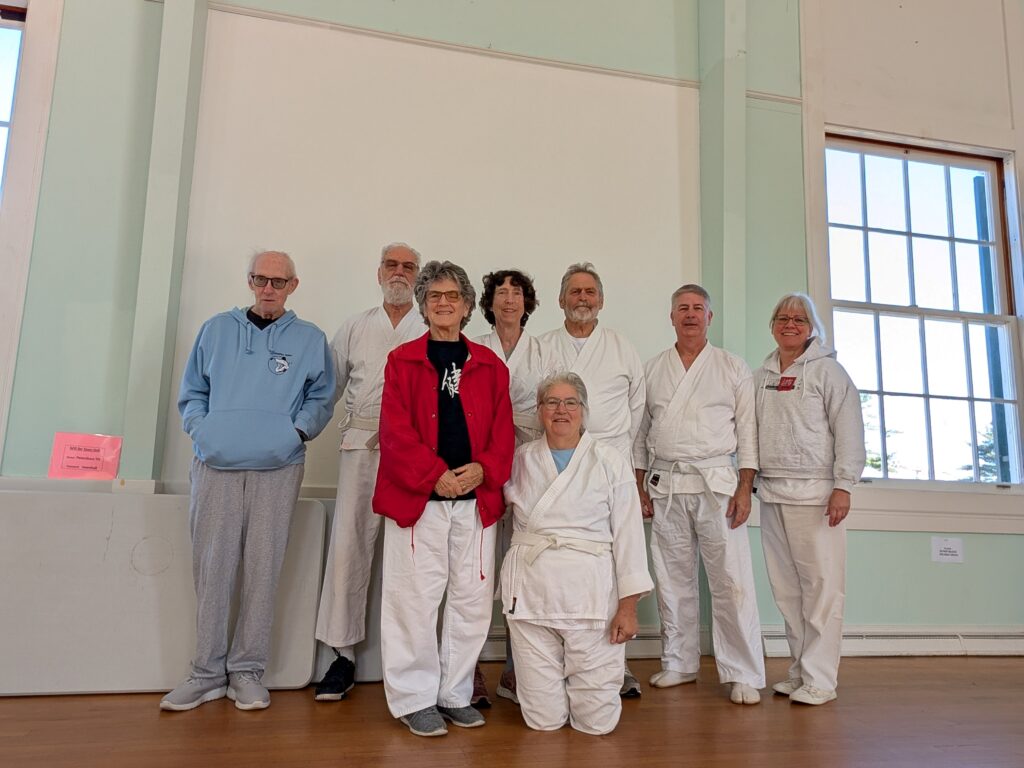
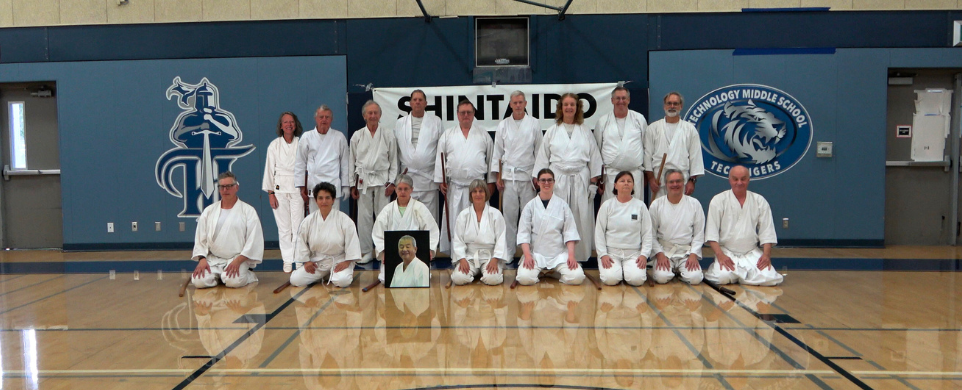
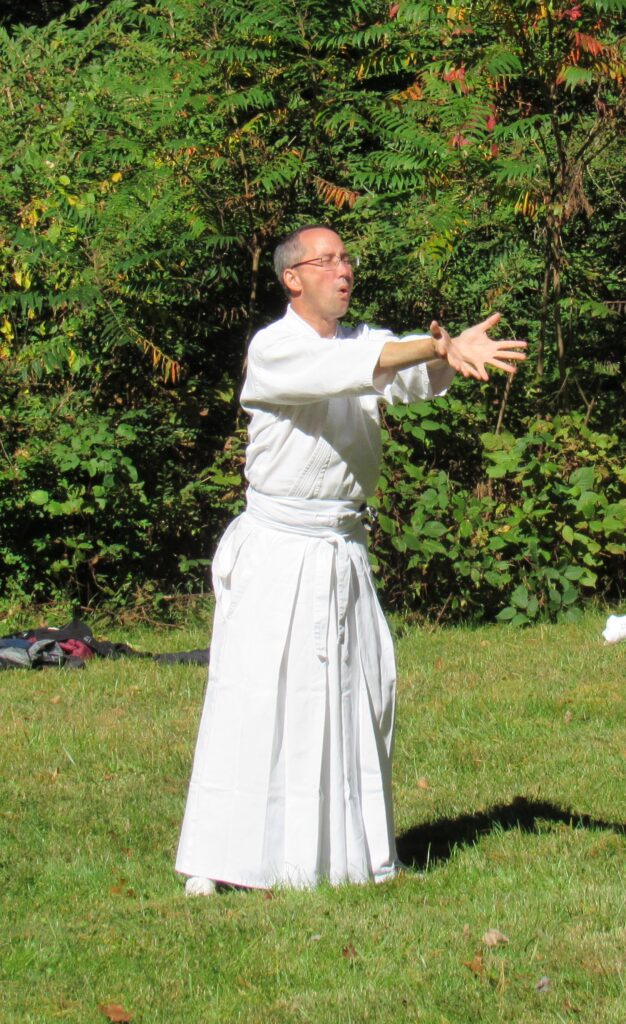
At a recent Shintaido Northeast one-day workshop (co-led by every person in this picture), each of us gave a short gorei over the course of two keikos.
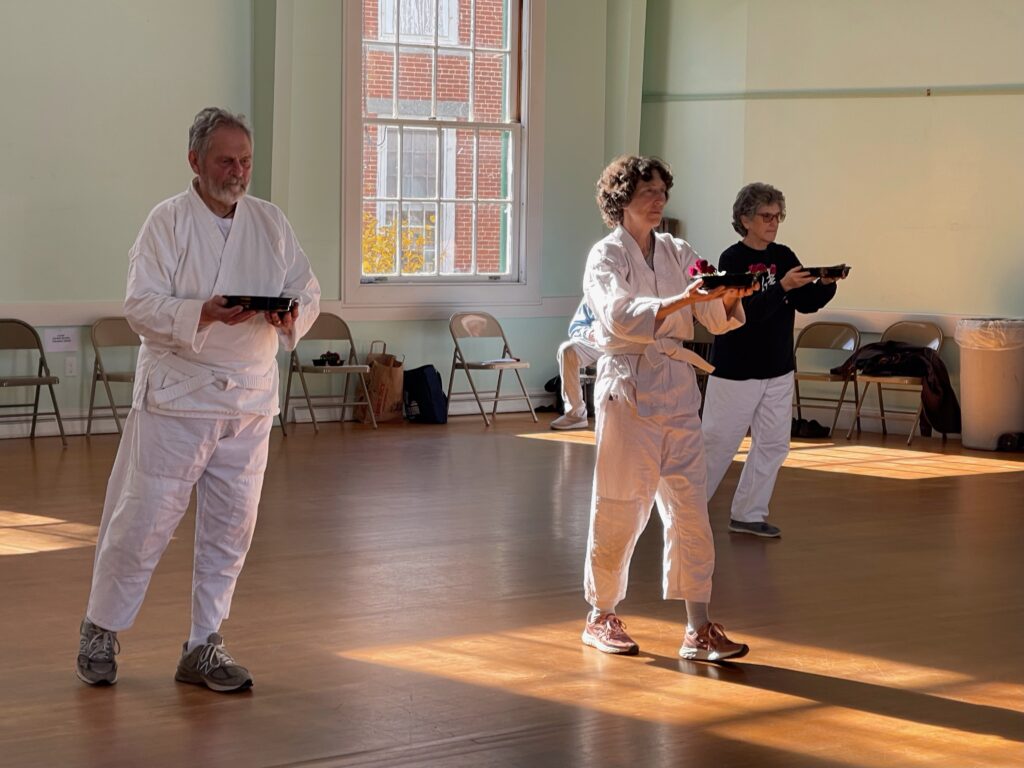
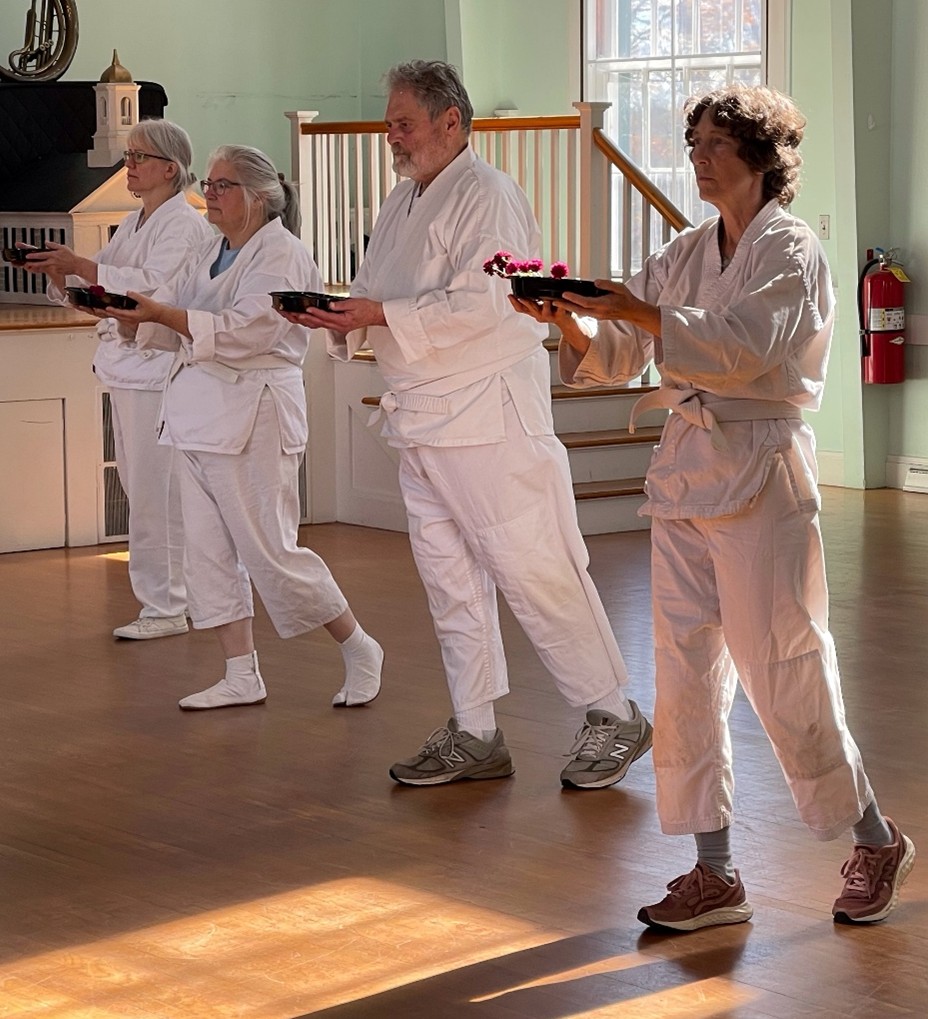
For my portion, we did a short study of Kenkain Hoko. As most of you know, Ken-Ka-i is position six in Shintaido’s ten position meditation, “offering flowers.” This segment included a comparison of Shintaido Kenkain Hoko Flower Walking with Zen Kinhin meditative walking. We looked at the differences and similarities between the two stepping styles and forms of meditation.
First we practiced the original Kenkain Hoko. We started with feet together and stepping in parallel. Some people find this stepping challenging because of difficulty of keeping their balance. Then we practiced Ito’s variation from the Taimyo network in which Ito described a reason for the change in stepping. He said he wanted to make Flower Walking easier for those with balance issues. He ended up with something like normal walking that includes stepping with a slight zig-zag step. Please check out the website link to get the complete description of the stepping.
When we tried Zen kinhin walking, the stepping was quite like Ito’s variation. Kinhin uses the hand position Kon-gō-i, also known as gassho-i, position number five in ten position meditation for lining up, and the shashu hand position from karate (one hand covering the other fist) instead of Ken-Ka-i while walking. There are other differences also. Kenkain Hoko is done in a line moving forward. Kinhin is done moving in a circle clockwise and following in footsteps of the person in front of you. When they take a left step you take a left step, and so on.
We also tried “fast walking kinhin” which is exactly as it sounds, still trying to follow in the footsteps of the person in front.
We finished doing Kenkain Hoko, with Ito’s modified, simpler steps, holding bowls of water and flowers:
Afterwards Master Instructor Michael Thompson pointed out that Aoki-sensei reversed the position of the hands in Bô-kyô-i (position number eight) and Jô-shin-i (position number nine): In Shintaido left hand is under right. In Zen it’s the opposite, right hand is under left. Also, in the karate from which Shintaido came, there’s a mudra of shielding or wrapping the right fist (active-yang) with the left hand (passive-yin). In Zen, shashu is the opposite, the right hand covers the left fist. Aoki-sensei made these choices deliberately, for reasons known only to him.
The group’s feeling was that though similar, the two forms of meditation expressed differently and created different meditative states.
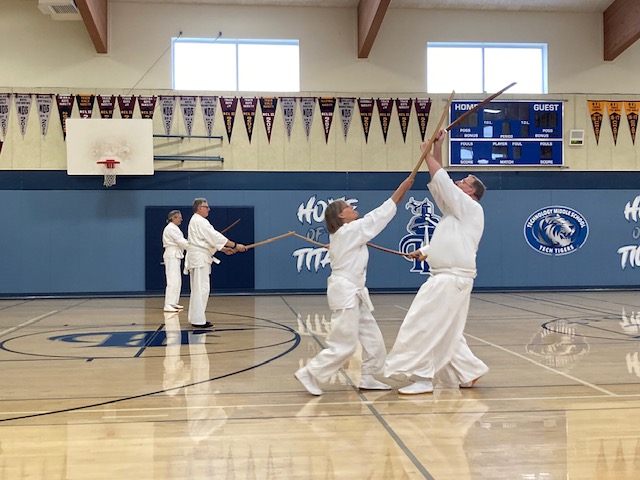
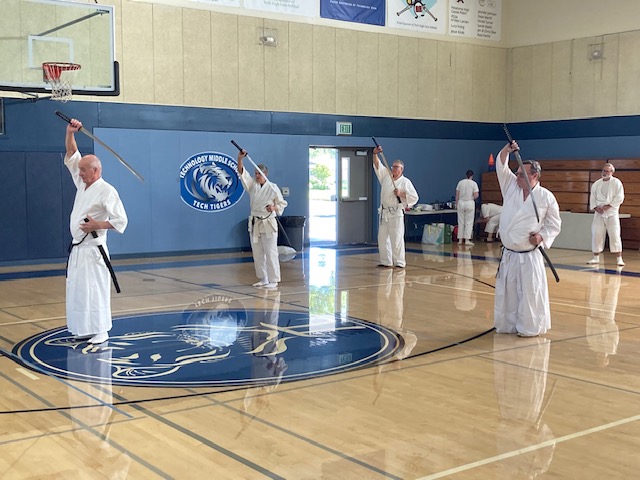
Sixteen people attended a six-Keiko workshop on Kenjutsu with guest instructor Pierre Quettier, 5th Dan Kenjutsu and Shintaido General Instructor. Assisting him were Shintaido Kenjutsu Yondan’s Connie Borden and Robert Gaston. The three-day workshop from 11-13 October 2025 was held in Rohnert Park, CA. The theme “Deepening Connections” suggested both a deepening into our traditions with Japanese sword and a blossoming of potential new classes and new students.
Organizers Connie Borden, Robert Gaston, and Lee Ordeman welcomed participants from both the east coast and the west coast of the USA. Lee, as team leader of the service teams, set the tone of joint collaboration to connect with each other and provide a sense of shared community. Sandra and Sally provided nourishing on-site lunches which served to keep us in community each day of Keiko. Martha, assisted by Dan and Gorazd, did sensei care to ensure our instructors were warmly cared for and allowed instructor’s Pierre, Connie, and Rob to share their lived wisdom from their practice of Kenjutsu. Jennifer, assisted by Laura and various students, did hakama care. Sarah videotaped the six-Keiko to give us a record for future studies. Mike assisted by Bevis, helped prepare the dojo space and ensured the needs for safety and comfort were met as the dojo team. Tom and Jason kept the group informed throughout with timely announcements, including use of WhatsApp. Robert was the facility liaison for smooth and clear communication with facility staff.
As most people stayed in the Rohnert Park area, Saturday and Sunday evenings included time for conversations. People were curious about many topics and had various inspirational moments. Lee Ordeman reflected in these post-Keiko discussions with a quotation from Chapter six of Shintaido: the body is a message of the universe. The quotation is “What is kiru-‘cutting’? The locus of one swing of the sword is itself a sign. Only that. Nothing more.” Lee also explored a quote from Sekiun teachings of being natural, moving like a baby in contrast to the typical advice of cutting with power. In another post-Keiko discussion, Tom Abbott shared his thinking and questioning about tenso, heaven and the word “surrender.” Pierre shared his perspective of teaching beginning students the martial art of Kenjutsu. Beyond the discussions there were opportunities to be together for breakfast, dinner, and relax in the pool or hot tub!
Over the 3 days we had six 2-hour Keikos.Three Keiko we practiced in one large group. Two Keiko were practiced by skill level in three smaller groups. The final Keiko was saved for a review and demonstration.
Connie challengedthose with beginning sword experience with the practices of Diamond 8, Tenshingoso Kumitachi no ken, Shoden no Kata Sei, and Go Ho Batto Ho #1 & 2. Robert worked with a group of intermediate level students working on Go Ho Batto Ho #1, 2, and 3 with bokken, the form of Chuden no kata, and Jissen.Rob’s group also joined Pierre’s group for some additional study. Pierre’s primary group of advanced studentsstudied Go Ho Batto Ho #1 to #5 using iaito (practice metal sword), and the form of Okuden no Kata.
Occasionally,Pierre combined his and Rob’s group to practice collectively. In this combined group, they worked on Chuden no Kata with applications with kumitachi (partner practice) of possible attackers from several possible directions and Jissen forms including Dotoh (#2), Gasshi-uchi (#3),Ryuhi (#4), Kasumi (#5), Iwao (#6), Kusanagi (#7), Kokuken (#14), and Aikiken (#17).
The final Keiko led by Pierre included demonstrations of what had been taught over the weekend. Connie led the entire group with Tenshingoso no Ken followed by kumitachi (partner practice). Each group showed their Go Ho Batto Ho practice. More advanced students demonstrated with iaito (practice metal sword) the Go Ho Batto Ho. Connie led those in her group to demonstrate the application of Shoden no Kata with Tenshingoso no ken kumitachi blended. Groups two and three showed several of the Jissen techniques they had studied.
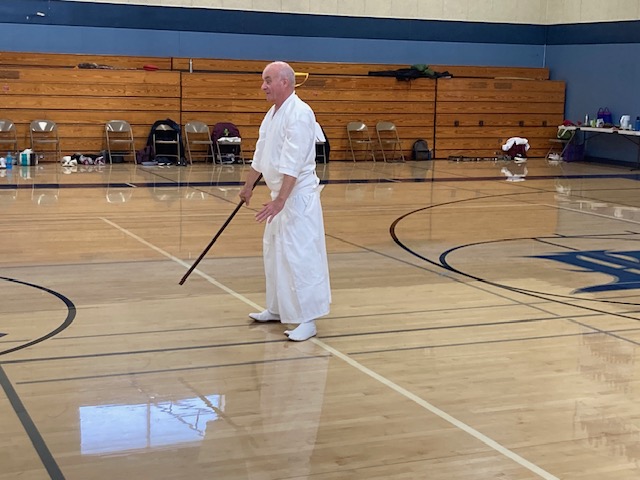
Pierre performed 8 sword techniques called Toyama-ryu Batto Ho Kata with his iaito. His demonstration showed clarity of cutting in different directions while also showing his soft, flowing, effortless mastery of the sword. In a cascade of demonstrations, each group did their kata (as mentioned above), finally all groups did Shoden no kata together. After three days of practice the group was unified in doing the kata as if they were breathing and moving in concert with each other.
Gratitude was expressed to Pierre at the closing ceremony for his time, wisdom, and teaching. Sally Gaston shared “Awesome weekend-thank you everyone.” John Bevis said “I enjoyed the workshop pace. Every section expanded what we did in the prior section.” Pierre shared his view that Shintaido of America Kenjutsu practice was on their way “with enthusiastic learners running ahead.” In departing, Pierre shared that the enthusiasm of the group “renewed (his) energy and inspiration to go on and to refine further our common good of Kenjutsu practices.” Throughout the practice, Ito Sensei was honored for his Kenjutsu legacy with his photo hanging beneath the Shintaido banner.
Glossary:
Diamond 8 – the creation of Masashi Minagawa for sword (and open hand)
Tenshingoso Kumitachi no ken – using the sword to do one of three core Shintaido movements
Go Ho Batto Ho – five drawing techniques for the bokken or iaito
Iaito – metal practice sword
Jissen – sword techniques for the bokken beyond the 9 basic Shintaido techniques taught with Boktoh. These twenty- two techniques have both names and numbers.
Shoden no Kata – the first of three Kenjutsu kata for sword
Chuden no kata – the second of three Kenjutsu kata for sword
Okuden no kata – the third of three Kenjutsu kata for sword (also know as the wisdom kata)
After more than two decades of dedicated service, we would like to express our heartfelt gratitude to Rob Kedoin, who will be concluding his role as SOA webmaster in September 2025. Rob has faithfully stewarded our online presence since at least 2004, helping to make the SOA website an invaluable resource for both members and the public.
Under his guidance, the website has continually evolved—sharing information about Shintaido classes, our curriculum in karate, bojutsu, and kenjutsu, as well as providing vital updates about SOA examinations. Rob’s steady, behind-the-scenes support has ensured that these resources remained reliable and accessible to all.
In 2018, with the support of the SOA Board, Rob spearheaded a major upgrade that made the website fully compatible with iPhones and iPads—an improvement that drew many positive comments from our community. Most recently, in 2025, Rob worked with Board member David Palmer to successfully migrate the SOA website to Dreamhost, a new platform offering enhanced security and SSL certification. These improvements have strengthened our online presence and ensured that SOA continues to serve members with professionalism and care.
In addition to his technical expertise, Rob also contributed as a member of the SOA Board from 2006–2015. His long-standing commitment and countless volunteer hours have left a lasting mark on our organization.
Rob, thank you for your remarkable dedication, your vision, and your tireless efforts on behalf of SOA. We are deeply grateful for all that you have given, and we celebrate your many contributions with heartfelt appreciation.
by David Palmer, Shintaido of America Board member
We are inviting interested members of SOA and the general public to listen to David Palmer speaking on the Value of Touch on Wednesday the 1st of October at 12noon via Zoom. David Palmer, with a massage career spanning 45 years, is speaking on the Value of Touch to the San Francisco End of Life Network (SFEOL). David has been recognized as the “Father of Seated Chair Massage” and in 2007, he was inducted into the Massage Therapy Hall of Fame.
From 1982 to 1989 he was Director of the Amma Institute, the first school in the United States exclusively devoted to traditional Japanese massage. It was during this time he met and studied with H.F. Ito, Shintaido Doshu. David’s study of Shintaido, especially his appreciation for the kata of kenko-taiso (the specific sequence of gentle warmups), continues to the present. David Palmer has been a SOA Board member from March 2024 to the present.
As a colleague of Irene Smith (1946-2021), David has been entrusted with her archive of teaching materials. Smith founded Everflowing in 2001, an organization dedicated to educational outreach and teaching skillful touching as an integral component to palliative care. She also ran Service Through Touch from 1982 until 1999, through which she created massage programs for people living with HIV-AIDS worldwide.
For this presentation David will speak with Connie Borden, SOA President, and Palliative Care Nurse Practitioner about the value of touch for the seriously ill and those at end of life. Join us and bring your questions to this interview that promises to be rich with insights into the ways that human touch can transform our human existence.