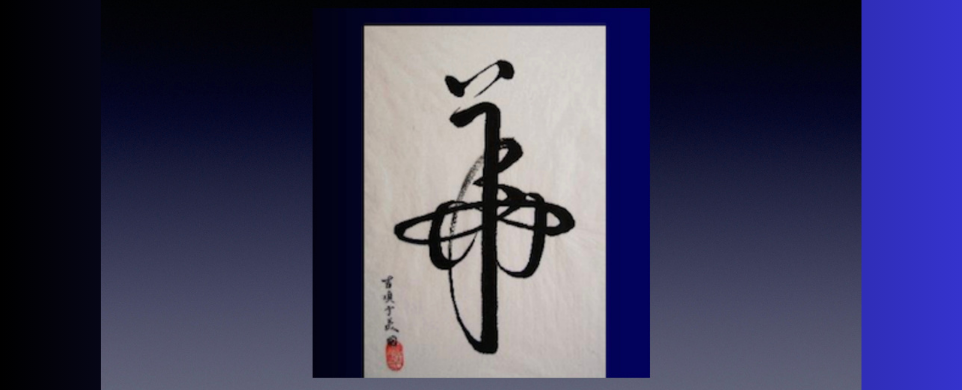
One day this spring, I was wandering around the desktop of my Mac, clearing out old files, trashing grade documents from classes I will never teach again. But the mouse arrow kept skating over a pile of “screen shots.” As I was pulled into the pile, a wonderful image popped up of a celestial Chinese calligraphy or brush stroke painting that I kept from ten years before, when I attended a neurology class in our Doctoral program at ACTCM.
What I remembered more was a companion handout which included a smaller black and white version from a PowerPoint slide labeled “MOTOR EXAM” with the six basic beginning steps of learning to do a neuro exam. I was deeply interested in the medical subject and all of Dr. Hao’s years of experience and skill using scalp needles to improve many difficult cases.
But alone, the beauty of the painting was stunning, especially since I was back on Sundays enjoying Taimyo, on Zoom. Each hour of these classes has reminded me of the richness of Shintaido and has helped my (nearly) 75-year-old body wake up and reengage in the movements, the company and the more ethereal stuff: Qi, composure, and the “oneness with nature and the group.”
I got a wake-up call, and continue to feel this each week, about how much lack of balance has become part of my being. I have been going through medical treatments since last fall that may continue for the rest of my life. I have been diagnosed with Hemochromatosis, too much iron in my blood and organs, something that goes undiagnosed often until we are too old to do anything about it. But that aside, my body is giving me new lessons and Shintaido is a great ally helping me to stop at least some of my dizzy spells.
I enjoyed reading Sally Gaston’s article about her relationship to Shintaido over the years. I wish I had been that young when beginning to train in Shintaido. But what I thought about those younger days, is that even at 25 when I began Shintaido, I didn’t need to think about balance. In fact, when I was a small child in Long Island, we ran up and down hills, high bluffs of sand and rocky piles at the waterfronts where with or with our shoes we would chase each other on wet rocks and never fall down.
At first, my relationship with Shintaido was to build up muscle and strength without competition as in other “sports” as well as learning to be still, quiet and willing to learn a new world of culture, community, trust and inner strength: that was the real new deal.
The balance I see in Dr. Hao’s painting is meticulous brushwork. As an acupuncturist, I have been looking at it now, not as Motor Exam diagram, but more like the revelation of the secret interiors of the human body that has treasures beyond Western medical anatomy, or what modern medicine knows and can see with technical machines and blood tests. It shows the millennium or two of study and meditation that built Chinese medicine’s understanding of diagnosis and treatment. The balance of treating the exterior using massage, needles etc. with the understanding the deeper interior systems that we now learn in acupuncture school.
There are major meridians that we see on the maps and there are the Eight Extra meridians, each working together to balance the Qi of the body which holds up the strength and health of the exterior. Even for those of us who have not studied medicine, eastern or western, when I ponder the loveliness of the calligraphy, I think of Shintaido in several ways: I think of the various Kata we learn and practice, I think of our Wakame movements, and I think of the idea of Ten/ Chi/Jin. I think of balance in movement and balance in stillness and quiet.
When Connie asked if I would be willing to write a “Body Dialogue” article about my experiences in practicing Shintaido these last few years and my decision to challenge boh and Shintaido exams I did not entirely know where to begin.
Shintaido has always been part of my life—the people in many ways even more so than the practice. However, my experience with boh has been the part of my Shintaido experience almost solely as an adult, but also opens up the side of Shintaido that relates most heavily back to my experiences in other types of body movement.
Jim’s Sunday classes where I would read or sleep or occasionally participate in my childhood were primarily Shintaido, as generally was our Kangeiko.
My Dad taught boh when I was younger that I did not attend.
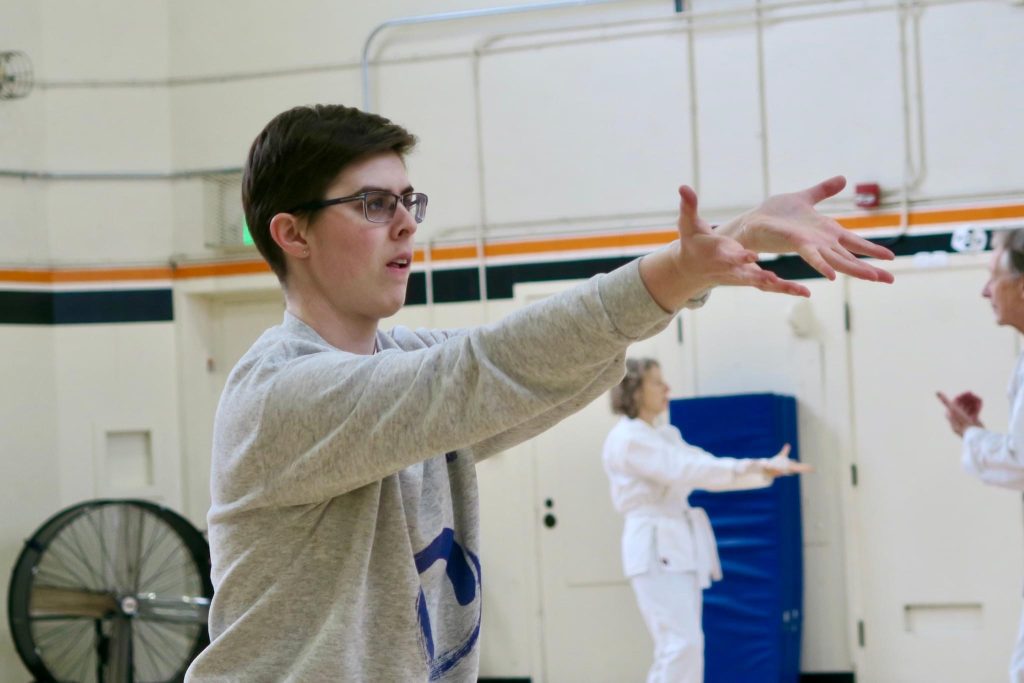
Boh has always appealed to me, especially kata, since I grew up doing ballet and that type of repeated practice is a way of learning and exploring body movement that is quite familiar to me.
I don’t remember what my initial thoughts were when my dad suggested I take a boh exam, but I think it was useful to have something specific to prepare for. It also forced me to learn the names of the movements I was doing—something that has not entirely been my strong suit.
Taking Shintaido exams was a similar experience. A lot of Shintaido movement is deeply embedded in my body and my being from years of exposure, but learning and remembering the movement names sometimes adds an element of understanding; sometimes philosophically and sometimes practically. Pushing myself to become comfortable in other things such as leading warmups and helping organize the boh workshop in June has helped as well, tying me in to the rhythm and practice of the bigger picture of keiko.
I cannot say that I have entirely achieved a coherent summation of my experience in Shintaido as an adult, but I think this mirrors my relationship with my own practice. I feel that I find myself frequently having two different experiences of Shintaido happening at the same time; on one hand, a raw beginner while also having it deeply imbedded in my body and psyche. This is, I think, why Shintaido remains so difficult for me to explain to others—I am too close to it while also still making my way in from the fringes.
I am not sure where I go from here, but I am excited to experience the International Gasshuku in England this summer. I think the experience will help me both in my practice and perspective. I look forward to continuing to deepen and develop my relationship with Shintaido and finding out where it takes me.
Age changes us, and as we bring our changed selves to keiko, we are forced to make accommodations if we are to continue to do it. At first this can feel like a disappointment. But in time the compromises we must make, surprisingly, fail to compromise us. Instead they open the way to something novel and possibly interesting. We encounter some problems we have not yet faced, and with these problems come opportunities for new insight. Our keiko, as well as our understanding of our ourselves, broadens and deepens. It is as if we increase our capacity or “bandwidth” for receiving the message of the universe.
I haven’t the flexibility, the wind, or the stamina I once had. I have pain in my knees. My right hip and right shoulder are liable to complain. But each of these complaints is the universe manifesting itself in a fresh way, and each gives me something to work with, a problem to solve, resulting in a refinement of technique, a discovery of a more efficient way to move, a better way to warmup, and a sensitivity to know my limits and call it a day. As my body weakens, slows, and takes longer to recover, it teaches me to adjust. I find myself listening even more closely for the message of the universe.
————
I once told Ito Sensei I was having difficulty with this expression, “the body is a message of the universe.” The profundity and universality the words convey have always inspired me, made me wonder, and stimulated my thinking and desire to do keiko. However, I did not know how to understand the words in regard to one of my students. She had lived since birth with cerebral palsy, which forced her into a wheelchair. She walked with unbending legs and only with the aid of crutches. How, I asked Ito Sensei, does the expression apply to her? Do they hold up in her case? Would they ring hollow to her? Clearly the universe’s message might feel unfair or even cruel to someone so challenged and who cannot do keiko as it appears in our textbooks and videos.
Ito was not puzzled by the question. As I remember, he simply told me to consider that the “body” referred to in the expression was the body in general, or all bodies. We receive the message not just by means of our own bodies but through those of others as well. He challenged me to receive the message via her body as well as my own. While I could not tell how his response answered my question, I felt my unease with it resolve.
It occurred to me that I was projecting onto my student an emotional response to keiko that she had not, in fact, expressed to me. As far as I could tell, she found keiko interesting and fun, and indeed, I saw her grow and gain confidence as she practiced.
One of her favorite practices was kumite with jo while seated. I would attack her with the jo in dai jodan and jodan while she received with ichimonji uke. When we first started this kind of kumite, she was timid and would tense and struggled not to shut her eyes as she raised her jo to meet mine. Eventually she relaxed and as I swung my jo down on her, her eyes would brighten, and she’d break into a beaming smile as her jo shot up to receive mine.
Afterward I’d give her a moment to catch her breath, her face happy and damp with perspiration.
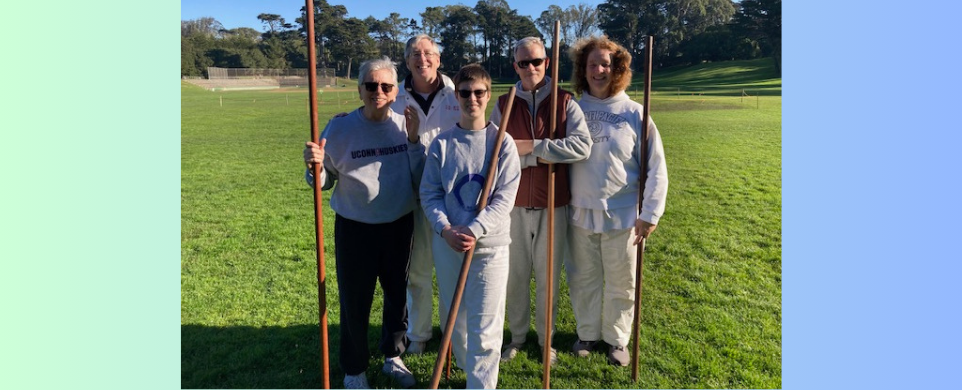
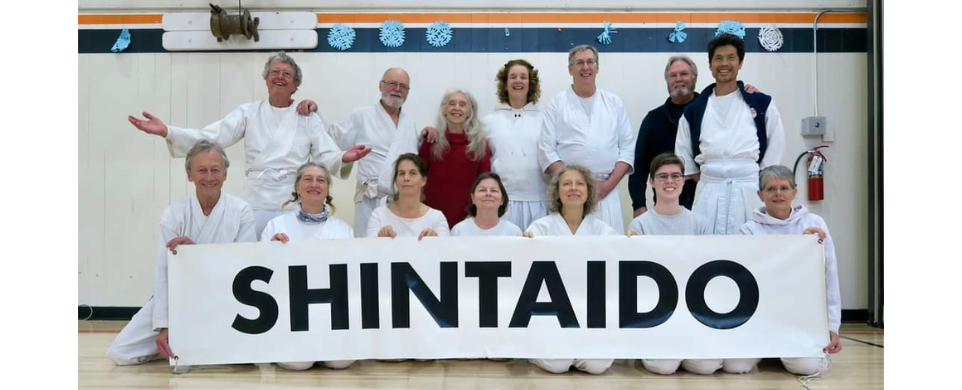
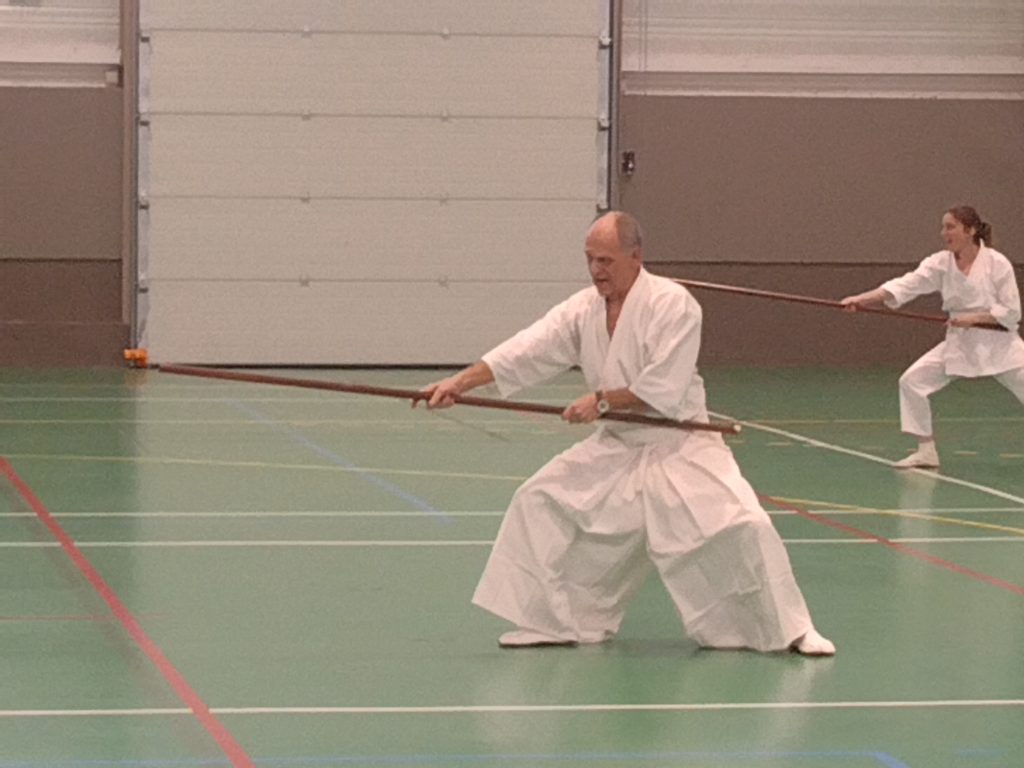
The Shoshi-no-kon bohjitsu workshop was held Sunday May 192024, in Cotati, California. Robert Gaston, Senior instructor and SanDan Bohjutsu taught two keiko and associated kumiboh. Sally Gaston and Nicole Masters organized the workshop. Nicole Masters hosted a potluck brunch at her home. Thank you to PacShin for providing financial support for the workshop. This workshop was held for the first time at a veterans facility in Cotati.
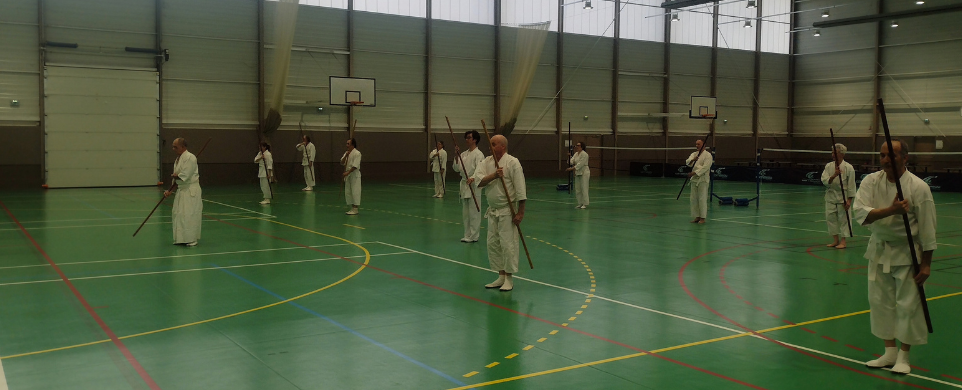
As reported in the April Body Dialogue article, Rob Gaston attended a European Shintaido College (ETC) workshop in Macon France. This workshop was taught by Alain Chevet, General Instructor and Yondan Bohjutsu, to share the newest Boh Kata – Shoshi-no-kon. This kata has been under development by HF Ito for the past 15 years. Shoshi translates into “Joyful Warrior” to reflect the state of relaxed joy after a shared moment of happiness.
Seven Shintaido “Joyful Warriors” attended the workshop: Shin Aoki, Sandra Bengtsson, Sally Gaston, Nicole Masters, Jason Ravitz, Mike Sheets and Robert Gaston. Go to the Shintaido YouTube channel to see videos of this kata:
I started high school in the public school system but due to circumstances, namely me not wishing to be in school, I was sent to Kentucky Military Institute in Louisville, KY.
At the beginning of the Vietnam conflict in 1966, I was drafted by the Army for a 2-year term. However, not wanting to be in the Army, I choose to enlist in the Navy for 4 years.
My job as an electronics technician and air crewman gave me many hours flying which included landings and take offs from an aircraft carrier. Saw many places around the world in twenty-four months at sea on four different aircraft carriers.
My duty station was Quonset Point Rhode Island and after my discharge I never went back home, choosing instead to remain in New England. I used the G.I. bill to take flight training and get my pilot’s license. It took eight or nine years of flying as a swordfish spotter to accumulate enough flight hours and experience to be hired by an airline.
After flying for a small commercial airline for about twelve years, I decided it was time to move on.
A few years before I left the airlines as a commercial pilot, I followed another lifelong dream of living on a boat and bought a forty-one-foot ketch (sailboat). I lived onboard that boat for the next twenty-two years.
I worked as a harbor master’s assistant in Westport, MA. As I found that I truly enjoyed working on the water, and I received my merchant mariners captain’s license from the Coast Guard.
Most of my time working on the water was assisting recreational boaters, responding to emergencies in any weather day or night.
Prior to my study of Shintaido I never practiced any other martial arts.
—–
When and where did you first encounter Shintaido?
In the early 90’s, I became good friends with a fellow live-aboard who was Sarah Baker’s brother. Through my connection with her brother, I became friends with Sarah. In 2012 we began spending more time together. It was then that Sarah began sharing some Aikido and Shintaido movements with me. At the time, I did not know anything about either art, but I became interested in the open hand and foot work she would show me. Sarah would try to teach me while we would go for walks on trails and in parks. I was introduced to Ito sensei through watching DVD’s Sarah had. He had been a friend of Sarah’s sensei in Massachusetts, and she studied with Ito when he came to their Aikido dojo. In 2017, Ito encouraged Sarah to visit and train with him in San Francisco, California where he would be for several weeks. Sarah invited me to go along, and we could see the sites while there. That is when I met Ito sensei and watched my first formal Shintaido class.
I have never enjoyed participating in organizations, group activities, social clubs, etc. However, the first time at Day Street Dojo, I felt a kinship with Ito sensei though Shintaido did not excite me yet.
The second time we went to San Francisco, Sarah asked if I would help video the practice. At one point, people were running around in circles, arms raised above their head yelling. “What is this Shintaido?” I thought.
The third time I experienced a formal class was in Quebec, Canada, where Ito was teaching. It was when I started to become interested in the practice. There are no schools in Florida that teach Shintaido. Sarah would help me with the movements and interpret their meanings. Because of Covid-19, Zoom became the gathering place for group activities. The more I practiced on Zoom the more I wanted to get better.
—–
What initially attracted you to Shintaido?
The challenge. From the beginning, when Sarah began sharing movements from Aikido and Shintaido I enjoyed the challenge of learning. Learning the forms, discovering my balance in a new way and just moving in these totally new patterns.
—–
Do you have a favorite technique, favorite parts of keiko?
I find practicing outside makes me feel closer to the universe. I really enjoy the movements of Tenshingoso and Diamond Eight, but sword practice, open hand and with bokuto, is what I like most. I also have come to really enjoy Taimyo as it has given me a way to slow down and meditate. The first thing I do every morning is go outside and do part one. Shintaido has given me a better understanding of myself and is teaching me to be understanding of others and listen differently. Work in progress.
Most of my in-person keiko has only been at PacShin Kangeiko and this only a few times. I was fortunate to study one time with the SNE group and in Quebec once. What I really enjoyed at these times was having so many new people to train and learn with.
I find the Zoom keiko on Sundays with Connie, Rob, and Sandra and Fridays with Nagako in the UK are very supportive. I can learn new movements, new ways of understanding older movements and expanding my overall technique.
—–
Why did you decide to take an Advanced Student Evaluation?
After about five years studying Shintaido more formally, Connie asked me if I would like to take a student evaluation. I did not feel that I had become proficient with the katas, and I did not know all the Japanese words and terms. My body at 78 is not as it was in my 50’s and some joints protest loudly. My arms don’t have a full range of motion anymore and balance could be better. However, I thought I would except the invitation because even if I did not pass, I would still have that experience. Another opportunity to learn by trying.
—–
Did you feel nervous before or during the evaluation?
Two months before the evaluation date I had started trying to learn the terms and names of the katas. It is a slow process and much if it didn’t stay with me. Sarah and I planned our trip to CA so that we would be there about two weeks before Kangeiko. This gave us extra time to practice in-person with Connie and Rob.
With that said, when evaluation day arrived, I was nervous and was losing confidence. Rob had taken the time to coach me for several days while Sarah and Connie were away in France, and I could not let him down. More than once in my life I have had to take a test twice before passing and if I needed to this time, it would be no big deal.
Two of us were being evaluated that day. Afterwards, we all went for lunch, and by that time I could feel the results of my stress, but I also felt I had done the best I could. I was pleased with my performance.
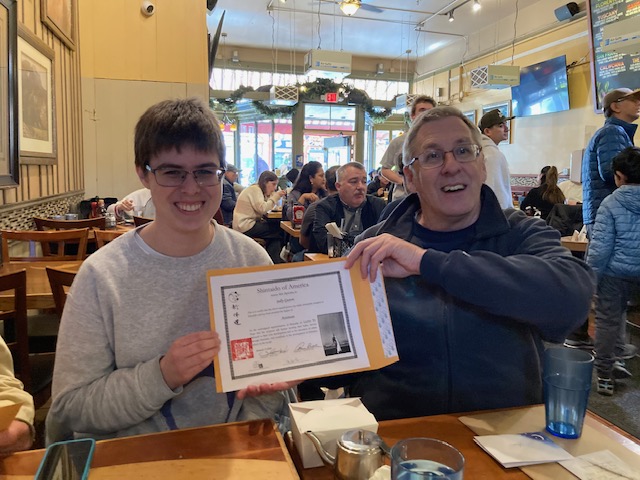
After lunch we were presented with our certificates. It was then that I realized how much I felt validated in my study and how much I really have learned in my practice to this point.
—–
What feedback did you get and what are your thoughts about it?
Shin and Connie each gave us their thoughts for areas of improvement and encouragement. One point that Shin explained, when I do a kata even if I cannot reach high or far, believe that I am reaching beyond my thinking. Expanding all my space.
Specifically, Shin mentioned my Tenshingoso movement. He noticed that I was not able to reach up above my head very high due to my limited shoulder movement. As I moved into the end of Ah he instructed me to focus my intention as if I were reaching up higher than I am actually able to do and connect in tenso, even if I am not able to duplicate the exact form of others. Then as I cut Eh he told me to allow my cut to come down lower than what I see others doing. His suggestion was to develop a greater distance from the top of my tenso to the end of my Eh cut – creating the desired change in elevation between tenso and the end of the cut opening space in front of me.
Since returning to Florida, and practicing in this new way, I have begun to find I actually am able to think less about the specific form. I have begun to find the form in my being instead of focusing on it in my mind.
I’m not sure if it was Connie or Shin who mentioned that I should allow my voice to connect to my movements in Eiko Dai better. Having very few opportunities to practice Eiko with instruction, I am not fully clear on this feedback, but I try to keep it in mind as I practice all forms.
—–
Any other thoughts?
The Shintaido community is very helpful, understanding, and makes no judgement of others.
Shintaido is wonderful in how it helps me look at things differently. I am happy with my study so far.
Because of everyone I have mentioned from San Francisco to the United Kingdom, I like what I have achieved and am looking forward to many more keikos. There is so much Shintaido I want to learn. I feel happy working on studying the Shintaido I have already been exposed to. It is less important for me to keep learning more and more new forms in Shintaido. I am very happy with my current practice as it is, hoping to continue to deepen my personal understanding as I keep practicing.
Here is a brief report of my trip to Macon France to attend the ETC boh workshop in which Alain Chevet presented Shoshi no kon boh kata that Ito developed over the last 15 years.
This kata had as its starting point as Sueyoshi-no-kon kata, the sho-dan level boh kata that was used in the bohjutsu exam curriculum until the early 2000s. In the new name “Shoshi” means after the laughter and I wondered if there a translation subtlety I missed from Japanese to French to English. Initially it sounded like a suggestion to stop laughing and be serious. Through repeated practice and Alain’s story of Ito sensei laughing as he taught it, I realized it was a peaceful joyous feeling one has after a good belly laugh.
I arrived in Paris and was met by Charles Burns for a short train ride to Tonnerre, in the Burgundy region. We had a wonderful welcome dinner and overnight stay with Georg and Natalie which included some Yon-dan Soei kumibo practice with Charles and Georg. We awoke early and drove to Macon Sport Center and continued practice that evening before dinner.
Saturday morning began the official workshop in which Alain demonstrated Shoshi no kon. We began a to break down the various parts of the kata. The first keiko was quite long and lasted 3 1/2 hours. The beginning movements of the kata worked well as a kumibo and we practiced for a while. It consisted of two jodan gyaku receives stepping back and a quick chudan morote tsuki to stop your opponent’s attack. The long-repeated practice softened our minds and bodies and we were doing a kumite that flowed back and forth with no clear leader or follower, curving and changing the rhythm so the attacker could at any time become receiver.
We progressed to learning the middle portion of the kata and took a break for lunch.
For keiko #2 we added in the left right change of direction portions of the kata. This part was familiar to those who had done the original Shodan boh kata. We explored it more deeply with a wave like kumibo that reminded me of the inyo-itai boh movements absorbing the boh into fluid motion. We progressed through the first 2/3s of it.
After dinner we retreated to the tea corner room and ETC had a boh subcommittee meeting that included drinking and brainstorming of how they wanted to include Shoshi no kon into the ESC Shintaido boh curriculum. For now, it will be in their teaching curriculum and reviewed in 2026 to add to the exam curriculum.
The next morning, in the final class, we finished off the kata and studied a third kumibo. This added a jump away and geidan uchi komi to protect our ankles as we step across and jump away from a tagurei tsuki to our ankle. By this time a sense of peace and relaxed smiles were evident in the practice. Alain finished the class with repetition of the kata as he fine-tuned our movements individually.
The warm welcome I received from the ESC members left me energized and excited for Shintaido bohjutsu. I am left in wonder at every Shintaido event that gets people together from diverse cultures and experiences, allows connection and understanding and my renewal of the value of Shintaido. The sense of being relaxed, happy and enthused has returned home with me.I quickly reached out to PacShin with a request to teach a boh workshop to teach the boh kata of the joyous warrior. It will be May 19th, 2024. I hope to get more opportunities to pass on this kata to those who love bohjutsu like I do.