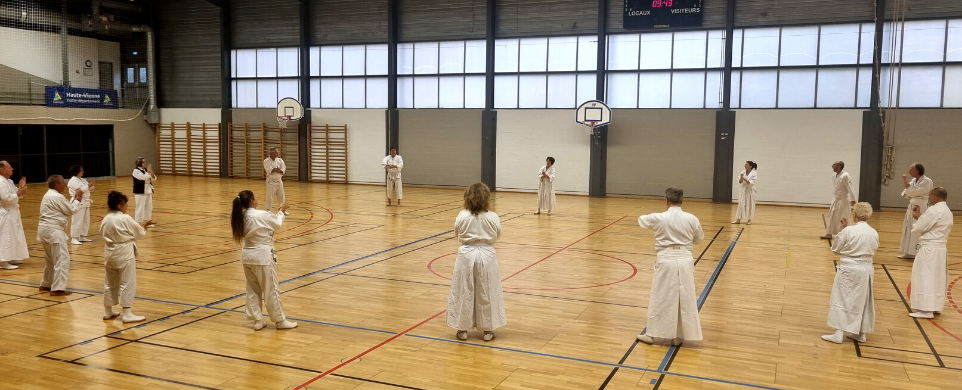
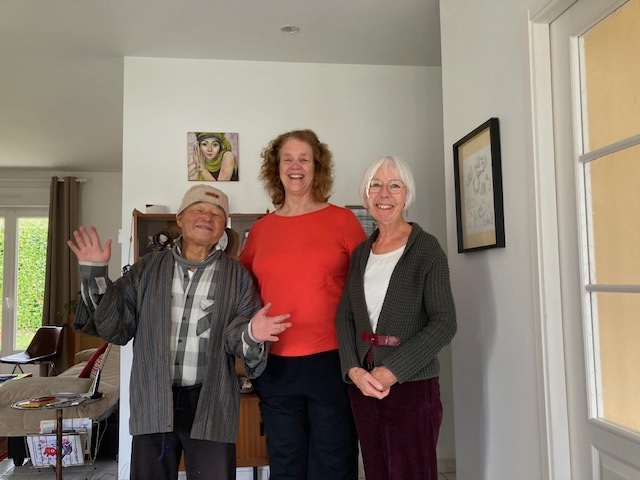
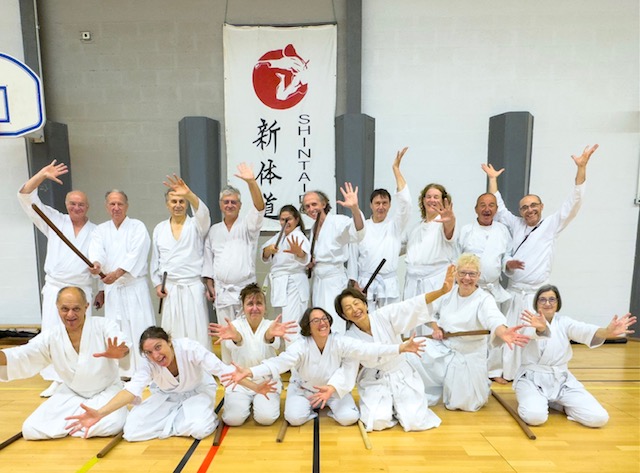
I travelled to France in early November 2023. HF Ito and Nicole Beauvois me for the first 5 days to enjoy their new house in Cuy France. The second half of the trip was to Limoges France to study Kenjutsu with Shintaido General Instructors and Yondan Kenjutsu Instructors Pierre Quettier and Mieko Hirano.
Cuy France is 90 minutes from Paris and near Sens and Troyes. We explored the Farmers Market in Sens and visited the majestic Cathedral. One day was spent exploring the historical section of Troyes France to see the architecture and have a splendid lunch at a French restaurant. I was fortunate to have a private lesson with Ito Sensei on Kenjutsu. Thursday afternoon, we did a Taimyo Keiko in honor of Brad Larson who recently unexpectedly died. Brad was a SOA Instructor and SOA Board Treasurer. The visit concluded with a dinner with friends of Nicole and Ito.
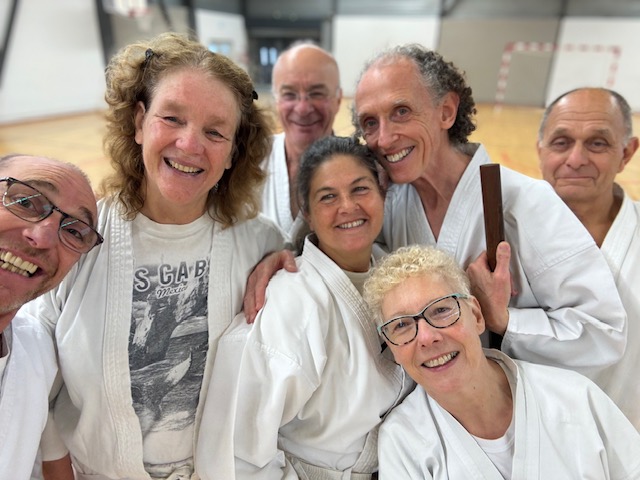
Limoges France, about 4 hours from Paris, was the site for the Kenjutsu workshop. During the past 2021 and 2022 workshops, they explored Shoden no kata and Chuden no kata. This year, our study was Okuden no kata, the third in the trilogy. Eighteen people attended this workshop. Pierre and Mieko hoped for attendees to “cultivate their garden of practice with complete peace of mind.” Practicing in person after time apart allowed us to do Kumitachi with a variety of partners while also sharing a little of the Shintaido “breath of eternity”, as Pierre stated.
This year, in order to optimize the practice time on site, they offered preparation beforehand. I met with Pierre and Mieko by ZOOM to review my study of Kenjutsu. As a result, my homework for the 5 weeks before the workshop was to learn and study Goho Batto-ho, the 5 drawing techniques. I thank Robert Gaston and Sarah Baker for their time and guidance during these 5 weeks. Ito Sensei during my private lesson gave many instructions to refine my techniques with the focus to “keep your blade active”.
Pierre presented a website to support our personal practices and serve as support for the goreï of Kenjutsu teachers. Pierre offers this website as a resource: Shintaido Kenjutsu Cyberdojo.
The workshop started Friday November 10th with a collegial keiko and meal. During our practice we studied Goho Batto-ho, known as 5 drawing techniques either with Bokken or Shin Ken. Saturday, November 11 there were two keiko. We divided into 3 groups based on level of practice. Mieko Hirano instructed Group A on Chuden no Kata and the first two Jissen Kumitachi. Alain Chevet assisted Pierre in teaching Group B and Pierre guided the practice Group C. We systematically studied the movements of Okuden no kata, often doing kumitachi applications of the movements. The repeated practice brought the kata alive to give a glimmer of it’s meaning. We then set a goal to study #1 to #11 of the Jissen Kumitachi, however for most of us we achieved practicing the first five kumitachi.
In the evening we met to discuss the Kenjutsu curriculum. Pierre distributed his comprehensive documents on the Hagakure – the Trilogy of three kata (Shoden no kata, Chuden no kata, and Okuden no kata). We discussed teaching Kenjutsu, especially to the new students. The group of 18 people included Ula Chambers and Charles Burns from the UK, me from North America and students from across France. Many report the advantage of teaching Kenjutsu to reach new audiences.
Sunday, November 12 was keiko 3. We continued with Jissen Kumitachi, now attempting to review #12 to #22! The last part of our morning, we combined into one group so all could practice Dotoh and Ryuhi Kumitachi. Pierre led our group to demonstrate Okuden no Kata to Mieko’s group, then the full group did Shoden no kata and Chuden no kata multiple times to bring our movements and breath into synchrony. After a meal, and the typical Shintaido goodbyes of hugs and kisses, we departed around 2 p.m.
I am grateful to Pierre, Mieko and Alain for their teaching and dedication to Shintaido Kenjutsu. I enjoyed the opportunity for kumitachi or partner practice in this focused workshop. While the workshop was located in France, our Shintaido study is the same art. The facility in Limoges provided comfortable lodging along with excellent French cuisine.
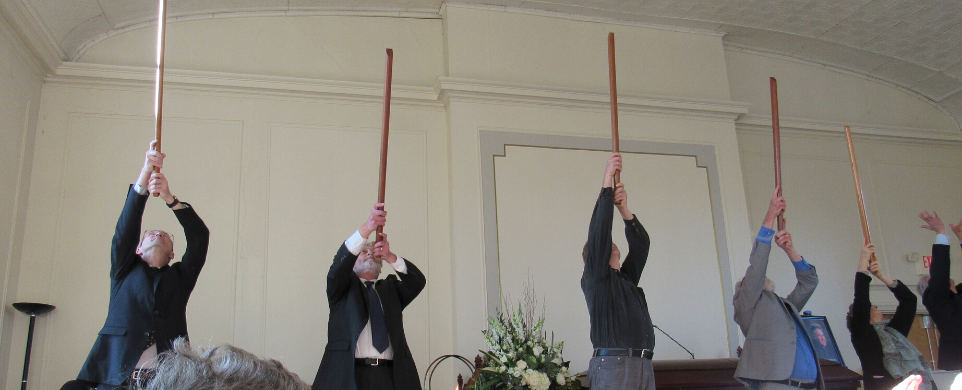
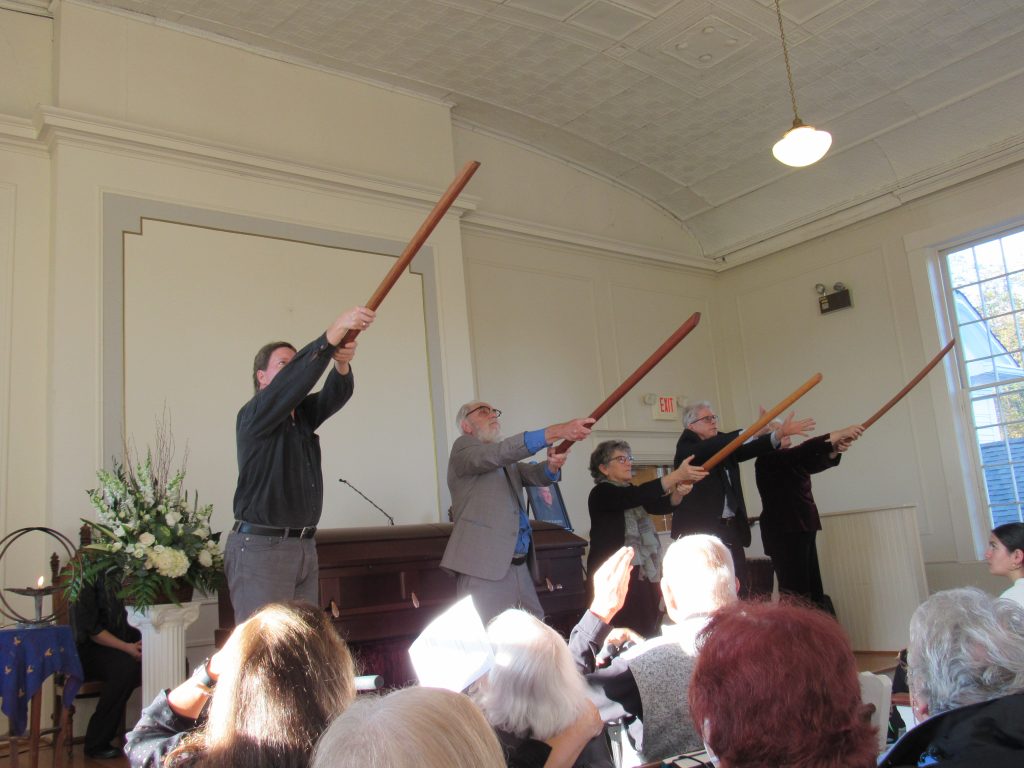
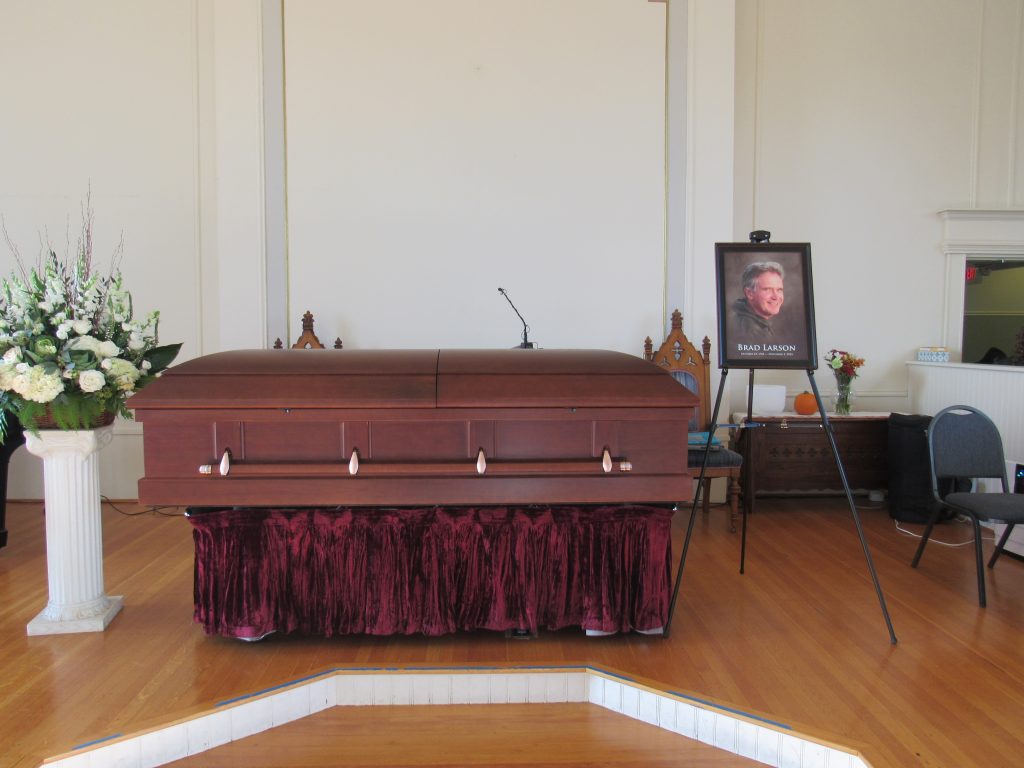
By Rob Kedoin On Sunday, November 12th, Shintaido members gathered at the Unitarian Church of Sharon for Brad Larson’s memorial service. The church was filled with so many people that some watched the service from an overflow location in the building. The service was beautiful. Rev. Jolie Olivetti spent time talking about Brad’s family as well as his many interests in Shintaido, Biodanza and drum circles. There was a period of sharing where people could tell stories of Brad. These stories ranged from his omnipresent smile to his involvement in the church, the Historical Society and his many contributions to the world of interactive storytelling in museums.
From a personal perspective, Gail and I began the day by hiking in the nearby Moose Hill Wildlife Sanctuary. I know how Brad loved to run with his boh or joh through the woods and while I have no idea if he ever ran the trails of Moose Hill, it helped me to envision being on trails he once traveled.
Toward the beginning of the service, the reverend relayed a message from Brad’s mother which affected me deeply, that, “Brad would be the first one to forgive.” I needed to be reminded about this because I had felt myself growing angrier and angrier about Brad’s death.
Matt Shorten spoke about Brad and Shintaido, then led us in Tenso and Shoko as we stood at the front of the church. David Curry then invited the attendees to join us in open handed Tenso and Shoko. Facing a church full of people, palms outstretched in Shoko, all sharing their love for Brad was awe inspiring.
For myself, I will always miss doing the standing back stretch with Brad. I always felt like I was being lifted like a rag doll and being stretched by a kind, gentle giant.
Brad once spoke to his church’s congregation about a three-rock meditation he learned from Thich Nhat Hahn. Since the congregation thought it fitting to send us away with packets of three rocks and the meditation directions, it seems like a good way to close. Hold each stone consecutively in hand:
Stone 1: Breathing in, I see myself as a flower; breathing out I feel fresh Stone 2: Breathing in, I see myself as a mountain; breathing out I feel strong Stone 3: Breathing in, I see myself as still water; breathing out I reflect things as they are
Shintaido of America is hosting a celebration of life for Brad Larson on 10 December 2023 via ZOOM. Brad died unexpectedly at home on November 2nd at the age of 62, a victim of an apparent homicide. As our community has experienced shock and grief, we hope for an opportunity to come together as a community to celebrate Brad and his life.
Brad began his Shintaido studies in 1987, in Cambridge, Ma. He initially studied with Michael Thompson, Master Instructor, and then furthered his studies for many years with Joe Zawielski, General Instructor in Worcester, Ma. There he was an integral part of the weekly Worcester area group, developing strong and deep connections within this group and the larger SNE community.
Over his 36 years of studying Shintaido, Brad’s love of the weapons (boh, bokutoh, jo, and bokken) was always shining through. He traveled to many workshops and gasshukus at the Shintaido Farm and around New England, and more broadly up to Quebec and California to study with Master Ito Sensei. He also spent many hours studying and crafting bohs, jo and bokutoh which he freely shared. At his home, Brad was frequently seen with his sticks, reflecting his love and joy of movement with them. He particularly loved running up Rattlesnake Hill, Shintaido boh in hand and had become a recognizable fixture in the fabric of the neighborhood.
As well as achieving the rank of Shintaido Instructor, he was also ranked Shodan in Kenjutsu (sword). He served many years on the Board of Shintaido NorthEast along with serving as Treasurer for Shintaido of America.
Brad was born October 23, 1961, in Mitchell, South Dakota and was living most recently in Sharon, Massachusetts. Brad received his Master’s Degree from Harvard University and began his career in Museum exhibit development at the Children’s Museum in Boston. He was widely appreciated in his field for the creation of ‘Story Habitat’, a means to help organizations record and save memories. Brad has a teenage son, Lucas Jasper Sincero Larson. He is mourned by his family, parents Merle and Virginia Larson, sisters Julie Larson Mudry and Jill Larson plus nieces, aunts, uncles, and cousins. He was involved with Biodanza, drumming, and was past president of the Sharon Historical society. He frequently wrote Haikus and added beautiful photos of nature.
Please join us on Sunday, 10 December via Zoom. Times: 9am West Coast, 12noon East Coast, 5pm UK and 6pm Europe.
Shintaido practitioners in New England were lucky during their October workshop.
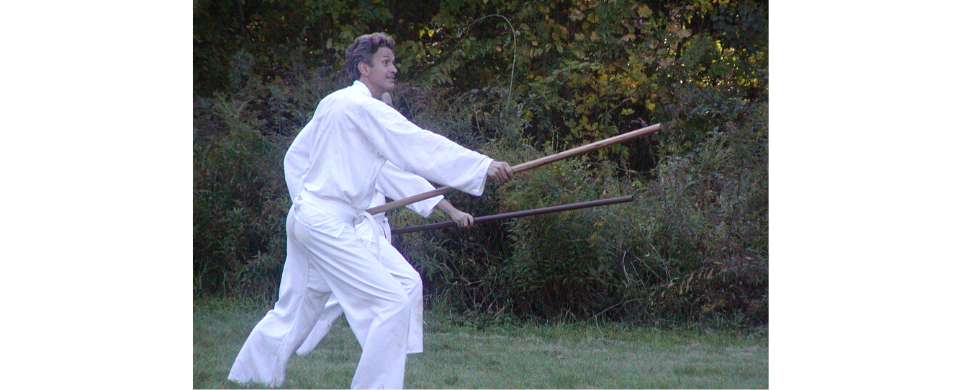
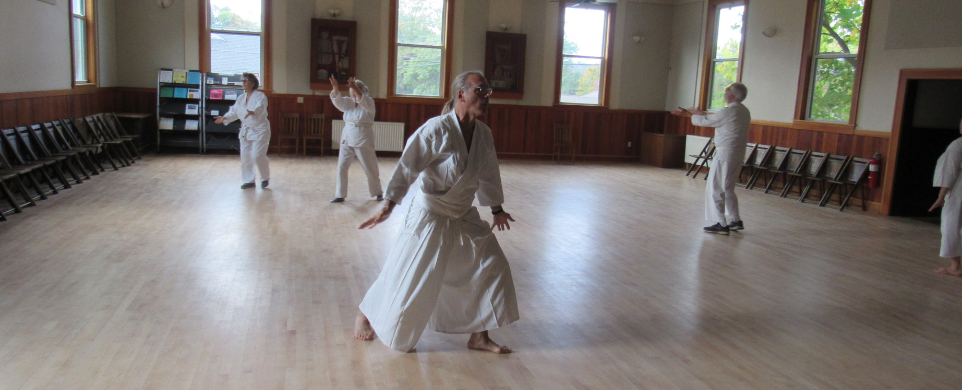
We were lucky to study with Senior Instructor Lee Ordemann who came up from Washington DC and led two keikos on Saturday that focused on the Jissen Kumitachi program. It was new for most of us and a refresher for a few. We practiced with bokken during two keikos on Saturday. A big thanks to Lee for making the trip and sharing his expertise with us. Heather Kuhn arranged to rent space at the Guiding Star Grange in Greenfield, the perfect dojo with a high ceiling and wood floors.
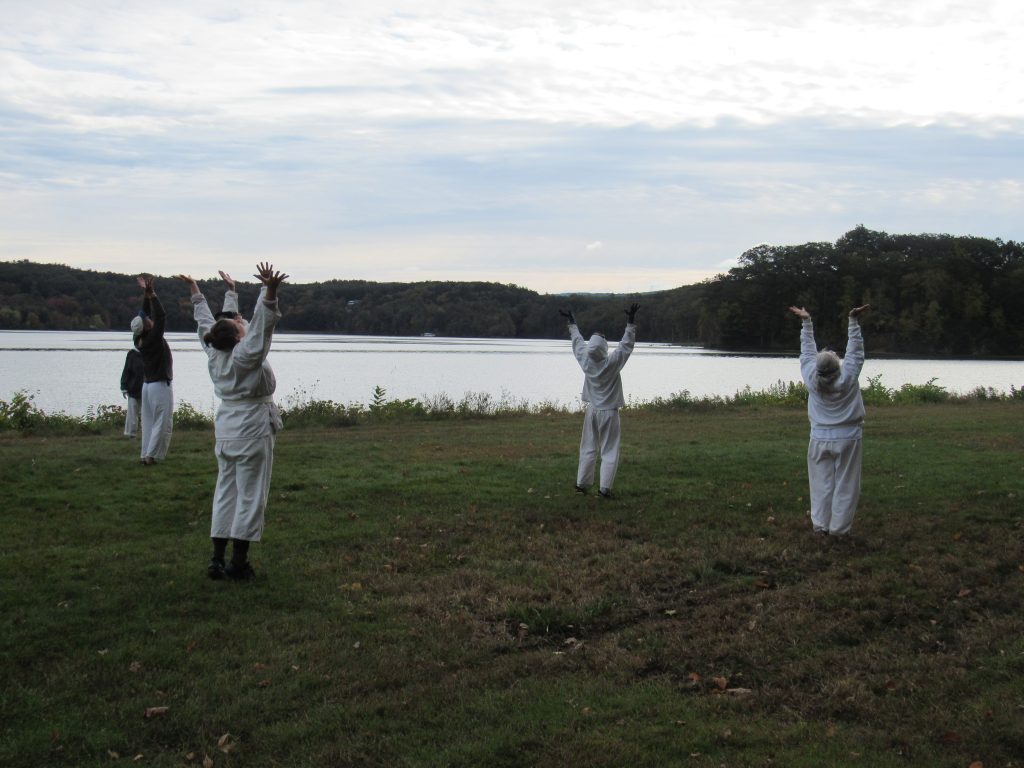
As New Englanders who have experienced the rainiest of falls, we were also lucky on Sunday morning when we gathered at Unity Park in Turners Falls. The sun came out just as we started, creating a dramatic backdrop. Bela led a Toitsu-Kihon and Eiko curriculum and encouraged everyone to express their energy and knowledge next to the beautiful Connecticut River. At least one practitioner (Eva Thaddeus) kept saying the field was her new favorite outside dojo. At the end of class, Stephen led us in Reposada, a new short kata developed by General Instructor Jim Sterling. “Reposada” means “restful “ in Spanish. It provided the perfect way to close.
In addition to the nourishment of learning from Lee and practicing the tried and true with Bela, we had two wonderful meals together: a potluck on Saturday night at Stephen and Bela’s house, and a breakfast and closing at Heather’s apartment in Turners Falls on Sunday morning.
Here’s a link to pictures from the weekend. You’re sure to recognize Margaret Guay, supreme organizer for the group, plus Lee, Bela, Stephen, Ann, Matt, Eva and Heather.
Bela and Stephen were delighted to host Lee and the women in his life – his lovely wife Elizabeth and his beautiful and energetic three-year-old daughter Esme.
I met Master Haruyoshi Fugaku Ito and his Shintaido in March 1995, in a yet frozen Quebec City. At the time I was 40 years old and had 20 years of karate training. Shintaido means New Body Way. It was created by Hiroyuki Aoki and the Rakutenkai, a martial artists group he gathered in 1965. Before, from 1958, Aoki had been an assistant of Master Shigeru Egami, at the time head instructor of the Karate-do Shotokai.
As for myself, from the 1980’s I had been searching for a Shotokai karate-do instructor, but these were hard to find. In my search, I had been using these two names (Shintaido and Aoki) and, eventually, I got lucky. Sometime at the beginning of 1995, one of my friends – a young karate instructor whom I won over to Master Egami’s karate revolution – told me that he had found Shintaido in some martial arts directory. He talked on the phone to a Japanese person in California who he thought was Master Aoki. In fact, it turned out it was Master Ito, a top student of Aoki who answered the phone. He had brought Shintaido to America in 1975. To my friend enquiries, Master Ito said that, since he was going to teach a Shintaido seminar in Quebec City in March, and we could find out more by attending. So, an excited Paul Gordon called me with the news. I was thrilled and we decided to attend that workshop, though at the time, Paul was living in Fredericton, New Brunswick and I, in Toronto, where we had first met a few years earlier.
Returning to Master Egami and his book, I was very attracted by the author’s approach to the practice of karate-do and the deep spirituality I could sense behind his simple wording. So, from the early 1980s I began to change my karate training from the popular, widely accepted JKA sport style to that outlined by Master Egami in his book. This book got into my hands by luck, I’d say. An acquaintance received it from his father who worked abroad and bought it for his son. Knowing of my passion, he offered it to me. I still have it and read it over and over again. With this new beginning, except for a few students that I had managed to win over, I was alone. The knowledge I had about these changes was general and restricted to the text of the book. Egami spoke of karate as a means of uplifting one’s spirituality by coming in contact with others, regaining human dignity and striving toward a state of body suppleness and natural power by reaching to the realm of vital energy laying beneath the limit of our physical/psychological strength.
Quebec City is somewhere halfway between Toronto and Fredericton. When the time came, I jumped in my old beaten-up Volvo and drove off. The seminar was to be held at L’Attitude, a massage school in downtown Quebec. On my way, in Montreal, I picked up an old friend and former karate student of mine who had expressed his wish to join us in this.
When we met, Master Ito presented us with the other, older book of Shigeru Egami,“Karate-do for the professional” of which 1,000 copies had been printed by the Shotokai. Following our request, Ito-sensei brought us this expensive and rare book featuring some 40 kata of karate and 4 kata of bojutsu (long staff) with black and white photos of Master Aoki performing these kata. Master Ito also appears in some of the pictures, and I still remember how, like two kids who had gotten a wonderful toy, Paul and I were sitting in the Kriegoff Cafe browsing through it and admiring the exquisite techniques of Master Aoki.
This seminar was dedicated to the massage practitioners of L’Attitude and was concerned with healing rather than martial arts. Friday night was more of a theoretical class about Amma/Shiatsu techniques and their Japanese names and meaning. Though we were not familiar with this massage and its terminology, we attended anyway especially because we learned that this was an integral part of Shintaido and that the martial art techniques and the massage techniques are the two edges of a sword. On our way in, at the front desk, we bought Master Aoki’s book “Shintaido, the body is a message of the universe” and were hosted in one of the rooms of L’Attitude.
The first Shintaido class seemed weird to us and unlike any martial art we had seen before. We were doing light kicks holding hands in a circle, (a sort of French cancan), standing jumps led by the hands by a partner, the seaweed partnered exercise and some short, strange kata (Tenshingoso) standing in place and moving our arms with the hands wide open in large gestures resembling some of the movements in the traditional karate kata. We were shouting the five sounds of A, E, I, O and Um. Also, we did a lot of unusual partner stretching and running with expanded free hand cuts derived from sword practice. I was enjoying it though, at times, I was slightly put off by its new-age tang I felt and because I couldn’t find in it much of the karate imagined from the descriptions which I read in Egami-sensei’s book.
And yet, here and there in Master Ito’s classes, some of Master Egami’s lines were flashing before my eyes as I could link some of the things we were doing with his teachings. For instance, he advised that, in order to improve them, all movements should be done exceptionally large at first and cut down to size only gradually. I have always imagined a large movement as a much larger than a normal movement but in Shintaido the movements were extended even to the infinite by being performed moving the arms and hands slowly while at a full run, some two-three hundred meters or even more. Theoretically at least, one should never stop running and cutting. Most exercises were to be performed by opening the body joints, especially the pelvis area and the shoulders and letting go of all unnecessary tension.
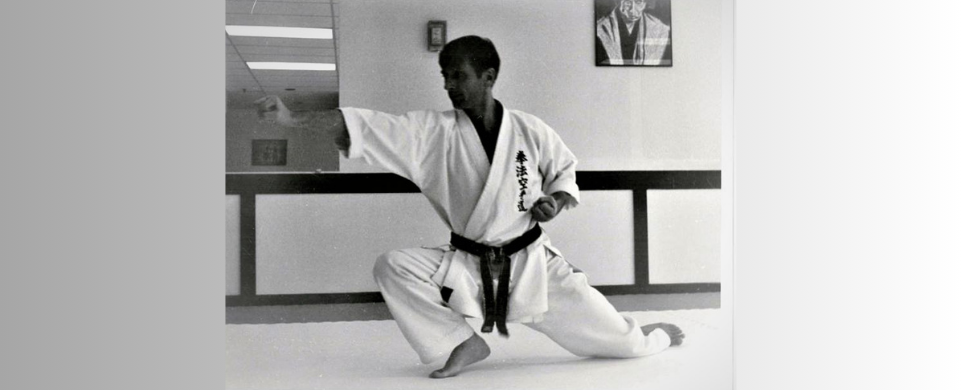
In the middle of all this, as if sensing we could be disappointed by all these imprecise, slacken looking and expansive movements, Master Ito took a very low stance – the Shotokai crouched stance – and did an Oi-zuki (stepping and lunging forward while thrusting out the fist on the same side with the advancing foot). He had been talking to someone just before doing it and his demo of the lunge punch might have been the result of the conversation he was having. But he saw us watching with a corner of his eye and I also supposed that, at this point, I had enough of running techniques and shouting and what not, and wondered if there was any real martial art movement in Shintaido. I thought he wanted to hook us in with this but I didn’t mind it because it was why we attended the workshop.
The step, the punch were one flash. Nothing like the Oi-zuki done in any other style, sluggish, stiff and delivered after the feet became stabilized, but a one solid, swift shift of mass with the one knuckle punch protruding ahead like a spearhead. I was much impressed with that thrusting punch that looked to me exactly like what Master Egami was talking about, starting and arriving together with the step.
I think it was some half an hour before the end of the last class when Master Ito asked the participants to take a rest as they were all pretty tired. Then, he turned to the three of us and said:
“Hey, karate kids, let me show you how I used to train under Egami-sensei!”
And he showed it to us indeed. First, we were asked to do punching in the horse-riding stance (Kiba-dachi) at his counting. On the surface there wasn’t anything different from the way we had been practicing before or the seiken choku zuki of other styles. That is, except the shape of the fist, the way we stood and we punched. The horse-riding stance is relaxed not tight and at least theoretically, as the fatigue grows the stance will get naturally lower by itself. You won’t stand up when getting tired like people do in the cramped stances of regular karate. Also, the one knuckle fist requires an upward bent wrist and that eases the tension in the wrist, elbow and shoulder allowing for smoother movement. And last, the body turns more with the punch and the shoulder joint opens instead of being locked back. In ten minutes, we were sweating and gasping for air mostly because we were too stiff and tense.
After this, it got harder. We were told to take kamae – en guard position in a front stance – with a lower-level block but, as Master Ito required of us, the stance was almost impossible. We were asked to virtually sit on our front heel which came off of the floor while the back leg and foot were struggling behind. It was crazy, I had never trained before in this so called koshi-dachi. Just imagine stepping forward from one stance to another. We had to lunge forward and punch holding this stance and, at one point, my friend from Montreal couldn’t take it anymore. He crawled outon all four. I remember sensei correcting the way I was doing the one middle knuckle fist by turning the fist out at the wrist. I got the feeling of a snaky arm right away and was thankful for it, it is the proper arm alignment when punching something that way.
Paul and myself kept going to the end of the half hour doing these crawling oi-zuki. When eventually I stood up, my heart was beating wildly in my neck – not long ago I had suffered a massive heart attack – and I must have said that to Paul who smiled and replied:
“Don’t worry, I feel the same!”
Conclusion
From my first encounter with Shintaido and Master Ito, nearly 30 years ago – our relationship still goes on today. I have learned the real skill is transforming conflict – its creed is “how to transform negative and destructive energy into positive and constructive energy.”
In order to do that, it is not enough to be able to beat others for the conflict will end only temporarily. He who wins by force has conquered only half his enemy someone said once. By facing your opponent squarely, one will surely make the statement that you are the enemy. According to the body wisdom of Master Ito stand or sit next to your enemy and reach some degree of agreement or cooperation which is already present in the two facing the same direction. From having developed force, one should proceed to the use of no-force. First to have and then not to have.
Master Minagawa replied to someone who, watched his demonstration and said “One needs a strong koshi” with “No, one doesn’t need a strong koshi, one needs a weak koshi.”
The use of no-force means to rely in an encounter mainly on your neuro-sensorial or efferent nervous activity. This way you will not create enemies. Mastering elements such as timing, space interval and energy flow belong to a higher level of skill and allow one to defeat the enemy without the damaging effects of brutal/animal fighting. I once asked Master Ito what he would do if he was attacked. His answer came quickly and spontaneously paraphrasing what Don Juan Matus gave to a young Carlos Castaneda:
“I will not be there.”
Biography
Lucian was born 8 December 1954 – In Brasov, Romania (at the time the city of Brasov was still called Stalin!)
He started his martial arts practice in 1969 with Judo and a little later Olympic free style wrestling until 1973.
He was in the military service (alpine troops) from March 1974 to July 1975.
He began to practice karate shotokan in the summer of 1975, right after the army service.
In 1980, he read Egami Shigeru “The Way of Karate Beyond Technique.” He decided to follow Egami’s approach and started his own group.
He arrived in Canada in 1989 and in 1992 worked for the Superkids Karate franchise as instructor at one of their locations. It was here that he met Paul Gordon and they became fast friends. The Superkids lasted for one year and in the fall of 1993 he opened his own dojo. Unfortunately, he had a massive heart attack that led to postponing the opening of the club until January 1994.
In March 1995, he met Ito Sensei and Shintaido and began to introduce it in his school.
His association with Shintaido as an organization lasted until 2007, when he participated in his last Kangeiko.
His health began to deteriorate, and he suffered a mini-stroke early in 2008. He remembered that 10 years prior he was briefly exposed to Dachengquan or Yiquan while visiting Romania.
He found that this practice was better suited to his condition than Shintaido, although he never stopped Shintaido totally, especially bojutsu and some karate. In 2012 he invited Master Ito to Romania and twice a year he would come and teach his group Shintaido Kenjutsu, until 2019. The next year the Covid came upon us and his seminars were interrupted.
He continues to develop a synthesis between the large and liberating Shintaido movements and the shorter, spring-like power envisioned by the Yiquan.
I led a group in meditation/worship at the beginning of a gentle movement workshop for Friends.* Without thinking, I took the group of 18 people into Um. After the session a participant came up to ask, “Is this group especially good at getting into deep meditation?” I remember thinking “That’s just Um.” I didn’t want to take too much credit, but I mentioned that it’s possible to lead a group into a deep meditation.
Friends spend a great deal of time in silence: it’s a familiar place to be. We also try to be attentive to those around us. That is where keiko and Friends’ culture overlaps. It hadn’t occurred to me how attentive to gorei a group of Friends could be.
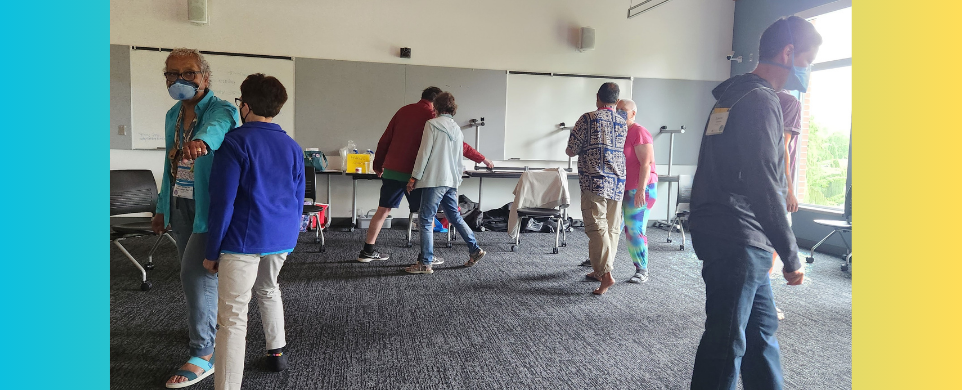
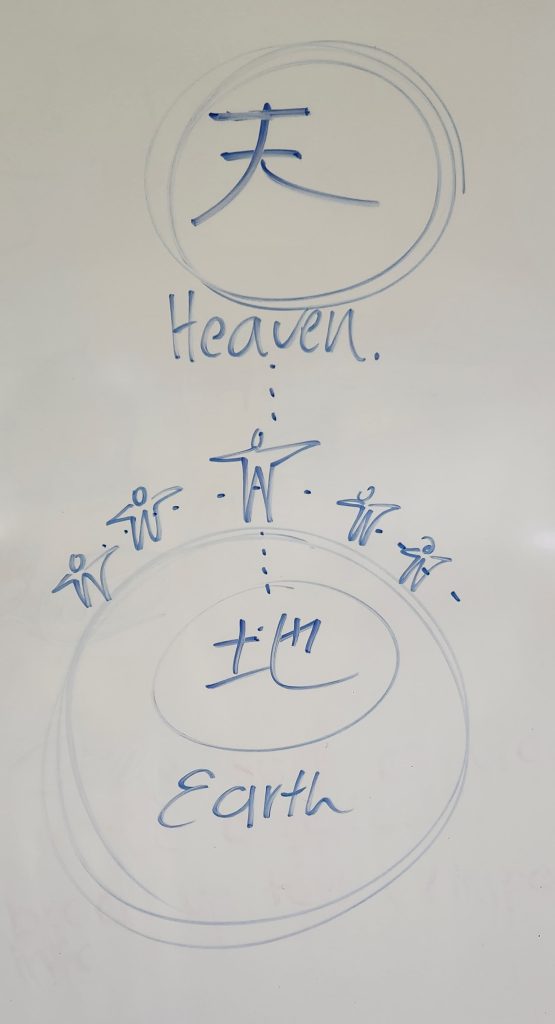
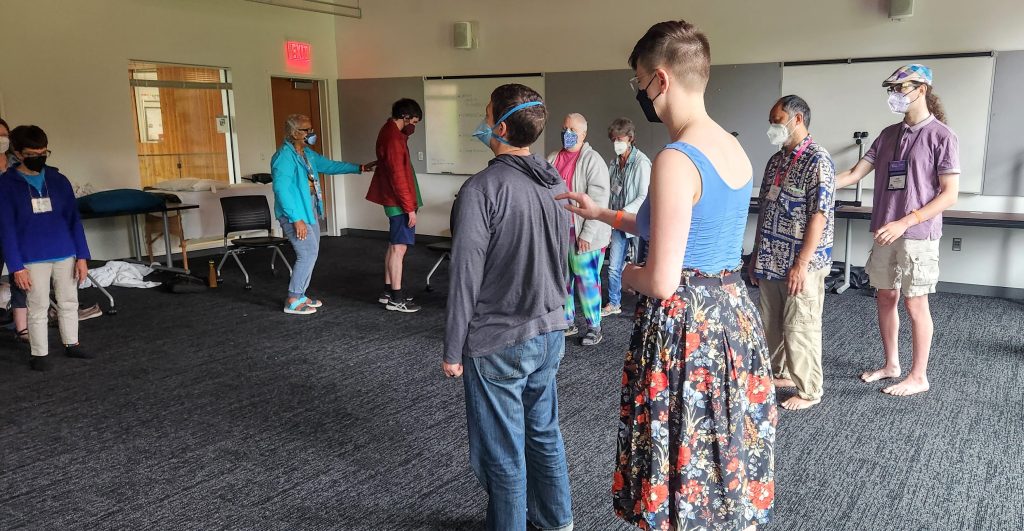
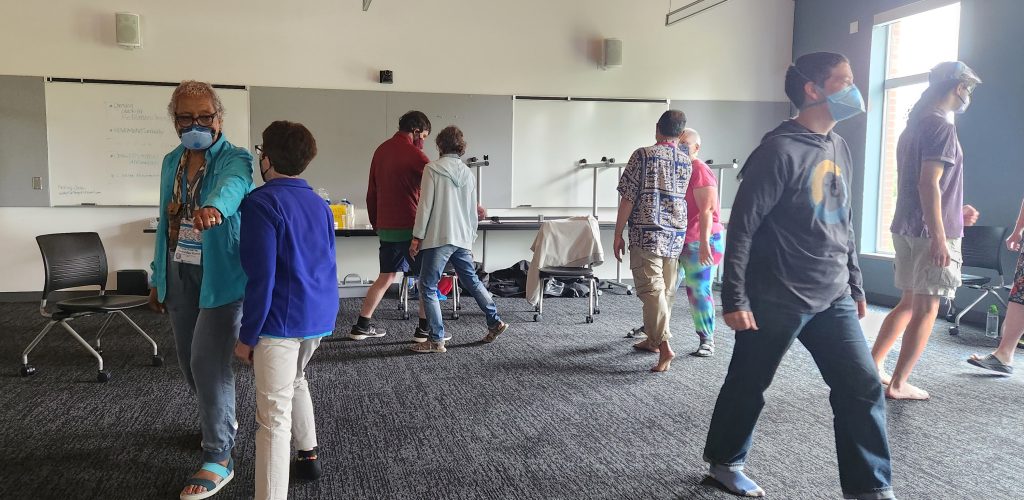
In July I traveled to Western Oregon University in Monmouth, Oregon to lead a five-day workshop (2.5 hours per day) entitled, “Gentle Movement for Traumatic Times.” The workshop was inspired by two F/friends who had survived serious illness and were unable to find accessible movement classes. Beyond that, I had heard many stories from Friends of the Global Majority who had been traumatized by insensitive interactions with white/European-American Friends. I wanted to both create a welcoming space and to share traditional martial arts tools from Shintaido to work with stress and conflict.
Over the five days I shared Panic/Rock/Wakame/Bamboo solo and with partners; Wakame kumite; SotoIrimi – stepping in; Sagari Irimi – dubbed “Welcome, This Way Please” by Ito; Tenshingoso and a simple leading/following kumite.
I shared Panic/Rock/Wakame/Bamboo as options for addressing stressful interactions. The main point was knowing when to let things go and go with the flow (wakame) or to stand firm (bamboo). People had a chance to think about situations in which they wished they had had these tools, and current situations in which they could practice them.
I was really glad that everyone took to kumite so quicklyand took good care of their partners. It makes me think that I don’t often consider the deep opportunities that kumite really offers. It really can be a door to liberation that I cannot access alone.
I knew I wanted to share SotoIrimi – simply stepping in and changing the plane of one’s body to be closer to an attacker. In the 1990s I was working closely with a talented woman I call my mentor/tormentor. I learned strategy from her and much more, but she moved fast, was intense and had huge demands. Eventually, I felt like she was coming at me full speed like a freight train. One evening I told this story to Lee Seaman in my kitchen and she had me stand up and pretend that she was my tormentor. She said, “Try stepping in.”
Stepping in and changing the plane of my body made all the difference. That practice helped me survive the next three years. I no longer felt like I had to be plastered by someone coming at me.
Everyone quickly connected with their partners and we practiced with just one step. During the debrief one person shared that their health care provider had demonstrated a stepping back technique that they had used to engage in a conflict, but that stepping in hadn’t even occurred to them. They asked themselves, “How could I make use of that in my situation?” they asked themselves.
I talked about and demonstrated – with my F/friend who was a great demo partner – how being in close is safer and not at all threatening to the other person: it’s simply in close and connected.
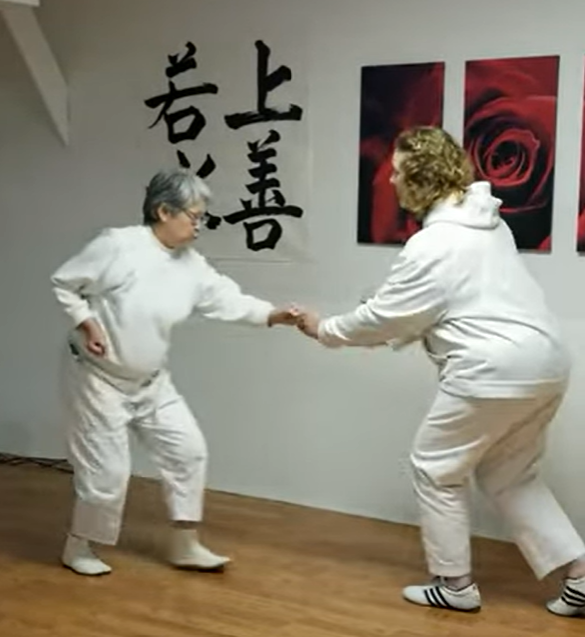
Then we moved on to a form of Ushiro Irimi that Ito calls, “Welcome, this way please.”
This 7 second video show me and Connie Borden demonstrating it. Ito describes this as going to the front door to greet a visitor, then opening the door and guiding them inside. I especially love this kumite.
Perhaps it’s because I was so incredibly slow to be able to demonstrate it. It took me years. In fact, Ito tried using different names, taught it several times in the Bay Area, and organized a workshop that I later realized was specifically for me! I was able to teach this to people who had no martial arts experience in a few minutes, so I think I finally get it.
During our debrief I shared what Ito says about literally sharing the same perspective as your opponent, standing shoulder to shoulder – and the game changing attitude of welcoming the person who is attacking.
I think it was hard for Friends to understand the value and importance of a sincere attack: Friends tend to be conflict averse (or passive aggressive!) so tsuki was a bit challenging.
During one of our large group conversations there was a long silence and the group naturally dropped into worship sharing — a time during which people can speak out of the silence on a particular topic. It was wonderful that everyone was so comfortable with silence – not something I ever experienced as a meeting facilitator since groups expect a meeting to be filled with talk.
It was fascinating to navigate across my experiences of meeting facilitation, gorei and worship leading – especially when these distinct practices overlap.
One big takeaway was how tiring it is to undertake a gasshuku without the support of a director of instruction or any sensei care. Outside of Shintaido and Japanese culture, no one thinks about such things. I did just submit a proposal to offer the workshop again next summer and this time I will make sure someone comes to support me! Stay tuned for a Body Dialogue update next year.