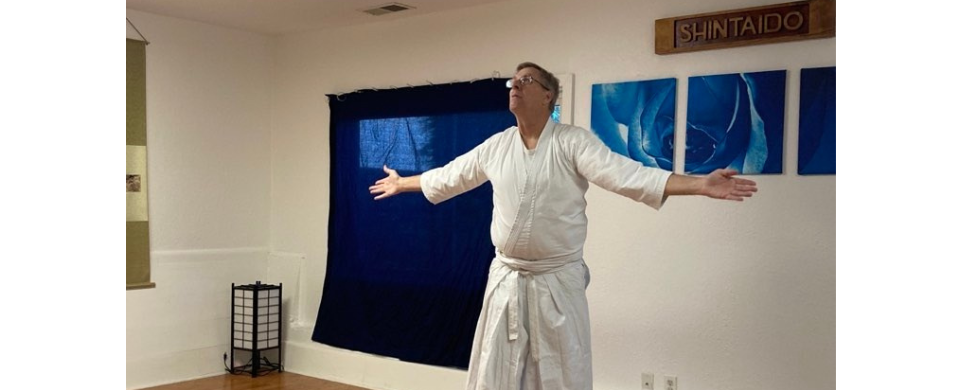
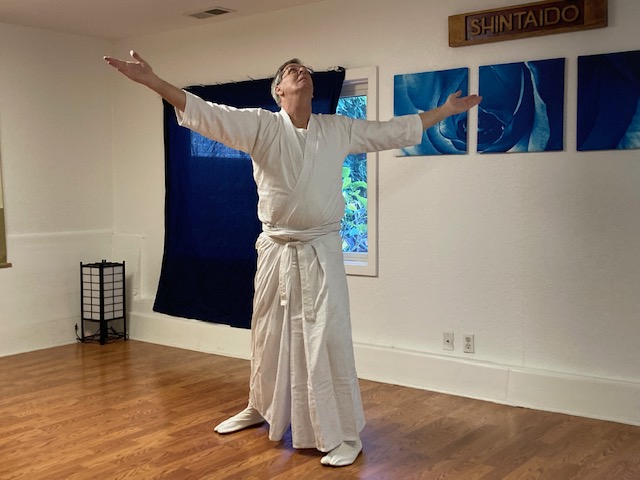
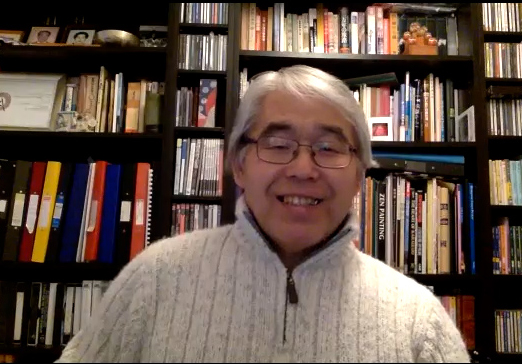
I wrote a recent article on grief, death and loss; I now have some reflections on the benefit of practicing Taimyo Part I — specifically the movement 碎山/Sai-Zan “breaking through mountains”— using kokyu in relation to the individual practice of death awareness. As a forewarning, the subject is awareness of one’s mortality, so you may wish to pick the best time to read and reflect on this topic.
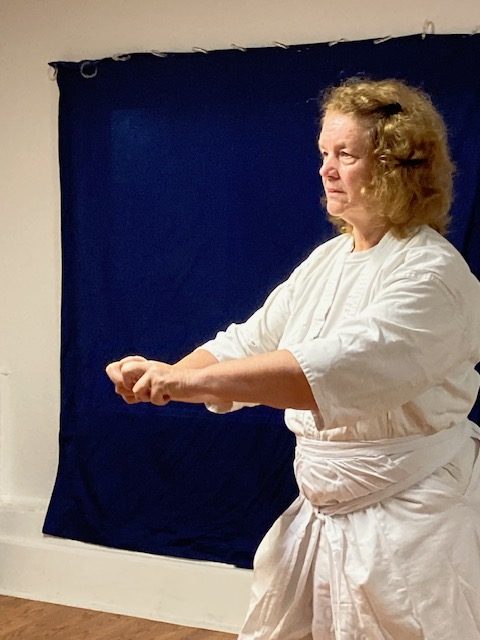
What can be practiced with Sai-Zan within Taimyo? This was a focus of study at the Quebec Gasshuku in September 2022: we step back while doing a tsuki forward, we step back a second time, while keeping our concentration, then we step back a third time bringing our fists to the center of our chest/heart and then tsuki forward to finish with our arms open wide. The analogous military strategy is when the leader retreats with their troops while keeping concentration, keeping troops from fleeing in fear, and making sure no one is left behind.
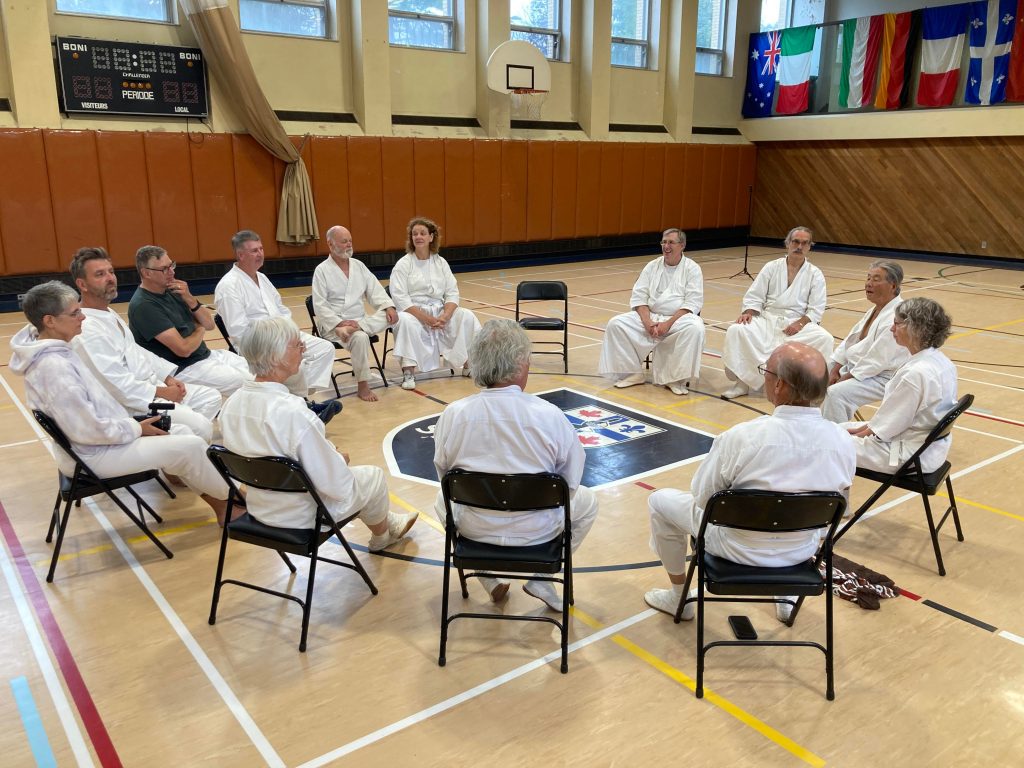
Sai-Zan and its application to living life was the focus of a dinner discussion in Quebec. I asked the group, “Can you name other (non-military) heroic efforts threatened by almost certain demise?” Here are some of the ones I thought about: the doctors and nurses in New Orleans during Hurricane Katrina in the stranded nursing home with its frail residents; neighbors like Ko Ueda taking food to isolated neighbors during the COVID pandemic; Mike Sheets taking sandbags in wheelbarrows up our street to prevent garages from flooding, when a large water main broke and sent rivers of brown sludge down our street. Can you think of examples?
I have been reading and reflecting on how our mind resists awareness of our mortality. Fears and regrets are often reasons to avoid this subject. What do most of us really wish for? One desire is to build an ideal world, to live fully, so we may not want to ask ourselves “What if?”
And what about our daily life awareness? I was fortunate to experience 20 years of working in hospice and palliative care, experiencing death and dying up close. I was aware of my mortality and the ever-present reminders of the shortness of life that made me stay awake and stay aware.
I see a practice for death awareness, so I explored doing the three movements of Sai-Zan, while incorporating what Thich Nhat Hanh wrote in his book, The Blooming of a Lotus:
Knowing I will get old, I breathe in, Knowing I can’t escape old age, I breathe out. Knowing I will get sick, I breathe in. Knowing I can’t escape, I breathe out. Knowing I will die, I breathe in. Knowing I can’t escape death, I breathe out.
>>>>>
Determined to live my days deeply in mindfulness, I breathe in. Seeing the joy and benefit of living mindfully, I breathe out.
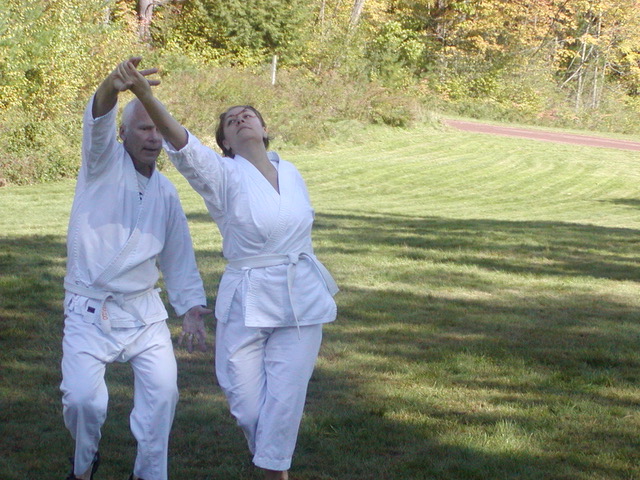
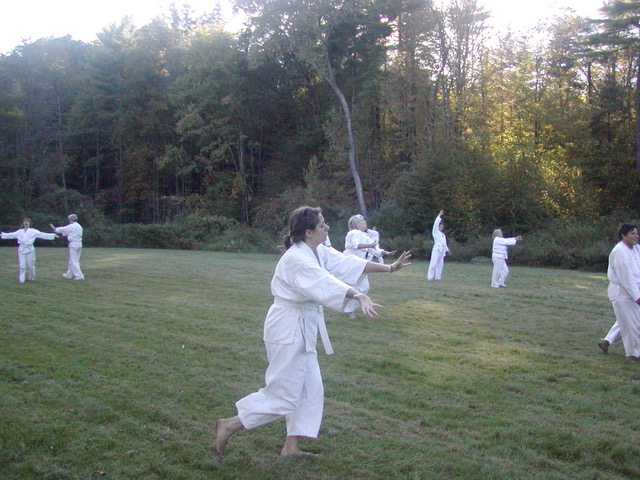
I brought this practice to a local hospice during an open mic session on death and dying on November 3rd. Comments included “visceral,” “cathartic,” and “a way to process grief.” For Shintaido and students of body movement, there is focused work with the breath – kokyu – breathing in through the nose; breathing into the belly and slowly releasing. We can practice Sai-Zan with a focus on our breath while stepping backward and reaching forward with our arms/fists.
This is an unfinished essay – how might you finish it? How do you develop awareness of mortality? What parts do you resist or how do you avoid daily practice? What are your deepest fears? What are your greatest joys?
Watch the Reflection on Sai-Zan on Shintaido of America YouTube channel.
*Many ask me “What’s next Connie?”- hence my moniker: Next Steps Connie.
Phillipe Beauvois has been a student and teacher of Shintaido for 45 years along with Taichi and Shin-Anma Shiatsu. He participated in the First International Shintaido Gasshuku in 1980 and studied with Robert Breant. In 1985 he started teaching Shintaido on the French Riviera in Grasse. Phillipe, who has been diagnosed with terminal head and neck cancer, reflects on his learnings and his wishes for future students.
Consider visiting Phillipe´s website (in French, can be translated into English in a browser).
About the author Many of you may have been fortunate to have had a chance to do keiko with Robert Gaston. He is a Senior Instructor of Shintaido and has practiced and studied for almost 40 years. He is a member of the International Technical Exam Committee (ITEC).
Rob initially studied Shintaido with John Seaman while he was at college in Oregon. When he left school, he joined the U.S. Navy and was stationed on the USS Enterprise aircraft carrier. He made part of this giant ship his dojo where he taught Shintaido to his colleagues.
He currently lives in the San Francisco Bay Area with his wife Sandra and daughter Sally both of whom practice Shintaido.
Rob teaches two classes a week; one Bojutsu and one Shintaido via Zoom. Please enjoy his movement and poetry.
This poem came to me at the end of a Zoom Master style class for the Global Taimyo Community taught by Clélie Dudon with Ito-sensei giving feedback.
She taught Taimyo part 3. Ito-sensei gave feedback to us all that focused on the Hoten-kyoku-ho. He expressed two important points, first focus on extending our reach in the bow, like a starfish encompassing and surrounding a sea urchin and second to feel ourselves being inflated from the outside, like the hairs on our entire body are being gently pulled.
I am not sure when I first learned the basic sequence of Hoten-kyoku-ho. It was probably at a Pacific Shintaido meditation workshop in the early to mid 90s.
Initially, it was a healthy body movement that helped ease my sore back after a lot of kaihokei Keiko. But when it was included in the Taimyo sequence and the subsequent Pacific Shintaido’s Taimyo workshop, it became one of the movements I began to feel connected, to others, to nature, to the universe, to something more.
It has had, like other Shintaido movements (i.e ,kirioroshi kumite) a multi-layer effect on my consciousness, peeling or cutting through levels of awareness. The effects and my awareness of Hoten-kyoku-ho have been gradual over many years and I have expressed my most recent “ah-ha” in this poem.
Thank you and please enjoy.
Hoten Kokyu Ho (“Hugging Heaven”)
I bow and embrace, thank and acknowledge myself, body, present situation. Turning to the right, I feel myself invited to expand my awareness to others my family, friends, coworkers, those I struggle with.
I turn and face forward, changing my view point to face life directly. I bow and embrace, thank and acknowledge them. Turning to the left, I feel myself invited to expand my awareness to a greater community the struggles we have with other viewpoints and cultures.
I turn and face forward appreciating the beauty and strength in diversity. I bow and embrace, thank and acknowledge humanity. Turning to the right, I feel myself invited to expand my awareness to Nature, ecosystems, the biosphere, the earth, the struggle of survival, the cycles of life and death of all beings.
I turn and face forward changing my view point, Nature and I are inherently interlinked. I bow and embrace, thank and acknowledge connection to nature. I turn to the left. I feel myself invited to expand my awareness to the solar system, the sun, the planets and all their moons, the space between and their cycles.
I turn and face forward changing my view point, I am affected by their cycles their pull and tug keeping my world safe for life. I bow and embrace, thank and acknowledge our solar system.
I turn to the right, I feel myself invited to expand my awareness to the Milky Way and all galaxies. The star nurseries, nebulae, supernova and black holes.
I turn and face forward changing my view point, I am made of stardust and all that is in the universe is in me. I bow and embrace, thank and acknowledge the cosmos.
I turn to the left and I feel myself invited to expand my awareness to Ten. I turn and face forward changing my view point, I am always in Ten and Ten is in me. I bow and embrace, thank and acknowledge. I rise up to Ten Chi Jin posture.
by Heather Kuhn Heather Kuhn has practiced Shintaido for 23 years with the Shintaido North East (SNE) group. Also, she is a somatic psychotherapist who provides individual therapy focused on early life trauma.
As you will read, she is launching a new group Good Enough for Me that integrates Shintaido movements with other expressive arts therapy.
I had been showing up to keiko with increasing fervor for a decade. For ten years, I cultivated the radical resources of pleasure, joy, connection, and yes, a modicum of self esteem. Simultaneously, peeling the many layers of the soma-spiritual defenses I had built up from early life neglect and narcissistic abuse. This required of me leaps of trust, courage, pacing, and apparently, oceans of tears.
The twisted shell I had formed to protect me was challenged, one muddy keiko at a time, until one day I could name what was happening as, gulp, healing. After all, I had come by these unconscious defense strategies all too honestly. They were both the shield I used to avoid grief and the arrows I threw to project my own self loathing.
Through generous gorei, and more than a few sensei willing to hang in there with me, I peeled away these layers, slowly revealing an impossibly soft belly of selfness. I could see with more and more clear how painful it actually was to live that way. I could sense the value of allowing and receiving. I began to plant the seeds of vulnerability as liberation. In a world that trains us to fight each other for scraps and trained me to stay a victim, standing tall while also being soft was nothing short of transformational.
“And the Day Came When the Risk to Remain Tight In a Bud Was More Painful Than the Risk It Took to Blossom.” – Anaïs Nin
As I peered out on the keiko field one Winter morning, I wondered to myself, is movement a recognized avenue for healing from trauma or am I the very first person to discover it? The question that has guided my purpose ever since was born.
And thankfully the simple answer was it absolutely is and no, I am definitively not.
Somatic psychology is a field that studies how our inner galaxies express, reflect, and can be influenced by our embodied awareness, movement, and relationship with our environment, the Earth and universe. It integrates wisdom traditions with grounded research and, more importantly practice to help us understand ourselves, evolve, connect, and heal.
Naturally, I chose to study somatic psychology at Naropa University, where learning is highly experiential, relational, and practice based. Naropa was a collaboration between Chögyam Trungpa and Alan Ginsberg and founded in 1974 on principles combining the wild-creative and Buddhist practice. There are compelling resonances between the Naropa and Shintaido lineages for sure.
While at Naropa, I learned to become what one of my professors calls an attention athlete, as well as how to observe and understand embodied phenomena, facilitate curiosity, and follow the threads of sensation and impulse (among much much more). I saw my studies in Dance/Movement Therapy as an extension of my Shintaido journey and learned to understand what we were up to in our practice, from a psychological perspective, along with strengths, tendencies of bias, and blind spots within it.
I saw myself as an ambassador for our modality, writing several papers integrating Shintaido principles with various therapeutic topics, including attachment theory, catharsis, issues around power and relationship dynamics, and finally in my masters paper about facilitating psychotherapeutic movement in the medium of water.
The program and working with a somatic therapist was what led me the rest of the way to total body connectivity; weaving my inner world with the outer and back again – the building blocks toward the aspiration of self awareness. For four years, I set down my Shintaido practice with an inner commitment to, in part, explore how my psyche was insidiously using my practice to avoid pain. I asked, ‘would I be ok without keiko?’, since I admit that before I began Shintaido, I was not.
I was ok, gratefully, but I discovered Shintaido provided a significant resource for me. Because of my trauma, compensatory practices will likely always be necessary. In other words, the more resilience I can cultivate through practice, the more capacity I will have to fully grieve. The more I can allow grief to move through me willingly, the more access I have to a fulfilling life without the need for defenses.
Fast forward to now. After 23 years of Shintaido, 25 years of meditation practice, 11 years of training in somatic psychology, and 9 years providing individual therapy focused on early life attachment trauma, I am thrilled to announce the launch of a program that integrates Shintaido with the expressive arts therapies to support others on similar paths.
The group is called Good Enough for Me and provides an in-depth process to support adults engaged in healing the lasting effects of childhood emotional neglect, low self-worth, and/or chronic self sabotage. It is a therapy group, complete with an intake process, one-on-one goals honing and check-in sessions, and peer support structures in place. Although there is never-ending depth to explore in Shintaido, the first 10 years of practice provided a universe of curriculum which can be shaped and shared with endless creativity. What might be considered beginning Shintaido is what I am drawing from for this group.
Good Enough for Me has been a dream in the making for 23 years. I’m incredibly proud of the work I have done to be in a place where I can support this vulnerable population and pass along the generosity I was so blessed to receive in our international Shintaido community.
There are a few call outs I would like to make to people without whom I would not have gotten this far. I will never ever forget the time Gianni said “you can do it!” at my side while I did kai kya kusho across the Shintaido farm dojo. It was the first time in my whole life someone said that to me. Or the time David encouraged me to focus on the trying rather than discerning good enoughness. Or how Joe, bless his spirit, would get tearful when he saw me after too long, letting me know I mattered, I belonged, and my presence was wanted. I could go on…
Which is to say, the movements of Shintaido are important, yes, but the opportunities afforded in the movements to help people heal and grow are the real treasures of Shintaido. I believe with all my heart we have something valuable to offer in this time of acute turmoil, volatility, and systemic narcissism.
I invoke Chapter 1 from Shintaido, The body is a message of the universe:
Shintaido is the light in the shade and the sun in the shadow. People who have been constitutionally weak and depressed from birth can discover extraordinary strength and ability through Shintaido. People who have lacked the will power or determination to express even a tenth of their talent can grow and develop in Shintaido. People who have never been aware of their true value will realize the dignity of being. Those who are too self-conscious by nature to express their ideas will find new confidence and conviction. Those whose spirits are closed and stagnant will be inspired with a new faith and purpose. Those who have become private and isolated will be able to communicate a new joy of life to others. Those who are downtrodden or oppressed will understand that all human beings are equal before God and free to express their being. This is why we call our movement Shintaido or “new body way.”
To read more about Good Enough for Me, follow this link.
Master Minagawa answers to questions prepared by Jean-Louis de Gandt for a conference held during the yearly Kangeiko of Ile-de-France Shintaido at Fort Mahon on January 25, 2020.
Master Minagawa
Shintaido has many disciplines, Open hand, Bojutsu, Kenjutsu, Karate… What would you say is the specific ‘role’ of Kenjutsu in this overall Shintaido program? What do we learn with this Kenjutsu practice?
Kenjutsu is the most essential practice within Japanese martial arts. We can see the history of Shintaido by following in our ancient masters’ footsteps, wisdom words, etc.
The sword can be used as a tool or compass which can show us how to manage our lives, it can show us which direction to follow.
By studying kenjutsu we can learn how to focus, how to concentrate, how to develop ‘Ki’ energy, and we can learn how to understand ourselves and others.
First, we need to calm ourselves, listen to ourselves, listen to our inner voice, be mindful in the present, take in the surroundings, and also listen to our opponents and nature. Then we can learn how to manage time and space, to unify ourselves with others through kumite. This process can help us to find joy, light and direction in our lives.
If we use a weapon in the wrong way this can lead to conflict and destruction. When using a sword, we have to focus seriously otherwise we might hurt ourselves or other people. We must practice the movements exactly and correctly. That is why we practice Kihon (the basic techniques) repeatedly so many times.
Now, we use a wooden sword but if we were using a real sword, we would have to be extremely careful. Even taking it out and putting it into the scabbard is dangerous, we could easily cut our hands. Even though we are using wooden swords this weekend, our intention must be as if using a real sword.
In Japanese, we have the word “Tan ren” 鍛 錬 which means training. Keiko 稽 古 means practicing. The word “Tan ren” comes from the process of sword making and is used by sword masters. “Tan” means to hit / hammer and fold. “Ren” means to knead, like making bread. This is the process of hitting and folding or kneading the steel to make the sword pure.
The word Keiko literally means looking back – at ancient wisdom – and learning from it.
Before starting the process of making a sword, the swordmasters purify their bodies and minds by going through a ceremony and praying to cleanse their bodies, minds and spirits. The masterpiece they create then becomes a gift from god. In Japan, the sword represents the spirit of god. When people die a sword is placed on top of the body to ward off evil and protect the soul.
In Japanese mythology, there is a story called “Yamata no Orochi” *, which tells how Japan was created when the god Susanoo No Mikoto came down to earth from heaven. There was a monster called Orochi, who had eight heads and eight tails. The god found an old couple weeping because they were forced to give one of their daughters every year to the monster. The monster had already killed seven of their daughters and now they had to sacrifice their eighth daughter. Susanoo decided to save her. He asked the couple to prepare eight barrels of sake, and make eight gates. He told them to put a barrel in front of each gate. The eight-headed monster came and drank all the sake. It became drunk and Susanoo was able to cut off all the heads. As he cut through the eighth head his sword hit something in the tail. There was a sword inside the monster. It was a very special sword.**
Later this sword was used by Yamato Takeru – a legendary Japanese prince of the Yamato dynasty – to stop a fire burning in the fields by cutting down the grass. Generations later this sword was called Kusanagi no Tsurugi. Kusanagi means to cut grass and Tsurugi means a sword.
The legendary sword Kusanagi-no-Tsurugi, which came from the tail of Yamata no Orochi, along with the Yata no Kagami, a mirror, and Yasakani no Magatama, a curved jewel, became the three sacred Imperial Regalia of Japan.
This year (2019) in Japan a new emperor acceded to the throne, and a new era was started. This era is called Reiwa. During the ceremony the three Imperial Regalia, the sword, the mirror and the curved jewel were handed down to the new emperor. These are the three gifts from God that only the emperor can own.
This myth is very important for Japanese people as it explains the beginning of Japan. The sword is a gift from god so when we use a sword, we always use it with great reverence and respect. We keep it clean and protect it. By practicing with a sword, we try to find the spirit of god. We try to protect ourselves from evil or difficulties and to cut the burning fields to find peace and purification in the world.
When Ito sensei and I were naming the Kenjutsu programme techniques I suggested we give “San-kajo” the name of “kusanagi” because of the image of cutting grass with Kusanage-no-Tsurugi.
Shintaido is a martial art, but also has other dimensions, meditative, spiritual even. It is what makes Shintaido so difficult to describe and explain. How would you describe this mix and interaction between the ‘martial’ and the ‘spiritual’ in Shintaido? Maybe there is no one answer for everyone; then what is it for you?
The purpose of martial arts or the way of the sword is to use a weapon to defeat people, but our way through Shintaido is to study the spiritual way. Martial Arts aims to use weapons to fight. The word Hei Ho 兵法 is used. This means the Strategy of War. If Hei is written differently (using another Chinese character 平) it can also mean Strategy of Peace 平法。
Hei written one way means war, another way means peace. Therefore, there are two ways of studying martial arts, the way of war and the way of peace.
There are two ways to have no enemies. One way is to kill or destroy all your enemies. The other way is to make friends with everyone.
In the sixteenth century, guns were imported into Japan from Portugal. The way of the Samurai was completely changed. All the years they had spent training no longer had any meaning. Anyone, even with little skill could easily use a gun and kill. The Samurai fought in close combat using their swords, face to face with their enemy but when guns were introduced there was no need to be close to the enemy.
So at that time the martial way divided into two different directions: one way was to develop better and better weapons – this direction has led humans to develop nuclear weapons and nuclear war. The other way was more spiritual, how to live, how to die. Meditation or Zazen became an essential practice on this path. The spiritual way of martial arts began to be developed.
Suzuki Daisetsu introduced Japanese culture and philosophy to the West. His book, “Zen Buddhism and its Influence on Japanese Culture” was published in English in 1938. This is a good book to read if you are interested in knowing more about this subject.
Carl Jung said we have to make a kind of spiritual journey. The life of a human being is a spiritual journey or pilgrimage on earth.
In Zen Buddhism, there is a story called “The Ox Herd story”. This story describes the journey to enlightenment. It reminds us that the only place we find the truth is within ourselves. The ox symbolizes the true self.
The outline of the story is
1. Seeking the ox 2. Finding the hoof marks 3. Finding the ox 4. Catching the ox 5. Taming the ox 6. Riding the ox 7. Forgetting the ox, only the man remains 8. Forgetting both ox and man 9. Returning to the beginning and going back to the source 10. Off to town, arms swinging (entering the world)
The Ox-herd story shows enlightenment to be the ordinary self-doing ordinary things in a most extraordinary way. Please find the story yourself and study it. I believe that is Hei-ho 平法.
So Shintaido as a martial art studies the second way, Hei-ho 平法, the spiritual way or ordinary way.
Kumite: When we begin kumite, we first need to release tension and get rid of unnecessary attachments. Then we can feel a new flow of energy beginning and we can start a new movement following the natural flow. Finally, we can unify with our partner and others. Even if we are studying how to cut, we are actually studying how to transform the movement to find harmony.
Meditation: Through meditation we pursue emptiness. We need emptiness in our bodies and minds in order for new things to come in. If we are full of attachments, we can’t receive new information. Meditation is very important when studying how to transform ourselves and accept energy from others.
Shintaido is a different type of Martial Art. It was established with a new concept including 3 fundamental forms: Eiko “hymn of life”, Tenshingoso “cycle of life” and Meiso Kumite (Wakame) “flow of nature, following sources of energy”.
We study how to use these three basic movements for exploring the wisdom of the great ancient masters.
Kata: Studying Kata is another important practice. Kata is the essence of the master’s wisdom which shows us a world of Shin 真 (Truth), Zen 善 (goodness), and Bi 美 ( beauty).
Through practicing Kihon, Kumite and Kata we can receive these Masters’ messages.
Shintaido has a ‘special relationship’ with nature. Could you comment on that? Is it something to do with Japanese culture? Where does it come from? We are here spending time on a beach in the middle of the winter. Why do we do that?
Practically speaking, Shintaido is a dynamic movement and needs lots of space. We also use voice and make a lot of noise. Japan is very crowded so in order not to disturb people, a beach is a good place to practice. Also, there are many places to stay near the beach so it’s easy to organise an event.
Kangeiko means cold Keiko. The reason we practice at a cold time is that when we face great nature, we realise how powerless and small we are. We try to find nature within ourselves. Through this, we can try to awaken our sleeping potential self. It is a challenge to try to get rid of our old self and find a new beginning.
Cold is fearful. We need encouragement and determination to withstand the cold. We face ourselves and our own fears. We challenge ourselves and encourage a determination to help us through difficulties. We get away from the noise and distractions of daily city life, so we can concentrate. For this reason, we like to go into deep mountains or wide beaches and unify ourselves with nature.
Mountain monks belonging to mystical Buddhism started the practice of ‘Taki Gyo’ or waterfall training over a thousand years ago. They made themselves face the fear of nature by cleansing themselves, living through an experience bringing them close to death. From this, people following martial arts have continued to challenge themselves in cold conditions.
There are two different ways of reading the word 自然 “nature” in Japanese. One is read “Shizen” and one is read “Jinen”. Shizen means nature. Jinen means existence or stillness. At kangeiko especially, we try to find the real existence, our own nature inside ourselves
I think there is also a connection with nature through Shintoism.
In Shintoism, everything in nature is a god, for example, mountains, trees, and rivers are all gods. These gods give us blessings in the form of food and happiness but they also bring disasters and crises. People fear the gods so they give offerings. They offer food from the harvests and thank the gods for protection. There are many ceremonies through the stages of life, to thank the gods for protection. There are many customs in daily life. Most houses have a shinto altar called ‘Kamidana’ where the gods who protect the house live. The first food of the day is offered to these gods. Farmers and fishermen have special ceremonies which they attend before setting out, to ask the gods for protection and abundant harvests or catches.
Shintaido is a martial art that actually helps us to relate better to others: How would you say this happens? What is it in our practice that facilitates and improves our connection and interaction with others?
Through attacking and defending techniques in kumite we can build up real communication with others. Shintaido is not a sport. It is not competitive. As there is no winner or loser, we can continue doing kumite endlessly.
In kumite, first, we have to feel the partner’s “ki” energy. We have to study how to manage time and space by reading the timing. The purpose is not fighting but understanding each other, which means unifying with others.
We need to be as pure as possible, so we need to empty ourselves. Then it is easy to give and receive freely. Through this process, we can understand each other deeply. We can find the joy of life instead of conflict. To be cut is important, this means to have your own ego cut.
There are 5 levels in the spiritual growth of martial artists: Shuchu (concentration) – Toitsu (unification) – Shinten (progression) – Seiketsu (holiness) – Rakuten (perfect liberty).
At a conference where I met the Dalai Lama, one of the head priests who was an organiser asked the Dalai Lama how to create peace in the midst of conflict.
Dalai Lama replied, “In Buddhism first we have to discard everything inside ourselves and then what is left is joy and light.” He said we should make the light shine within ourselves, then gradually spread the light to those around us, then spread the light further into society.
There is a famous saying by Saicho, a monk of the Tendai Buddhism who lived in the eighth century. He said, “Those who can shine light onto themselves and into a dark corner are a national treasure.” The Dalai Lama said the important thing is non-violence. Then I realised this is Hei Ho 平法 – the strategy of peace. I realised Shintaido is the way of peace. I think the purpose of kumite is to take yourself to zero and with a partner spread joy and happiness. Then there is a connection with Hikari to tawamureru. This is the Keiko I would like to do with everyone.
You mentioned earlier that Kangeiko is also the opportunity to clean up the past and to be open to new things in the new year. Could you say a little more on that, on where this coming from, on the mindset of going from one year to the other in the Japanese culture maybe?
Shinto incorporates purification rituals called “Oharai” and Shintaido draws from many of these cutting movements. Oharai is a movement performed by Shinto priests when they want to clean the space, call the spirits and calm them. It is also used to show gratitude to ancestors or spirits. It is like the Shintaido movement Kiri harai.
Before New Year everybody cleans up their lives. This means paying off all debts and returning borrowed money, it means doing a big clean in the house so there is no dirt or dust anywhere. People cook lots of special food to offer to the gods, and also so they can rest and enjoy the first few days of the New Year without cooking. Many guests come to visit and special food is offered.
At New Year we refresh our old selves and go back to the original beginner’s mind. Then we celebrate the coming year and ask for health and happiness.
In Japan, at about 11.45 pm people gather at local temples and join in striking the temple bell 108 times. This represents humans’ 108 sins. So, by striking the bell we ask to be cleansed. Then we gather at a wide place and wait for the rising sun to appear on the horizon. This is why beaches and mountains are good places to gather.
Kangeiko is the traditional ceremony of the Keiko world held at the beginning of the year.
And to conclude, maybe you could tell us your own definition of Daiwa (if you have not yet done this before the interview), what does it mean to you, today, now, halfway through this Kangeiko?
My own definition of Daiwa is expressed in the diamond eight cut which crystallises my 50 years of practicing Shintaido.
First, I wondered how I could explain or introduce the meaning of cutting with a sword to westerners. I wanted to explain it was not about hurting or killing people. I struggled for a long time.
In Kenjutsu there is an expression “Satsu Jin Ken” which means killing sword. There is also an expression “Katsu Jin Ken” which means liberating sword. If you don’t cut seriously with the feeling of Satsu Jin Ken then you can’t get to the liberating cut of Katsu Jin Ken.
The final expression is “Ka-Satzu Jizai”
Jizai means self-being or freedom. This means Satsu and Katsu cutting are both the same, there is no duality between them. If there is no duality between the Katsu and Satsu cuts then you have achieved the freedom of Ka Satsu Jizai. This is the goal of Kenjutsu.
I think that Tenshinken sets a goal for Shintaido Kenjutsu.
It is very hard to teach how to cut and also how to be cut with “Tenshinken” feeling (Ichi ka jo or Kirioroshi no kumite). It is a liberating cut that I have experienced from my master, and I have been thinking about how to transmit this feeling for a very very long time. Tenshinken means universal truth or heavenly truth.
While I was researching Tenshingoso Arrangements I visualised the 5 elements which are air, fire, water, wind, and earth. I could embody four elements but I couldn’t embody the fifth element ‘fire’. It was very difficult. During meditation in “Kon go I” mudra suddenly I understood how to show fire.
This was the meeting of Tenso and Shoko, like striking flints to make fire. The direction of ki energy in Tenso is rising, and the direction of ki energy of Shoko is coming down and forward, so together the movements are like striking flints together. While doing the tenso movement I experienced the feeling of receiving grace from heaven and that light penetrated me. It met the light inside me and made a spark. That position is Shoko or “Kon Go I” (the diamond mudra). Suddenly Tenshingoso, Eiko, and Wakame were all crystallised into the kata of Diamond Eight.
Fire can burn up everything to create diamonds or crystal so cutting using that sword means burning out all unnecessary things to make ourselves like shining crystal. This is why I called the movement Diamond.
There are eight cuts but also eight means infinity. The more cuts, the more a diamond will shine. If we continue doing many cuts, we will be led to Hikari to tawamureru.
All my martial techniques and all spiritual experiences and learning are unified in this movement. I understood that even people who cannot move well can do this by inner movement or image work.
Notes
* Master Minagawa is giving here a simplified version of the myth for the purpose of his conférence. For a more detailed presentation, you may usefully refer to the Yamata no Orochi Wikipedia page.
** About the legendary Kusanagi-no-Tsurugi sword, please refer to the Kusanagi Wikipedia page.
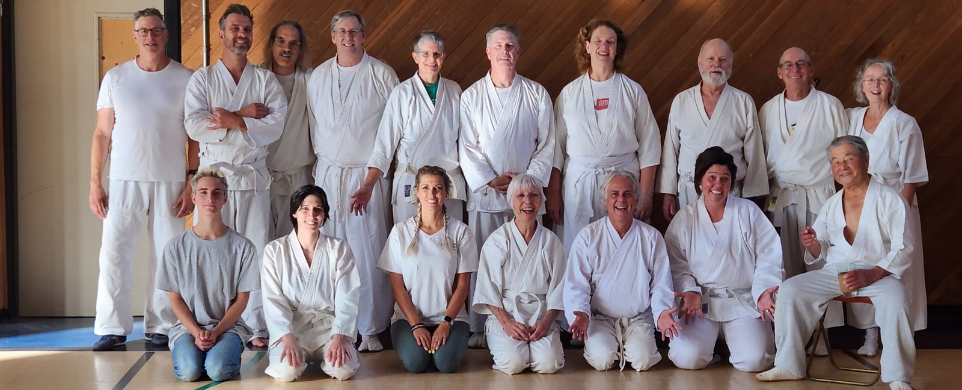
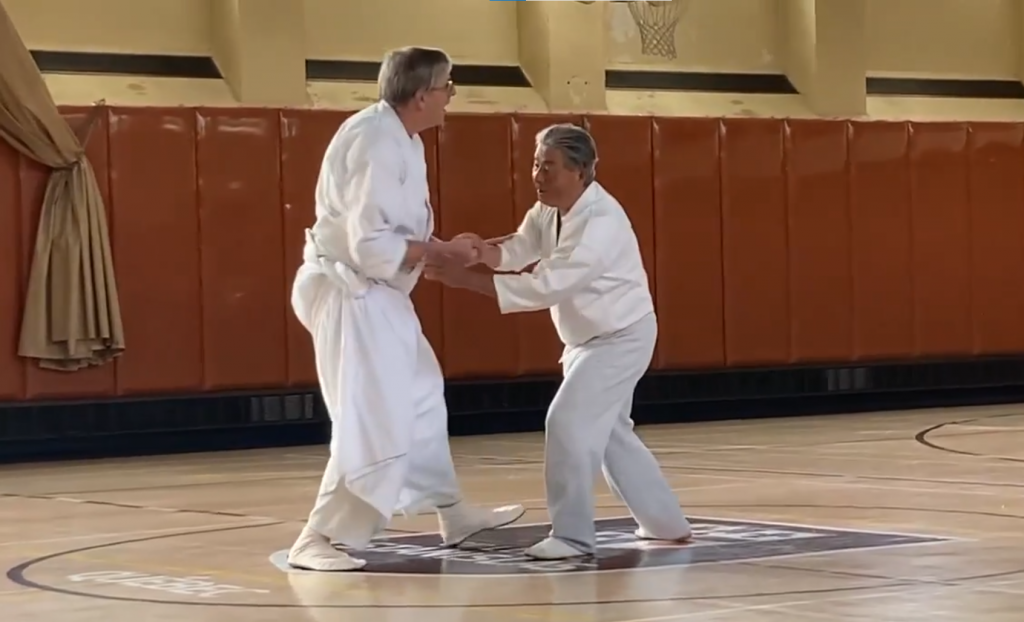
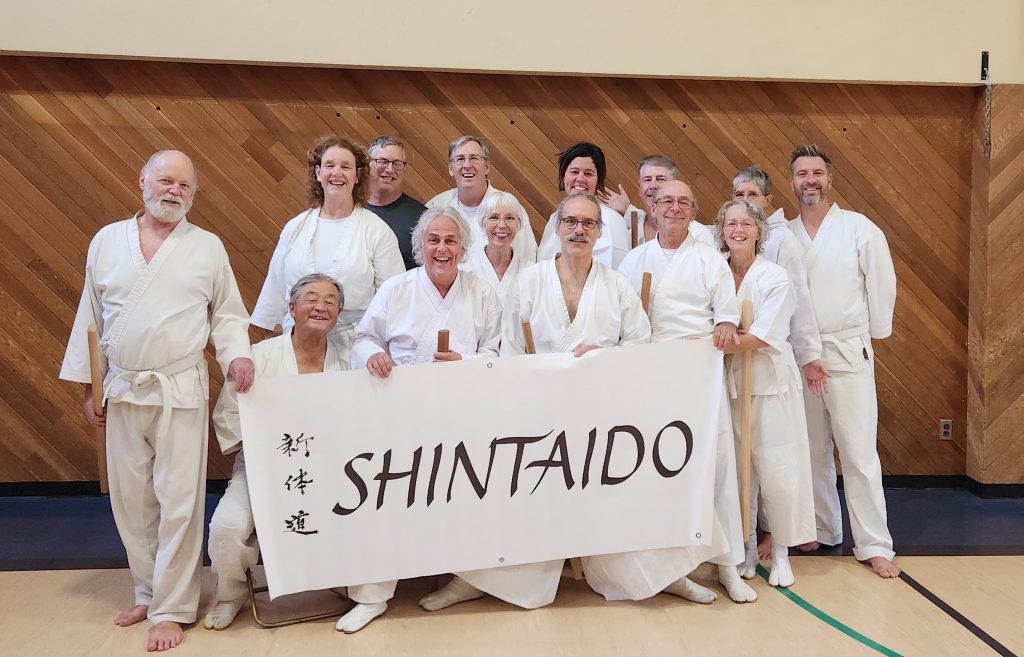
From 16 September to 18 September 2022, fourteen of us gathered in Quebec City, Canada for a Gasshuku. Now that it has ended, we have returned home with a sense of enrichment. Here are some impressions and remembrances.
First Carole and Herve as the organizers did the preparations of planning the Gasshuku with Rob Gaston, myself, and Ito sensei. We heard from people in California, Vermont, Florida, and Washington D.C. who planned to attend. Seven people planned to attend from Quebec. Ito Sensei and Nicole Beauvois were to travel from their new home in France. With both excitement and trepidation, we committed ourselves to this adventure and started our travels by plane, and by car. The Gasshuku was going to happen!
We arrived in Quebec City to the hospitality of Herve who housed many of us and provided the evening dinners and gatherings. Ito Sensei started Friday morning with a study of Muso-I, the stage of “Non-Phenomenon”. Followed by Ki-ichi-I the stage of “Returning Oneness.” Ito sensei mentioned these poses have been his major study over the preceding year and shared his deep reflections.
Friday afternoon, Ito Sensei provided advanced instruction on the roots of Taimyo from three Karate kata, Meikyo, Hangetsu and Kanku. Mark Bannon and Chris Ikeda-Nash demonstrated their knowledge of these three kata. Then, Ito sensei lead us through the movements linked to Taimyo.
Ito spoke of Kan-Ki, the sequence at the beginning of Taimyo as viewing Universal “Qi” energy.
Reppaku are the layers of energy, much like the movement of oceans waves. Sai-Zan is to break through the mountains to provide support even during a retreat. Ito spoke of Aoki-sensei’s inspiration for Taimyo Part 1 coming from symphony #9 written by Beethoven, Kan-Ki “Ode to Joy.”
We finished the morning and afternoon keikos with Taimyo meditation. People expressed feelings of interconnectedness with others and nature, and feelings of expansion and extending beyond their skins. Ito sensei described the floating feeling of the meditation grounded by the kata to keep connection with the earth.
Saturday morning keiko was taught by Rob Gaston. He focused on Kiri-o-roshi kumite. He led us to open ourselves with our partner to the beginning stages of “Ah”. Gradually we opened our partners and ourselves to Ten and then slowly cut Shoko.
Ito Sensei stressed the importance of continually moving from the very start of Kiri-o-roshi and at first, stepping back to pull our partner into ourselves, followed by reaching Tenso higher and higher to cut over and beyond our partner.
In the afternoon, Connie Borden reviewed Diamond eight Kaishoken (open hand) to focus on the three connecting cuts of Chudan Kiri Harai, Gedan Kiri Harai, and Jodan Kiri Harai. This was followed by practice of cutting one person as the target, holding center, while people practicing the precision of the cut while moving in a line. The opportunity to practice in pairs using the full gym for Eiko Dai no Kumite (open hand) was then offered. Ito sensei lead the group in Eiko Dai no Kumite with Boktoh. The Quebecois faced the Americans from opposite ends of the gym and practicing cutting large groups of people.
Ito sensei did a special request keiko on Saturday to review Kasumi and then Aikiken. In this advanced kumitachi, he taught Daijodan Kirikomi or Kiroroshi versus Kasumi and then Daijodan Kirikomi or Kirioroshi versus Aiki-Ken. He then taught the four stages with Renki-kumite.
Sunday morning Rob Gaston taught Boktoh to deepen our concentration through the drawing technique, stepping and turning. Then, he taught wakame to receive jodan and daijodan (both open hand) and this was repeated by many pairs.
Tenshingoso Dai concluded the morning keiko.
Connie Borden followed with teaching to receive dai jodan and jodan with boktoh while keeping wakame feeling. One side first did dai jodan with boktoh while to other side received into their body using wakame. This progressed to standard kumite of both partners cutting simultaneously dai jodan and jodan.
Ito sensei finished the Sunday keiko by asking Carol and Denis to demonstrate three cuts from Shintaido Kenjutsu. The basic Kyu-ka-jo Kumitachi with three cuts of Jodan-Kirikomi-Chudan Kirikomi-Gedan Kirikomi showing them as one cut with 3 movements. The second round was Chudan-tzuki- Jodan Tzuki and Jodan-Kiriharai again as one count with 3 movements.
Here is a list of various impressions from people who attended the gasshuku:
We made deeper connections with one another
Felt open further than before (Chris Ikeda- Nash)
Recommitted to practicing boktoh (Melanie Marin)
Expressed gratitude to being in community
Love of practicing Shintaido and remembering why he started 30 years ago ( Dany Simard)
Enjoyed the experience of being in a group to see the movements to help refine their stepping
Learning to allow the boktoh to lead the cut
Body movement speaking louder than words
Joyous
Many smiles
Arrived at a deep emotional shared space/connection that transcended words.
Felt many emotions of love, sorrow, happiness, and sadness without the desire to block the emotions.
Here is Denis’s impression:
He felt a beautiful sharing of emotions during the weekend. The energy that flowed between the participants was a connection that allowed him to communicate without worrying too much about the language spoken.
As Maya Angelou said
“I’ve learned that people will forget what you said, people will forget what you did, but people will never forget how you made them feel”
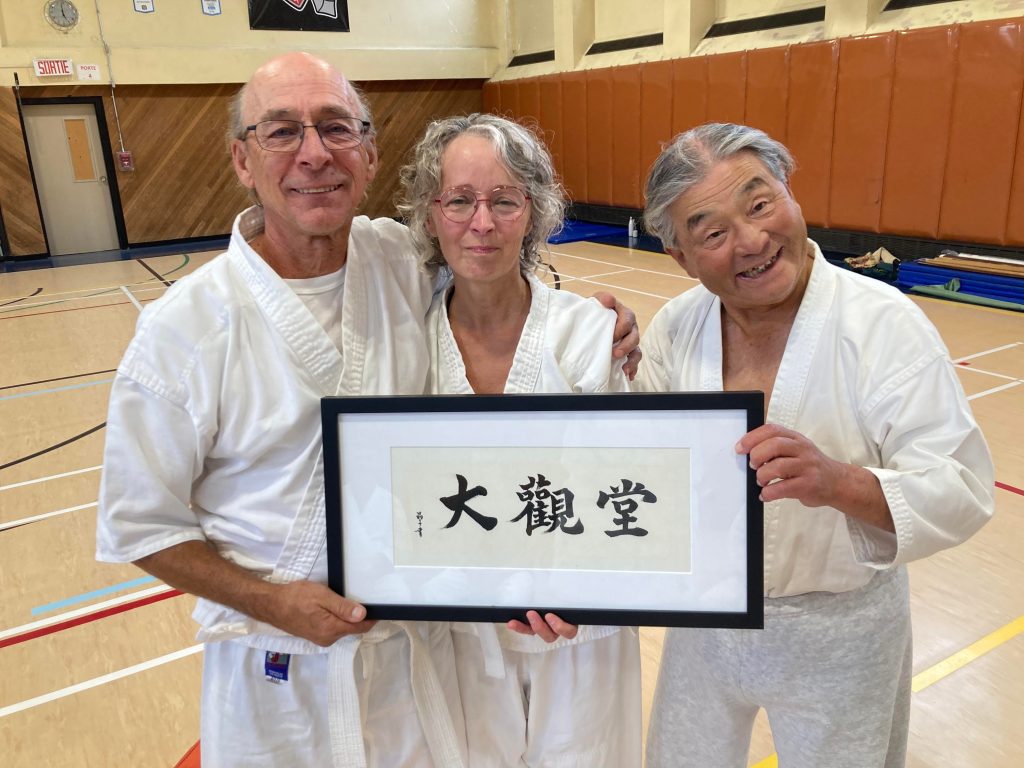
Ito sensei spoke during the closing ceremony of his gratitude to Carole and Denis and their dojo. He presented them with a framed calligraphy for their dojo. This is a name that Ito Sensei created specifically for their dojo.
The name of the building: Tai-Kan-Do >>> 大観堂 >>> the Hall of the Great OverLook
Calligraphy: Tai-Kan >>> 大観(体感)>>> Great Overlook/Great Overview/Great Anticipation (Bodily Sensation)
Carole and Denis expressed this: We are moved and honored that Ito Sensei came to our dojo in 2021 and that he also gave us a name for this dojo. It is thanks to him that we have built it, because it is following his invitation to travel to Japan and our attraction to the practice with the sword that we had the energy to build it. We feel a lot of gratitude towards him.
Everyone in attendance gave thanks and gratitude to the organizers – Carole, Herve, and Melanie. We also remembered Anne Marie and her love of Shintaido. With the closing ceremony complete, we returned to our homes more enriched, more open, and more human.
Introduction Tomi Nagai-Rothe and Connie Borden, both Shintaido Instructors, are also active with HF Ito, Sarah Baker, Rob Gaston and many others in the Global Taimyo Community (GTC). GTC formed after September 11 in 2001 and re-formed on the 20th anniversary in 2021. GTC believes that Taimyo Kata can function like a ritual form through which we can search and/or heal our inner world as well create better relationships with our outer world — including neighbors, community, and Nature.
This is the second of two articles written for the 2022 gatherings on the theme of Kintsugi (金継ぎ, “golden joinery”), also known as kintsukuroi (金繕い, “golden repair”). Mending is one way to transform objects and ourselves. Yet before we can mend or make amends, we need to feel the brokenness fully, be it a personal weakness or the violence of war. Deeply feeling the brokenness is a personal responsibility and a collective responsibility that is painful and necessary.
These articles were written to help open conversations. Our hope is to create a brave space rather than a “safe space.” The keiko analogy would be a perspective-altering kirioroshi kumite as opposed to an enjoyable keiko where you leave the same way as you arrived. It’s not that we feel unsafe in an incredible kirioroshi kumite – quite the contrary – we feel so safe with our partner that we can open ourselves to them.
Please reflect and share your comments on these articles being shared with the Shintaido audience via Body Dialogue.
My understanding of feelings of grief and loss stem from my experience working in the hospice field starting in 1994 and the death of my father in 1998. Later my professional experience expanded into palliative and hospice care.
Each person is different, and feelings of grief can vary in intensity. Feelings of grief and grieving can be cyclical. This process can often feel like one step forward and two steps back. Anniversaries and special occasions can bring back these feelings of grief.
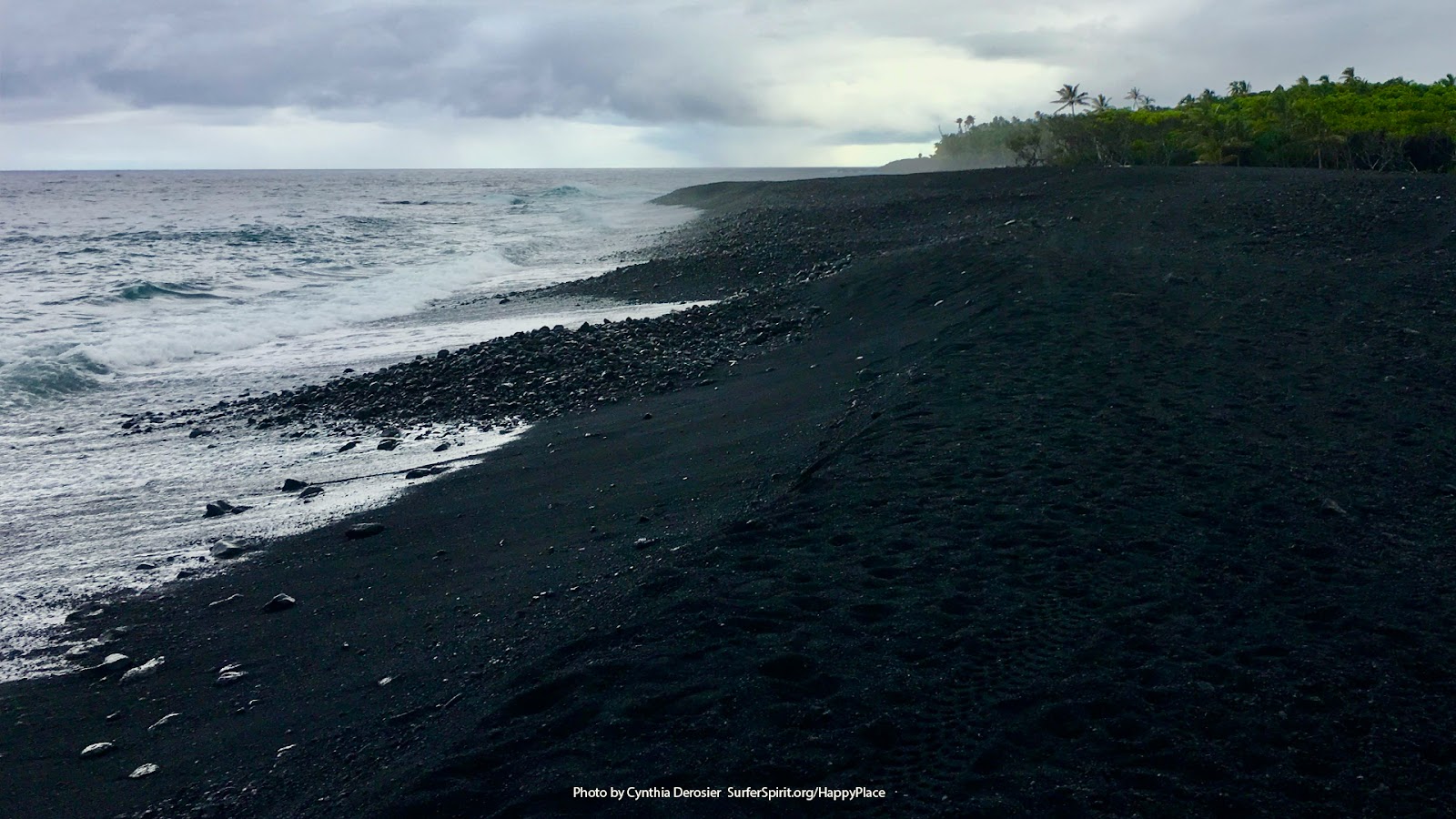
Photo by Cynthia Derosier
What have I experienced? The first step was becoming vulnerable enough to experience these emotions. It’s much easier to deflect and deny them. Due to our fear of being controlled by our emotions, it is common to hide these feelings. My own experience at my father’s death was numbness. I recall seeing a poster showing faces of 32 emotions. I could only identify two or three of the emotions at that time. I was that numb. Over time through therapy and doing more Shintaido, I could also experience anger, sadness and gradually remembering more of the many facets of my father’s life.
Perhaps you remember something similar? Perhaps you too can recall the impact of opening your hands, opening your body and then opening your mind through Shintaido movements? And did you wonder what was happening? I believe these movements of raising our arms overhead, opening the center of our body and using our voices can result in feelings of vulnerability.
How did I experience doing some of these movements? The first was centering, finding where I feel my emotions, where I hold tension, where I block to avoid joining with others. One way to center is the seated, rocking motion where we rock from one hip to the other hip. Rocking itself is soothing. Rocking side to side draws our attention to where the center of our being is and when we are off center. Being centered, I could be aware of my emotions, thoughts and feelings. Another movement was raising my arms overhead and relaxing to allow my partner to cut me during Tenshingoso kumite. As I opened my arms overhead, leaned backwards from my center and received the overhead cut, I found my center – often the heart area – being opened. This life exchange of energy through kirioroshi kumite can be supportive as each person is cut and then cuts their partner. When I opened and was cut, I was then softer and more receptive to the energies of the environment. This cathartic type of movement allowed me to cry. Early in my practice at gasshukus amongst the beautiful, strong, enduring redwood trees. I would find myself crying and hugging the redwood trees. At another gasshuku on Ocean Beach with sand below my feet, I found myself crying when being cut and rolled. Over time these reactions to being opened during practice have been less startling, and more familiar so I can say “Oh this is happening again, what can I learn from this?”
Photo by Tomi Nagai-Rothe
Death is one of the most obvious reasons for grief. What else might constitute times of grief from loss? Sometimes it comes with the diagnosis of a medical condition that results in loss of physical mobility. At other times it might be from a change in a significant relationship with resulting feelings of loss of a promised future. A job loss, change in a living situation or a loss of income are others. Even what we consider to be happy events – a child’s high school graduation or a marriage – can bring tears that are a mixture of happiness and sadness. These emotions seem to reflect a clear demarcation of a change we are experiencing from one state of being to another state of being.
What are some ways people can begin to acknowledge feelings? For some it is focused talk therapy, for others journaling, for others listening to music, and for others doing art, gardening, or body movement. Where and how to acknowledge feelings with others is also critical. Where and how require a space that provides love and is non-judgmental. One of the common experiences for a person who has had a recent event such as death is they report that people grow tired of hearing about their loss. Some people find it helpful to join a focused support group on loss, such as a bereavement group. For others, the sacred space of a dojo provides the place to explore and acknowledge feelings, thoughts and emotions.
Suffering is present for us all. I am reminded of the saying “be gentle with others, you do not know what they are experiencing.” To open and be aware of one’s emotions including grief, anger, and sadness, is the first step. Sharing with others as a next step keeps us human and open. These upcoming Global Taimyo Community gatherings can be one place to practice vulnerability. Our gatherings can be a place to gather, to build peace within ourselves and to support each other by being in community. Our gatherings can be a community to foster mending and finding ourselves more human.
Les sentiments de deuil
par Connie Borden
9 mars 2022
Ma compréhension des sentiments de deuil et de perte provient de mon expérience de travail dans le domaine des soins palliatifs depuis 1994 et du décès de mon père en 1998. Plus tard, mon expérience professionnelle s’est étendue aux soins palliatifs et aux soins en hospice.
Chaque personne est différente, et les sentiments de deuil peuvent varier en intensité. Les sentiments de chagrin et de deuil peuvent être cycliques. Ce processus peut souvent donner l’impression d’un pas en avant et de deux pas en arrière. Les anniversaires et les occasions spéciales peuvent faire resurgir ces sentiments de deuil.
Qu’est-ce que j’ai vécu ? La première étape a été de devenir suffisamment vulnérable pour vivre ces émotions. Il est beaucoup plus facile de les détourner et de les nier. Par peur d’être contrôlé par nos émotions, il est courant de cacher ces sentiments. Lors du décès de mon père, j’ai moi-même ressenti un engourdissement. Je me souviens avoir vu une affiche montrant les visages de 32 émotions. Je ne pouvais identifier que deux ou trois de ces émotions à ce moment-là. J’étais à ce point engourdie. Avec le temps, grâce à la thérapie et à la pratique du Shintaido, j’ai pu ressentir de la colère, de la tristesse et, progressivement, me souvenir des nombreuses facettes de la vie de mon père.
Peut-être vous souvenez-vous de quelque chose de similaire ? Peut-être vous souvenez-vous aussi de l’impact de l’ouverture des mains, de l’ouverture du corps et de l’ouverture de l’esprit par les mouvements du Shintaido ? Et vous êtes-vous demandé ce qui se passait ? Je crois que ces mouvements consistant à lever les bras au-dessus de la tête, à ouvrir le centre de notre corps et à utiliser notre voix peuvent entraîner des sentiments de vulnérabilité.
Comment ai-je vécu l’exécution de certains de ces mouvements ? Tout d’abord, en me centrant, en trouvant où je ressens mes émotions, où je maintiens des tensions, où je bloque pour éviter de me joindre aux autres. L’une des façons de se centrer est le mouvement de balancement assis, où l’on se balance d’une hanche à l’autre. Le balancement en soi est apaisant. Se balancer d’un côté à l’autre attire notre attention sur l’endroit où se trouve le centre de notre être et sur les moments où nous sommes décentrés. En étant centrée, je pouvais être consciente de mes émotions, de mes pensées et de mes sentiments. Un autre mouvement consistait à lever les bras au-dessus de ma tête et à me détendre pour permettre à mon partenaire de me couper pendant le Tenshingoso kumite. Lorsque j’ouvrais les bras au-dessus de ma tête, que je me penchais vers l’arrière à partir de mon centre et que je recevais la coupe au-dessus de ma tête, je découvrais que mon centre – souvent la région du cœur – était ouvert. Cet échange d’énergie vitale à travers le kumite kirioroshi peut être un soutien car chaque personne est coupée et coupe ensuite son partenaire. Lorsque je me suis ouverte et que j’ai été coupée, j’étais alors plus douce et plus réceptive aux énergies de l’environnement. Ce type de mouvement cathartique m’a permis de pleurer. Au début de ma pratique à Gasshukus, parmi les beaux, forts et durables séquoias. Je me surprenais à pleurer et à étreindre les séquoias. Dans un autre gasshuku sur Ocean Beach, avec du sable sous les pieds, je me suis retrouvée à pleurer quand on me coupait et me roulait. Au fil du temps, ces réactions à l’ouverture pendant la pratique sont devenues moins surprenantes et plus familières, ce qui me permet de dire : “Oh, cela se reproduit, qu’est-ce que je peux apprendre de cela ?”.
La mort est l’une des raisons les plus évidentes du deuil. Qu’est-ce qui pourrait constituer d’autres moments de deuil à cause d’une perte ? Parfois, il s’agit du diagnostic d’un problème médical qui entraîne une perte de mobilité physique. Dans d’autres cas, il peut s’agir d’un changement dans une relation importante, qui entraîne un sentiment de perte d’un avenir promis. Une perte d’emploi, un changement dans les conditions de vie ou une perte de revenus en sont d’autres. Même ce que nous considérons comme des événements heureux – l’obtention du diplôme d’études secondaires d’un enfant ou un mariage – peut provoquer des larmes qui sont un mélange de de bonheur et de tristesse. Ces émotions semblent refléter une démarcation claire d’un changement que nous vivons d’un état d’être à un autre état d’être.
De quelle manière les gens peuvent-ils commencer à reconnaître leurs sentiments ? Pour certains, il s’agit d’une thérapie par la parole, pour d’autres de la tenue d’un journal, pour d’autres encore d’écouter de la musique, et pour d’autres de faire de l’art, du jardinage ou des mouvements corporels. Le lieu et la manière de reconnaître ses sentiments avec les autres sont également essentiels. L’endroit et la manière nécessitent un espace qui offre de l’amour et ne porte pas de jugement. L’une des expériences les plus courantes pour une personne qui a vécu un événement récent comme un décès est que les gens se lassent d’entendre parler de leur perte. Certaines personnes trouvent utile de se joindre à un groupe de soutien axé sur la perte, comme un groupe de soutien aux personnes en deuil. Pour d’autres, l’espace sacré d’un dojo permet d’explorer et de reconnaître les sentiments, les pensées et les émotions.
La souffrance est présente pour nous tous. Je me souviens du dicton “soyez doux avec les autres, vous ne savez pas ce qu’ils vivent”. S’ouvrir et prendre conscience de ses émotions, y compris le chagrin, la colère et la tristesse, est la première étape. L’étape suivante consiste à partager avec les autres, ce qui nous permet de rester humains et ouverts. Les prochains rassemblements de la communauté mondiale Taimyo peuvent être un lieu de pratique de la vulnérabilité. Nos rencontres peuvent être un lieu de rassemblement, pour construire la paix en nous-mêmes et pour nous soutenir mutuellement en étant en communauté. Nos rassemblements peuvent être une communauté qui favorise la réparation et la découverte de notre humanité.