The cost for the three-day event is 250 €. But, if you register before the end of July, it is only 220 €!
Ula Chambers, from the United Kingdom, is the Director of Instruction from the event. Here is an excerpt from her, “Welcome message” from their home page:
During the November event in Reims, I invite you to discover for yourselves the vastness of the Shintaido field and the depth of this inner world: find out how familiar Shintaido techniques can be presented in ways to enable people of different abilities to practice sincerely together; how listening deeply to our bodies can enhance our own personal practice and meet the needs of a changing body condition or environment. We will study the essence and deep philosophy of Shintaido in unexpected ways so that you can share Shintaido with your friends, family and co-workers; with younger or older people adapted to their ability and understanding.
If you have questions about the event, please check their contact page to choose the proper person to contact.
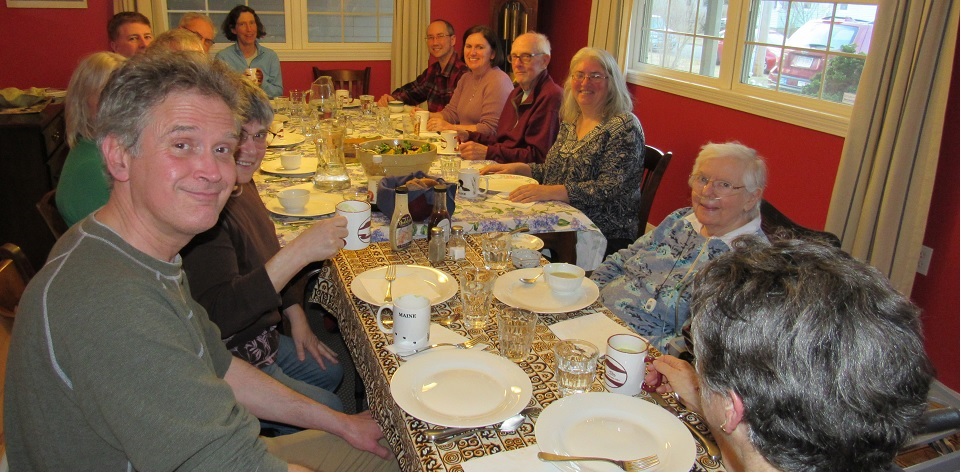
Springtime in New England means many things. For Shintaido Northeast (SNE) it has come to mean “Springeiko” – a gasshuku to welcome the return of warmer weather and outdoor practice. This year, like last year, we met in South Deerfield. However, unlike last year, this year we had to deal with the absence of our beloved Joe Zawielski. The loss of Joe, who was often SNE’s Director of Instruction for gasshuku, and a mainstay of SNE, has left us facing some major shifts. We decided to have a meeting over the Saturday night potluck to think about new directions.
At lunchtime, three questions were proposed for our unconscious minds to ponder during the afternoon keiko. After dinner, we looked at our individual responses. The two fundamental themes that emerged are community and a holistic practice. But rather than interpreting these responses, they have been collated here. I invite you to think about how you would answer these questions for yourself.
What did Shintaido give you when you first encountered it, and what did you bring to it
What does Shintaido give you now – and what do you give to Shintaido?
What do you hope Shintaido can give you in the future – and what do you envision you could contribute to Shintaido?
What did Shintaido give you when you first encountered it?
A new universe to explore, and a willingness to do so. An opening for a new way to look at the world
Energy – and lots of it! Vitality!
Beginner’s mind and fresh eyes
An excitement about life’s journey and a new lens to look at it through.
Showed me the whole body-mind-spirit connection.
Strong legs and a wonderfully toned body. Sore thighs. A broken nose!
A completely new way to be with my body. I was able to feel (and be) strong, graceful, capable.
An opportunity to learn that my body was more than just flesh and blood and bones – that there was whole being who encompassed also memory, spirit, energy and will. This was news to me at the time.
A community of people. Community is fundamental to Shintaido. Fun, laughter. Welcome. A sense of belonging.
A place where it was important to express all of myself, and not have it be viewed as ‘too much.’
An outlet for self-expression and extension of one’s interest into a bigger realm.
Big nature: Ocean Beach, Tennessee Valley, Golden Gate Park…Hard practice on the beach in the cold and not-so-cold, but being one with the beach and cold and the others practicing.
A sense of community and a practice to develop and work on.
It challenged me to open my body and heart and spirit. Physical, mental and existential challenge. It gave me many, many opportunities to challenge myself.
Stress relief. Bright, shining world.
The thought of “Wow! This is pretty neat stuff.”
It gave me a different way of connecting with my undergraduate students.
Shintaido gave me hope for extending a truncated life, being more expressive, feeling more deeply.
It gave me license to be weird, and made my body stronger.
It gave me a lot of challenges – for years I felt that I would never improve; I was just terrible at it. So it gave me difficulty, and that intrigued me, I think it kept me coming back.
What did I give, in the beginning?
Commitment and enthusiasm. Back then, I gave it my enthusiasm, going to as many classes as I could. My time, as an eager student.
A lot of energy, interest, and thought.
I gave an injection of foreign perspective to French Shintaido practitioners.
A level of participation both in and out of keiko.
Perseverance – it took a long time to “get” certain movements.
I gave Margaret Guay a student!
Not so long after starting, I volunteered to serve as SOA treasurer, SNE board member, etc.
What does Shintaido give you now?
It gives me an indomitable spirit. When I do the movement, even it is only ten-part meditation, I am reminded of the many instances when the body was weak but the spirit was willing. And there’s also a sense of community that is, I think, a vital part of Shintaido.
A place to start over.
Rebirth, new beginning.
A different perspective and philosophy.
Energy!
A community of people. (Several peple said this in different ways.)
Connections that go back a very long way.
Knowledge to share in my own voice and in my own way (example: teaching at Senior Center)
The confidence and expertise that comes from doing something for more than 40 years.
A wholeness of spirit.
It still gives me community and a practice to work on. But Shintaido also helps me grow spiritually, and it provides a form for me to express my physical self with.
It gives me a community of people I have known and done something with for more than half my life, and friendship – or really, more like family.
When I practice with others, it give me energy and joy.
It gives me a depth of contact with myself, my body, my spirit that I can count on, and that I can find when I need it.
Now I know how to relax, and how to deepen.
Shintaido provides a form for me to play with physical expressions in nature. It also provides what has grown into a long-lived community of friends.
One can understand the value of Shintaido in Jungian terms – that it allows us to grasp our shadow and bring it forth in creative and constructive ways if the forms are allowed their full spiritual breadth, depth and energy. But it is still shadow and can overwhelm and even terrify people (I think this is really why people stop.) It can also put people into a frustrating tension if it is dampened by focus on linear hierarchy or mere from, since the spirit understands its bounded nature, senses the great sky. Of course this is easy and in some ways formulaic thinking in the part of someone who has lived in the more visceral tension of shadow-fear for a lifetime! That’s my rant!
It continues to give me a way of thinking about my body as embodied spirit, which is helpful in my current situation.
It gives me connection. Ten, chi, jin. It gives me a remote connection to others, and a spiritual practice.
A door into Japanese culture that enlarges my understanding of their art, film and literature.
A chance to reconnect with other practitioners, some of whom are close (or closer than) family. It also reminds me of the physical person I used to be, and even though I’ll never get back there. I am more aware than many people about what’s going on in my body.
An embodiment and practice of a life philosophy.
A framework in which to continually question evaluate, and reconsider my choices in life, and a way to work through them with a very valued physical, mental and spiritual practice.
What do you give to Shintaido now?
Love.
I still volunteer on the SOA and SNE board.
I’m not currently practicing, but I’m on the SOA and SNE boards.
A desire to contribute to Shintaido’s ongoing existence.
48 years’ experience.
Some tribal knowledge.
Lots of sharing and work at the organizational level of the Shintaido community.
What do you hope Shintaido will give you in the future?
As I am aging, I trust it will continue to support me throughout my life journey. And I also see that the physical part is less, and the spiritual is more.
Community, continued community.
I hope Shintaido will continue to provide this community that gets together throughout the year on different levels.
I hope that it will help to keep me healthy physically and mentally.
An option to share knowledge and movement in my own way separate from the Shintaido hierarchy.
A changing practice that will sustain me even as I become less able to execute physically challenging movements.
I hope it continues into the future. I worry that it will become extinct.
I hope to get back to teaching and possibly giving Shintaido retreats and classes at other venues.
In the future I plan to continue practicing as best I can despite aging. I hope my practice and insight will deepen.
Vitality!
A legacy to pass on/lineage.
Continued enjoyment with sword!
In-home services for the elderly? I expect there will always be some kind of practice for me if I continue to stay in touch with Shintaido. But there will always be the core movements of Shintaido that have kept me well in spirit over many years. Simply doing tenshingoso in the morning or evening or maybe both helps me to maintain an attitude of gratefulness, humility and wonder.
What do you hope you can contribute to Shintaido in the future?
Presence.
I hope to share more through teaching.
Continued time and commitment to practice and share Shintaido with others.
I will continue to volunteer as best I can during a big transition in life.
What I give is my most sincere effort in keiko, and I try to bring what I’ve learned to other aspects of my life.
I’d like to contribute to planning special events, like Anne-Marie’s memorial in Montreal, and special classes with James Cumming.
After we had reflected and written in silence for several minutes, people were asked to come up with two sets of ideas to share: one abstract, and one concrete. Perhaps you’d like to do the same? Here are the combined lists from SNE Springeiko 2019:
Seeds of Change
Concepts
Vitality!
Community
Branding
Tribal knowledge
Expression!
Integration of physical and spiritual self
Embodied spirituality
LOVE
Practice of opening body and heart
Evolution
Relationships
Health
Bring one new person each (1 + 1 = 2; would double our group)
Concrete (something we’d like to see happen within the next two years)
Let’s collaborate with thriving organizations!
“Collaborative teaching”
Hold a longer gathering with multiple teachers
Bring keiko up to Bill Burtis!
Collaborative workshop on “mindful movement” with EMI (Judy Tso)
As many of you know, in the summer of 2017, our friend Joe Zawielski was found to have a brain tumor. The Shintaido community wrapped itself around him, sending messages, positive energy, and love from all over world. After surgery and treatment, he began his recovery.
That fall, Joe came to a Shintaido Northeast event in Worcester. It was the first time I had seen him since his treatment, and it was very hard for me to see the change in this once vibrant man with seemingly boundless energy. During lunch, he said that he wanted to do the Pan-Mass Challenge (PMC), the bike ride that raises money for Dana-Farber Cancer Institute (DFCI), where he had received his care. At the time, his balance and stamina weren’t great, so I toyed with the idea of partnering with him, perhaps the two of us riding a tandem to complete the ride. I’d known Joe nearly 30 years and this was the least I could do to repay all those years of instruction and friendship.
Joe and Roger kumite
Unfortunately, the cancer returned, and his health declined rapidly. Many of us were lucky enough to attend Joe’s last keiko, which was a truly blessed event. On my last visit with Joe before he passed, I asked him if I could ride the PMC in his place. Though he wasn’t able to articulate his answer, Joe started to cry; his wife Deb assured me this meant “Yes!”
I’m riding this year in honor of Joe. I’m doing the one-day Sturbridge to Bourne route, a 108 mile ride. I haven’t attempted a journey of this length in nearly 20 years, but I’ll have the spirit of my friend and sensei whispering “Gambatte!” (Do your best!) in my ear as I ride. My fundraising goal is $4000. Last year the PMC raised $56 million for Dana-Farber; 100% of all rider-raised funds go to directly support DFCI and the Jimmy Fund, the charity which raises money for adult and pediatric cancer care and research at DFCI.
On April 13, 2019 in Bruges, Belgium, I presented Shintaido for a second year at the 2nd Global Conference on Death, Dying and the 21st Century. This year 22 people from 10 countries came together for 2 days as an interdisciplinary research community. We discussed the ways culture impacts the care for the dying, the overall experience of dying, and the ways the dead are remembered. Attendees came from the Netherlands, Australia, Portugal, Switzerland, Wales, the UK, Israel, Lebanon, the USA, and Canada. Our interdisciplinary group included scholars from philosophy, ethics, the law and literature; experts in the field of design for both products and processes; photography and videography; writers; and healthcare professionals including me as both a healthcare professional and student of Shintaido.
I presented Tenshingoso with overtone chanting, as part of an array of topics from personal reflection on the journey through and after death of a loved one to review of literature and poems that gave voice to the illness experience. During the 45-minute interactive demonstration, the participants used their voices and their bodies to explore the sounds of Ah, Oh and Um to express grief and facilitate mourning. Participants were first given the opportunity to stand facing inwards in a circle, and then with alternating groups they were invited to stand in the center of the group while these three movements were being done by the external circle.
Group Movement in Bruges
Participants reported feeling soothed and relaxed. Many reported feeling the vibrations of sound within their bodies. All agreed the simplicity of the three repeated movements made it easier to learn and potentially use in the future. Many were eager to work with their colleagues and explore how patients might benefit from these movements and sounds.
Our group quickly formed an intimacy and connection through our mutual sharing and teaching over these two days. For almost everyone, these two days moving toward the unknown and mystery of death brought us closer together. I received feedback that the inclusion of body movement was welcome to both “get out of our heads and into our bodies” and to facilitate our interconnection as a group. I am making plans for next year’s meeting already!
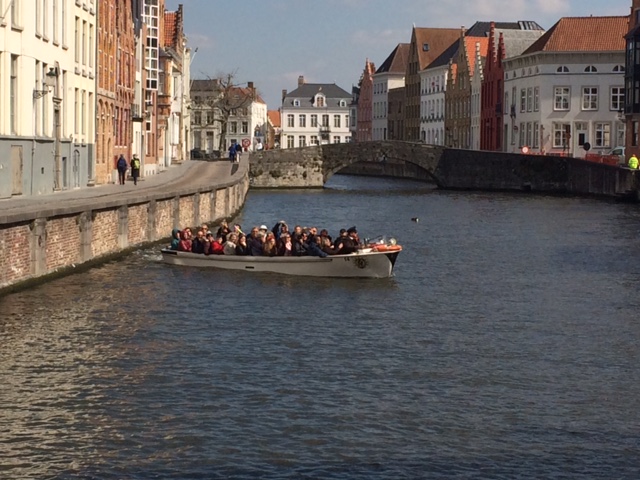
Bruges canal
Here is my paper on my presentation:
Kotodama Applications for End of Life; a performance/audience participation presentation Abstract: The use of sound combined with body movement crosses all cultures, languages and religions to provide a physical means for spiritual growth that for end-of-life purposes can provide a way to express grief and connection with the deceased. When the voice is added in Japanese martial arts such as Shintaido, the sound can be a spiritual basis for teaching. The Japanese word for sacred sound or word spirit is Kotodama. In the Japanese belief system, mystical powers dwell in words or names and ritual word usages can influence our environment. The Japanese martial arts body movement is Tenshingoso, with specific attention to the sounds “Ooo”, “Uumm”, and “Aaa”. This presentation will bring the results many years of weekly practice and instruction for use in celebrations of life.
Presentation: Tenshingoso is called “The Cycle of Life” so that through body movement one can study life as measured from moments to a lifetime, while using the voice to increase the flow of energy. Tenshingoso is derived from esoteric Buddhism with each movement accompanied by a Sanskrit sound. For this presentation, the sounds of O-Um-Ah will be presented and practiced. This movement with voice will advance to transition from one sound to the next sound ultimately doing three sounds with one breath.
O – Reaching out into the universe to reach what is omnipresent
Push hands forward and up as far as possible with the palm facing forward, fingers pulled back so as to open the palm of the hand. The sound of “Oooo” is made throughout this movement and as the movement Um is started, the sound changes to “Uumm” to start the stage of Um.
Um – Bringing the universe, perhaps those who have gone before into one’s center
The right-hand rests lightly inside your left hand. Eyes can be half closed or completely closed. Bring all your concentration into one single point where everything else disappears. Release all tension from the top of your head to your feet. Bring the hands back to rest lightly over your lower abdomen. The sound of “Uumm”” continues through this movement and begins to change to the sound “Aahh” to start the stage of Ah.
Ah – Opening Space – asking those who have died to reappear.
Opening your eyes, drop your arms down and backwards with shoulders relaxed, your fingers open and palms open, leading with the thumbs pointing backwards. Look toward the skies. Your chest will be open, head tilted backwards so that your chin and face is looking up. Your arms with palms open will be at your sides. Making the sound of “Aahh” and transitioning to the sound “Ooo”.
The video was produced by our Shintaido North East group, October, 2008.
This features keiko taught by Shin Aoki sensei. It includes various Shintaido movements, historical footage and interviews with instructors and practitioners who describe the qualities of joy and transformation inherent in the practice of Shintaido.
“Shintaido – Tenshingoso” – August 2009
Tenshingoso is one of the fundamental kata of Shintaido Enjoy this video of Gianni Rossi Sensei demonstrating Tenshingoso Dai.
“Ito Sensei – Diamond Eight Cut with Naked Blade” – December 2016
Here is Ito Sensei showing diamond eight cut with the naked blade. Filmed at Seminar de Shintaido Brasov, December, 2016