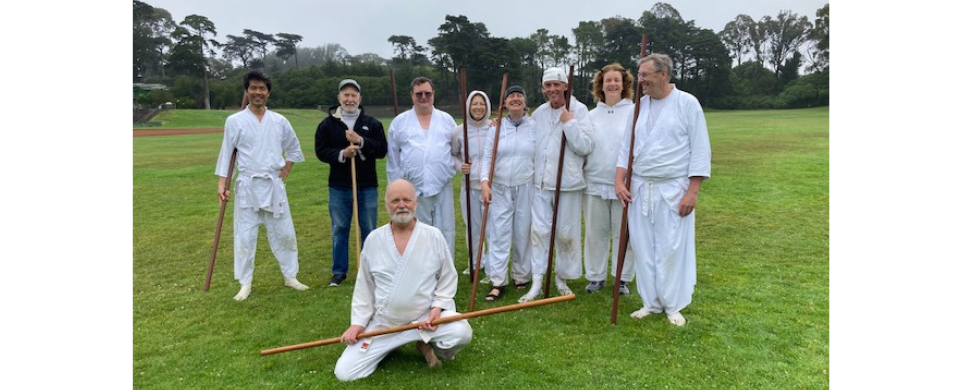
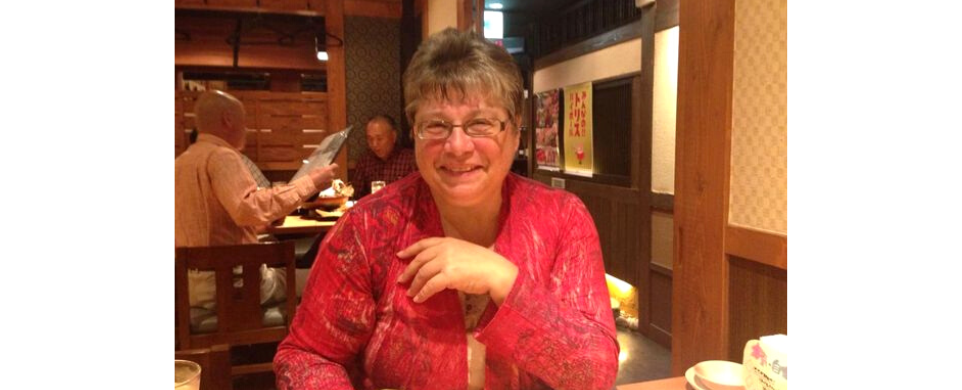
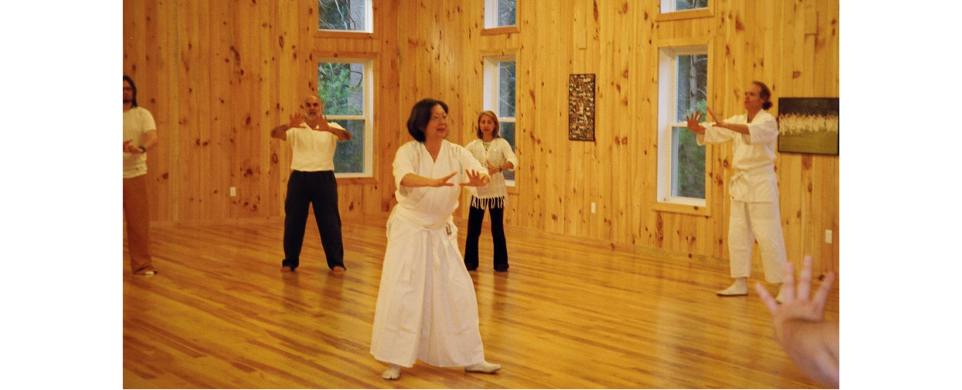
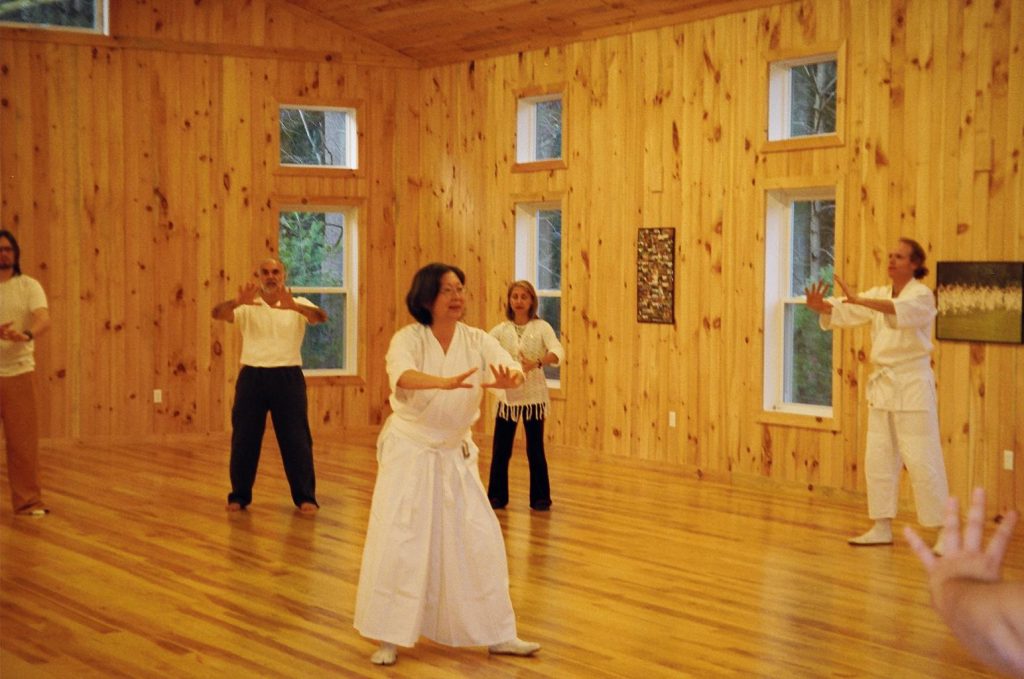
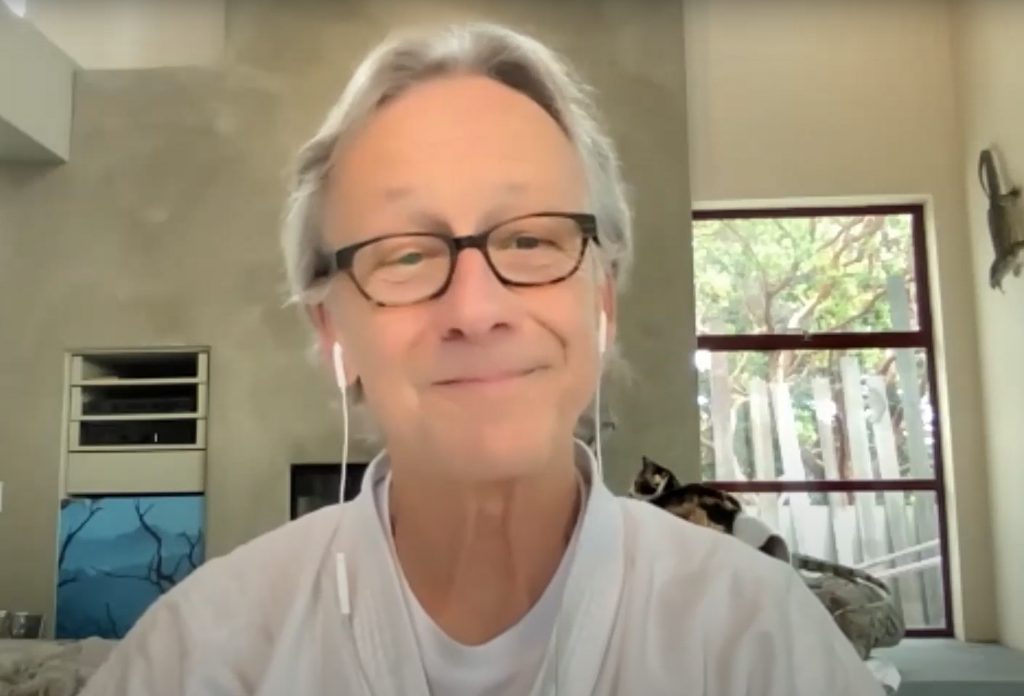
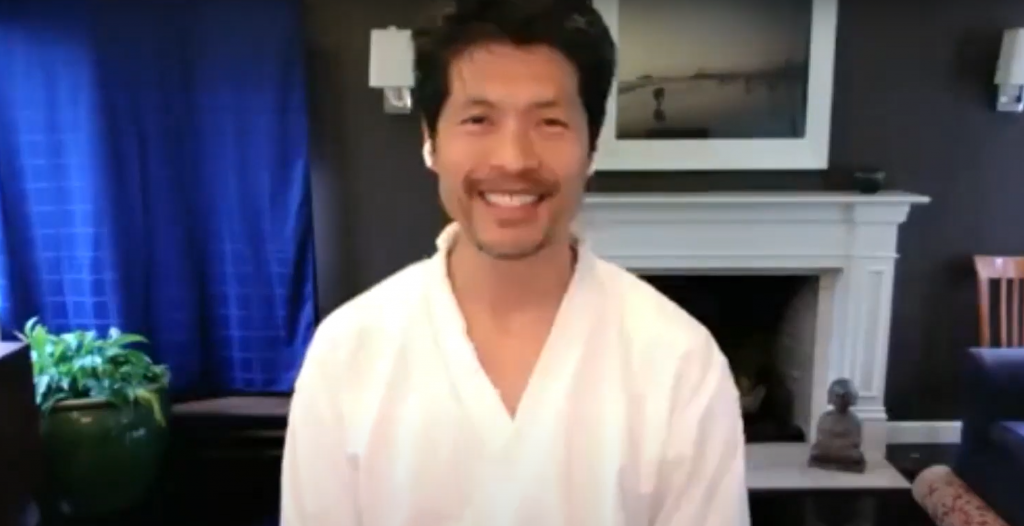
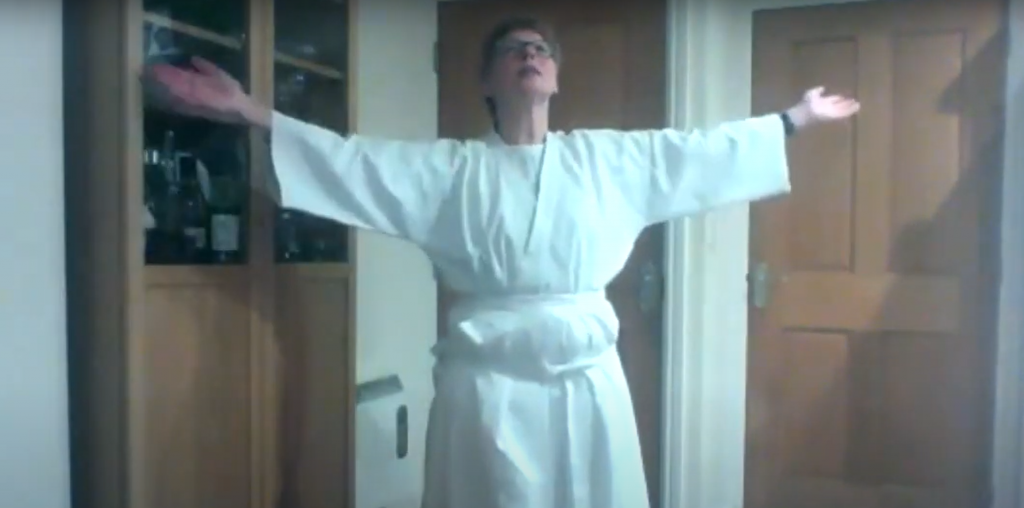
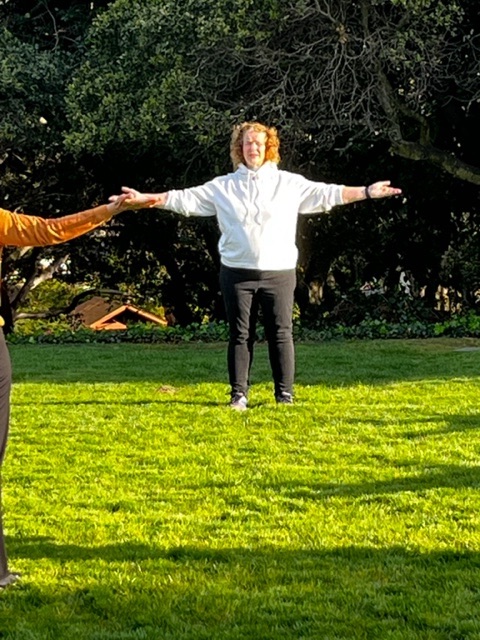
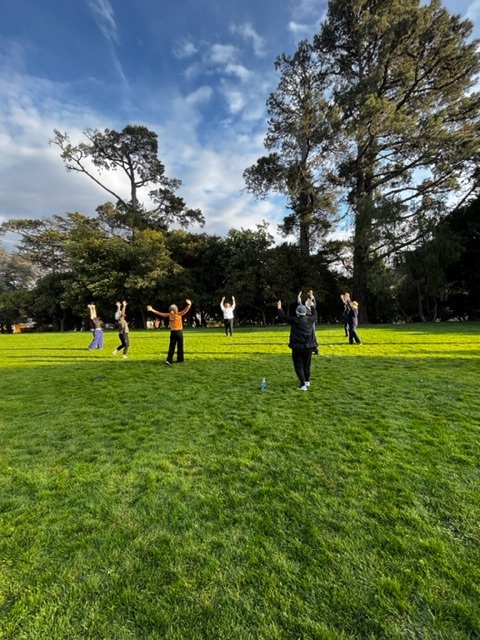
Rob Gaston, Senior Instructor, ranked Sandan in Shintaido bojutsu had an inspiration to hold a Shintaido of America boh workshop in 2022. Post COVID, it would be an in-person gathering in the San Francisco Bay Area open to all Shintaido bojutsu practitioners. The theme would be “Connections in Nature”. Charles Burns, from the United Kingdom, accepted the invitation to be a guest instructor. Charles holds the ranks of Shintaido General Instructor and Sandan in bojutsu. Shin Aoki, ranked Yondan in bojutsu and Senior Instructor in Shintaido, graciously agreed to join the teaching staff.
As a Nurse Practitioner trained within western medicine, I reflected on this theme, and thought of the recent health-focused activities that recommend including nature in our lives. This is a growing trend of so-called “park prescriptions,” which have increased in popularity over the last decade along with research into the benefits of spending time in nature. In these programs, physicians strongly encourage patients young and old to spend more time outside to improve their mental and physical health. In Japan, this has been called “forest bathing.” Thich Nhat Hanh spoke of the healing capacity of the natural world.
“When we suffer, the Earth embraces us, accepts us, and restores our energy, making us strong and stable again. The relief that we seek is right under our feet and all around us.”
So, I reflected on my good fortune to be introduced to Shintaido in 1984 and the many opportunities to practice in nature. I was eager to see the impact from our outdoor boh workshop.
Charles Burns arrived from the UK on Tuesday to allow for two days of keiko with Rob and Connie and to explore our keiko sites of Golden Gate Park and Ocean Beach. Charles shared his inspirations of study of a Boh Kata called “Karei no Kon,” which translates into ‘Spirit of the Flower.’ Those who visited Japan in 2004 for the Matsuri international event may recall this long kata, introduced there by Oi sensei. Charles shared his inspiration to use segments from this kata throughout his keiko during warmups and kumite. Hoshi o Toshi was shared from this kata to take our eyes and vision to the horizon for greater awareness of nature. Charles then visited Stow Lake in Golden Gate Park and the majestic redwood trees in Muir Woods. Friday the 29th of July, Shin joined Charles, Rob, and me for a collegial keiko in Upper Noe Park for a study of yondan and godan kumibo and Hakuson Kata.
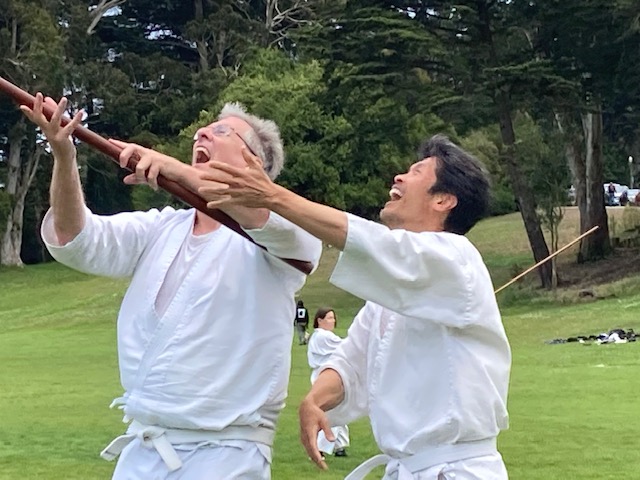
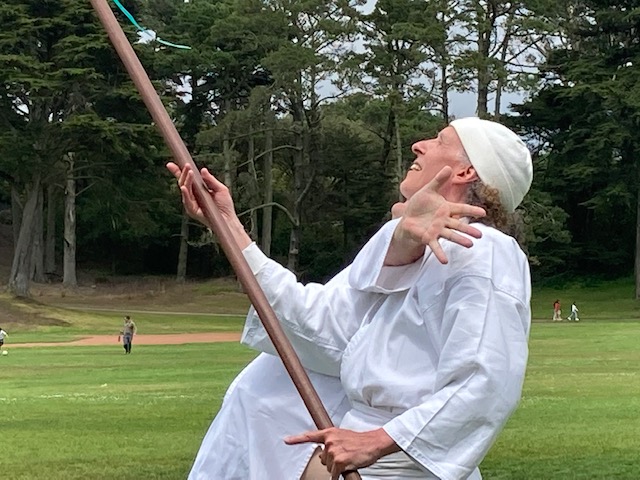
On Saturday 30 July, the workshop began at 8 AM in Golden Gate Park with Rob Gaston, teaching the first keiko. Nature provided heavy fog and drizzle. Rob taught a gentle ten-nage (catch boh – literally “throwing to heaven”) sequence which developed from mochikae to feel like doing eiko dai. We sent energy high into the sky/heavens as we pulled the boh up through our bodies to pass it overhead to our partners. We held shoko to shine brightly for our partners. Next, we explored the same idea using chudan Tsuki; receiving directly into our stomachs, tightening the ma, and then moving to one side to allow the boh to pass. We were taught to take hold of our partner’s boh and lift it skyward into age-oroshi. This transformed the horizonal chudan attack into a peaceful dissolving of energy.
Rob closed with repetitions of Hi No Kata sharing the imagery of a brightly burning fire. Nature provided sunshine to break through the clouds to create focused areas of bright light on field. We did larger and free movements and closed with one synchronized kata.
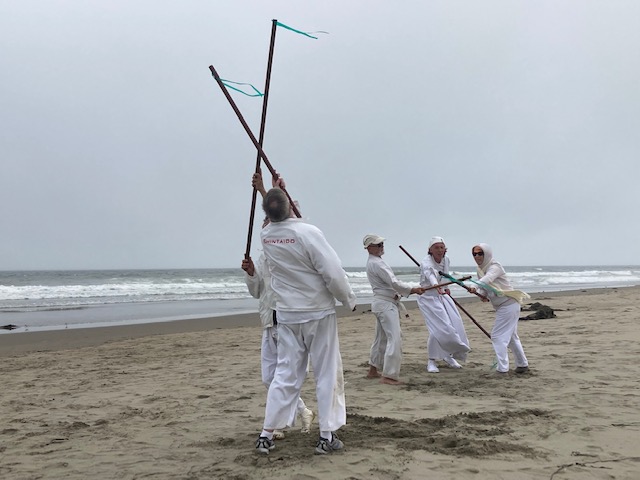
The second keiko, at Ocean Beach, was taught by Charles Burns. We arrived in light fog and mixed visibility of the ends of the beach, and the windmill above the sand dunes. Pelicans flew overhead in formation several times. Charles had us tie green flags on the end of our bohs asking us to use it like a paintbrush. He began with a warm-up sequence based on mochikae in which the side-to-side movement of the boh gradually morphed into various basic kihon.
Charles then described the experience of being inside Millennium Dome in London, a building visible from space. He wanted us to visualize painting the inside of this vast dome with our boh. We painted from side to side, from top to bottom and all around this dome as we moved our bohs to his gorei. Charles then led the group into kumite with neriai. We started one to one with our partners, then in groups of three and finally with much amazement we became a group of six. It felt as if we formed a large teepee with our bohs, moving in unison with everyone and nature.
Our second kumite was Dai-jodan versus ichi-monji receive and then jodan to jodan kumite to create a simple kihon kumibo sequence. Charles moved us into kata to face the ocean and do Kaze no Kata, repeating it several times going faster and faster, then one slow kata. We closed with Hoshi o Toshi as we stirred the clouds and the stars beyond the clouds.
Sunday 31 July started our second day and third keiko at Golden Gate Park taught by Shin Aoki. Shin taught stepping with boh movements so that when we moved into kumite, we did a soft yet direct jodan into our partners center/their heart. We repeated this movement twice and then our partner descended energically deep in the earth to hook, turn and raise our partner up into the heavens – wakimuso. Shin taught about the flow of energy in circles, moving the energy inward and moving the energy outward. The next kumite was daiheigen against chudan tsuki, so we began to move energy at the level of the horizon. Shin concluded the practice with Mizu no Kata, completing the sequence of three basic boh katas which we practiced throughout this event.
The Fourth Keiko was at Golden Gate park taught by Charles Burns. With instinctual awareness of the group energy after three Keiko, he led a boh massage warmup. He then reviewed aspects of the first three Keiko so our bodies could remember the richness of the teachings. First, we reviewed the neriai / ten-nage combination introduced by Robert in keiko one, developing it into Shoten. Next, we practiced the Daiheigen movement shown to us by Shin in keiko three, developing it into Eiko. Charles encouraged us to cry “look at the beautiful horizon!” as we opened our arms to send our partner rolling backwards with their boh.
Finally, Charles reshared the Millennium Dome image to combine the three basic boh kata into one kata. Through the apex of the dome, energy came down above to the ground, igniting our world in fire. We did Hi No Kata. Then water fell from above to extinguish the fire and as the world filled with water, we did Mizu no Kata. The ground was now wet, however fire and water created stream, and this created a wind – a vortex and we started Kaze no Kata. We closed with a large horizontally encompassing Hoshi o Toshi.
We finished with deep gratitude for the teachings and for our community. I felt content, my mind was calm, and my heart felt wide open. Charles expressed his appreciation to teach within his new role of General Instructor. Shin expressed his learnings of more imagery work with kata. Rob expressed his gratitude the workshop was successful to connection further with nature while building a story across the boh kata.
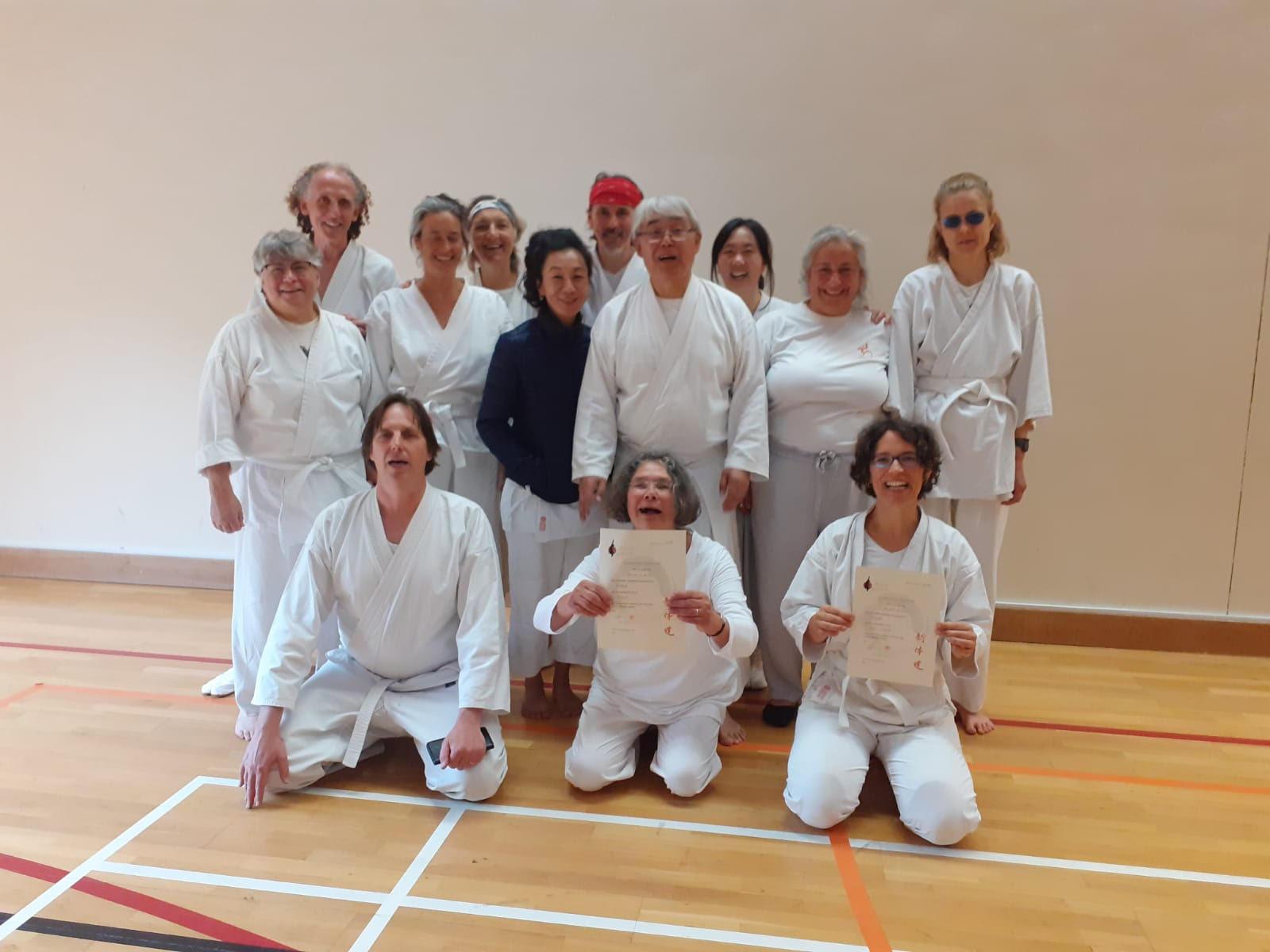
I just got back from the British Shintaido daienshu, their summer gasshuku. It was delightful. The theme was “Genryu: Return to the Source”. The event was led by Masashi Minagawa, ably assisted by two general instructors (Charles Burns and Ula Chambers) and a senior instructor (Nagako Cooper).
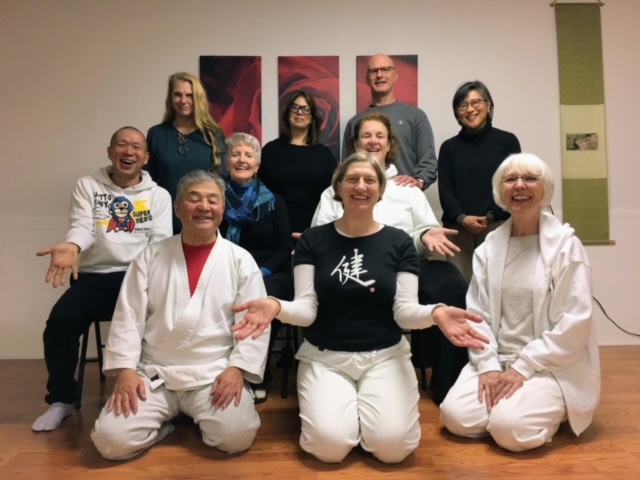
BACK ROW: Nancy Billias, Charles Burns, Viola Santa, Belinda French, Kim Chan, Terry Bickers, Minagawa sensei, Nagako, Jackie Calderwood, Charlotte Stace FRONT ROW: Craig Thorn new shodan kenjutsu, Marianne Van der Tass ( New advance student), Mirabelle da Palma , new BS assistant.
There were subtle cultural differences, but there was a lovely familiarity to it all, from the warmups to the closing ceremony to the fact that everything tastes so darn good after keiko! About 15 of us were gathered from all over the UK, including one person from Scotland, one from Cornwall, and one from Belgium (I know, not officially part of the UK). There were exams, and a bonfire, and early morning taimyo in a garden infused with birdsong.
Minagawa-sensei took us back to the roots of Shintaido with each keiko, talking about how the various kata had come into being and developed, from the very beginning right up through kenjutsu. It was amazing – really like touching the source. He talked a lot about his teacher, Kato. I was privileged to be assigned to do sensei care, so I had a lot of opportunity to chat with him.
Like Shintaido in America, British Shintaido is “greying,” but it was good to see that there is one senior instructor and one assistant in their 40s. There are five groups spread around the country which meet regularly, and eight – yes, eight – weekly Zoom classes. They have fine-tuned Zoom teaching up to a very good standard.
They did one thing differently at this gasshuku which I really appreciated: they began the event on Zoom on the Monday before we actually met on Friday, with kenko taiso each morning from 7.15 – 7.45 am and meditation every evening from 9.30 – 10 pm. For that, they broke down ten-position meditation and focused on only two movements each time.
Bringing everyone together in this way created a good group feeling, so that by the time we actually met on Friday, we were already in that groove. Something for the US groups to consider, perhaps. I’m already looking forward to their Kangeiko! Where I’m living now (in Kent, England), the person in charge has asked me to start a weekly Shintaido class to see what happens, and two people from the gasshuku have offered to come as guest instructors once I get that going.
I’ve just retired from college teaching, and am living and working in a Christian community which exists to support people with mental illness, who for one reason or another can’t quite manage independent living. They can stay with us from one week to two years; the goal is to get them back on their feet and confident to live on their own. The community members meet three times a day for prayer in a 15th century chapel. Prayer is optional for our guests, and about half of them join in. I can’t wait to see what they make of Shintaido.
Author Biography
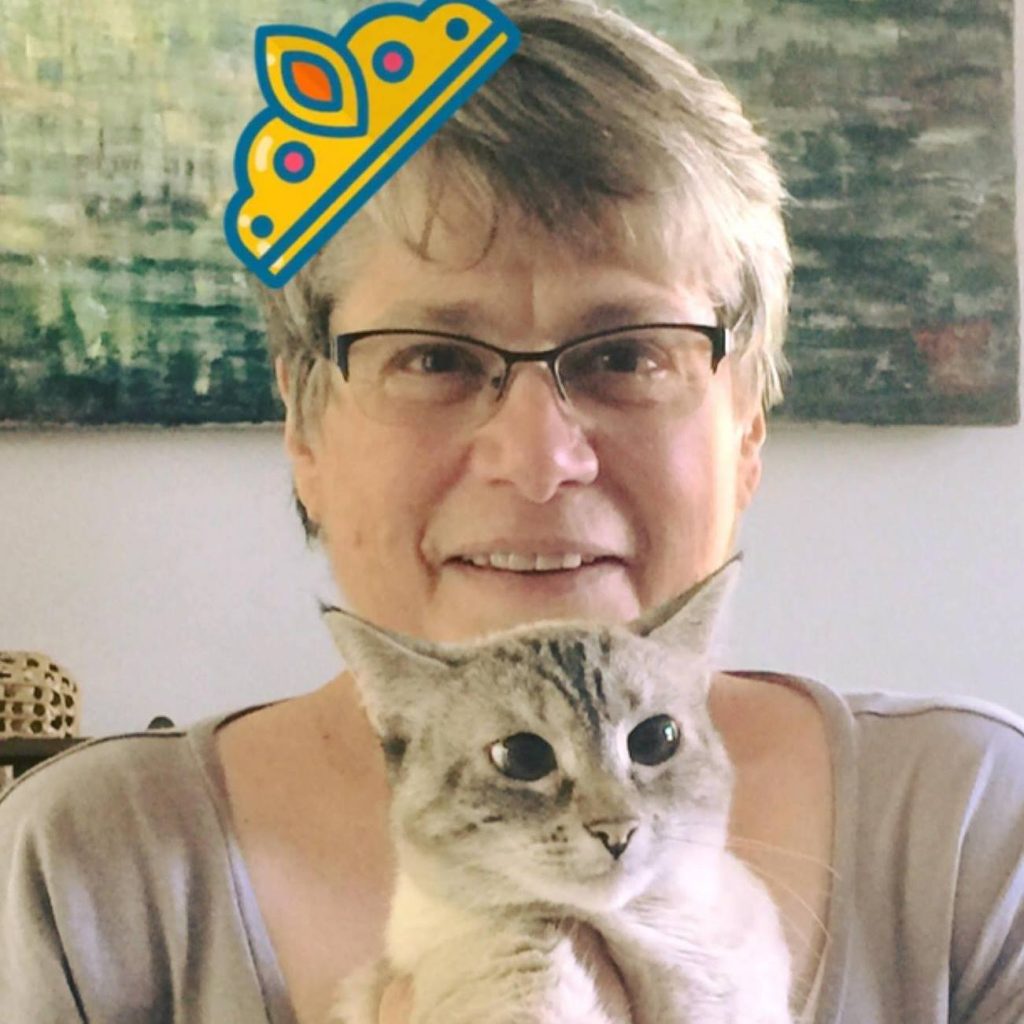
Nancy Billias has been practicing Shintaido since 1997. She holds the rank of Instructor. She was introduced to Shintaido by her brother Stephen Billias and his wife Bela Breslau. She was for many years a member of the board of Shintaido North East and has been on the Board of Shintaido of America for the past four years. She has just relocated to the UK and jointed the British Shintaido College. For many years she taught philosophy, mindfulness, meditation and Shintaido at the University of Saint Joseph in Connecticut. She has now retired to the Pilsdon at Malling Community in Kent, England, where she is planning to share Shintaido with the resident community.
Jane Muromoto Yung began her studies of Shintaido in the late 1970’s. Tenshingoso was her favorite movement. In this article, Jane shares her impressions following a ZOOM keiko with Ito Sensei.
Ten years before I started playing with Shintaido, the universe embraced me for a moment. This moment sprang up from darkness and deep despair I felt after the assassinations of Martin Luther King Jr. and Robert Kennedy in 1968.
That void revealed my connection to the universe. A non-human-centered existence…an existence with everything…not above or below anything. Anything. A harmonious continuum. An ever-present balance of opposites and possibilities. Playing with Shintaido was wonderfully wild, wacky, deeply profound. It evoked the universe’s essence: Timeless. Boundless. Wordless. Connectedness. Tenshingoso remains a revelation.
The five moves enjoin the soul of life and death in our own bodies, connected with a partner and connected to a community, whether playing under fluorescent lights or the open sky touching the depth of stillness with humility and gratitude, the trust in another who grasps my wrists or the collective exhaustion and supportive consciousness with others, Today, at 72, I am learning to play with tai chi. I am learning that playing with the universe is still wonderfully wild, wacky and hidden nowhere.
On 20 March HF Ito led a ZOOM session on the DaiKihon where he presented his distillations from 57 years of study since Tenshingoso was finalized in April 1965.
On 24 May, David Franklin and the team released his Shintaido of America podcast reading, episode 10, from Shintaido: The Body is a Message of the Universe describing the creation of Tenshingoso.
We are sharing these combined presentations for your reading, listening, and viewing pleasure. Please drop us a note in the “Comments” box at the end of the Body Dialogue Article. We would love to hear your impressions.
Pacific Shintaido 2022 Kangeiko: “Cultivating Compassion” Held January 15-16 via Zoom Director of Instruction: Shin Aoki Instructors: Shin Aoki and Ula Chambers Gasshuku Managers: Derk Richardson and Cheryl Williams Zoom Manager: Sarah Baker Communications: Brad Larson and Tereza Soldátová
PacShin set an ambitious and timely goal for its 2022 Kangeiko: “Cultivating Compassion”. As explained in opening remarks by event manager Derk Richardson, as we enter the third year of the global pandemic, societies are facing a crisis of “compassion fatigue”. Derk described compassion as “the willingness to bear witness and to be with — the quivering of the heart in response to — pain and suffering.”
Quoting Buddhist teacher Stephen Batchelor, Derk explained that compassion arises out of emptiness: “If we experience emptiness as being empty of any separate self, then we will naturally be compassionate and never put ourselves above others, because the true self is inclusive of all others.”
Derk observed, “So maybe cultivating compassion has to do with realizing emptiness — letting go of self-centered reactivity, bearing witness to the suffering of others, with loving kindness and a sense of equanimity.” He continued, “In Mahayana Buddhism the sword of compassion is used to cut through the illusion of separation of self and other, of this and that. And Shintaido, to me, is a wonderful vehicle for reaching that state of being empty of any separate self and therefore a way, through the body, to cultivate compassion.”
In further opening remarks, Shin Aoki, director of instruction and co-instructor, observed, “In difficult times such as this, it is particularly important that we keep respect and understanding for each other and practice simple acts of kindness. To me Shintaido is a rich source of learning-tools that help us cultivate compassion. We develop sensitivity to others and remind ourselves to keep our hearts open and communicate with sincere irimi, or stepping, into our partner’s heart. We hope that you’ll have a more open and bigger heart by the end of the workshop and keep building a better world, around you and inside you.”
Ula then set forth the objective: “In the coming keikos, Shin and I are going to take you on a journey, and the journey involves looking at where compassion can be found and how we can increase it, how we can cultivate and grow it, how to plant the seeds and make them grow up.”
With this agenda set, the three keiko that followed offered fresh approaches to adapting our Shintaido curriculum in innovative ways within the limitations of the Zoom medium. The approach seemed to achieve the desired affect: eliminating barriers between self and others.
Recordings of the keiko are available on the Shintaido of America Youtube channel, so there is no point in detailing every single thing that was taught. Instead, the following report will offer highlights and “takeaways” found in the teaching. If you find something in this description that piques your interest, you can go to the recorded source and go deeper.
Watch the Kangeiko videos on YouTube of Shintaido of America
Keiko 1
After Shin eased participants into practice with jumbi taiso, Ula shared a way to use Ten Position Meditation as a source for partner practice for giving and and receiving energy or the partner’s feeling. She matched bokyo-ii (“returning home” or “looking homeward”) with joshin-i (“purifying the heart/mind”) in a back-and-forth fashion with partner that allowed for giving and receiving. These movements flowed naturally enough into renki kumite, back and forth with a partner — first Ula and then a randomly selected partner in a breakout room. Partners applied palm to fist, as if they were really touching and feeling the cycle of energy given and received.
Shin carried the renki practice further, creatively with short sword and movements from the Jissen kumitachi curriculum, namely seichuken and jigoken. Ultimately we were piercing forward with seichuken, like tsuki, and receiving with jigoken, taking care to bring the receiving sword through the heart chakra area. Again the give and take of energy was felt as screen-to-screen partners stepped forward and backward, alternating between these two forms, first with Shin and then in breakout.
After the breakout period during which partners could choose to do Renki Kumite with “swords” or by fist and palms, Ula and Shin ended the keiko with wakame taiso, at one point suggesting that instead of imagining a partner pushing us we instead imagine the ground gently swaying beneath our feet, like a very gentle earthquake. This seemed an imaginative variation that would adapt well for solo practice, not just practice by Zoom. Finally, Ula led wakame taiso with her voice while “pushing” with her hand as the participants had their backs to their screens and imagined receiving from behind. Group wakame without an individual leader followed, as individuals moving together across continents and ocean.
Keiko 2
After another relaxing and warming jumbi taiso with Shin, Ula taught Tenshingoso as a way of feeling and exploring life’s journey, saying that we can find in our lives a place for kaihotai Tenshingoso or the yokitai style found in the Taimyo kata. She said that through the study of Taimyo kata we know that sometimes life’s journey requires us to change our mode to being more relaxed, gentle. The yokitai style of Tenshingoso allows us to find that mode anytime we might be tired or may be dealing with someone who needs a gentle approach. We then did Tenshingoso dai, and then a a softer, subtler, receptive Tenshingoso as in the Taimyo kata. Then she led us in a mirroring kumite and afterwards sent us into breakout rooms to explore the dynamics of mirroring Tenshingoso in pairs.
Next Ula started us down a path of variations on Aozora (Blue Sky) Taiso, which normally involves alternating “AH” and “OH” movements and voice. The variation involved fudodachi stepping backward and forward with the same leg, starting, AH (backward), EH (forward), then eventually also EE (backward), then OH (forward). The EH was a deep diagonal cut in front of the body. This pattern could be repeated with a deepening and engrossing rhythm that took over for itself as we explored our spaces at home. Shin then showed how this could be done using a stick or sword. He partnered with the viewer in something like a renki exchange using the weapon.
Ula finished the keiko by grounding us with a lovely series of movements based on traveling down into UN, heightening and deepening with each repetition, as we raised the starting place of UN from the lower chakra up the torso, to the forehead and finally above to Ten and returning to UN position.
Keiko 3
Shin’s warm ups featured self-care with massage and used AH and EH. His warmups for all three keiko offered a wealth of ideas for how to keep the classic jumbi taiso fresh, fun, and affective.
As the main keiko began, Ula continued the previous keiko’s stepping, backward from musubidachi into AH and forward with EH. A natural progression took the form of a one-step Eiko into fudodachi, backward with AH and forward with EH and then back again, repeating continuously, exploring the space in this fashion. This could be done with open, free hand or with short sword. Shin then demonstrated how the cut could be done farther and deeper into fudodachi or even hanmihandachi.
In preparation for the breakout-room kumite to follow, Shin offered a preparatory exercise for “cleansing the body” by hanging forward and stretching with both hands, palms down on the sword, then slowly stretching outward and up to Ten, then lowering the sword straight down through the heart chakra and downward toward the feet and all the way down to the starting point, hanging down in front. This was repeated as a cycle, and as the sword would pass through the chakras in its downward journey “making more space inside you so that it’s easier for you to be a recipient of compassion.” We were encouraged to continue to explore the space and move about our various rooms, stepping forward and back with fudodachi. A variation without sword was introduced, resembling receiving in kiriorshi kumite, imagining we had hold of the wrists of a partner who cut down and through the heart chakra and below — something we’ve missed over the past two years of isolated keiko.
Ula took over as our partner, doing kirioroshi kumite in preparation for breakout room kumite. She encouraged us to cut or receive into the heart, the solar plexus, and the ground root — the koshi: “Keep your voice going for your partner and reach inside their world if you are cutting. And accept your partner’s blessing if you are being cut.”
After the time for breakout-room kumite, Ula then led us in 5 minutes of shoko to deepen our process of opening while both sending and receiving: “… relaxing your shoulders but pushing out through your heart, solar plexus, koshi — all those channels that have been opened and filled with compassion [and] are now streaming out to the world ahead and to the future.”
After Shoko, Shin brought us back together, instructing us to open our arms in an imagined, all-encompassing circle. As our screens turned to “gallery view so that all could be seen in their own spaces, Shin urged us to “reach out arms to friends in a big circle across the ocean, extending your compassion to others and ourselves. Arms were then lowered and after a moment of quiet, “mokuso” was called.
During the closing ceremony, Derk commented on how successfully he felt Ula and Shin had “planted seeds of compassion we can cultivate in our practice through movement and contemplation.” He then read the poem “Keeping Quiet” by Pablo Neruda, which felt so eloquent and germane, perhaps because we were so open and ready to receive its wisdom:
“Keeping Quiet” by Pablo Neruda Now we will count to twelve and we will all keep still for once on the face of the earth, let’s not speak in any language; let’s stop for a second, and not move our arms so much.
It would be an exotic moment without rush, without engines; we would all be together in a sudden strangeness.
Fishermen in the cold sea would not harm whales and the man gathering salt would look at his hurt hands.
Those who prepare green wars, wars with gas, wars with fire, victories with no survivors, would put on clean clothes and walk about with their brothers in the shade, doing nothing.
What I want should not be confused with total inactivity. Life is what it is about; I want no truck with death.
If we were not so single-minded about keeping our lives moving, and for once could do nothing, perhaps a huge silence might interrupt this sadness of never understanding ourselves and of threatening ourselves with death. Perhaps the earth can teach us as when everything seems dead and later proves to be alive.
Now I’ll count up to twelve and you keep quiet and I will go.
Reflections
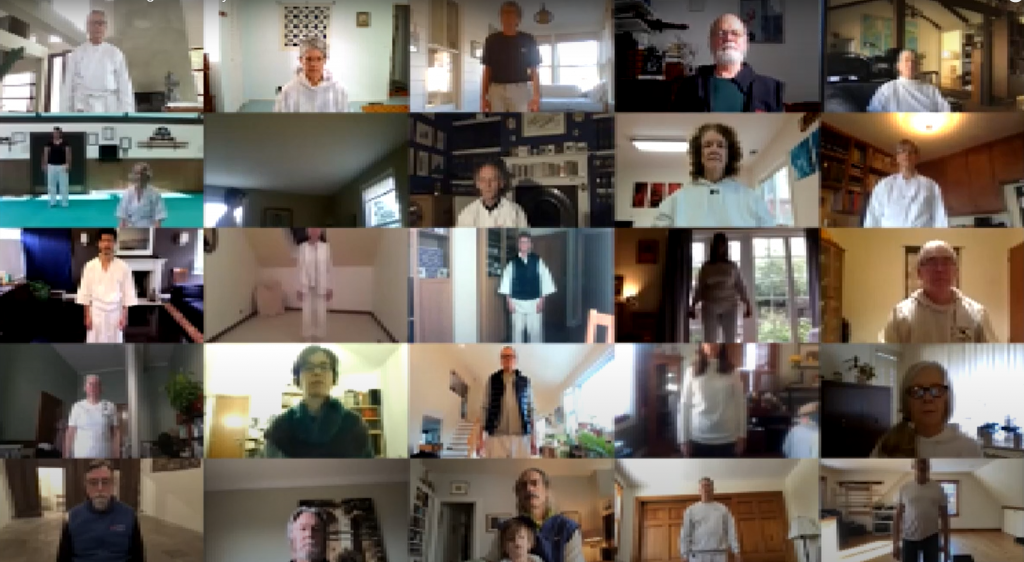
It was clear by the end of this gasshuku that two years of constraints and difficulties of adapting our keiko to the Zoom platform, along with all the trial and error and improvisation that came with it, have resulted in new and effective developments in goreijutsu. Even though remote web-linked keiko cannot satisfy our needs completely, this gasshuku successfully brought its participants closer for a shared experience that was emotionally and technically rich, satisfying and remarkably deep.
One effect of having the expression of keiko constrained in this fashion is that we must be creative to come up with ways to make it work. In doing so, we find the novel choices and the required innovations lead us to look at relatively unexplored elements of our practice, and in new ways that can expand our thoughts of what keiko is, and maybe even what Shintaido is.
Ito Sensei sometimes talks to us about “image training”, which is a way of practicing by imagining yourself performing a kata or even a kumite. One simply sits or lies still and performs the movements in one’s mind. Another way is to do kumite with an imaginary partner, sort of like “shadow boxing”. These are particularly effective techniques for those of us who do not have keiko partners living nearby. It is an essential practice for senior practitioners who might have difficulty finding partners with whom to practice advanced techniques for kumite. Online events such as this gasshuku offer powerful ideas of how to use the imagination to practice alone and further develop our keiko in the absence of our friends and colleagues. Perhaps the greatest benefit of web-linked keiko will be the strengthening and enlistment of our imaginations in our practice.
In this gasshuku in particular we were shown how to enlist our imaginations to cultivate our ability to relate to others — to maintain and cultivate our capacity for empathy. In other words, to embody, exercise, and strengthen the “Hitobito-Ware” (self-other) axis that crosses our vertical Ten-Chi-Jin (Heaven-Earth-Human) axis and which together form the paradigm of our Shintaido world-view: Ten-Chi-Jin/Hitobito-Ware. Would we have imagined three years ago that this was possible without being physically together? Probably not, as we would not have imagined the necessity.
By necessity we not only imagine it, we do it. The particular creative solutions are new, but there is nothing new to being forced to make adjustments in the face of change. Whenever a mode of expression confronts a structural limitation, the expression, by necessity, must find its way through or around. The new path leads to discovery and even new variations in the expression.
Finding new modes for expression in the face of constraint has always been part of creative expression, including verbal communication, all the arts, and of course our keiko. Embracing this phenomenon can give us heart when we sadly cannot physically be together. As we cultivate our Zoom practice, as so successfully demonstrated at the PacShin Kangeiko, we may find new ways to sustain our practice and to grow with each other despite the limitations. And we may grow not just in the ways that are familiar, but in something else, something new, even something more than we once could have imagined.
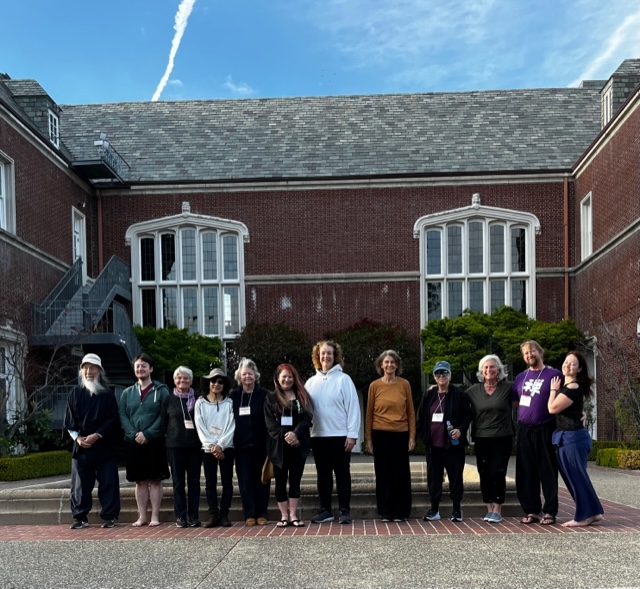
I was extremely fortunate to teach Shintaido exercises during the week-long calligraphy course presented by Zenbrush at the Mercy Center in Burlingame, CA from March 8th through March 12th. Fifteen people, along with Sensei Kaz Tanahashi participated in late afternoon Shintaido exercises to relax and rejuvenate after their daily classes.
Kazuaki Tanahashi, born in Japan in 1933 and active in the United States since 1977, is an artist, writer and peace and environmental worker. As a painter and calligrapher, he has been pioneering the genre of one-stroke painting. He has produced over forty books in English and Japanese. As a peace activist he has worked against nuclear arms race and is the founding director of A World Without Armies. At age thirteen, he studied in at an underground, post world-war II class of martial arts. The teacher was Morihei Ueshiba, the founder of Aikido (read more at brushmind.net).
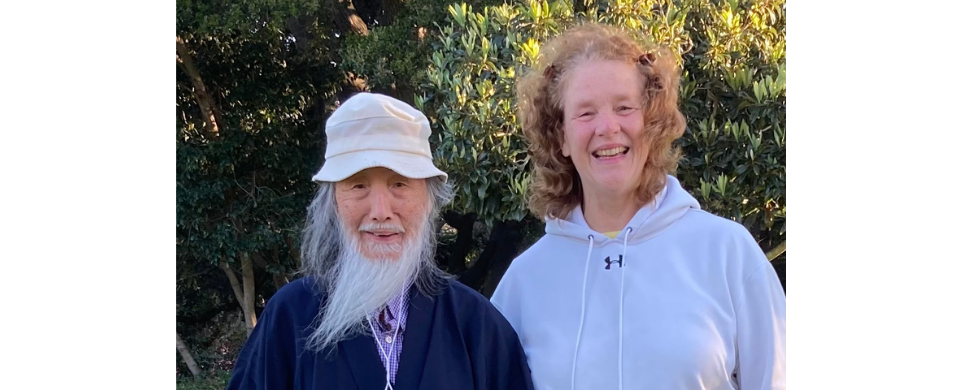
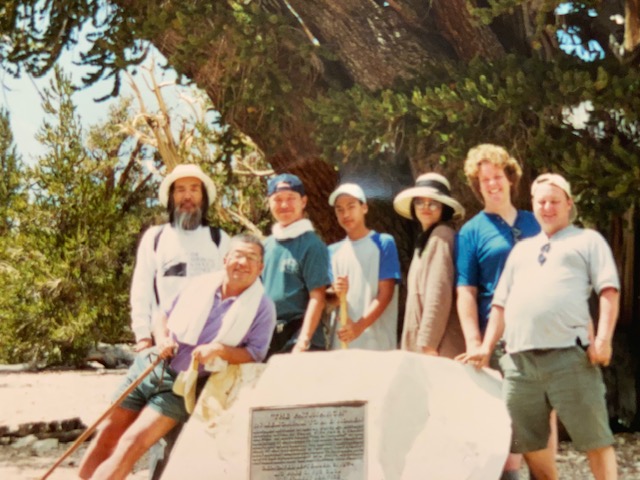
A long-term friendship between Sensei’s Ito and Tanahashi paved the way for me to be asked to teach on this occasion. Here is a photo from 2003 when Shintaido and Brushwork collaborated during a weekend workshop. In 2000, Mike Sheets and I joined the Sensei’s and friends for a trip to Bristlecone pines.
The spring 1996 issue of Body Dialogue describes a collaboration in June 1995 when Shintaido and the American School of Japanese Arts celebrated the 50th anniversary of the UN at the SF Civic Center Plaza. The world’s largest brush-drawn circle was created by Tanahashi Sensei while Ito Sensei and a number of students performed Shintaido movements (shintaido.org).
The Mercy Center is forty wooded acres in Burlingame CA near the SF Airport. After each day of calligraphy classes, I taught kenko taiso to focus on joint articulation, especially focusing on the shoulder, elbows, wrists, and hands. Using the idea of the calligraphy brush (and inspired by teaching from artist/Shintaido teacher Charles Burns), I taught Azoro Taiso to ‘paint the sky.’ Gradually the class grew more confident to add their voices to this movement. To close, we did Taimyo Part III, allowing ourselves to connect with each other, nature, and the universe. The retreat center’s beauty of nature supported so everyone connected more deeply. My hope was for everyone to find themselves rejuvenated and more creative.
What are some steps to effective collaboration?
First: what organizations do you know that might want to include Shintaido exercises? As a starting place, working with people you know can be easier to build connections. For example, at a senior center or senior living community where you have family members. Lee Ordeman is an example of this in Maryland. Or a spiritual group that you attend, such as Lee Seaman does with her church in Washington State.
Perhaps you are able to include Shintaido into school or college curriculum. Gianni Rossi does this in Italy and is now working with the music teacher to add Shintaido exercises. One advantage to collaboration is you will have an organization who are finding people to attend. With a good match, there are common purposes and interest, so the participants are more likely to be excited and curious about Shintaido.
Second: is there a good match of needs? Is the need for exercise for relaxation and to reduce anxiety? Or for joint health? Or is the need to help prevent falls? Is the need for community connection and fostering overall health? Or is the need to provide a club within an organization?
The range can be from a specific need for a set of exercises to providing ongoing classes. Some places are the Boys and Girls clubs, the YMCA, community colleges, and senior centers. Shintaido was taught at Harvard during the times Michael Thompson and David Franklin were teaching. Nancy Billias currently does this through her teaching of ethics and philosophy.
Third, keep expectations modest. Some people might be interested in ongoing study and others might not. Some may share the name of Shintaido to others.
I appreciate the opportunity to collaborate and hope that others find ways to share Shintaido within their communities.