Reflections on Shintaido

Reflections on Shintaido

by Tom Abbott

I started my Shintaido practice in 1975 in San Francisco. I studied Shintaido under Master Ito and Michael Thompson for 5 years, then taught it for 10 years in Massachusetts. For the past 30 years, I have done Shintaido for and by myself. Shintaido is in my body, and I find joy in expressing it. Shintaido has made me a better person in life, in my relationships, my work, my tennis and my sailing. I am open and empathic toward others, can focus, learn and adapt to change and take risks due to my Shintado experience. After all these years, it is still animating my life.

Today, my Shintaido practice is about opening, stretching and quietly expressing my energy and imagination. I find power spots where I can let Shintaido open the world around me. My practice starts by stretching and warming-up slowly with soft and steady progressions of stretching and squats. Nature is my Shintaido partner.

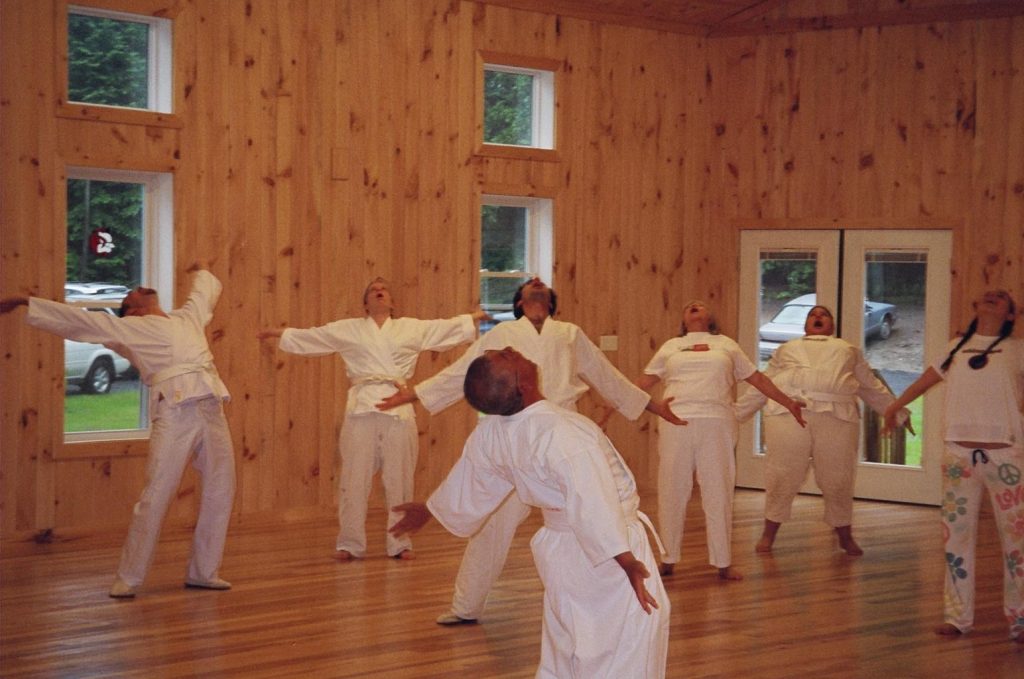
What I do is based on Tenshingoso, the essence of which is the simplicity of the five forms. As we all know, Tenshingoso can be done alone, sitting or standing, with a partner, in a group, or with nature. The 5 movements are a distillation of karate movements, with an overlay of 5 universal vowel sounds. The initial “Ah” is unique to Shintaido. Each movement starts with a sound and the result is a powerful and almost infinite sequence of movements, sounds and variations. Studying these movements lead to deep insight into one’s physical and spiritual development.

Using my imagination, I practice with elements of nature, such as trees or wind in a fluid, dynamic kata. I have developed three main katas for my practice. I often start with a compass-kata, just simple Ah-A, where I cut into the furthest and tallest tree in the distance, then move to the right 10 degrees, and cut again, until I complete a 360 degree embrace of the world around me. I extend my energy and touch the world around me. If I feel a connection with a tree, I do tree-kata, where the tree is my partner. I follow the flow of the trunk, the branches. I start with Ah and then relax and open wide into an Oh, feeling the shape of the canopy of trunks, branches, and leaves, then move into A, cutting down through the trunk, and continue into E, feeling the roots, then oh, to embrace the whole tree. If it is windy , I do a wind-kata. I let the wind talk to me, and it becomes my partner. I turn toward the wind and embrace it with an open Ah, and then I cut with A into the wind with my arms as swords, vertically, diagonally and horizontally. At this point, I have moved beyond form, I just let my body flow into a feeling and go with it. For example, I might open up with an E and that flows into an A. I also study sequences such as E-A, and Ah-E.

I also have an active meditation based on a combination of breathing exercises and mantras. My breathing is the basic technique of a long exhale, quick inhale, and pause for a random number of seconds, letting the rib muscles relax and allowing my lungs to settle down into the diaphragm. I pause here, and then breath out slowly to a count of 10. This process of Inhale-Hold-Exhale process is repeated over and over. centers and calms my mind. I do it at any time of day, as needed. During the day, when I am under great stress, I will make a gentle humming sound. In the afternoon, under the guise of taking a nap, I meditate for about 45 minutes, getting to deep relaxed state for about 10 minutes, and then I am refreshed. And at night, I do it to fall asleep. I find some combination of Japanese sounds, such as Ah-A-E-O-Um, counting in Japanese, or the Zen mantra, nam meoto renge kyo, will always calm my mind. Sometimes while falling asleep, I will feel Ah, and my body will relax, or I hold one sound, like E for an extended period of time, until I forget and fall asleep.

Ito was my instructor in San Francisco starting in 1975, assisted by Michael Thompson. I respected Ito as my Sensei and learned a great deal from him about Zen, Japanese culture, and martial arts in general. Friends of mine, including Jim Sterling, Pamela Olton and Steven Pizzella, started practicing with Ito, and eventually I joined them. Richard Rappaport and Bela Breslau started to practice along with many others. Over the years, we had a moderate group of about 50 serious students.

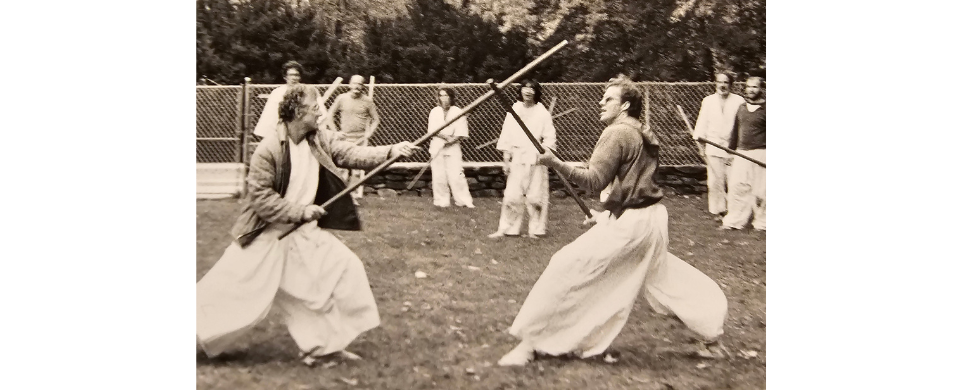
Ito used to say, the body needs to warm-up before it is ready to do Shintaido. We had 3 dojos, a small dance studio on Clement Street, a big open room at the American Can Factory, and a baseball field in Golden Gate Park, near 7th Ave. Ito developed a distinct practice for each dojo. A typical Friday night class with Ito started with pure karate, stretching, hoping, jumping, and various kata. Once our body had burned-off excess energy, our egos had relaxed, and spirits opened-up, we were ready for Shintaido, starting with Tenshingoso, at first standing individually, and then, sitting in kumite with partners. Then, we would progress into standing Tenshingoso partner kumite, cutting and rolling. It was timeless. After most classes, we would find a place to eat on Clement Street, or sometimes, Ito would cook a Japanese stew for everyone.
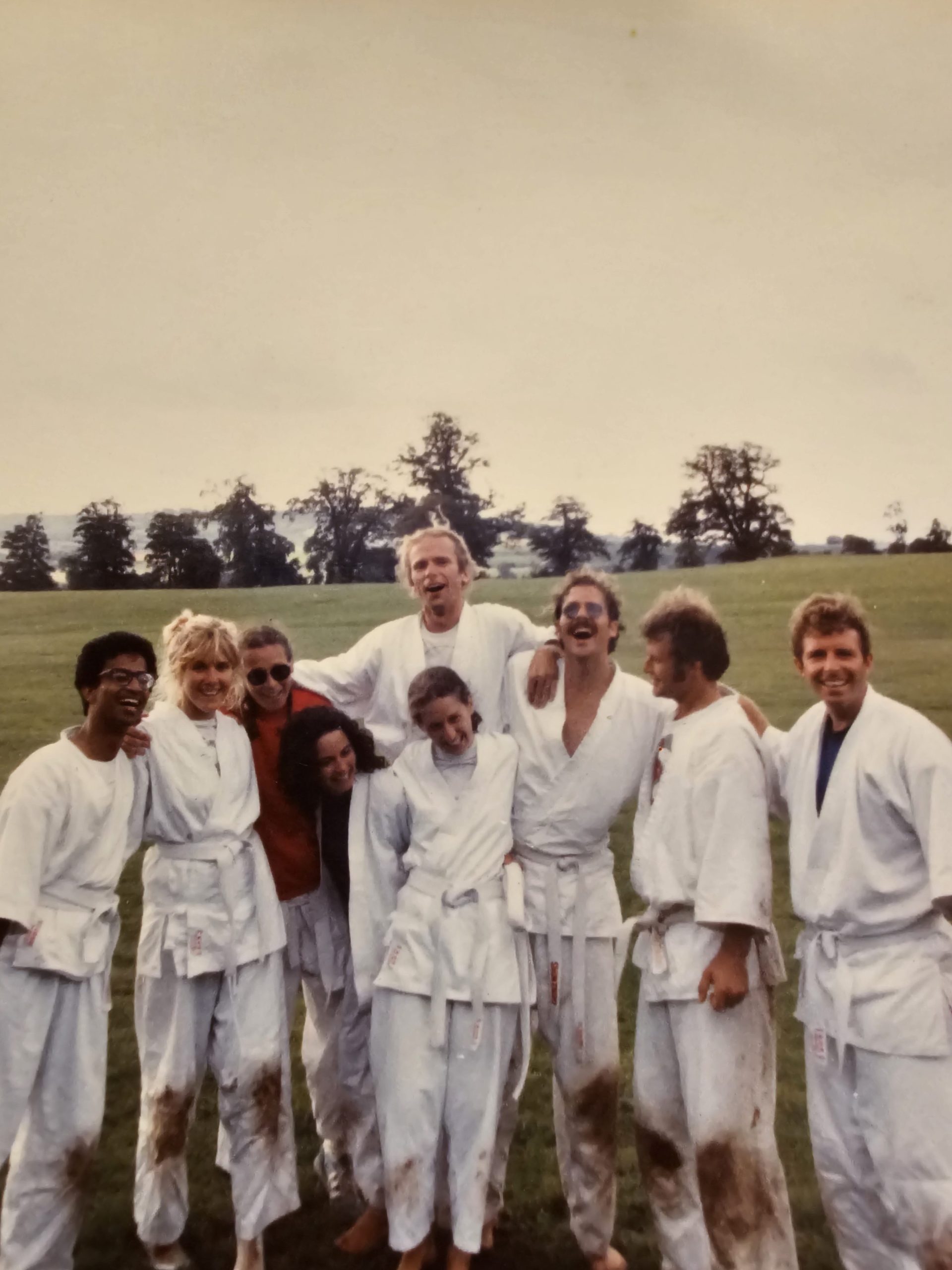
I moved back to Massachusetts in 1980 with my wife, Adrienne, who also did Shintaido. I had graduated from SF State with a degree in Sociology, and we wanted to start a new life together grounded in nature. Adrienne aspired to become a full-time potter with a studio, wheel and kiln. I got a job in Worcester, Mass., and we bought a house in Holden with 20 acres at the end of a dirt road. I approached the local, Greendale YMCA about teaching a new martial art, and they said yes, and offered me an underutilized studio, twice a week. This became my dojo for 10 years. At the peak, I had 25 active students. I loved every minute of it.

Serious students emerged, such as Joe and Deb Zawielski, Kesh and Annelie Narayanan, along with Bill Burtis and Michelle. Eventually we moved classes outside in summer months to practice on a large field, next to a lake outside the Y, where we could do Eiko-dai. We did occasional weekend retreats, where Ito or Michael would teach. I taught seminars on Shiatsu for Couples to raise money so I could travel to gasshukus in England and France. It was a dynamic time of my life. Eventually, one of my students found an apartment in Cambridge for Michael, and he moved east, and started teaching at Harvard, and doing weekend seminars.

Shintaido is a tool to release a powerful, creative and imaginative energy, but as a Shintaido Instructor, it was a challenge to explain it. I would compare it to other practices that people knew about. For instance, Shintaido is a blend of Karate, Tai Chi, Aikido, Yoga and Sword. I would explain the connections, that karate has katas, TaiChi the soft hand, and Aikido the dynamic partner kumite. I would say, Shintaido is a dynamic, moving yoga. Shintaido is based on sword practice, but without the sword. Shintaido uses the wooden sword and a long wooden stick, because real, metal swords are too dangerous. Shintaido used an open hand, and the arm becomes a sword. The open hand is stronger than a closed fist.

Shintaido evolved out of Shotokai Karate, into a practice that was beyond fighting, but still grounded in karate warm-up techniques and kata. It is not really a martial art any more. Tenshingoso kumite with partners is based on cooperation rather than competition. Taking a partner’s wrists to follow their lead enables a leader and follower relationship, that can be reversed, and become very dynamic. As a sword-based practice, students stretch their arms out as if they were a sword, with open hands the blade, and extend energy out to cut into our partner’s bodies, feeling for their center. We cut without effort, and without ego. The follower allows themselves to be cut, to be vulnerable, letting go of resistance, fear and insecurities.

I believe that Shintaido leads to deep insight into the body. The student learns that the body is stronger than the mind. Shintaido opens the body by releasing the grip of the unhealthy ego, and has the potential to burn away the trauma, drama and pain of being human.

I loved teaching Shintaido but there came a point after 10 years, where I had to stop teaching. I needed surgery on both knees to clean-up torn cartilage. It was hard to stop teaching Shintaido, but I was ready to make Shintaido mine, to bring it into my body directly, to become my own student. I lived on the edge of an open space, and I would run in the woods and cut the trees with a stick. I was mad at Shintaido for ruining my knees, but eventually came to accept that they were my knees, and I got good use of them doing Shintaido. I now understand that knee problems are common across all martial arts. I recovered enough to resume being a healthy and active person, playing tennis and sailing.
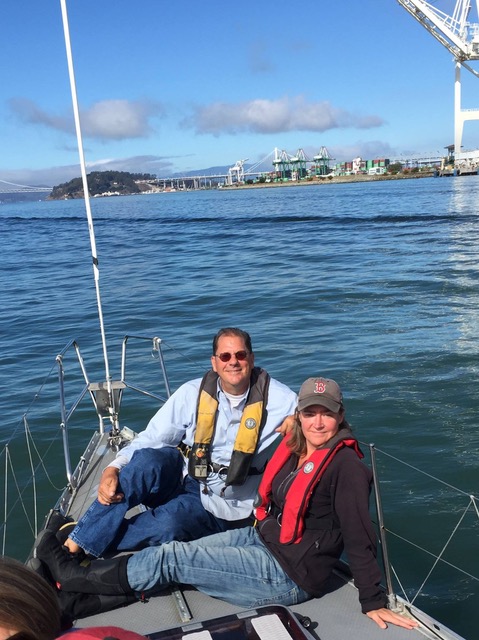
Eventually, in 1992, Adrienne and I decided to move back to California and I pursued a new career in technology in Silicon Valley. I joined a Men’s 4.0 Doubles Tennis Team and loved competing in doubles. And I started to learn to sail with my father.

Adrienne passed away in 2014, after losing her battle with early-onset of Alzheimer’s. I retired shortly thereafter and sailed more than 12,000 miles, to Hawaii three times and to Tahiti. I am now living in Alameda, and working as a sailing instructor. I still do Shintaido every day. I had knee replacement surgery in July, and my Shintaido practice has been the key to my recovery.

This article is a result of thinking about what Shintaido means to me. I moved beyond Shintaido, but Shintaido still flows out of me. My life has been informed and enhanced by Shintaido. It is my private practice and my secret weapon in life. Even though my body is now 70+ years old and I can’t run any more, I feel it…

I feel ready to re-connect with the larger Shintaido community again.
Celebration of Life for HF Ito via ZOOM

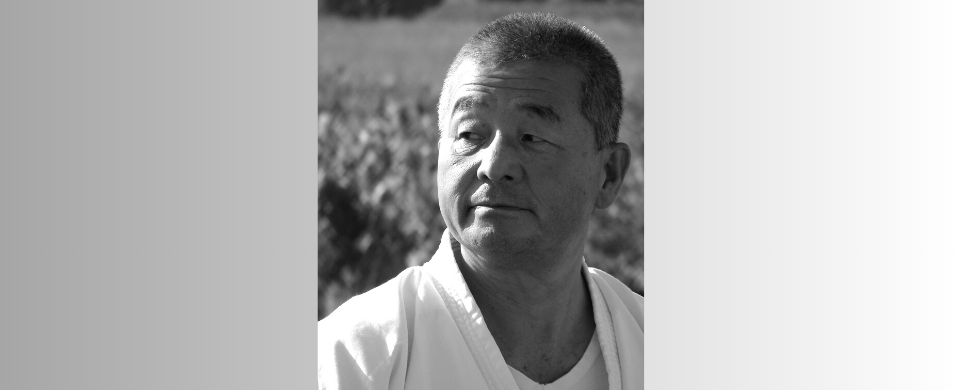
As many are aware, HF Ito died on 30 December 2023, peacefully at home with his wife Nicole at his bedside.

The funeral was held on 10 January in France.

We are aware the community of people who studied with Ito Sensei is extensive, so we are offering a ZOOM Celebration of Life on 4 February 2024.

Times: 9am West Coast USA; 12noon USA, 5pm UK, 6pm Europe; and for Japan – Monday, 5 Feb at 2am.

ZOOM link is here:

https://us06web.zoom.us/j/83763251916?pwd=aYaeFjC0wvT9STry4VpxwjoXOQ2afw.1

Meeting ID: 837 6325 1916
Passcode: 237172


H.F. Ito Obituary

H.F. Ito Obituary

With great sadness, we announce that H.F. Ito died peacefully at home in Cuy, France on Dec 30, 2023. He was born in Hiroshima, Japan on May 23, 1942. He is survived by his wife, Nicole Beauvois, his sister Hiroko and his brother Yoshitaka Ito.

*Haruyoshi Fugaku Ito was born in Hiroshima, Japan in 1942. He attended Chuo University in Tokyo, and in 1965 graduated with a degree in law. At age 18, while at university, he began training in Shotokai Karate with Shigeru Egami, and at 21, after less than four years of practice, he was awarded the top Shotokai rank of 5th Dan.

He collaborated closely with Hiroyuki Aoki throughout the early 1960s, researching methodologies for creating a sogo budo (“comprehensive martial art”). In 1965, H.F. Ito was one of the founding members of the Rakutenkai group in Japan. In 1971, he founded the Sogobudo Renmei, which became the Shintaido Kyokai.

In 1975, Ito moved to San Francisco and developed what was eventually to become Shintaido of America. He has been Shintaido’s most energetic itinerant teacher, travelling the globe in his tireless quest to spread Shintaido on the world stage. In 2006 he suffered a severe stroke and was hospitalized in the SF Bay Area. He surprised hospital staff, with the speed of his recovery, and was soon instructing them on the best ways to rehabilitate him.

After his recovery, he continued to travel the world to fulfil his busy teaching schedule. He led seminars in Shintaido, Life Exercise, Amma massage, Wu style Tai Chi, in France, the United Kingdom, the U.S., Japan, Canada, Switzerland, Germany and Romania.

In 2001 he founded the Taimyo Network for World Peace, which he regarded as one of his most significant achievements.

An update since the writing of Ito Gaiden: the Taimyo Network for World Peace (now called The Global Taimyo Community – GTC) formed after September 11, 2001 as a peaceful and compassionate response to the violence of 9/11 and subsequent retaliatory invasion of Iraq. As we practice, we see ourselves standing around the globe holding hands in a protective embrace.

GTC believes that Taimyo Kata can function as a movement through which we can search and/or heal our inner world as well create better relationships with our neighbors, community, and Nature — beyond time and space.

Join the community in sharing tributes for HF Ito at: Tribute to Haruyoshi Ito, 1942 – 2023 (muchloved.com)

A memorial fund has been established for Ito on the Shintaido of America website. To donate using Credit, Debt, or PayPal please go to the Shintaido of America web store and choose “Donations“.

*Excerpt from Ito Gaiden – compiled and edited by Andrew Stones


Links

Tribute page to Haruyoshi Fugaku Ito
https://ito.muchloved.com/

Memorial fund for HF Ito
http://www.shintaido.org/store/

Kenjutsu study in France

Kenjutsu study in France

by Connie Borden

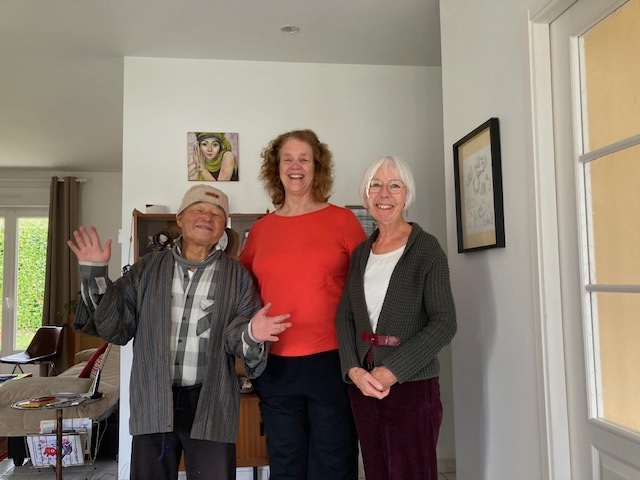
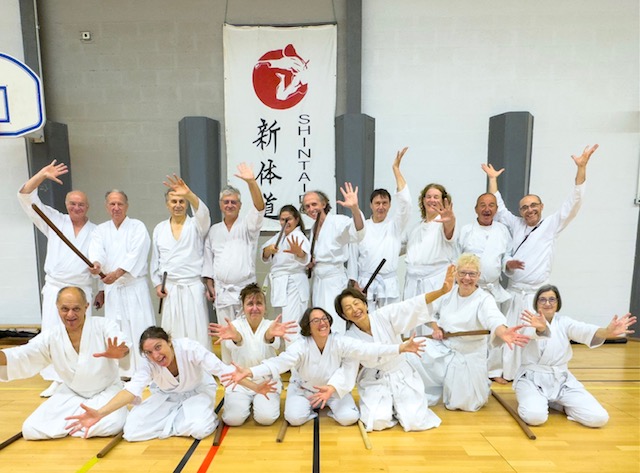
I travelled to France in early November 2023. HF Ito and Nicole Beauvois me for the first 5 days to enjoy their new house in Cuy France. The second half of the trip was to Limoges France to study Kenjutsu with Shintaido General Instructors and Yondan Kenjutsu Instructors Pierre Quettier and Mieko Hirano.

Cuy France is 90 minutes from Paris and near Sens and Troyes. We explored the Farmers Market in Sens and visited the majestic Cathedral. One day was spent exploring the historical section of Troyes France to see the architecture and have a splendid lunch at a French restaurant. I was fortunate to have a private lesson with Ito Sensei on Kenjutsu. Thursday afternoon, we did a Taimyo Keiko in honor of Brad Larson who recently unexpectedly died. Brad was a SOA Instructor and SOA Board Treasurer. The visit concluded with a dinner with friends of Nicole and Ito. 

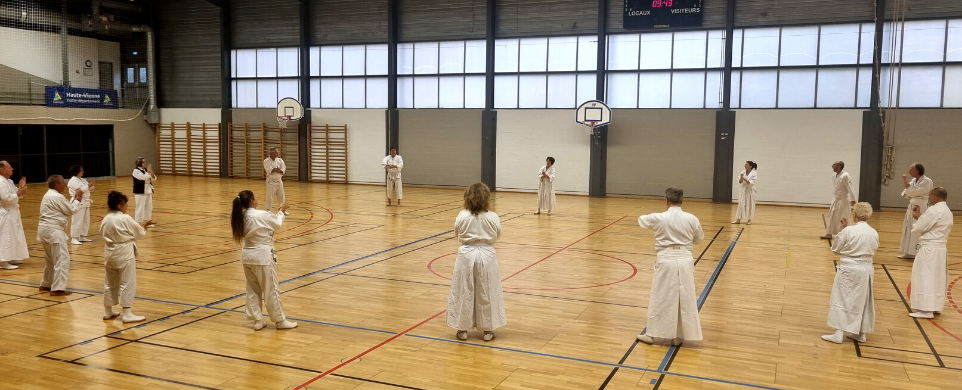
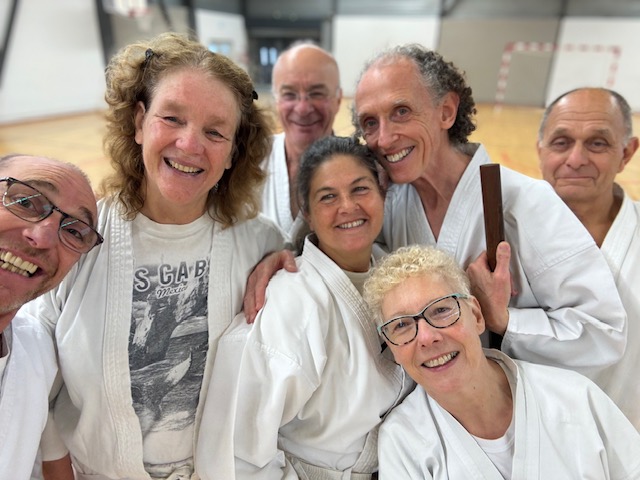
Limoges France, about 4 hours from Paris, was the site for the Kenjutsu workshop. During the past 2021 and 2022 workshops, they explored Shoden no kata and Chuden no kata. This year, our study was Okuden no kata, the third in the trilogy. Eighteen people attended this workshop. Pierre and Mieko hoped for attendees to “cultivate their garden of practice with complete peace of mind.” Practicing in person after time apart allowed us to do Kumitachi with a variety of partners while also sharing a little of the Shintaido “breath of eternity”, as Pierre stated.

This year, in order to optimize the practice time on site, they offered preparation beforehand. I met with Pierre and Mieko by ZOOM to review my study of Kenjutsu. As a result, my homework for the 5 weeks before the workshop was to learn and study Goho Batto-ho, the 5 drawing techniques. I thank Robert Gaston and Sarah Baker for their time and guidance during these 5 weeks. Ito Sensei during my private lesson gave many instructions to refine my techniques with the focus to “keep your blade active”. 

Pierre presented a website to support our personal practices and serve as support for the goreï of Kenjutsu teachers. Pierre offers this website as a resource: Shintaido Kenjutsu Cyberdojo.

The workshop started Friday November 10th with a collegial keiko and meal. During our practice we studied Goho Batto-ho, known as 5 drawing techniques either with Bokken or Shin Ken. Saturday, November 11 there were two keiko. We divided into 3 groups based on level of practice. Mieko Hirano instructed Group A on Chuden no Kata and the first two Jissen Kumitachi. Alain Chevet assisted Pierre in teaching Group B and Pierre guided the practice Group C. We systematically studied the movements of Okuden no kata, often doing kumitachi applications of the movements. The repeated practice brought the kata alive to give a glimmer of it’s meaning. We then set a goal to study #1 to #11 of the Jissen Kumitachi, however for most of us we achieved practicing the first five kumitachi. 

In the evening we met to discuss the Kenjutsu curriculum. Pierre distributed his comprehensive documents on the Hagakure – the Trilogy of three kata (Shoden no kata, Chuden no kata, and Okuden no kata). We discussed teaching Kenjutsu, especially to the new students. The group of 18 people included Ula Chambers and Charles Burns from the UK, me from North America and students from across France. Many report the advantage of teaching Kenjutsu to reach new audiences. 

Sunday, November 12 was keiko 3. We continued with Jissen Kumitachi, now attempting to review #12 to #22!  The last part of our morning, we combined into one group so all could practice Dotoh and Ryuhi Kumitachi. Pierre led our group to demonstrate Okuden no Kata to Mieko’s group, then the full group did Shoden no kata and Chuden no kata multiple times to bring our movements and breath into synchrony.  After a meal, and the typical Shintaido goodbyes of hugs and kisses, we departed around 2 p.m.

I am grateful to Pierre, Mieko and Alain for their teaching and dedication to Shintaido Kenjutsu. I enjoyed the opportunity for kumitachi or partner practice in this focused workshop. While the workshop was located in France, our Shintaido study is the same art. The facility in Limoges provided comfortable lodging along with excellent French cuisine.

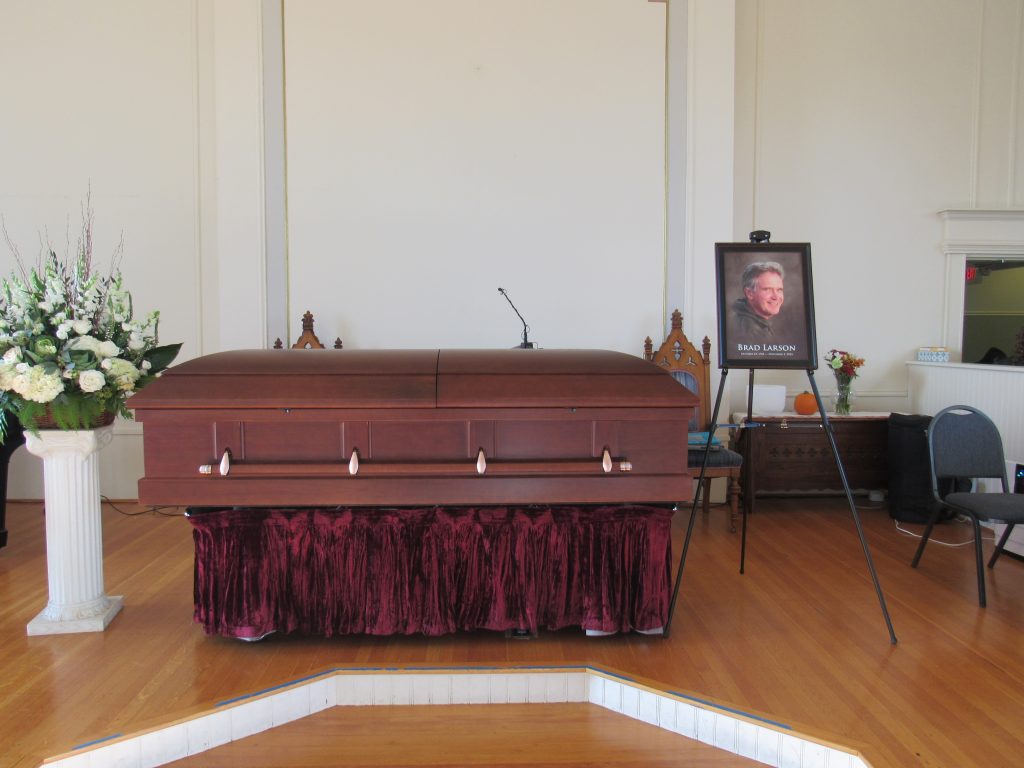
Brad Larson’s memorial service

Brad Larson’s memorial service

By Rob Kedoin
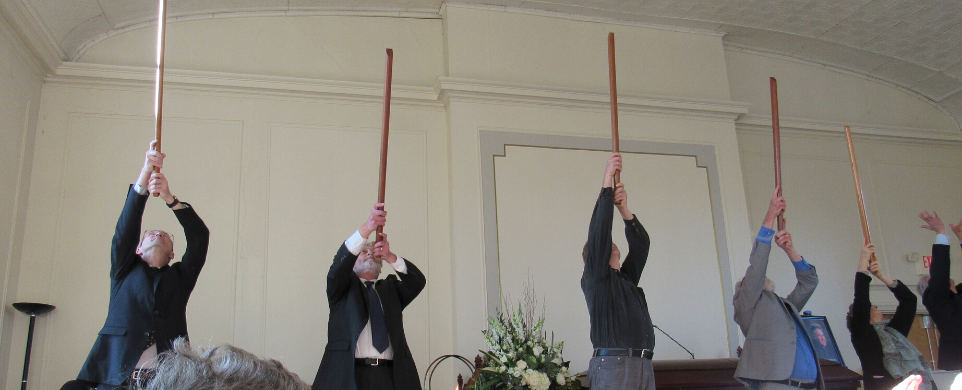
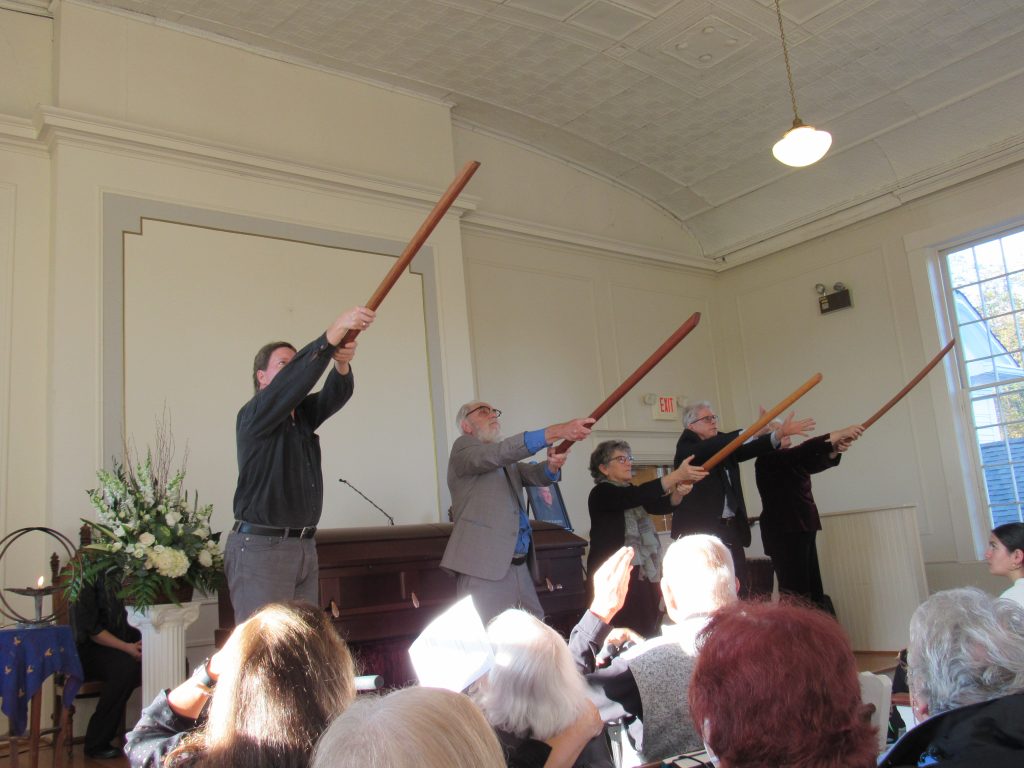
On Sunday, November 12th, Shintaido members gathered at the Unitarian Church of Sharon for Brad Larson’s memorial service. The church was filled with so many people that some watched the service from an overflow location in the building. The service was beautiful. Rev. Jolie Olivetti spent time talking about Brad’s family as well as his many interests in Shintaido, Biodanza and drum circles. There was a period of sharing where people could tell stories of Brad. These stories ranged from his omnipresent smile to his involvement in the church, the Historical Society and his many contributions to the world of interactive storytelling in museums.

From a personal perspective, Gail and I began the day by hiking in the nearby Moose Hill Wildlife Sanctuary. I know how Brad loved to run with his boh or joh through the woods and while I have no idea if he ever ran the trails of Moose Hill, it helped me to envision being on trails he once traveled.

Toward the beginning of the service, the reverend relayed a message from Brad’s mother which affected me deeply, that, “Brad would be the first one to forgive.” I needed to be reminded about this because I had felt myself growing angrier and angrier about Brad’s death.

Matt Shorten spoke about Brad and Shintaido, then led us in Tenso and Shoko as we stood at the front of the church. David Curry then invited the attendees to join us in open handed Tenso and Shoko. Facing a church full of people, palms outstretched in Shoko, all sharing their love for Brad was awe inspiring.

For myself, I will always miss doing the standing back stretch with Brad. I always felt like I was being lifted like a rag doll and being stretched by a kind, gentle giant.

Brad once spoke to his church’s congregation about a three-rock meditation he learned from Thich Nhat Hahn. Since the congregation thought it fitting to send us away with packets of three rocks and the meditation directions, it seems like a good way to close. Hold each stone consecutively in hand:

Stone 1: Breathing in, I see myself as a flower; breathing out I feel fresh
Stone 2: Breathing in, I see myself as a mountain; breathing out I feel strong
Stone 3: Breathing in, I see myself as still water; breathing out I reflect things as they are