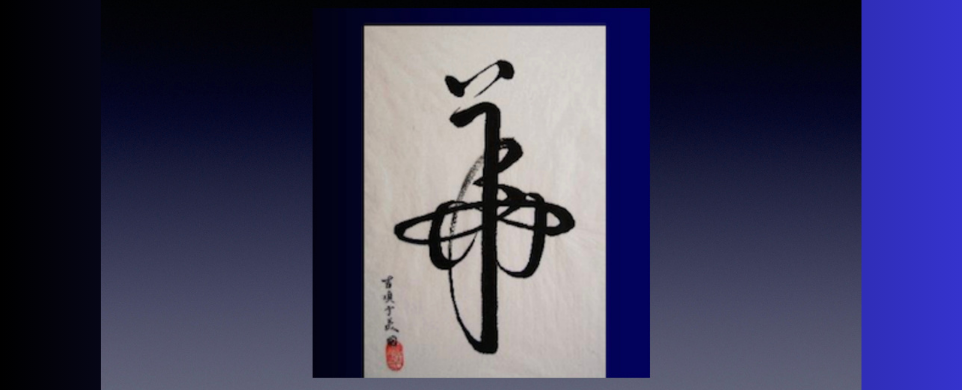
One day this spring, I was wandering around the desktop of my Mac, clearing out old files, trashing grade documents from classes I will never teach again. But the mouse arrow kept skating over a pile of “screen shots.” As I was pulled into the pile, a wonderful image popped up of a celestial Chinese calligraphy or brush stroke painting that I kept from ten years before, when I attended a neurology class in our Doctoral program at ACTCM.
What I remembered more was a companion handout which included a smaller black and white version from a PowerPoint slide labeled “MOTOR EXAM” with the six basic beginning steps of learning to do a neuro exam. I was deeply interested in the medical subject and all of Dr. Hao’s years of experience and skill using scalp needles to improve many difficult cases.
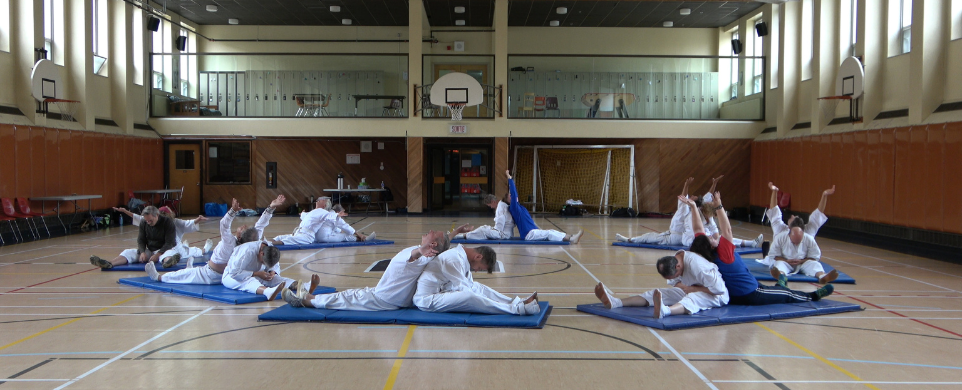
But alone, the beauty of the painting was stunning, especially since I was back on Sundays enjoying Taimyo, on Zoom. Each hour of these classes has reminded me of the richness of Shintaido and has helped my (nearly) 75-year-old body wake up and reengage in the movements, the company and the more ethereal stuff: Qi, composure, and the “oneness with nature and the group.”
I got a wake-up call, and continue to feel this each week, about how much lack of balance has become part of my being. I have been going through medical treatments since last fall that may continue for the rest of my life. I have been diagnosed with Hemochromatosis, too much iron in my blood and organs, something that goes undiagnosed often until we are too old to do anything about it. But that aside, my body is giving me new lessons and Shintaido is a great ally helping me to stop at least some of my dizzy spells.
I enjoyed reading Sally Gaston’s article about her relationship to Shintaido over the years. I wish I had been that young when beginning to train in Shintaido. But what I thought about those younger days, is that even at 25 when I began Shintaido, I didn’t need to think about balance. In fact, when I was a small child in Long Island, we ran up and down hills, high bluffs of sand and rocky piles at the waterfronts where with or with our shoes we would chase each other on wet rocks and never fall down.
At first, my relationship with Shintaido was to build up muscle and strength without competition as in other “sports” as well as learning to be still, quiet and willing to learn a new world of culture, community, trust and inner strength: that was the real new deal.
The balance I see in Dr. Hao’s painting is meticulous brushwork. As an acupuncturist, I have been looking at it now, not as Motor Exam diagram, but more like the revelation of the secret interiors of the human body that has treasures beyond Western medical anatomy, or what modern medicine knows and can see with technical machines and blood tests. It shows the millennium or two of study and meditation that built Chinese medicine’s understanding of diagnosis and treatment. The balance of treating the exterior using massage, needles etc. with the understanding the deeper interior systems that we now learn in acupuncture school.
There are major meridians that we see on the maps and there are the Eight Extra meridians, each working together to balance the Qi of the body which holds up the strength and health of the exterior. Even for those of us who have not studied medicine, eastern or western, when I ponder the loveliness of the calligraphy, I think of Shintaido in several ways: I think of the various Kata we learn and practice, I think of our Wakame movements, and I think of the idea of Ten/ Chi/Jin. I think of balance in movement and balance in stillness and quiet.
When Connie asked if I would be willing to write a “Body Dialogue” article about my experiences in practicing Shintaido these last few years and my decision to challenge boh and Shintaido exams I did not entirely know where to begin.
Shintaido has always been part of my life—the people in many ways even more so than the practice. However, my experience with boh has been the part of my Shintaido experience almost solely as an adult, but also opens up the side of Shintaido that relates most heavily back to my experiences in other types of body movement.
Jim’s Sunday classes where I would read or sleep or occasionally participate in my childhood were primarily Shintaido, as generally was our Kangeiko.
My Dad taught boh when I was younger that I did not attend.
Boh has always appealed to me, especially kata, since I grew up doing ballet and that type of repeated practice is a way of learning and exploring body movement that is quite familiar to me.
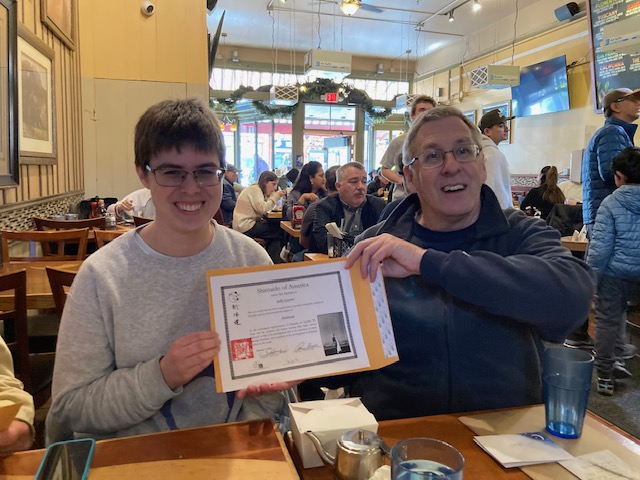
I don’t remember what my initial thoughts were when my dad suggested I take a boh exam, but I think it was useful to have something specific to prepare for. It also forced me to learn the names of the movements I was doing—something that has not entirely been my strong suit.
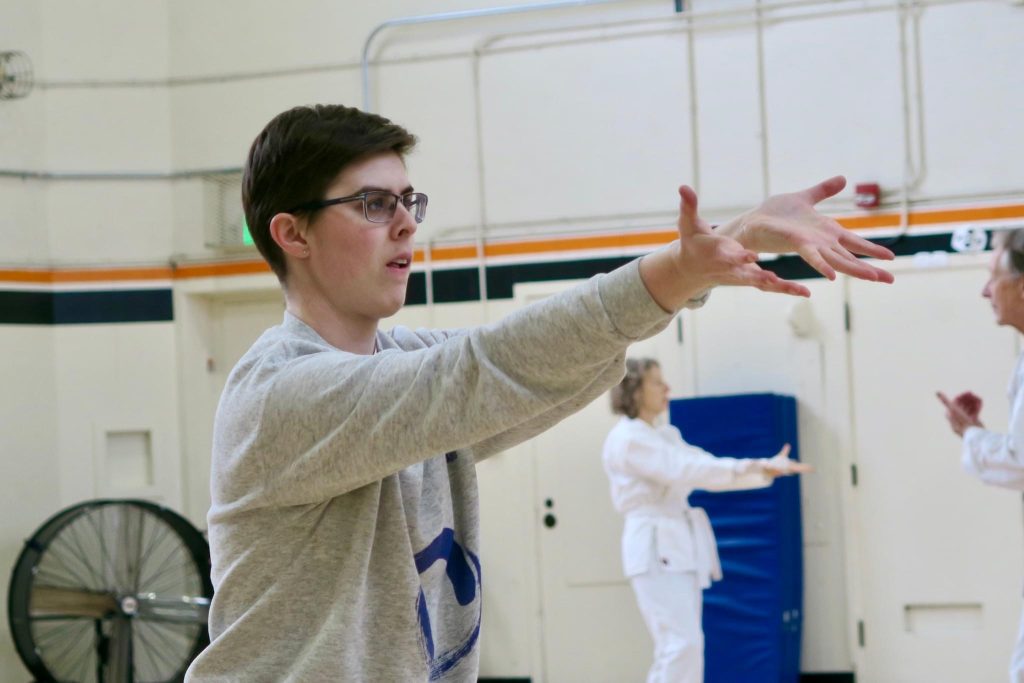
Taking Shintaido exams was a similar experience. A lot of Shintaido movement is deeply embedded in my body and my being from years of exposure, but learning and remembering the movement names sometimes adds an element of understanding; sometimes philosophically and sometimes practically. Pushing myself to become comfortable in other things such as leading warmups and helping organize the boh workshop in June has helped as well, tying me in to the rhythm and practice of the bigger picture of keiko.
I cannot say that I have entirely achieved a coherent summation of my experience in Shintaido as an adult, but I think this mirrors my relationship with my own practice. I feel that I find myself frequently having two different experiences of Shintaido happening at the same time; on one hand, a raw beginner while also having it deeply imbedded in my body and psyche. This is, I think, why Shintaido remains so difficult for me to explain to others—I am too close to it while also still making my way in from the fringes.
I am not sure where I go from here, but I am excited to experience the International Gasshuku in England this summer. I think the experience will help me both in my practice and perspective. I look forward to continuing to deepen and develop my relationship with Shintaido and finding out where it takes me.
Age changes us, and as we bring our changed selves to keiko, we are forced to make accommodations if we are to continue to do it. At first this can feel like a disappointment. But in time the compromises we must make, surprisingly, fail to compromise us. Instead they open the way to something novel and possibly interesting. We encounter some problems we have not yet faced, and with these problems come opportunities for new insight. Our keiko, as well as our understanding of our ourselves, broadens and deepens. It is as if we increase our capacity or “bandwidth” for receiving the message of the universe.
I haven’t the flexibility, the wind, or the stamina I once had. I have pain in my knees. My right hip and right shoulder are liable to complain. But each of these complaints is the universe manifesting itself in a fresh way, and each gives me something to work with, a problem to solve, resulting in a refinement of technique, a discovery of a more efficient way to move, a better way to warmup, and a sensitivity to know my limits and call it a day. As my body weakens, slows, and takes longer to recover, it teaches me to adjust. I find myself listening even more closely for the message of the universe.
————
I once told Ito Sensei I was having difficulty with this expression, “the body is a message of the universe.” The profundity and universality the words convey have always inspired me, made me wonder, and stimulated my thinking and desire to do keiko. However, I did not know how to understand the words in regard to one of my students. She had lived since birth with cerebral palsy, which forced her into a wheelchair. She walked with unbending legs and only with the aid of crutches. How, I asked Ito Sensei, does the expression apply to her? Do they hold up in her case? Would they ring hollow to her? Clearly the universe’s message might feel unfair or even cruel to someone so challenged and who cannot do keiko as it appears in our textbooks and videos.
Ito was not puzzled by the question. As I remember, he simply told me to consider that the “body” referred to in the expression was the body in general, or all bodies. We receive the message not just by means of our own bodies but through those of others as well. He challenged me to receive the message via her body as well as my own. While I could not tell how his response answered my question, I felt my unease with it resolve.
It occurred to me that I was projecting onto my student an emotional response to keiko that she had not, in fact, expressed to me. As far as I could tell, she found keiko interesting and fun, and indeed, I saw her grow and gain confidence as she practiced.
One of her favorite practices was kumite with jo while seated. I would attack her with the jo in dai jodan and jodan while she received with ichimonji uke. When we first started this kind of kumite, she was timid and would tense and struggled not to shut her eyes as she raised her jo to meet mine. Eventually she relaxed and as I swung my jo down on her, her eyes would brighten, and she’d break into a beaming smile as her jo shot up to receive mine.
Afterward I’d give her a moment to catch her breath, her face happy and damp with perspiration.
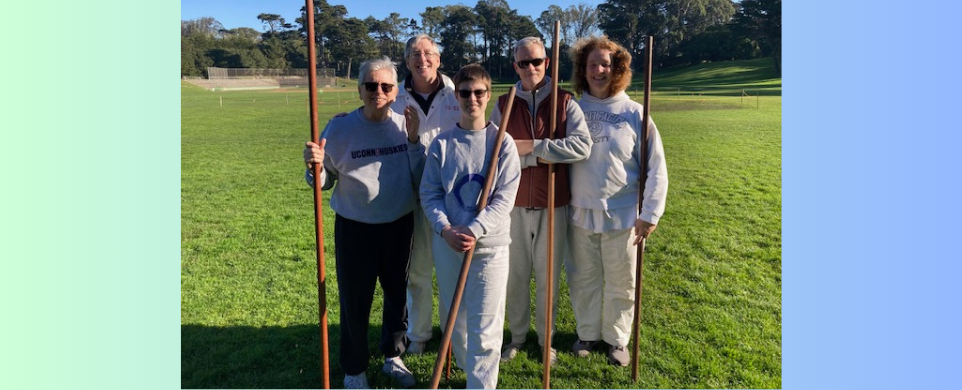
The Shoshi-no-kon bohjitsu workshop was held Sunday May 192024, in Cotati, California. Robert Gaston, Senior instructor and SanDan Bohjutsu taught two keiko and associated kumiboh. Sally Gaston and Nicole Masters organized the workshop. Nicole Masters hosted a potluck brunch at her home. Thank you to PacShin for providing financial support for the workshop. This workshop was held for the first time at a veterans facility in Cotati.
As reported in the April Body Dialogue article, Rob Gaston attended a European Shintaido College (ETC) workshop in Macon France. This workshop was taught by Alain Chevet, General Instructor and Yondan Bohjutsu, to share the newest Boh Kata – Shoshi-no-kon. This kata has been under development by HF Ito for the past 15 years. Shoshi translates into “Joyful Warrior” to reflect the state of relaxed joy after a shared moment of happiness.
Seven Shintaido “Joyful Warriors” attended the workshop: Shin Aoki, Sandra Bengtsson, Sally Gaston, Nicole Masters, Jason Ravitz, Mike Sheets and Robert Gaston. Go to the Shintaido YouTube channel to see videos of this kata:
Lee Seaman, Chairperson of the National Technical Council, sent in these official exam results from the recent international gasshuku, MATSURI 2004. She has indicated the country each person is from as: US=United States, J=Japan, GB=Great Britain, F=France, I=Italy.