by Connie Borden and Lee Seaman
October 10-11, 2026 Workshop
Shintaido of America 50th Anniversary
by Connie Borden and Lee Seaman
Have you found yourself feeling stressed, depleted, and conflicted? Then you are feeling similar reactions with many of the sixteen of us who gathered in October for a 2-day workshop. This workshop is part of the 50th SOA Anniversary celebrations in 2026. With the planning and guidance of Tomi Nagai-Rothe, Shintaido Instructor, this workshop was planned to use the Shintaido in our bodies to heal and transform internal and external stress and conflict.
Our Workshop Goals were to
-
- Apply our built-in body wisdom to de-escalate stress and conflict situations in daily life, and improve our relationships
- Re-experience Tenshingoso, Tenshingoso Kumite and other kumite in a joyful and accessible way
Tomi started each session with massage exercises so that our nervous systems could relax, digest and restore. She included eye exercises, humming and laughter. These sounds filled the dojo and created vibrations felt by all. All agreed we were able to relax and soften our bodies to embody the practice more fully.
Tomi taught the first session finding ways to respond to life’s challenges using Wakame and Bamboo. Tomi offered herself as the partner for several people to practice the touch while she changed from Bamboo to Wakame. People commented that they felt solid and rooted when Tomi was in Bamboo. Then discussions explored: What does it mean to transmit energy and how do I do this? What is kumite? How does working with a partner help? Tomi introduced the concept of kumite as intertwined hands. We explored this image for connections and building trust.
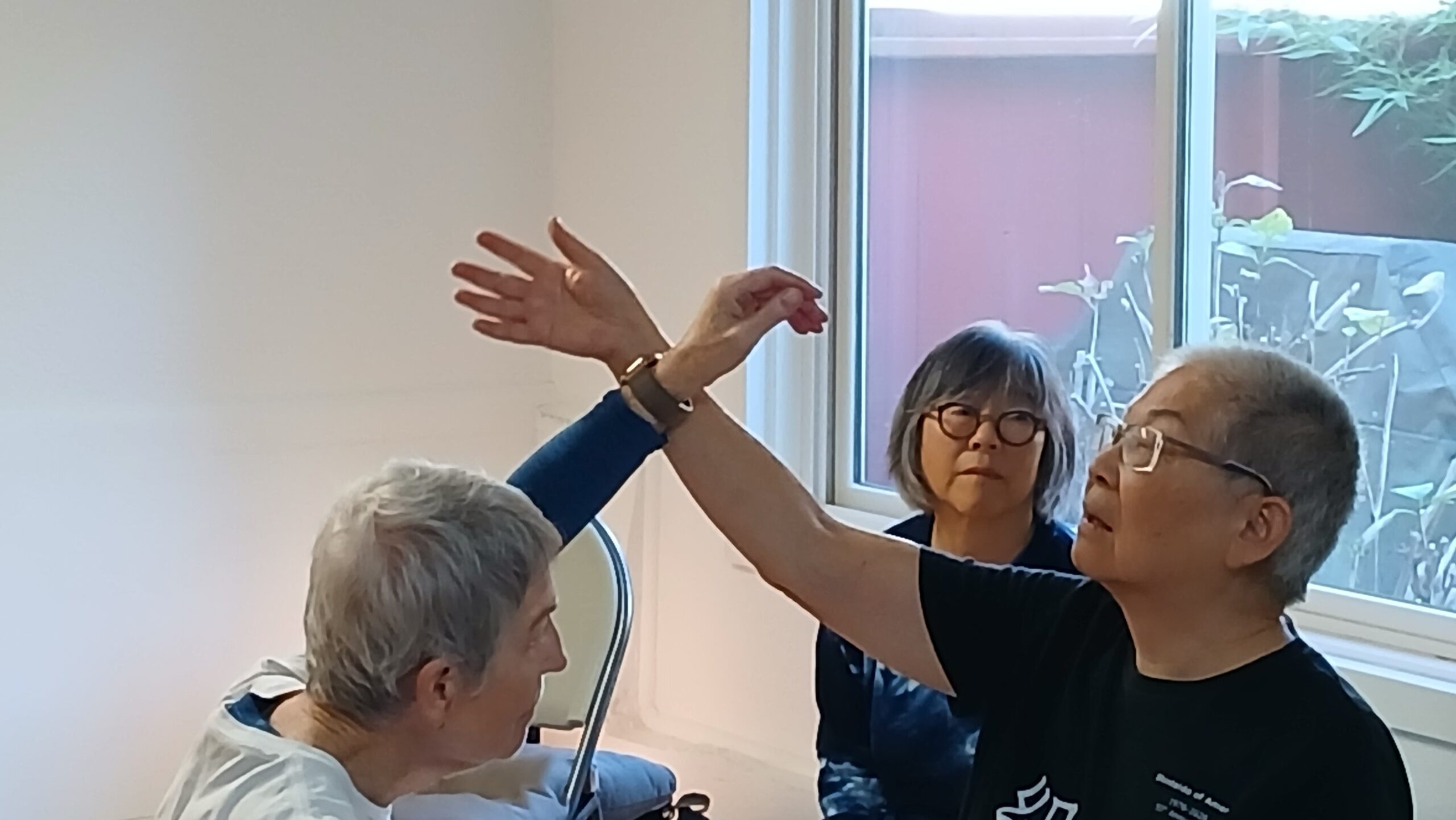
Then we discussed how to apply these movements in everyday life. The challenge to move quickly from ‘going with the flow’ to ‘standing firm’ was a new opportunity for learning. Others felt they were rarely bamboo and usually wakame. Session one ended with Tenshingoso and Tenshingoso Kumite. Lee spoke to ‘ma’ and having a strong hand/palm connection to follow your partner closely rather than ‘doing your own thing.’ Sally Gaston noted the connection of doing Renki to doing Tenshingoso Kumite with the strong hand connection.
After a lunch break, Tomi gathered us for the second session. We reviewed the reflections on the morning followed by seated warm-ups. We then practiced stepping in using “Welcome, This Way Please” – Ushiro Irimi. Tomi shared her long-time struggle to learn this technique from Ito Sensei and how Ito attempted to show many ways to approach learning. Tomi stated that the image of opening a door to greet a guest and then walking with them into the house finally made the technique accessible for her. Lee stressed the importance of timing. Lively group teaching followed with a practice of the stepping, along with coordinating hand and feet. When applying Ushiri Irimi to conflict resolution, people noted many factors for success. These include the need for others to be willing to be engaged in the conflict resolution, how when anger is the main emotion it is difficult to engage, and when you see something from the other person’s perspective it really does change one’s own view. Another spoke of the importance to be ahead/early with your timing of the response to avoid the conflict.
Sunday morning the 11th provided us with the Video premier of Roots of Shintaido: Our Cultural Inheritance from Three Masters – with Master Masashi Minagawa. Before viewing the video, Connie spoke about how important it is now, which is our 50th Anniversary of the founding of Shintaido in America, to know more about our Shintaido roots. While a graphic recording was done in 1999 by Tomi during a four-hour talk by H.F. Ito, Tomi and Connie recognized the importance to have an updated graphic with a video to record this historical knowledge to guide us into the future. The SOA board agreed with this necessary and timely project. The SOA board is grateful to Masashi Minagawa for his time to record our roots. Thank you to Lee Seaman for engaging with Minagawa sensei in this recorded conversation. Following a viewing of the video, the group reflected on the video and updated color graphic. (note: the video will be available on SOA’s YouTube Channel in Dec 2026.)
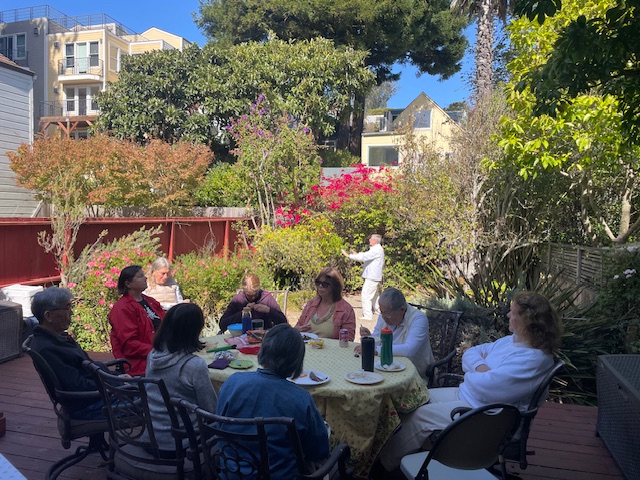
Many appreciated the linear layout of a history that had often been told to us as various stories over time. Nicole and Antigone spoke deeply of the concept of Shintaido as the Way of Peace in today’s world of endless conflicts. Kazu shared the role of Judo and Feldenkrais post-World War II. Connie spoke of her new awareness of Ch’an and Wu wei with the concept of effortless action and its impact to change her teaching to focus more on breath, and softer movements. Jane wondered about the role of women in the development of Shintaido. Appreciation was expressed on the continued innovation of these three Masters – Funakoshi, Egami and Aoki. The morning’s discussion continued during lunch with many people sharing how they were introduced to Shintaido, who introduced them, and the impact on their own lives.
Lee Seaman taught the final session. She began with a brief overview of her early upbringing and how she was introduced to Shintaido in Japan. Lee led comprehensive warmups from the lower back to a full self-massage. She taught seated hand connections with a partner, moving from the sitz bones much like wakame and Hikari movements. Lee reviewed stepping of Irimi. Everyone eagerly participated with early timing and sincere attacking. Lee concluded with a practice of seated ‘e’ and ‘oh,’ allowing people to do soft movements or more dynamic exchange of energy. Lee shared one of her learnings from Shintaido “If you want to grow, hang out with people who are growing”.
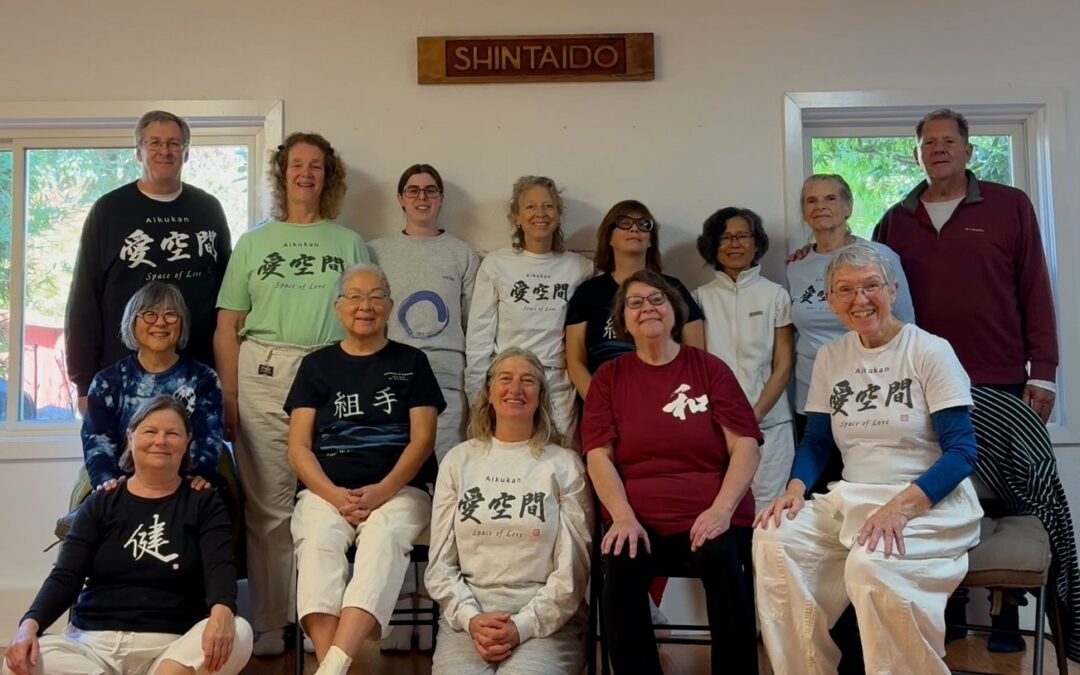
The two days ended with appreciation to Tomi and Lee for their instruction. Gratitude was shared with the opportunity to be together in practice. For some such as Kazu Shibao and Tom Abbott it was a reunion after 40 years. Boni Cruz and Jane Miramoto Yung shared their joy in doing kumite that felt timeless – they had not seen each other for decades but in doing kumite they felt instant recognition of each other. The workshop ended with the typical group photo and ‘sticky ma’ of goodbyes until next time.
The revised version of the Roots of Shintaido: Our Cultural Inheritance From Three Masters graphic map and accompanying text is available on the Shintaido of America Store, in English, French and Japanese.
0 Comments