Here is a brief report of my trip to Macon France to attend the ETC boh workshop in which Alain Chevet presented Shoshi no kon boh kata that Ito developed over the last 15 years.
This kata had as its starting point as Sueyoshi-no-kon kata, the sho-dan level boh kata that was used in the bohjutsu exam curriculum until the early 2000s. In the new name “Shoshi” means after the laughter and I wondered if there a translation subtlety I missed from Japanese to French to English. Initially it sounded like a suggestion to stop laughing and be serious. Through repeated practice and Alain’s story of Ito sensei laughing as he taught it, I realized it was a peaceful joyous feeling one has after a good belly laugh.
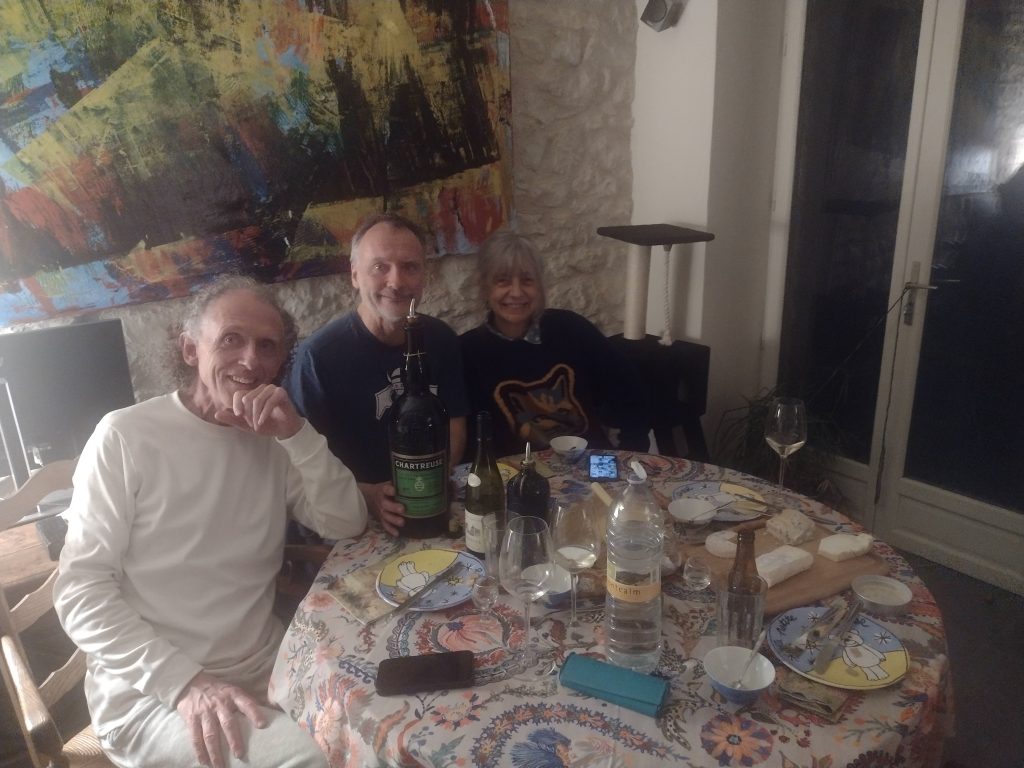
I arrived in Paris and was met by Charles Burns for a short train ride to Tonnerre, in the Burgundy region. We had a wonderful welcome dinner and overnight stay with Georg and Natalie which included some Yon-dan Soei kumibo practice with Charles and Georg. We awoke early and drove to Macon Sport Center and continued practice that evening before dinner.
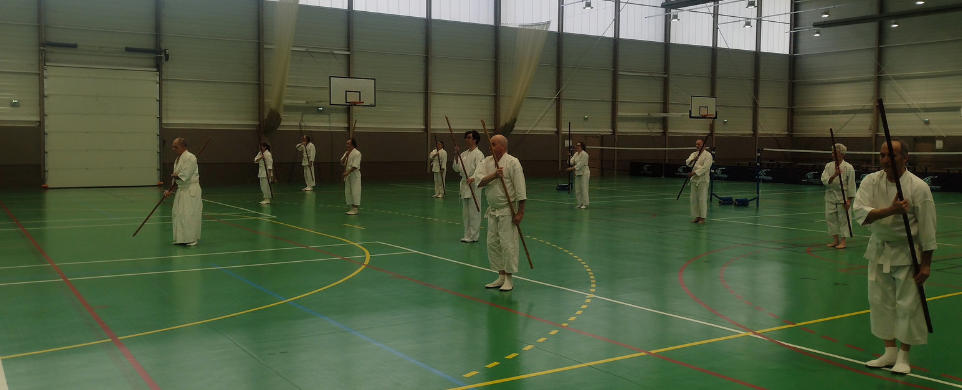
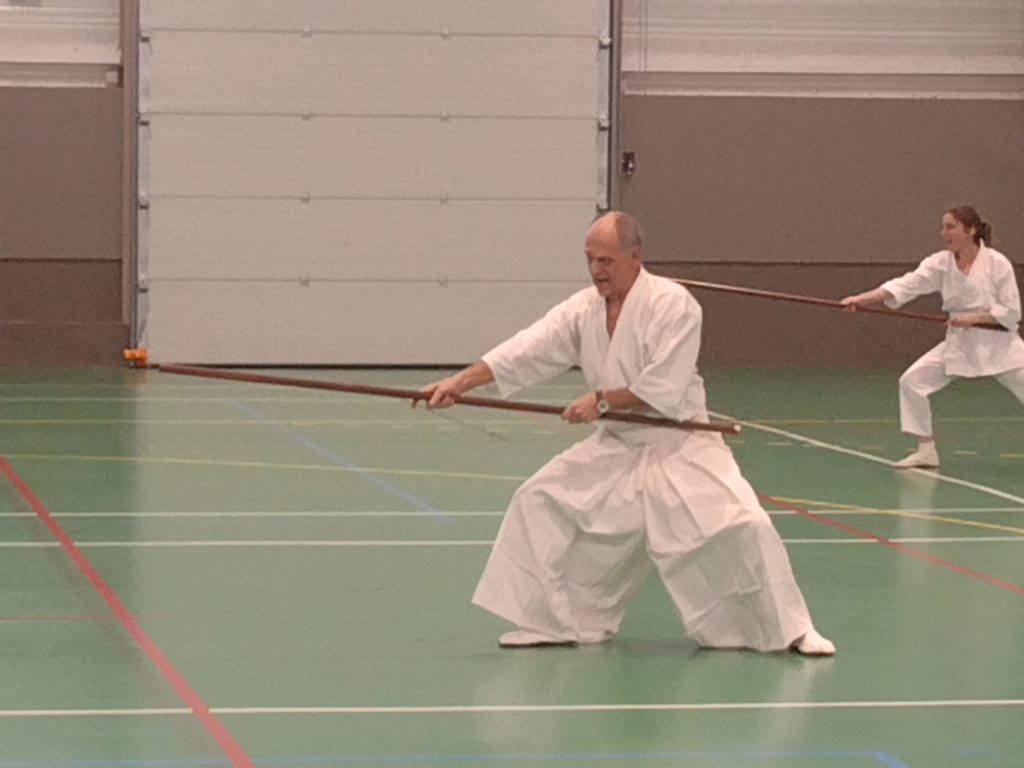
Saturday morning began the official workshop in which Alain demonstrated Shoshi no kon. We began a to break down the various parts of the kata. The first keiko was quite long and lasted 3 1/2 hours. The beginning movements of the kata worked well as a kumibo and we practiced for a while. It consisted of two jodan gyaku receives stepping back and a quick chudan morote tsuki to stop your opponent’s attack. The long-repeated practice softened our minds and bodies and we were doing a kumite that flowed back and forth with no clear leader or follower, curving and changing the rhythm so the attacker could at any time become receiver.
We progressed to learning the middle portion of the kata and took a break for lunch.
For keiko #2 we added in the left right change of direction portions of the kata. This part was familiar to those who had done the original Shodan boh kata. We explored it more deeply with a wave like kumibo that reminded me of the inyo-itai boh movements absorbing the boh into fluid motion. We progressed through the first 2/3s of it.
After dinner we retreated to the tea corner room and ETC had a boh subcommittee meeting that included drinking and brainstorming of how they wanted to include Shoshi no kon into the ESC Shintaido boh curriculum. For now, it will be in their teaching curriculum and reviewed in 2026 to add to the exam curriculum.
The next morning, in the final class, we finished off the kata and studied a third kumibo. This added a jump away and geidan uchi komi to protect our ankles as we step across and jump away from a tagurei tsuki to our ankle. By this time a sense of peace and relaxed smiles were evident in the practice. Alain finished the class with repetition of the kata as he fine-tuned our movements individually.
The warm welcome I received from the ESC members left me energized and excited for Shintaido bohjutsu. I am left in wonder at every Shintaido event that gets people together from diverse cultures and experiences, allows connection and understanding and my renewal of the value of Shintaido. The sense of being relaxed, happy and enthused has returned home with me.I quickly reached out to PacShin with a request to teach a boh workshop to teach the boh kata of the joyous warrior. It will be May 19th, 2024. I hope to get more opportunities to pass on this kata to those who love bohjutsu like I do.
My first exposure to karate keiko was practicing with a student of Tsutomu Ohshima, founder of the Shotokan Karate of America school, in New Orleans, when I was studying in law school in the early ‘90s. I was interested primarily in the self-defense aspects back then.
After law school, I moved to Japan to study at Chuo University in Tokyo. Although I was a post-graduate student, I had the good fortune to join the University Karate Club. At the time, I was wholly ignorant of its proud history and important role in the Shotokai. I practiced regularly with the Club during my three years at Chuo. At that time, student club members practiced every day, usually twice a day, and attended gasshukus (special intensive offsite trainings) several times a year.
In terms of the content, the stances were lower than I was used to, and the practices were quite vigorous and initially painful and exhausting. Lots of paired stretching and dynamic jumping and hopping exercises (kaikyaku zenshin) in the warmups. Even cleaning the dojo floor in the traditional manner was a tough workout.
As I met and became friendly with recent graduates of the club, I had the opportunity to practice more widely, at the Main Dojo, with company clubs, at other universities, and with various other teachers and groups. I found that the flavor of Shotokai practices in Japan varied depending on the group within the Shotokai organization and the particular instructor and/or dojo. The Shotokai in Japan at the time was a big tent.
For example, one small group I regularly practiced with was very close to Shintaido, perhaps nearly indistinguishable (I’m guessing) from Master Ito’s early practices in the U.S. Lots of running kumite, tenshin goso kumite, rolling on ground, use of bokuto and bo, a dynamic, ecstatic, free (and exhausting) keiko, etc. This group had a huge influence on my karate at the time – it became more flowing and more dynamic.
Other teachers I learned from emphasized different aspects of Master Egami’s karate that had inspired or resonated for them, but the content of keiko was quite different and not Shintaido-y. Yet other groups within the Shotokai were stylistically much like mainstream Shotokan karate, but with no competitions or free sparring.
So, at that time, there was a wide spectrum of practices that co-existed within the Shotokai. And each of the university clubs that constitute most of the active membership of the Shotokai had their own unique flavor as well.
Meanwhile, at the time, the top of the organization transmitted to the university clubs and more broadly, a renewed emphasis on the traditional karate keiko/curriculum of Master Funakoshi. It seemed that the soft techniques and esoteric practices introduced by Master Egami were fine for a master practitioner or for senior students to explore in private but not appropriate to be taught broadly as Shotokai karate, especially to more junior members. Overall, practices and instruction that strayed too much from the mainstream were discouraged. In hindsight, I’m sure it was viewed as “quality control”.
My impression is that this eventually resulted in some of the “softer”, Shintaido-adjacent karate groups and practitioners splitting off. However, they continue to practice, either independently or as part of one or more groups of like-minded clubs.
After I returned to the U.S., and moved to Boston, I was not interested in the types of karate I found there, and instead started practicing aikido. I also had the good fortune to connect with a Shintaido group led by David Franklin in Cambridge. I found the practice very enjoyable and practiced with the Cambridge group for a couple of years in the late 90’s before moving overseas for work. The emphasis on heart/body opening was new to me.
I reconnected with Shintaido about twenty years later when Mark Bannon, my longtime karate-do training partner in Vermont, connected with Shintaido of New England and began attending Master Ito’s training sessions in Quebec. Mark was really inspired by Master Ito’s training and began incorporating his new learning into our training sessions.
Eventually, I joined Mark for several trips up to Quebec to train with Master Ito, Connie and Rob, and the wonderful Quebec group. In terms of open hand movements, many of the exercises were familiar to me from my days in Japan practicing karate and my earlier exposure to Shintaido, but the kenjutsu practices were completely new to me and very exciting. In addition, practices like Diamond Eight, Sunrise-Sunset, Lower Limb strengthening exercises were a revelation and allowed me to practice as I recovered from having my knee “scoped”. More recently, Mark and I were so lucky to have learned some batto jutsu (sword drawing) from Master Ito via Zoom.
My current practice is very circumscribed since I’ve torn my rotator cuff and am about to have a shoulder operation. I do Master Ito’s Lower Limb strengthening routine most days, in combination with a light one-handed karate keiko. Also, I am practicing my mae-geri and yoko-geri regularly again after a long hiatus. I join Connie and Rob’s Sunday zoom keiko. Going forward, I am looking forward to picking up the sword again this summer and getting back into batto justu and the kenjutsu curriculum with my training partner. And continuing to practice the karate techniques and kata I learned more than thirty years ago in Japan.
As I think back on the wonderful teachers of karate-do and Shintaido who have taught me, I am filled with profound gratitude and appreciation. In particular, in recent years I have been so inspired by and learned so much from Ito Sensei – he has given me a path to follow for the rest of my days. Domo arigato gozaimashita.