How Deep is Your Community?
Reflections on the Global Taimyo Community Workshop, August 2021
by Tomi Nagai-Rothe
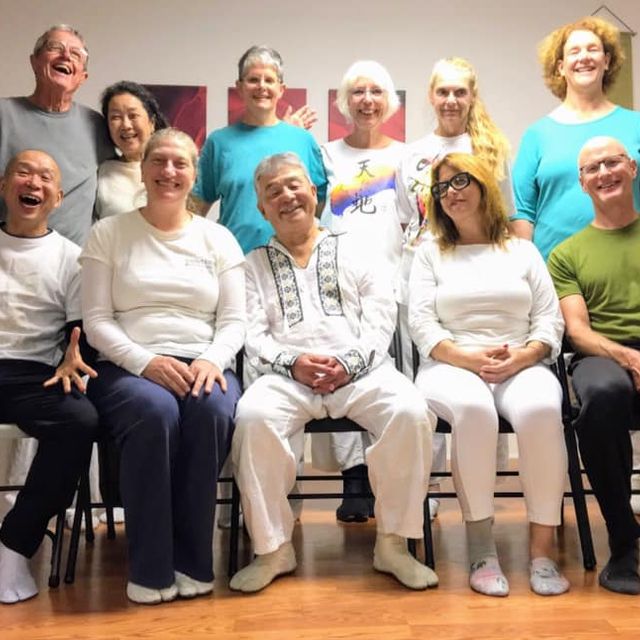
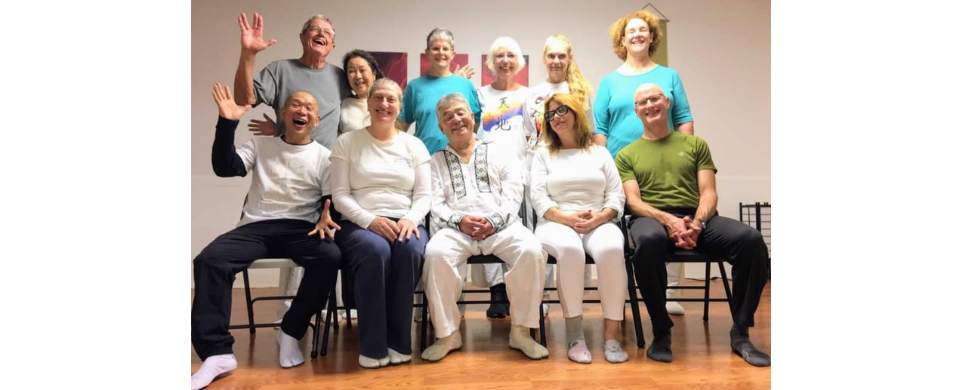
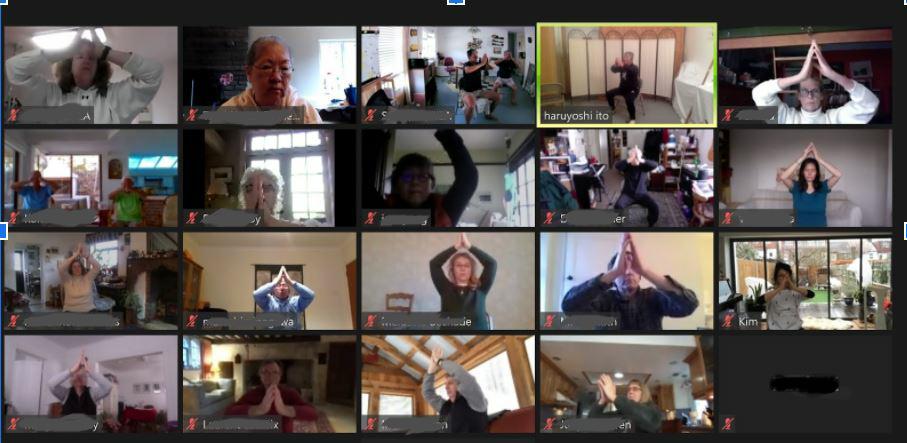
Over the past year I helped plan and organize – with a team of three others – a virtual international workshop marking the 20th anniversary of H.F. Ito’s founding of the Global Taimyo Community* in 2001. The creation of this community came in the wake of 9/11, and a deep desire to create connection and peace in an increasingly violent, chaotic time.
We scheduled the workshop between Hiroshima Day (August 6) and Nagasaki Day (August 9) and September 11 – a backdrop of war and violence – to highlight the importance of Taimyo Kata as a tool for fostering inner and outer peace.
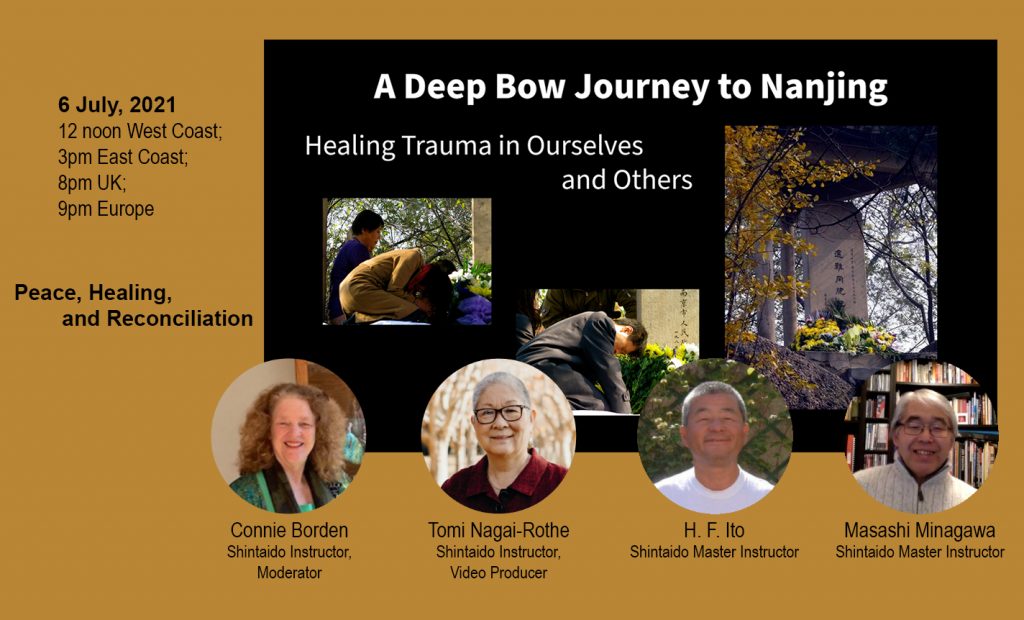
In conjunction with the workshop we produced a 32 minute video entitled, A Deep Bow Journey to Nanjing: Healing Trauma in Ourselves and Others ** in which H.F. Ito and Masashi Minagawa tell their stories of accepting an invitation from Kazuaki Tanahashi to join 30+ Japanese citizens for a trip to Nanjing, China to apologize for the 1937 Nanjing Massacre by the Japanese military.
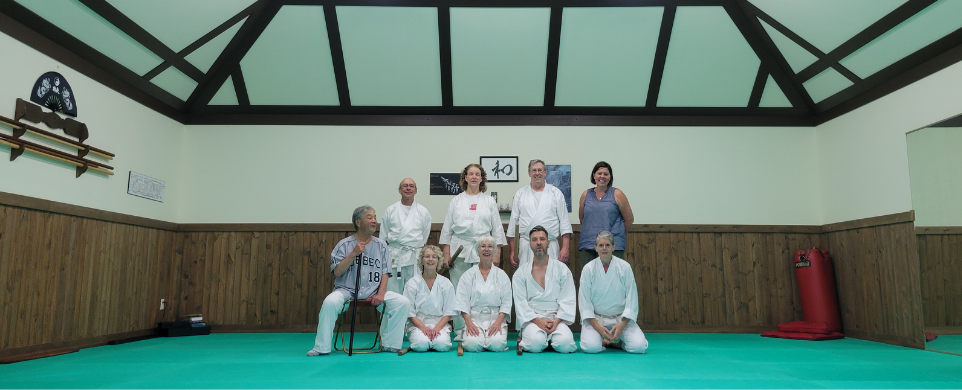
From this account the workshop might sound like a grim commemoration of several violent anniversaries but in practice it was so completely different than that. I witnessed playfulness and humor; the joy of reconnecting with old friends and meeting new ones; practice with folx who had never encountered Shintaido or Taimyo before; a 90 minute dialogue about Taimyo practice, violence and reparations; and new insights into Taimyo. Several people shared profound insights with the group and a few reported transformational experiences during the week.
For me it was a beautiful manifestation of the unification of self, family/friends/society, Nature (Earth) and Heaven (Ten): Ten-Chi-Jin-Ware Ittai. The two elements that I believe set this gathering apart were:
1) The power of a strong shared intention to foster healing and peace
2) Coming together as a deeply accepting community to meet participants where they were emotionally, spiritually, and physically
I think this is what allowed the group to encompass the space between Hiroshima-Nagasaki Day, September 11 and the Nanjing Massacre. Without deep community I know I cannot survive the trip to difficult places in history or in my own heart. A loving community allows me to shift my consciousness and to grow in challenging circumstances.
Most of us are privileged enough to not live our lives in constant trauma. Yet there is so much we can learn from those who experience life in extremes where our mortality is so clear. As a martial art, Shintaido is by definition about living at the edge of life and death.
Those who have worked in hospice settings or acted as caregivers at the end of life understand this. H.F. Ito recounts the story of his rescue dive training in which his instructor told everyone the importance of descending to where the diver in trouble is and just being there with them: feeling their panic and whatever else they are experiencing. “You cannot save them” was the warning. “You can only be there fully, in the hope that they can save themselves.”
The hope and intention is that the two divers can eventually make their way to the surface – to the light and air.
Going into Um (the meditative space of Nothingness and darkness) with a partner can be the same as the rescue dive. Can we go so deep that it scares us? Go so deep that we are in uncharted territory?
Only by fully embracing the depths of Um and Nothingness in my life can I taste Heaven (Ten, the Universe).
As essential as H.F. Ito and Masashi Minagawa’s examples are to help us see the possibilities of apology and the start of healing trauma, I don’t think what we experienced could be attributed to the presence of any particular person or even our Taimyo practice. I think it could have been any short kata – even Tai Chi or another short movement form – if the two elements of clear intention and community had been present.
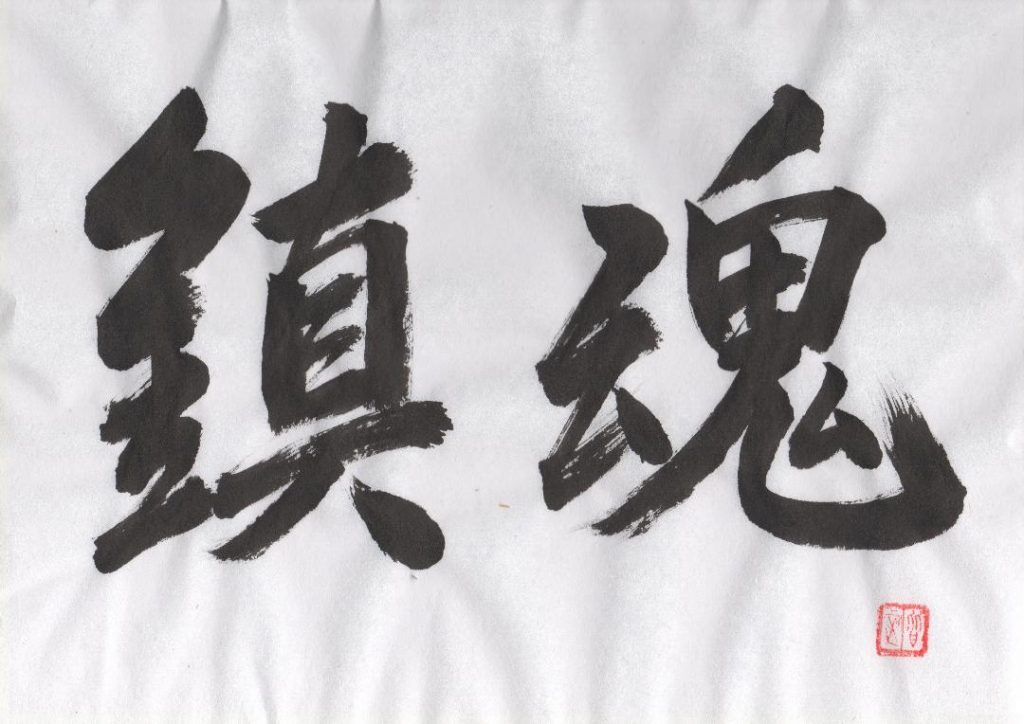
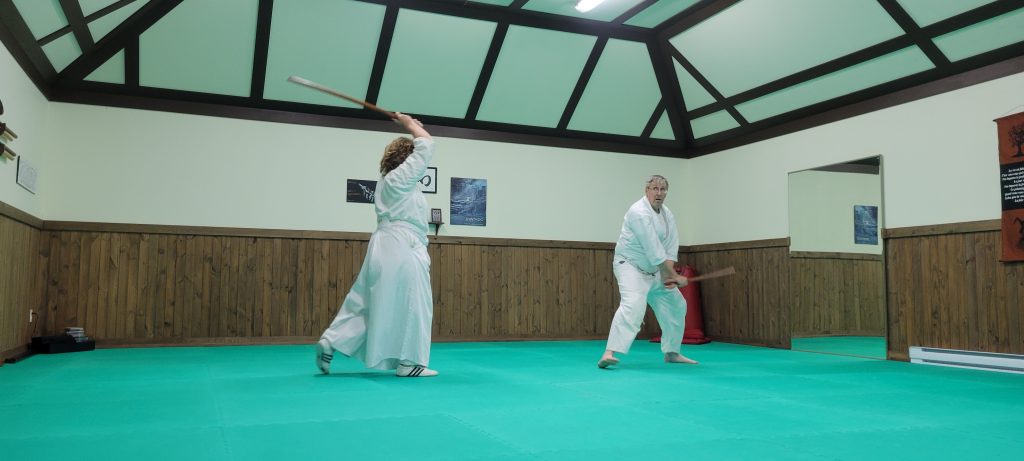
Used to set the tone for a Taimyo Peacemaking Workshop in August 2020
I think the transformative aspect, the crucible as it were, was coming together to witness one another. As Masashi Minagawa says in his Personal Journey to Nanjing video***, the purpose is not to teach or show or heal but only to be fully present and loving. I would call this unconditional love.
John and Lee Seaman taught Shintaido (and Tai Chi/Life Exercise) in Bellingham for more than 30 years and Lee continues to teach today. There was a widespread conception that John and Lee taught Shintaido to struggling and broken people. In truth, each one of us is broken and struggling in some way whether personally, in the life of our family, our culture or our nation. The only difference was that in John and Lee’s presence it was brought out of the shadows. The rest of us are just hiding our brokenness so no one can see it.
“There is a crack in everything.
That's how the light gets in.”
― Leonard Cohen, Selected Poems, 1956-1968
The taste of deep community we felt was an experience of holding and witnessing one another.
As a Friend (Quaker), we often use queries to help unpack and explore big topics. It may be helpful to carry a query with you, like a smooth polished stone in your pocket.
In the spirit of exploration, I leave you with these queries:
• What is the ultimate purpose of my practice?
• How deep is my community?
Notes and links
* Taimyo and Peacemaking
Several articles on Taimyo by H.F. Ito and research on the etymology of Chinkon (Requiem) by Masashi Minagawa Day Street Dojo
** A Deep Bow Journey to Nanjing: Healing Trauma in Ourselves and Others (32 min.)
An account of the 2007 apology trip to Nanjing, China by H.F. Ito and Masashi Minagawa
– with English subtitles
– with French subtitles
– with Japanese subtitles
*** A Personal Journey to Nanjing, China and Spreading Light in the World (21 min.)
An interview with Masashi Minagawa.